
Workpiece loading: where minutes are lost at the lathe
Workpiece loading often eats minutes each shift. We examine how part orientation, work zone height and access to the chuck change the work tempo.
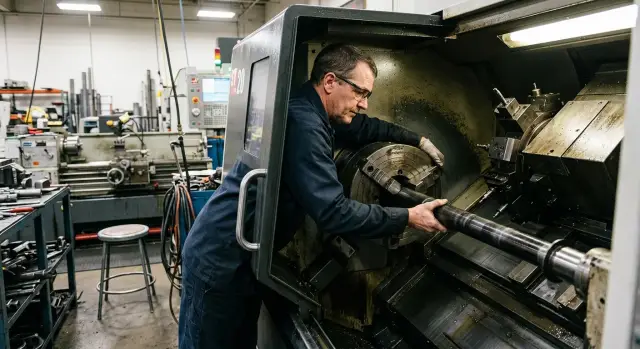
Why minutes are lost during loading
Minutes disappear not in one big pause but in a chain of short breaks. The operator picks up a workpiece, brings it to the machine, changes grip, turns the part, looks for the entry angle, adjusts the seating, reaches for the chuck and only then starts the cycle. Each step seems small on its own. Over a shift, these small actions add up to a noticeable downtime.
Time usually gets lost between three actions: pick up the part, put it in the correct position, and clamp it quickly without a second try. If the workpiece is heavy, slippery or awkwardly shaped, an extra movement is almost inevitable. Sometimes it's 2–3 seconds to rotate the part. Sometimes another 5 seconds go to a second grip or to carefully aligning into the clamping zone without touching nearby parts.
In real work the difference is obvious immediately. With comfortable loading the path is short: pick up the part, bring it in, set it, clamp it, start the cycle. With inconvenient loading the same sequence stretches out. There’s a step to the side, a lean of the torso, a wrist rotation, a second check, an extra push. The cutting itself doesn’t change, but throughput for the shift falls.
Even a small delay accumulates quickly. If you lose 12 seconds per part and have 120 loadings per shift, that’s 24 minutes. Nearly half an hour is spent not on machining but on extra movements at the machine. If there are several such machines in a shop, the losses are no longer negligible.
Delays often appear in the same places. The part must be rotated before installation, the work zone is too high or too low, the chuck is hard to reach, the seating point is poorly visible, and the workpiece has to be regripped at the machine. As a result, speed depends not only on the operator. It depends much more on how much the machine itself helps make the movement short and clear.
If the part goes in with the correct orientation, the work zone is at a comfortable height, and access to the chuck doesn’t force reaching or leaning, the cycle starts faster and more calmly. These three things most often consume minutes: part orientation, work zone height and access to the chuck.
How part orientation slows down work
The problem begins before clamping. The operator takes the workpiece to the chuck and at the last moment changes grip, rotates the part or searches for the entry angle. On a single cycle this is almost unnoticeable. Over a shift the difference becomes significant.
When a part is fed along the spindle axis the movement is usually simpler. It’s easier to introduce a shaft, bar or long blank that way: hands move in a straight line and the end face immediately faces the chuck. The operator doesn't need extra adjustments and the part reaches the jaws faster.
Side feeding is trickier. You need to bring the blank from the side, rotate it and only then enter the clamping zone. If the passage is narrow or the jaws are partially blocked by a door, guard or tool, hands trace an arc instead of a straight line. Time is lost here.
This is easy to notice on ordinary parts. A short bushing is often grabbed from the bin however it lies, and the needed end face then doesn’t face the chuck. The operator has to regrip with fingers, sometimes twice, especially if the part is oily. For a long blank the picture is different: the operator first aligns the far end, holds the axis and carefully feeds the part forward to avoid hitting the bed, door or tooling area. If the approach is uncomfortable, he slows down before even touching the jaws.
Short parts are not simple either. They’re lighter but easier to skew or feed at an angle. If the jaws are deeply recessed or hard to see from the working position, the operator literally feels for the seating with his hands. That adds a short but constant pause on every cycle.
There are clear signs that part orientation is interfering. The operator grabs the workpiece with a grip that doesn’t match how it will be fed into the chuck. The needed end face isn’t visible immediately. A long part has to be led in an arc instead of a straight line. The jaws become visible only after the torso leans or a second grip. If any of these signs appear, time will be lost on every cycle.
So before buying it’s useful to look beyond the spec sheet. It’s much more honest to hand a typical workpiece to an operator and let them do a few loadings at a normal pace. If they rotate the blank in their hands every time or need to adjust it to the chuck, losses are already present even if everything looks fine on the surface.
What work zone height changes
Work zone height affects the pace more than it looks from the outside. The difference may be just 5–10 seconds per loading, but over a shift that becomes a noticeable loss. The reason is simple: the body makes an extra movement each time.
If the zone is too high the operator raises their hands above a comfortable level and holds their shoulders tense. At the start of a shift this barely matters. After an hour movements shorten, grip precision drops, and a part becomes harder to feed to the chuck on the first try.
If the zone is too low the problem is different. The person constantly bends forward, rounds their back and takes longer to align the workpiece before installation. When the part is heavy or slippery from coolant this rhythm quickly tires and breaks the pace.
Comfortable height isn’t the same for everyone. It depends on operator height, arm length and the type of parts. A different setup works for short light blanks than for heavy parts that need two hands.
You can see the difference in a run. A too-high zone forces reaching up with elbows held out. A too-low zone causes leaning and longer alignment. A suitable height produces a smooth movement without pauses or extra corrections. That’s important in serial work where the operator repeats the same gesture dozens of times.
When someone doesn’t need to raise their shoulders or bend each time they keep a steadier pace for longer. There are fewer mistakes too. The part is easier to hold, easier to place correctly and faster to clamp without fuss.
People often evaluate a CNC lathe by spindle, power and control. That’s understandable. But the ergonomics of the work zone must be checked by hand, not by photos. It helps to stand in front of the machine and run a typical cycle: pick up the blank, bring it in, align with the chuck, hold it until clamped, remove hands. If this simple test shows extra shoulder raising or deep bending, in a real shift that will turn into a constant time loss.
Why access to the chuck matters more than it seems
Much time goes not into the clamping itself but into the approach. The operator makes an extra step, reaches the chuck from the side, leans the torso, withdraws a hand and then brings the part in again. If this repeats dozens of times per shift the whole cycle slows because of the loading.
The most useful question is simple: can you approach the chuck straight on, without turning the body and without obstacles for the hands? When the operator stands square in front of the work area they feed the part faster, hold it more confidently with both hands and insert it into the jaws more accurately. Working from the side immediately slows the movement.
Often small design details interfere that are easy to miss during a demo. A narrow door opening, an overhanging guard, a column too close to the front, an awkward door handle, a lip at the work area — each of these seems trivial alone. Together they can add 10–20 seconds to one setup, especially if the part is heavy or short and requires a precise feed.
Visibility matters too. The operator should immediately see the jaws, the end face and the contact point. If visibility is poor they lean, check the angle, verify the clearance again and often open the door wider than necessary. That’s slow and tiring.
Good visibility is important for a simple reason: the person needs to quickly confirm the part sits straight, the overhang is correct and the jaws clamp without skew. If all this is visible instantly the check takes seconds. If the end face is hidden by a guard or door frame even an experienced operator works more cautiously and spends more time.
On two similar machines the difference can be striking. On one the operator brings the blank straight to the chuck, sees the jaws immediately and completes the setup with a short check. On the other a column gets in the way and the upper guard blocks the view. Formally the actions are the same but one cycle is short while the other adds two extra moves and a pause.
So when choosing a CNC lathe it’s useful to look beyond the specs. It’s far more important to understand how real work happens: pick the part, bring it to the chuck, see the jaws, set the overhang, clamp and check the seating. If this can be done without extra movements the machine will save time every day.
How to check loading convenience step by step
You can quickly assess loading convenience if you test the machine with your hands — standing nearby isn’t enough. Take a typical workpiece and repeat the motion the operator will do many times per shift.
Don’t pick the lightest or easiest part. Choose the one that actually goes into production most often. An empty chuck almost always looks convenient. With a real workpiece the truth becomes clear.
A good check follows this order:
- Bring the workpiece to the chuck at a normal pace without adjusting your body for the machine. If you have to rotate your shoulder, reach forward or regrip the part, you’ve already found a source of loss.
- Look at what’s visible at the moment of installation. The jaws, the part end and the seating stop should be obvious. If a door, guard or the layout blocks the view, precise seating will take longer.
- Don’t do just one loading — make at least five in a row. One successful try can be an exception. By the fifth attempt hands and back will honestly show whether the work is comfortable.
- Compare the same part on two machines or two layouts. Watch the full cycle, not the spec sheet: pick up, bring in, set, align, clamp, remove hands.
There’s a simple rule of thumb. If by the third or fourth loading the person starts shifting stance, raising elbows or searching for a view with their head, the problem won’t go away. In a series it will turn into extra minutes per shift.
It helps to test in pairs. One person loads while the other watches and notes unnecessary torso turns, bends and regrips. The operator often doesn’t notice habitual discomfort because they’ve adapted to it.
A simple workshop example
Imagine a typical run: a short steel blank, 120 pieces per shift. Diameter 45 mm, length 70 mm. The program is tuned, cutting is stable, and it seems most time goes to machining. But on such batches losses are often in loading.
The operator takes the blank from a bin to their right and places it in the chuck. The approach axis is awkward: they must come at the chuck with a slight body turn. The blank is short, so it can be inserted quickly, but only if the jaws are visible and the hands operate at a normal height.
Assume those conditions aren’t met. The chuck sits slightly above a comfortable level and the operator raises their elbows nearly to chest height each time to get the blank into the clamping zone. Then they pause for a fraction of a second to check seating. If the jaws are partially hidden by the door frame or the clamping zone is recessed, another move appears: they have to twist their wrist and adjust the part with a second attempt.
A single cycle loses a little time: about 2 seconds for the extra turn to the chuck, another 2–3 seconds to lift hands to a high clamp zone, and roughly 2 seconds to correct the part before clamping. That’s 6–7 seconds per setup.
For one part that’s nothing. For the whole batch it isn’t. With 120 parts that’s 720–840 seconds — 12–14 minutes of pure loss just from operator movements. If two such batches run in a shift the shop loses 24–28 minutes. If three, 36–42 minutes. That time could have been used for the next batch, setup or quality checks.
On a machine with a better layout the picture is different. The operator approaches the chuck straight on, sees the jaws immediately and doesn’t have to lift their hands high. The part goes in without a pause or second try. On paper the difference seems small. In practice it’s felt within the first hour.
Common mistakes when evaluating a machine
The most common mistake is judging a machine by the catalog rather than the work area. On paper everything looks fine: dimensions fit, travels are sufficient, the chuck seems accessible. But seconds are lost not in the specs but in hand, body and part motions.
Another mistake is trying the machine without a workpiece. An empty approach almost always feels convenient. Once a real part is in hand unnecessary moves become obvious: the wrist hits a stop, the elbow won’t clear, the torso has to turn, and the part gets regripped right at the chuck.
People also forget about operator height. A height that’s fine for an average person may be too low for a tall operator who will bend all day. Conversely, a short operator struggles to feed a heavy part that’s too high. If parts are fed from a cart, pallet or roller table, include that route in the assessment. Otherwise a layout that looks good can be impractical in actual work.
Another typical error is calculating seconds based on a single loading. If a machine saves 8 seconds per cycle that’s easy to underestimate. But on a batch of 1,200 parts that’s 160 minutes — 2 hours 40 minutes of pure time.
There is also the opposite trap. Fast access to the chuck is mistaken for ergonomics when the operator has to reach forward on extended arms, twist their back and hold the part unstably. The first few loadings may be quick, but the pace will drop.
A good check is simple. Watch how the operator picks the workpiece, which side they approach from, whether they regrip before the chuck, whether their back stays straight and if the seating spot is visible without tilting the head. If the same motion is easy on the tenth try as on the first, the layout is likely truly convenient.
A short checklist and the next step
Minutes at loading leave quietly. One or two seconds for rotating a part, one extra torso lean, an attempt to better see the jaws — over a shift this becomes a noticeable loss when the operator places the same workpiece dozens of times.
For a quick check answer a few simple questions:
- Do you have to rotate the part in your hands before clamping?
- Do elbows and shoulders stay relaxed, without repeated lifting or deep bending toward the work zone?
- Are the jaws and stop visible immediately without peering deeper?
- How long do 10 identical loadings take at a normal pace?
This is enough to rule out inconvenient options quickly. If you answer no to at least two of these, the operator will very likely lose time on each part. Training won’t fix it — people simply adapt to discomfort.
It’s better to measure a series of ten loadings rather than a single try. One attempt is often too clean: the operator is focused, the part lies conveniently, hands aren’t tired. A series shows the real picture. If 10 loadings take 6 minutes instead of 4 minutes 40 seconds the difference seems small, but over a long run it easily becomes an extra half hour or more.
Pay special attention to the trio "part orientation — work zone height — access to the chuck." If one element is inconvenient the others rarely save the situation. A low zone forces bending. Poor visibility of the jaws adds an extra wrist move. Bad part orientation requires another rotation before clamping.
The next step is simple: take your typical workpiece and run this test on real equipment or on a similar layout. If you need help selecting a CNC lathe with attention to these working details, EAST CNC in Kazakhstan offers consultation, selection, supply, commissioning and service. In that conversation it’s useful to discuss not only machine specs but also the operator’s usual motions at the chuck — that’s where minutes are most often lost.