
Winter delivery of a machine to Kazakhstan: what to check
Winter delivery of a machine to Kazakhstan requires checking packaging, unloading, storage conditions and a safe delay before commissioning after the cold.
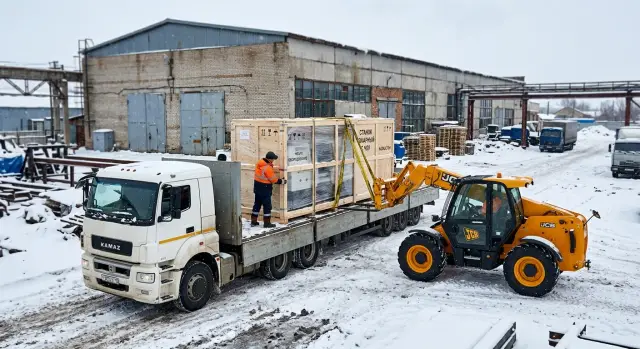
Why winter delivery of a machine is harder
In winter problems rarely come from a single big cause. Usually they add up from small issues that hardly matter in summer. Frost changes how materials behave and makes ordinary operations less predictable.
In the cold grease thickens, rubber seals stiffen, and cables tolerate sharp bends worse. Pulling a wire or sharply bending a hose during unloading may not break the part immediately but can cause a failure later. That's especially frustrating when the machine looks fine from the outside.
Logistics become more difficult too. Snow, ice and packed crust prevent a truck from reaching the gate, and it becomes harder for the crane, forklift and riggers to operate precisely. The surface may seem level, but there can be ice under the wheels. Even a small slip during unloading already increases the risk.
For heavy equipment that's enough. One unlucky jerk of a sling, a twist when removing from a platform or a slide on a ramp can easily lead to downtime for several days. Instead of starting the machine you end up checking geometry, fastenings, the control cabinet and the condition of components.
A separate issue is temperature changes. The machine travels in the cold, then arrives in a warm shop and condensation forms inside. Moisture appears not only on the outside but also in the electrical cabinet, on terminals, connectors, sensors and metal surfaces.
The cold itself is not always as dangerous as rushing afterward. If you apply power right after unloading, the moisture inside may cause false errors, short circuits or sensor faults. Sometimes a simple drying solves it, other times finding the cause takes a long time.
This is especially sensitive for CNC lathes and machining centers. Such equipment has large mass, precise mechanics and electronics that do not like haste. So in winter it's not enough to just bring the machine into the shop. You must plan packaging, access, unloading and a pause before start-up in advance.
Otherwise even a small mistake becomes expensive. Losing one day to preparation is easier than waiting a week for diagnostics, part replacement or re-setup.
What to agree before shipping
Before a winter shipment, paperwork and phone calls are often more important than the transport itself. If the route, unloading equipment and installation spot are not agreed in advance, the machine may arrive on time but sit outside for extra hours. That's an added risk for packaging, the electrical parts and accuracy.
Start by confirming the route. You need not only departure and arrival dates but all transshipment points, storage locations and border waits. Each transshipment is an additional lift, repositioning of slings and a chance to damage the packaging. If the carrier changes the truck en route, it's better to know that before dispatch, not on the day of receipt.
Next, verify actual dimensions, weight and center of gravity. Mistakes often occur when people look only at the general specification and ignore the delivery set. The machine may come with separate modules, boxes of tooling, a tank, chip conveyor or control cabinet. For the crane and forklift these are not trivial. If the center of gravity is shifted, the usual sling scheme may no longer be suitable.
Before shipping, appoint one person responsible for acceptance on site. Not the procurement department in general and not the workshop as a whole, but a specific employee with a phone who knows the schedule, documents and unloading procedure. They take the driver's call, inspect the packaging, coordinate the crane and resolve disputes without a long chain of approvals.
Also agree in advance who will provide unloading equipment. Crane, mobile crane, forklift, spreader, slings and rigging rollers — confirm all of this in advance and with a safety margin for lifting capacity. If the machine weighs several tonnes, a warehouse forklift "just in case" might simply not cope.
Decide ahead where the machine will stand immediately after arrival. This is not a formality. The place must be accessible, cleared of snow and ice, with a level floor and clearance around it. If the machine cannot be placed in its permanent spot, prepare a temporary area where it can rest after the cold.
In practice it's useful to boil this down to five points: the route with all transshipments, exact weight and dimensions, center of gravity scheme, the person responsible for acceptance, unloading equipment and the exact installation spot after arrival.
What to check in the packaging
In winter packaging matters more than it seems. Frost, wet snow, condensation and road shocks quickly find weak spots. If the crate is flimsy or moisture protection was done hastily, problems begin before unloading.
First check crate rigidity. The pallet should not shift under the machine's weight and the box walls should not bow when handled by a forklift. Heavy equipment needs a reinforced base so the load does not shift in transit or puncture the bottom.
Moisture protection must also be complete. One sheet of film on top is not enough. Cover the machine with moisture-barrier material all around, seal joints and prevent direct access of snow and water to metal. Desiccants inside the packaging are useful for long trips. This simple measure often protects guides, chucks and open machined surfaces from rust stains.
Do not leave moving parts unsecured. The saddle, spindle assembly, doors, guards and other parts that can shift from impact should be fixed separately. If the machine has transport locks or bolts, install them before shipping and note them in the documents so they are removed in the correct order later.
The exterior needs clear markings. Sling points, center of gravity, top and bottom, and forklift entry points should be marked large and on several sides. In winter this is especially helpful: crews work faster in the cold, visibility is poorer, and no one should guess where to put the slings.
Also check the electrical parts. The electrical cabinet should be closed and protected from moisture, and cables and connectors sealed with caps or packed in airtight bags. If a cable is simply taped to the body, that's a bad sign.
Before dispatch ask the supplier for a short photo report: overall views from all sides, the base and corners close-up, fixation of moving parts, marking of sling points and the state of the electrical cabinet, cables and connectors. With such photos it's easier to understand whether the crate was damaged in transit and to resolve a dispute with the carrier if the box arrives wet, skewed or with an impact in one corner.
Good packaging doesn't remove all risks but significantly reduces the chance that the start-up will fail because of a small oversight.
How to prepare the unloading site
The unloading spot matters as much as the transport. Even a good crane and an experienced driver won't help if there's ice at the gates, a narrow access or nowhere to place the crate without a tilt.
Start with the basics: clear snow at the gate, the entrance and the area where the machine will be taken off the truck. Don't just chip the ice — spread sand or small gravel. If equipment starts slipping on the approach, unloading quickly turns into a long, stressful operation.
Then check the entire route from the entrance to the installation point. On paper a truck may pass but in reality it may lack a few meters to turn. Often obstructions are a canopy, a post, parked cars, pallets or gate leaves that are too narrow. Measure these things with a tape measure rather than estimating by eye.
Choose unloading equipment based on the machine's mass with a margin, not to the limit. If the machine weighs 4 tonnes, a 4-ton forklift is a poor choice in winter. On slippery surfaces you always need a safety margin in lift capacity and stability.
The unloading area should be level and firm. Puddles, slushy snow and ice under the crate cause tilting, and a heavy box can sink at the worst moment. If the concrete is wet, prepare pads or sleepers so the crate doesn't sit directly in water.
Decide in advance practical details: who will open the gates and clear the approach, where the crane or forklift will stand during work, where to put film, packaging and fastenings immediately, and who will photograph the packaging condition. Usually such small details delay unloading.
If the area is tight, don't drag the machine across the entire shop immediately after removal from the truck. It's calmer to place it first in a prepared spot near the entrance, remove packaging, inspect condition and only then move it further.
What to do at acceptance
In winter acceptance requires a calm pace. Do not immediately remove slings, film and fastenings. First inspect the crate from all sides while the load stands as it arrived. This helps later determine whether an issue occurred in transit, during unloading or on the site.
If you see dents, punctures, forklift marks or wet spots, document them immediately with photos and video. Capture both a wide plan and close-ups. It's especially useful to record the crate corners, the bottom and places where water could have entered and frozen.
After external inspection verify the delivery contents. Check against the invoice and packing list everything: the machine, documentation, tooling, cables, pendant, guards and boxes with spare parts. In winter small boxes and bags get lost more often, especially if unloading happens in snow, dusk or a cramped yard.
Then check whether the machine sits level after placement. Sometimes the problem is not the equipment but the floor, pads or haste during unloading. If the frame is crooked, don't start the machine thinking "we'll fix it later." That often leads to vibration, geometry errors and extra service issues.
Record all remarks in the acceptance act the same day. Verbal agreements are quickly forgotten. Use simple, concrete wording: "dent on the left side of the crate," "wet spot underneath," "one box with tooling missing," "tilt visible after placement."
A good acceptance usually takes 20–30 minutes. It can save several days later.
How to let the machine acclimate after the cold
After freezing temperatures you must not power the machine immediately. Metal, glass, cables and the electrical cabinet cool at different rates, and warm shop air causes moisture to condense. Condensation is often a bigger problem than the cold itself.
Bring the machine into a dry room without drafts and rapid temperature swings. If doors open frequently nearby and cold air streams across the floor, acclimation will be worse. You need a steady temperature so the body and internal parts slowly equalize with the room air.
Do not apply power right away. Even if everything looks dry externally, condensation can remain inside the control cabinet, on terminals, connectors and sensors. That causes false errors, electrical faults and the risk of short circuits.
What to watch during acclimation
Check not only external surfaces. Moisture most often appears on guides and other exposed metal parts, on protective door glass, inside the electrical cabinet, and on cables, connectors and the pendant.
If you notice droplets or fogging, the machine needs more time. You can gently wipe metal, but that does not replace proper acclimation. The main goal is to wait until the machine's temperature gets close to the room temperature.
Follow the manual and the supplier's recommendations rather than guessing. Different models require different times. A heavy CNC lathe and a compact machining center warm up differently. If EAST CNC handles delivery and commissioning, it makes sense to check the required wait with the manual and the service team.
In practice it looks simple: the machine arrives in the morning from the cold, you move it into a closed shop and leave it powered off. Later inspect the cabinet, glass and exposed surfaces. If the inside is dry, temperatures are equalized and the supplier does not demand a longer wait, you can proceed to the next step.
This pause seems unnecessary only until the first failure. One day of waiting usually costs far less than electronics repair or a lengthy search for the cause of unstable operation.
Commissioning sequence
After transport and acclimation do not immediately load the machine with normal shift production. Winter haste often causes the most expensive faults: leaks at connections, sensor errors, unusual noise in units and poor first part quality.
Begin with a calm visual inspection. Check cables, hoses, connectors, guides and fastenings. If something loosened in transit, it's better to see it before applying power.
A simple sequence helps. First check fluid levels per the manual and inspect lubrication: it should not be lumpy, discolored or detached from surfaces. Then apply power without load and allow the control cabinet, drives and display to stabilize. After that run basic functions in sequence: indicators, axes at low speed, then the spindle at low rpm and short cycles.
During the first run listen carefully. Unusual knocks, whistles, uneven noise and noticeable vibration rarely disappear by themselves. Record any errors shown on the control, even if they vanish after a restart. One short error code often saves hours of debugging.
If the machine runs smoothly, move to a trial run without a part or with a simple blank. Reserve complex first operations and maximum feedrates. A calm test is usually more valuable than any rush.
Only after these steps make the first finished part. For new equipment this order helps the service team distinguish normal behavior from deviations.
Common winter mistakes
Most problems do not happen on the road but in the first hours after arrival. They usually start with ordinary haste: people want to unload quickly, remove packaging immediately and power up the equipment right away.
The most common mistake is unloading on ice, packed snow or an uneven surface. The forklift slips, slings work at a bad angle and the machine rocks more than usual. One sharp jerk when taking it off the platform can later reveal a dent on the hood or a skewed mounting.
Opening packaging out in the cold is another bad habit. Plastic becomes brittle, tape tears and condensation appears later in the shop. Because of that you can miss small surface damages, an impact mark on the corner of the crate or a crack in a guard.
A frequent error is powering the machine immediately after bringing it inside. Metal, the electrical cabinet, cables and sensors warm at different rates. Powering up too early lets moisture from temperature changes settle where it shouldn't.
Mistakes also happen during acceptance. The crate is opened, the machine seems in place, documents are signed but contents are not fully verified. Later you find a missing chuck, support, tool, cable or commissioning document. Hidden damage has the same story: a small dent, a cracked connector or evidence of shifting during transit is often noticed only before the start-up.
To avoid extra work, follow a simple routine: unload only on a cleared and sanded surface, open the packaging inside the shop, let the machine acclimate, check contents against documents and take photos before and after unpacking.
Photo documentation and short notes seem unnecessary until a dispute arises. In practice 10 minutes with a phone and a checklist often save days of investigation.
A simple example without theory
A shop expects a new machine after an overnight frost. It's −18°C outside, with snow and ice at the entrance. If you rush that day, problems start immediately: slippery area, wet packaging, condensation on metal and a failure at the first start.
A normal winter acceptance does not look heroic. The team prepares before the truck arrives. They clear the unloading spot, sand slippery areas and free the approach for the forklift or crane. Inside the shop they choose a dry spot without drafts or sharp temperature changes.
When the machine arrives they don't drag it straight to the workbench and certainly don't power it "just to check" in an hour. First they inspect whether the packaging is intact, check for impact marks, wetting and damaged fastenings. Then they carefully unload the machine and place it in the prepared warm area.
The next day a technician performs a calm inspection. They check for moisture on guides, inside the electrical cabinet and on connectors, verify oil levels, inspect cables and fastenings. If everything is dry, perform a trial start without load, then proceed to normal component checks.
This approach only looks slow on paper. In reality it often saves a whole day or more. One day of waiting is cheaper than a failed start from condensation, electrical errors or an extra service call.
What to do next
A single short one-page document works best. No general phrases — only steps, dates, responsible persons and completion checkboxes.
If you have a winter delivery ahead, such a sheet saves time on the day the truck arrives. The logistician sees how the load is packed and when it arrives. The technician knows where to unload, how long to keep the machine in warmth and when the first start can be done.
Typically the sheet includes the date and time of unloading, the required acclimation time after the cold, the date of the first trial start, and the names and phone numbers of those responsible for acceptance and start-up.
Then open the machine passport and follow its recommended sequence, not memory. Different models can have different requirements for protective lubrication, warming, connections and the first cycle. This step is the one most often missed in a hurry.
It's also useful to hold a short call beforehand between the logistician, the technician and the shift leader. When everyone has the same unloading date, the same acclimation time and the same window for the first start, there is less chance the machine will be unloaded into a cold shop at night and then someone will try to start it the next morning.
If you need more than a checklist — full delivery support — EAST CNC in Kazakhstan helps with equipment selection, supply, commissioning and service. It's convenient when one contractor handles the process from machine selection to commissioning.
FAQ
Why can't you power up a machine immediately after winter delivery?
Because after freezing temperatures condensation often forms inside the machine. Powering up too early can cause sensor errors, faults in the control cabinet or even short circuits.
How long should the machine sit in a warm area after the cold?
Follow the machine's manual and the supplier's recommendations. In practice, keep the machine in a dry workshop until the cabinet, the enclosure and exposed metal parts are dry and have equalized to room temperature.
What should be checked in the packaging before shipment?
Check crate rigidity, moisture protection, fixation of moving parts and marking of sling points. Also ensure the electrical cabinet, cables and connectors are sealed against water and dirt.
Is a photo report of the packaging before dispatch necessary?
Yes — it greatly simplifies acceptance. Photos from all sides, corners, the base, fixation of moving parts and the condition of the electrical cabinet help quickly determine where any damage occurred if the crate arrives wet or dented.
How do you prepare the unloading area in winter?
Clear snow and ice, spread sand or small gravel on slippery spots, and check the whole route from the gate to the installation point. The unloading area must be level, firm and free for the crane, forklift and the truck.
What to do if the crate is wet or dented at acceptance?
Take photos and video immediately and record the remark in the acceptance report the same day. Be specific: where the dent is, where it is wet and which items are missing from the set.
Is it okay to open the packaging outside in the frost?
Better not. Plastic and tape become brittle in the cold and small damages are easy to miss. It's safer to bring the machine inside, let it sit and open the packaging in a warm area.
How to choose a crane or forklift for winter unloading?
Choose equipment with a safety margin in lifting capacity and stability, not just the bare minimum. In winter, ice, snow and uneven approaches make crane and forklift operations less precise.
What to check before the first start after the cold?
Start with a visual check of cables, hoses, connectors, fastenings and guides. Then check working fluids, power up without load and run axes and the spindle gradually at low speed.
Who should be responsible for machine acceptance?
Assign one specific person with a phone number and authority to make quick decisions on site. When one person is responsible, it's easier to coordinate the driver, crane, documents and the unloading process.