
Who decides a disputed dimension on the first run in the shop
Who decides a disputed dimension on the first run: the roles of the technologist, setup technician, and QC, step-by-step actions, common mistakes, and a shop-floor checklist.
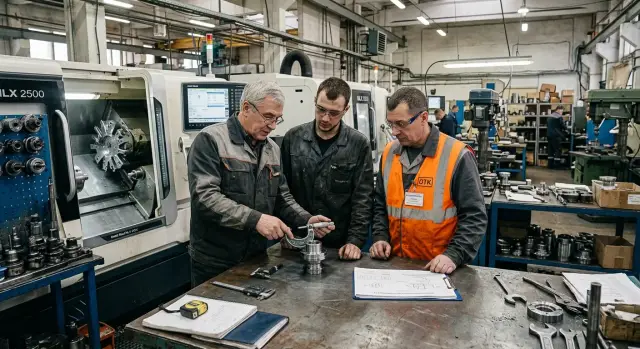
Why a disputed dimension gets stuck
A disputed dimension rarely appears for only one reason. Usually people look at the same part from different angles, measure it differently, and expect someone else to make the decision.
On the first run, this happens all the time. The setup technician sees that the machine is holding the size steadily and still has room inside the tolerance. The inspector gets a number right at the upper or lower limit and does not want to release the batch. The technologist looks at the drawing, the route, and the setup, but at that moment may not be nearby.
The problem gets worse when everyone measures at a different time. Right after machining, the part is still warm. Twenty minutes later the size changes by several hundredths, and that is already enough for an argument. If one person measures at the machine and another in the inspection area, they can easily get different numbers even on the same part.
There is also a very simple source of conflict: people measure in different places. One takes the size closer to the edge, another moves to the middle of the surface, and a third presses the tool harder. Formally, everyone "checked the size," but in practice they are comparing different results. After that, one person says "reject," and another answers "within tolerance."
On a turning department, that pause quickly hurts the pace of work. The machine stands still or runs idle, the first batch sits by the equipment, the supervisor waits for an answer, and the next operation does not know whether it can take the parts. Even 15 to 20 minutes of waiting can easily turn into an hour if no one takes responsibility for the decision.
The most unpleasant reason is simple: before startup, no one assigned the final decision right. The setup technician does not want to sign off on something that QC might later challenge. QC does not want to accept the size without the technologist. The technologist does not want to confirm the result if they did not see how the part was measured and what condition the machine was in.
Because of this, the question of a disputed dimension comes up not in the office or during preparation, but right at the machine, when the parts are already done. That is the worst moment for an argument. Under pressure, people are more likely to defend their role than to check the fact quickly.
In short, the dispute gets stuck wherever there is no single shared rule. Until the shop, the technologist, and QC agree on the measuring point, the inspection time, one measuring method, and the person with the final word, any borderline number will slow down the start of the series.
Who is responsible for what on the first run
On the first run, the dispute usually arises not because of the size itself, but because the boundaries of responsibility are unclear. One person thinks the technologist should decide, another waits for the setup technician, and QC does not want to accept the part without a clear measuring rule. In the end, the part sits on the table, the machine waits, and the batch does not move.
The technologist is responsible for the meaning of the drawing. They define what counts as the datum, which surface the measurement should be taken from, which tolerance matters at the disputed point, and which dimension affects assembly. If the drawing leaves room for two interpretations, the technologist removes that ambiguity and gives one rule.
The setup technician is responsible for what happens on the machine. They hold the setup, choose the tool, set the compensation, and check whether the required size can be achieved consistently rather than just once by chance. If the size drifts because of rigidity, tool overhang, insert wear, or clamping method, that is their area.
QC should not measure "their own way" if the shop measures differently. Inspection checks the dimension using one заранее agreed method. One dimension, one measuring tool, one datum, one measuring location. Otherwise the dispute will never end: each side will show its own result and will be right only under its own conditions.
Where the boundary lies
The technologist does not turn the compensation on the machine. The setup technician does not change the meaning of the drawing. QC does not assign a new measuring datum on the spot. When everyone stays in their role, disputes are resolved faster.
The working scheme is simple. The technologist sets the measuring rule and confirms that it matches the drawing. The setup technician brings the process to a stable result under that rule. QC checks the first part using the same method and records the result. The supervisor or the shop does not release the series until all three have reached one decision.
That last point is often underestimated. If the decision has not been made yet, production must be stopped. Otherwise, in an hour the disputed dimension will no longer be on one part, but on ten.
When the people on the floor know in advance who is responsible for what on the first run, the dispute does not get stuck between them. It quickly comes down to three questions: how to read the drawing, whether the size can be held on the machine, and how to accept it properly.
What to agree on before starting the first part
A size dispute rarely starts at the machine. It usually starts earlier, when the technologist has one version of the drawing, the setup technician has an older printout, and QC is looking at a different tolerance in their copy. On the first run, this breaks the pace immediately: the part is already in hand, but there is still no shared rule.
Before startup, everyone needs to open the same set of documents. Not a similar one and not the "latest, probably," but one approved file or one paper version with a revision mark. If old copies are lying around in the shop, it is better to remove them right away. Otherwise, a disputed dimension quickly turns into an argument about who looked at what.
It is also worth reviewing the places where mistakes happen most often: fits, lengths from different datums, grooves, chamfers, concentricity, and runout. On the process map, these dimensions are better marked in advance. Not for neatness, but so the setup technician and inspection do not waste time guessing during acceptance of the first part.
Before startup, a short note is useful. It is enough to record the drawing revision, the dimensions with a higher risk of dispute, the measuring datum, the person who can authorize continuing the series, and the deviation at which the technologist and QC must be called immediately.
One of the most common causes of conflict is not the size itself, but the way it is measured. The size is on the drawing, but in the shop everyone checks it differently. That is why the measuring point and datum are best shown directly on a photo of the part, a sketch, or a process diagram. Even a simple marked-up photo often clears the question in a minute. If the size is taken after repositioning, that should also be written down.
The decision to continue the series should never be left to "the situation." Before the first part, you need to name the person who gives the go-ahead. In one shop, that is the technologist; in another, it is the supervisor together with QC if the size falls within the agreed range. The process may be different, but it must be the same for everyone.
It is also helpful to agree on an escalation threshold. If the size goes beyond the internal control limit, the setup technician does not quietly adjust the program but calls the technologist immediately. If the deviation is related to setup or drawing interpretation, QC is involved before the next part is released. On a CNC turning department, this is especially noticeable: one marked dimension and one clear measuring datum often solve more than a long discussion after startup.
How to break down a disputed dimension step by step
A disputed dimension should not be discussed on the fly while the machine keeps producing parts. If the first part has already raised a question, it is better to stop production right away. Five minutes of pause are almost always cheaper than a batch of parts with the same deviation.
On the first run, the decision is not made from memory or from the habit of "we have always done it this way," but from documents, the setup, and a repeated measurement. Otherwise, the dispute quickly gets stuck: the setup technician refers to the program, QC to the measurement, the technologist to the drawing, and the size is still hanging between people.
- Stop production after the first disputed part. Do not keep stacking parts "until we figure it out." If the size left tolerance for one reason, the next blank will most likely repeat the same result.
- Check the documents. Verify the drawing revision, the operation number, and the inspection sheet. In practice, the dispute often starts not because of the machine, but because of an old drawing version or because the size is being checked at the wrong operation.
- Look at the machining process itself. The setup technician checks the setup datum, tool overhang, wear, active compensation, and which tool actually performed that pass. The technologist confirms that the chosen datum and the sequence of operations match the process.
- Repeat the measurement. One inspector or an agreed pair of employees uses one instrument and measures the same point using the same method. If one person measures with a micrometer near the edge and another takes the size deeper on the cylinder, the dispute will not end.
- Compare the result with the tolerance and the record in the sheet. If the size is within tolerance, record it and continue production. If the size is out of tolerance, the team writes down the cause and the action: change the compensation, reset the setup, replace the tool, review the datum, or return to the technologist for clarification.
Production can continue only after the decision is recorded. A verbal agreement almost always turns into a new dispute an hour later or on the next shift. A short note in the sheet or log saves time and removes questions about who allowed the series and on what basis.
Example from a turning department
On the first run of shafts, the dispute usually starts not with a defect, but with two different views of the same dimension. On a CNC lathe, after facing the end and turning the outer diameter, the setup technician got a collar diameter of 39.98 with a tolerance of 40.00 -0.02. By their measurement, the part was acceptable. A few minutes later, QC measured 39.96 and stopped the part.
In such a situation, the decision is not made by the person who speaks loudest, but by the person who can connect the drawing, the datum, and the actual machining sequence.
The setup technician immediately noticed that the discrepancy appeared after changing the insert. The old insert started dragging the surface, so they installed a new one, corrected X compensation, and made another pass. From the machine's point of view, everything looked logical: the size was holding, the surface became cleaner, and runout did not grow.
QC looked at the part differently. The inspector placed the shaft on V-blocks and measured the dimension using the adjacent land as the datum. The number came out smaller because after facing and the insert change, the actual reference to the face shifted slightly. The diameter itself had not drifted much, but the measuring scheme used by the setup technician and QC no longer matched.
The technologist did not argue from memory. They took the drawing, the routing, and the process sketch, then checked the setup by operation, the sequence for producing the collar and the adjacent diameter, as well as the tool and the point where the control dimension was taken.
The problem was found quickly. On the drawing, the collar dimension was tied to datum A at the face, but in inspection it was effectively measured from another datum. Because of that, the setup technician saw one result, QC saw another, and both were working from their own logic.
The team agreed on a simple sequence. First, the part was set again based on the face defined as datum A. Then the setup technician made one X correction of 0.01 without unnecessary changes on the other axes. After that, they made one more part and measured it in the same way: with the same tool and at the same point the technologist had marked on the sketch.
The repeated inspection removed the dispute. The collar diameter came out at 39.97, the face stayed within tolerance, and the difference between measurements disappeared. It took about 15 minutes. If the team had started adjusting the cutting mode, compensation, and setup at the same time without a shared measuring rule, the dispute would have dragged on for half a shift.
On a turning department, stories like this are common. The error is rarely only in the machine or only in inspection. More often it hides between the datum, the operation sequence, and the way people take the first measurement.
Mistakes that make the dispute drag on
A size dispute rarely lasts because of the part itself. More often it is stretched out by shop-floor habits. People look at the same first part, but they work with different starting data, different tools, and different measurement times.
The first common mistake is an old drawing printout. The sheet may still show the previous tolerance, an old datum revision, or a note that has already been removed. The setup technician relies on one thing, the technologist on another, and QC on a third. After that, the dispute is no longer about the size, but about the document version.
It is no better when the part is measured immediately after machining while it is still warm. On a turning department, that is a common rush: the machine is stopped, the size is checked, and compensation is adjusted right away. Fifteen minutes later the part cools, and the number changes. In the end, everyone argues not about the fact, but about the moment of measurement.
Another trap is comparing readings from different instruments without checking them. One instrument has not been verified against a master for a long time, another is held with a different force, and a third person measures using their own habit. A difference of a few hundredths quickly turns into a long conversation, although first you should check not the part, but the measuring method itself.
What stretches the dispute the most
It is worst when compensation starts being changed before there is a shared decision. The setup technician wants to get to the size faster and changes the value after every comment. The technologist has not yet confirmed which datum to use. The inspector has not yet recorded the result. After two or three adjustments, it is already hard to tell which setting produced the final result.
Another mistake seems minor, but it hurts the most: the dispute is left only in words. Who measured what, with which instrument, at what part temperature, according to which drawing - nothing was written down. An hour later, everyone remembers the situation differently. Then a work issue turns into a personal argument, even though it should be solved from the data.
Usually the dispute drags on when several mistakes happen at once on the floor: they work from an outdated drawing revision, measure a hot part, do not compare instruments before inspection, change compensation without recording it, and fail to write down the first check.
The normal sequence is simpler. First the team confirms the current drawing. Then they wait for the part to stabilize in temperature and measure it with the agreed instrument. Only after that do the technologist, setup technician, and QC discuss the deviation and record the decision. On the first run, this can save a whole shift.
Short checklist before releasing a series
To avoid arguing about the decision on the first run, the team only needs to close a few simple questions before startup. Usually the series slows down not because of a difficult tolerance, but because of small things: one person has an old drawing revision, another uses a different measuring method, and a third has an instrument without a current calibration check.
Before startup, check five things:
- the setup technician, technologist, and QC all have the same drawing number and revision;
- the setup datum and measuring point are shown right at the machine;
- the exact instrument that will be used to confirm the size has been selected;
- the first part is marked and kept separate from the batch;
- the person who will make the decision if the size is on the tolerance limit or if two measurements give different results has already been named.
This order seems simple, but it is exactly where errors most often appear when accepting the first part. The setup technician may be checking the size from one datum, while the inspector uses another. Both are honestly doing their job, but they get different numbers. If the datum was not shown at the machine before startup, a dispute is almost guaranteed.
The same applies to the instrument. If the size was first checked with a micrometer and then someone decided to recheck it with another tool without agreement, the discussion moves away from the part and turns into an argument about what should be used for measurement. It is better to decide this in advance and not change the method during acceptance.
It is useful to keep the first part separate not for the sake of order on the shelf, but for faster troubleshooting. A tag usually only needs the date, machine number, part designation, and the name of the person who accepted it into the process. A couple of hours later, that saves time: nobody has to look for which sample was treated as the reference.
If such a checklist is kept by the machine and filled out before startup, the disputed dimension does not get stuck between the shop, the technologist, and QC. Everyone has one version of the data, one checking method, and one clear person who says the final "yes" or "no."
What to do after the first run
The first run does not end the moment the shop releases good parts. Right after startup, it is useful to spend 10 to 15 minutes on a short review while everyone still remembers where the delay started, which dimension caused the dispute, and who checked what.
If everything is left to memory, the same dispute will come back in the same place on the next startup. That is why after the first run it is better to record not general conclusions, but specifics: which dimension caused doubt, which measuring tool was used to make the decision, which compensation the setup technician changed, what the technologist confirmed, and what QC accepted as the working rule.
After that, update the documents right away. If the operation sheet is missing a clear measuring step, add it in simple words. If the size is best checked only in one position of the part, write that down too, so the next shift does not waste time guessing.
Photos of the measurement also help. Often one or two pictures are enough: how the part is positioned, where exactly the measuring tool touches it, and what value is considered acceptable. For disputed areas, that is more useful than a long comment passed between shifts.
It is also worth keeping an example of the most disputed case. That can be the part with the borderline size, a note about the first correction, or a photo of the surface that raised doubts. This archive later saves hours, especially when a similar series starts again a month later.
If the first run is on new equipment and the size behaves unstably, it is better not to delay calling the supplier for help. At EAST CNC in Kazakhstan, this is usually handled through a combination of consultation, commissioning, and service support, so it is more convenient to work through these questions before restarting. The east-cnc.kz blog also regularly publishes practical materials on metalworking and machine operation.
A good result after the first run looks simple: the disputed dimension has a clear checking rule, the operation sheet is easier to understand, and the shift has a ready example for the next startup. Then the next batch begins more calmly and without old arguments.
FAQ
Who should have the final say on a disputed dimension?
The final decision is best assigned **before** the first part is started. Usually the technologist confirms the measuring rule, the setup technician shows that the machine holds the size, and QC accepts the part using the same rule. If no one is named in advance, the discussion almost always drags on.
Should production be stopped if the first part raises a dispute?
Yes, it is better to stop production right after the first disputed part. That way you do not build up a batch with the same deviation, and you can find the cause faster.
Why do the setup technician and QC often get different numbers on the same part?
Usually people measure at different times, in different places, and with different tools. It also often happens that one side checks the size while the part is still warm, and the other measures after it cools down, so the numbers no longer match.
When is it better to measure the first part: right after machining or later?
First, let the part cool down to a normal condition for inspection. If you measure it immediately after machining, the heat can easily shift the size by a few hundredths and create a dispute for no reason.
What should you do if people have different versions of the drawing?
Check the revision right away and work only from one approved document. Remove old copies from the shop floor, otherwise the team will argue not about the part, but about the paperwork.
Can you adjust compensation right away if the size is on the tolerance limit?
No. First the team should agree on how to read the size and where to measure it. If the setup technician starts adjusting compensation too early, you quickly lose the connection between the cause and the result.
Who defines the datum and the measuring point on the first run?
The technologist defines this part, because they are responsible for the meaning of the drawing and the setup. The setup technician follows that rule on the machine, and QC checks it the same way, without a separate method.
What is the best way to measure a disputed dimension?
Use the instrument the team agreed on in advance for accepting that dimension. The important part is not the name of the tool, but one rule: one instrument, one point, and one measuring force.
What should be recorded after a decision on a disputed dimension?
Write down who measured the part, with which instrument, at which point, and according to which drawing revision. Also note what happened next: the size was accepted, compensation was changed, the tool was replaced, or the technologist was called in.
What is worth keeping after the first run so the dispute does not come back?
Keep a short note about the disputed point, a photo of the measurement, and the first part itself if it is needed for comparison. On the next startup, this will save time and clear up old questions without a long argument.