
White Cast Iron: How to Spot the Problem Before the Insert Breaks
White cast iron can be spotted before the insert breaks: by the cutting sound, spark, chips, and wear marks. Here is a simple way to check.
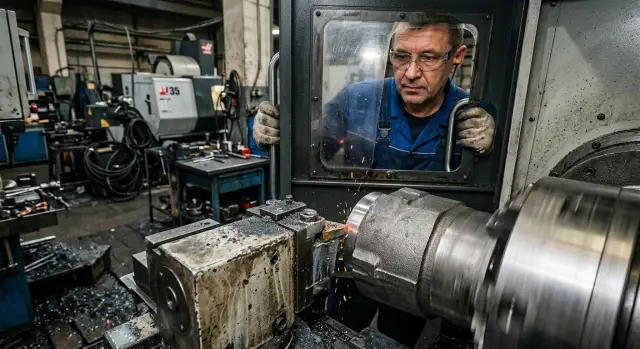
What changes when cast iron has chill
When a part has chill, the cutting tool is no longer working on normal gray cast iron, but on a much harder layer. Most often this is a surface skin left after casting, a hard stock allowance, or an isolated hard spot. In these areas the metal structure is different, so the cutting edge works under much heavier conditions.
The difference is obvious to the machine right away. On a normal area, the load stays steady. As soon as the insert enters the chilled zone, cutting force rises sharply. The edge does not remove metal smoothly — it takes a short удар.
That is why the issue is easy to mistake for a bad insert. But when the cutting conditions are wrong, wear usually builds gradually: the edge heats up, dulls, and dimensions drift step by step. Chill behaves differently. The failure often shows up on the first entry, on the skin, near a rib, at an end face, or in the same place around the circumference.
In practice, this looks familiar to many shops. The first part still cuts acceptably, the second shortens insert life, and on the third the edge is already chipping on entry. If this happens only over a short section rather than along the whole pass, it is worth looking at the material first instead of immediately replacing the whole box of inserts.
The earlier you spot it, the better. Otherwise the shop starts treating the wrong cause: reducing speed, changing conditions, trying a different geometry, while the hard layer keeps breaking the edge.
How chill differs from a bad insert batch
The main clue is simple: chill is almost always tied to a specific spot on the part, while a bad batch of inserts behaves the same way on different blanks and in different cutting zones.
If an insert consistently chips near the same diameter, shoulder, or end face, the material is the first suspect. If a new edge fails on the first, second, and third part in roughly the same way, but the failure point shifts a little each time, it makes more sense to check the inserts, the holder setup, and the cutting conditions.
Chill usually has a clear pattern. The pass runs smoothly, then the tool reaches a certain zone and takes a sharp удар. A bad insert behaves differently: it tends to fall apart from the very start and without an obvious link to the part geometry.
A simple shop example: on several identical castings, the edge chips at the same depth near the flange. The operator takes inserts from another box, but the break point does not move. That is a strong sign the cause is the workpiece. If, on the other hand, a new insert leaves a poor surface on the very first part and then behaves the same way on the next one, but each time at a different point, the issue is more likely the tool or the setup.
What you can hear in the cutting sound
An experienced operator often hears the problem before seeing it on the edge. In normal cast iron turning, the sound is usually steady and dense. If the workpiece has chill, it changes: it becomes drier, sharper, and harsher.
The most common sign is a short click or sharp ring in the same place during the pass. The insert runs smoothly, then hits the hard layer for a second, and the sound levels out again. On the next revolution or the next pass, it repeats in almost the same spot. That location-based repeatability is very characteristic.
If the feed and speed have not changed, but the noise suddenly becomes noticeably harsher, that is also a reason to be alert. The machine did not start behaving differently on its own. Most often, this is how a local hard area shows itself.
A bad or unsuitable insert sounds different. The unpleasant sound starts right away and continues through almost the whole pass. It does not jump from zone to zone. With chill, the difference is audible even between neighboring sections of the same part: smooth here, then a dry ring a few millimeters later, then quiet again.
So it helps to listen not to the overall shop noise, but to repetition. Does the sound change in the same place? Are there short clicks? Does the noise grow without a change in conditions? If the answer is the same several times, the cause is usually in the material.
What the spark and chips tell you
External signs often tell the truth before the insert actually chips. When the metal cuts normally, the spark is weak or almost invisible, and the chips come off as ordinary fine fragments. On a hard section, the picture changes quickly.
The first signal is that the spark becomes sharper and more visible. It looks shorter and harsher, as if cutting suddenly became dry and rigid. That is typical for chill: the tool enters a zone of high hardness, and temperature at the cutting point rises immediately.
The most useful thing is to see whether this happens across the whole part or only over one section. If the spark changes locally and everything before and after is calm, suspicion falls on the workpiece structure. If the problem runs along the entire cut, the cause is more often the insert or the cutting conditions.
The chips show the difference too. In the problem zone, they often turn into a mix of dust, very fine particles, and dark overheated crumbs. Sometimes dry black dust remains near the tool. That is a bad sign: the edge is working under strong friction and impact.
The mark on the part also helps. On a calm section, the surface is usually even and uniformly matte. In the suspicious area, the mark is rougher, and local waviness or shiny patches can appear. Sometimes the transition between the normal zone and the hard one is visible right along the tool path.
If in doubt, it is better to look at a combination of signs rather than just one: sound, spark, chips, dust, and the mark left after the pass. One symptom can still be blamed on the cutting conditions. Several matching signs rarely mislead.
How insert wear points to the cause
Even wear rarely breaks an insert without warning. If the edge dulls gradually, a normal wear land grows on the flank and dimensions drift slowly, the cause is more often the cutting conditions, feed, or insert life. White cast iron behaves differently: the edge may look fine for a while, then take a sudden chip.
It is not the failure itself that matters most, but the pattern. With chill, small chips often appear on one side of the cutting edge. They gather in one spot, as if the tool hit the same hard section several times. With a bad insert batch, the picture is usually more random: one edge fails early, another lasts longer, and the marks on the cutting part do not repeat as closely.
It helps to look at several things at once: did wear develop smoothly or did the edge crumble suddenly, are the microchips on one side or along the full length, and what did the two previous inserts look like? Comparing three edges often tells you more than inspecting one broken insert.
The first chip location also explains a lot. If the chip appears on entry, that often points to a hard casting skin. If it happens in the middle of the pass, it is more likely a local hard spot. Failure on exit is more often linked not to chill, but to an exit удар, a sudden change in stock allowance, a burr, a void, or lack of rigidity.
Here is a simple trick. Put the broken insert next to the two previous ones without cleaning them to a shine. Under a lamp, it becomes easy to see whether the wear path repeats. If the pattern is the same, the material is pointing to the cause. If the patterns are different, first check the tool and the setup.
How to check the suspicion step by step
It is best to check a chill suspicion with a short, identical test. If you immediately change the insert, the cutting conditions, and the workpiece at the same time, the cause gets mixed together and the conclusion becomes random.
Test order
- Install a new insert and keep the same spindle speed, feed, and depth of cut. Do not try to "save" the process by lowering the conditions right away.
- Make a short pass over the same area where the chip or sudden wear appeared before. That is enough to see the picture without losing the part.
- Immediately note how the cut sounded, whether there was local spark, what the chips looked like, and where wear began.
- Then take a workpiece from another batch and repeat the same short pass with the same settings.
- Compare the length of cut before the first wear marks, the sound, the spark, and the edge behavior.
How to read the result
If the cut on the other workpiece becomes smoother, the spark is weaker, and the insert goes farther without chipping, the cause was most likely chill in the first batch. If the behavior does not change and the edge crumbles quickly again, you need to check the inserts themselves, clamping in the holder, runout, and the cutting conditions.
It is useful to record not just the failure itself, but also the details: length of cut before the chip, the spot on the part, the sound, spark color, chips, and wear appearance. Such a log takes a couple of minutes, but later it saves arguments based on memory.
The most common mistake is simple: the operator changes everything at once. New insert, different speed, different feed, and a new workpiece too. After that, you can no longer honestly say what actually caused the carbide insert wear.
Where people most often go wrong
Most often, the issue gets blurred in the first few minutes. The operator hears the harsh sound, sees the spark, and immediately slows down. Sometimes the insert does last longer, but then it is harder to understand the original cause.
If you suspect chill, it is more useful to first record the baseline: speed, feed, depth, part section, and the wear pattern after a short pass. Otherwise it is easy to think the lower cutting conditions helped, when in fact you simply moved out of the hardest zone.
Another common mistake is comparing inserts that should not be placed in the same group. A different grade, different geometry, a different nose radius, or a chipbreaker already changes the sound and the wear pattern. After such a swap, you are effectively starting a new test.
People also draw the wrong conclusion from one broken edge. One insert may have hit a cavity, casting skin, chuck runout, or a random impact on entry. That is why you do not look at one chip — you look at repetition. If several edges fail in a similar way in the same area, that is already more like a material problem.
Casting skin gets confused with this all the time. The first pass over the outer layer often runs harder, with a brighter spark and faster wear. That does not mean the whole part is bad. If cutting calms down after the skin is removed, the cause was that top layer.
Machine vibration is also sometimes taken as a sign of chill. The sound is similar, but vibration has its own pattern: the surface comes out wavy, behavior changes with spindle speed, and wear becomes uneven and not always local. With a hard section, the edge is usually damaged exactly where the material really becomes harder.
A simple shop-floor example
In turning, this often happens without any drama. The first workpiece goes through cleanly: sound is steady, chips are normal, and the insert is still healthy after the pass. On the next part, the edge chips after a minute, even though the settings and the machine are the same.
At first, people usually blame the inserts. That is understandable. But then the operator takes an insert from another box, runs the same pass, and gets almost the same result. The failure repeats not just anywhere, but in the same place around the radius.
In that area, the sound changes sharply. Instead of the usual hiss, you hear a short click. A local spark appears almost immediately. The chips change too: they become drier, finer, and sometimes look more like crumbs and dust.
The next check is simple. The operator removes a little more of the surface layer and runs the same section again. After the hard skin is gone, cutting evens out. The sound settles, the spark almost disappears, and the insert no longer chips immediately.
In that case, white iron is indicated not by one sign but by several at once: the failure repeats in the same area, changing the insert box does nothing, a sharp click is heard before the chip, a local spark appears, and after the top layer is removed the pass becomes calmer.
A quick check before the next part
If the edge breaks almost immediately, do not blame the whole insert batch right away. Very often the problem sits in the workpiece itself and repeats in one zone.
The fastest check is this: take the next part, keep the same settings, and carefully compare the first seconds of cutting. If the new workpiece runs more smoothly while the previous one was breaking the edge in the same place, the problem is almost certainly local.
Watch three things: where the sound changes, whether there is a more visible local spark, and what the edge looks like after a short pass. If the sound gets harsher only over a small section and the spark appears there too, that is a strong signal. After that contact, the insert usually shows not smooth wear, but small chips or crumbling.
Another useful test is to change only the insert and repeat the short pass on the same part. If the failure stays in the same place, the insert box is not the issue. If another workpiece then cuts calmly with the same settings, suspicion of chill becomes even stronger.
This check takes 2–3 minutes, but it often saves the insert, the dimension, and the setter’s time.
What to do next without unnecessary losses
When an insert suddenly starts crumbling or the edge burns, do not mix suspicious parts with the normal batch. It is better to set a few parts aside separately and label them. That makes it easier to tell whether the problem is one-off or repeatable.
Do not change the insert, cutting conditions, holder, and program all at once. Change one factor at a time and watch how the edge wear and cutting behavior change. It helps to record a few things immediately: photos of the wear, insert grade, speed, feed, depth, part number, and the spot on the surface where the problem began. These short notes are often more useful than a long argument at the machine.
If the failure repeats in the same zone on different inserts, look not at the insert box but at the workpiece itself: stock allowance, casting skin, local hardness, and how the cut enters. Sometimes the overall hardness of the part is normal, but one problem area behaves very differently.
If these cases repeat across a series, it is useful to review them together with EAST CNC specialists. In such situations, it makes sense to look not only at the insert, but at the whole set of conditions: cutting data, setup rigidity, tool geometry, machine type, and the behavior of the workpiece itself.
The most expensive mistake here is simple: see a failure and immediately blame a bad insert batch. A calm check of the facts almost always gives a better result. It helps preserve inserts, good workpieces, and shift time.
FAQ
How can I tell that white iron is breaking the insert?
Look for repetition in the same spot. If the edge chips at the same shoulder, flange, or diameter, the cause is more often the workpiece than the insert box. Another sign is that the failure comes suddenly. The tool cuts normally, then takes a short удар on a small section.
How is white iron different from a bad insert batch?
A bad insert batch usually behaves similarly on different parts and in different cutting zones. White iron, on the other hand, is almost always tied to one area of the part. If you took an insert from another box and the chip location did not change, check the material first.
Where on the part is white iron most common?
The problem is most often found on the casting skin, at the entry into the cut, near an edge, at an end face, or at a shoulder. White iron also often appears in a short section around the circumference where the metal structure is harder. If the edge crumbles in the middle of the pass at the same point every time, look for a local hard spot.
How does the cutting sound change with white iron?
The sound becomes drier, sharper, and harsher. Often the operator hears a short click or a sharp ring in the same place during the pass. When the cutting conditions have not changed, but the noise suddenly gets rougher only over a small area, that is a strong signal.
What can you see from the spark and chips?
On the hard section, the spark is usually brighter and sharper, and the chips get finer. Sometimes dry black dust appears near the tool. If cutting is calm before and after that spot, the cause is more likely the workpiece than the overall setup.
What does insert wear look like with white iron?
With white iron, the edge often does not wear down smoothly — it gets small chips or crumbling. These marks are often concentrated on one part of the cutting edge. If you place several inserts side by side and see the same wear pattern, the material itself points to the cause.
How can I quickly check whether white iron is the cause?
Make a short pass with a new insert at the same spindle speed, feed, and depth of cut. Immediately note the sound, spark, chips, and where the first wear mark appears on the edge. Then repeat the same test on a workpiece from another batch. If the second part cuts more smoothly, suspicion of white iron rises sharply.
Should I lower speed and feed right away?
No — first capture the original picture. If you reduce the cutting conditions right away, it becomes hard to tell what was actually damaging the edge. It is better to make one short, identical test first, and only then change one factor at a time.
Can white iron be confused with vibration or casting skin?
Yes, they are often confused. Vibration creates a wave pattern on the surface and changes with spindle speed, while white iron hits the edge in a specific zone of the part. Casting skin is also easy to mistake for it. The first pass may be harsh, but once the top layer is removed, cutting often calms down.
What should I do with suspicious workpieces next?
Set those parts aside and label them so they do not get mixed with the normal batch. Then change only one factor at a time and watch how the edge and the sound behave. If the failure repeats in the same zone on different inserts, check the stock allowance, skin, local hardness, and how the cut begins.