
Where a Magnetic Table for Steel Plates Falls Short
A magnetic table for steel plates is not always the right choice. We look at part thickness, roughing, release risks, and the checks to make before starting.
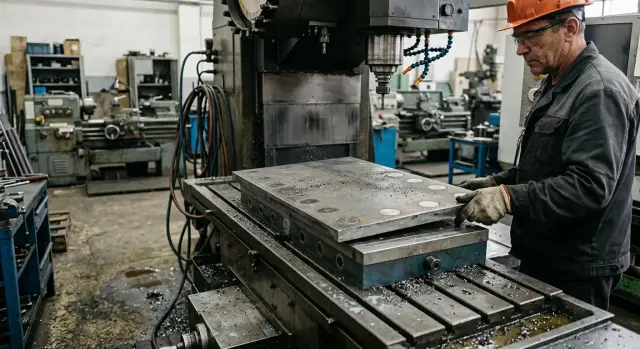
Why a magnet can fail in the middle of a cycle
The catalog force looks convincing only under ideal conditions. A magnetic table holds a steel plate well when the bottom surface is flat, the metal is clean, the contact area is large, and the cut is calm. If even one of those conditions disappears, the holding reserve drops quickly.
The most common mistake is simple: the operator sees the clamping force number and assumes it gives plenty of margin. But that number is not measured during real cutting. In work, the cutter creates jerks, vibration, and side load. It is easier for the magnet to pull the part down to the table than to keep it from shifting sideways.
This is especially noticeable with a thin plate. It can bend a little because of internal stress, an uneven base, or a cutter pass near the edge. The contact is no longer across the full area, but only in places. Even a tiny gap sharply reduces the real holding force. From the outside everything may look fine, but the part is already held worse than it seems.
Small details matter a lot here. Chips, oil, rust, and dirt create a layer between the table and the workpiece. For a mechanical clamp, that is annoying but not always critical. For a magnet, it is a direct path to losing force. Sometimes just a couple of hard particles are enough for the plate to stop sitting flat.
There is one more point that is often underestimated. The operator mentally checks one thing: will the part lift up? But in a real cycle, the cutter more often pulls it sideways. If the pass is rough, the stock removal is large, the feed is aggressive, or the toolpath goes through a corner, the side load rises quickly. Then the plate does not necessarily jump. First it creeps almost invisibly, and only then does it break loose.
That is why the middle of the cycle is often the most dangerous. At the start everything is calm, then heat and vibration increase, part of the contact is lost, the part shifts by a fraction of a millimeter, and only after that does the hold fail completely.
When a magnetic table is truly convenient
A magnetic table works well where you need a fast and calm cycle, not maximum clamping force at any cost. You can place a flat part quickly, align it, and remove it without spending time on clamps and repositioning. If the job involves many identical plates, the time savings become very noticeable.
This clamping method works best for finishing and semi-finishing passes. With a moderate cut, the tool does not jerk the part, and the machining runs more smoothly. It is especially handy for long plates, where ordinary clamps often get in the way of the toolpath or force you to change the setup.
A large contact area is another advantage. The magnet pulls the part not at two or three points, but across the whole support zone. Because of that, the plate usually sits more calmly, and the risk of a local tilt is lower. On thin and wide blanks, this often gives a flatter base than clamping only at the edges.
In the shop, the difference is very practical. If you need to machine a batch of identical covers or mounting plates, the operator removes one part and immediately places the next. Without constantly adjusting clamps, you can save not just a few seconds, but 15–20 minutes per shift.
Magnetic clamping is especially useful when the part is flat and sits well on the table, the batch consists of identical plates, the top surface must remain fully open, and the operation does not require aggressive stock removal.
There is another benefit too: setup becomes easier when a large tool is in the work area or the program runs long passes across the full surface. Mechanical clamps often only get in the way in such jobs. A magnet removes that obstacle and gives the operator more freedom in the toolpath.
Part thickness: there is no single number
When people ask what thickness is already "safe" for a magnet, it is tempting to give a simple number. In practice, there isn’t one. Thickness by itself decides very little. A 6 mm plate may hold calmly, but it may also move if it has little contact with the table or sits with a gap.
You should not look at one dimension in millimeters. You need to consider several things at once: how much metal is actually sitting on the table, whether there are windows, slots, and large holes, whether the underside is flat, and what the cutting mode will be. Thickness only works together with contact area and the stiffness of the part itself.
A wide, flat plate can sometimes hold confidently even at a small thickness if it covers the poles with a large continuous area and the machining is light. A narrow strip with the same thickness gives a completely different reserve. A magnet needs not just metal, but a continuous path through the metal without large interruptions.
Cutouts change the calculation more than people expect. A solid 8 mm plate and an 8 mm plate with a large window in the middle are two very different cases. The thickness is formally the same, but there is less steel under the poles, and the holding force drops. The same happens with long slots, a grid of holes, and narrow bridges.
Warping is another separate problem. A sheet may look flat but actually touch the table only at the edges or at two diagonal points. In that case, thickness stops guaranteeing anything. A 10 mm part with a wave can sometimes hold worse than a flat 4 mm plate.
So it makes no sense to look for a rule like "anything from 5 mm is always fine." First you need to understand how much continuous metal the magnet actually sees and how tightly the part sits on the table. Only then can you decide whether the magnet is suitable for the job.
Roughing: when the reserve disappears
A roughing pass quickly destroys the feeling that "the magnet will hold anyway." When the cut is light, the magnet holds through attraction and friction. As soon as feed, depth of cut, and width of engagement increase, the reserve disappears very quickly.
The problem is not only the size of the force, but also its nature. The cutter does not pull the part in one direction. It creates side load, lifts the edge in places, and adds short impacts. On a finishing pass, that is still tolerable. In roughing, this combination can already shift the plate by fractions of a millimeter and then break it loose completely.
Magnetic clamping performs especially poorly with interrupted cutting. If the tool goes through windows, holes, weld areas, or rough scale, the load becomes uneven. Every entry and exit from the metal hits the holding force harder than a smooth continuous pass with the same average stock removal.
Work near a free edge is even more dangerous. In the center of the table, the part usually rests across the whole area and stays more stable. Near the edge, part of the support area is gone, and the plate is easier to lift or move. That is why a pass that runs fine in the center can end in a shift at the edge.
A warning sign usually looks familiar: the operator slightly increases the settings, the machine runs smoothly at first, then a thin squeal appears, the cutting sound changes, and the surface shows chatter marks. That is no minor issue. It is what it looks like when the reserve is almost gone.
If you need a deep cut in one pass, if the tool hits an interrupted contour, if the machining runs near the edge of the plate, or if the part is thin and bends easily, it is better to move away from the magnet right away. In such cases, mechanical clamps, stops, vacuum, or a combined setup that holds the part not only downward but also against sideways movement are more reliable.
Yes, setup will take more time. But that is still cheaper than a stopped cycle, a damaged tool, and a risk to the operator.
How to check the clamping before starting
Even a good magnetic table can fail if you miss a small issue before starting. Most often the problem is not the magnet itself, but a dirty table, a burr on the edge, or a part that sits on only a few points.
Start with the simple things. The table and the underside of the plate must be clean and dry. Remove chips, wipe off oil, and remove burrs. One hard particle under the middle of the part already changes the contact, and then the magnet holds not the full area, but random spots.
After cleaning, do not look only at the corners. A plate can sit tightly at the edges and still have a gap in the center. Press it by hand in several places and check whether it rocks. If you are unsure, it is better to remove the part and go over the table and base again than to catch a failure on the first pass.
A useful habit is to gently test the edge for movement by hand. No jerk is needed. A firm normal push is enough. If the plate moves even a little, it is too early to start the cycle.
Then evaluate the operation itself. A deep pass, large feed, a dull tool, or milling with strong side pull is often more dangerous than it seems. A magnet handles sideways movement worse than upward pull. If the load will clearly go to the side, reduce the stock removal in advance or add a mechanical stop.
It makes sense to make the first pass cautiously. Reduce depth of cut and feed, make a short test cut, and see how the part behaves under real load. Then stop the machine and inspect the marks. If the plate has shifted, you will usually see an uneven trace, fresh scuffing near the edge, or a slight change in position.
There are a few mistakes that come up more often than others. The part is placed on a dirty table. People trust the rated force without a test cut. They set a thin plate near the edge and immediately use a heavy cut. Or they keep running when the sound has already changed and the size is drifting. Almost all of these mistakes seem minor until the first failure.
Operator safety
With magnetic clamping, a mistake rarely gives you a second chance. If a plate moves during roughing, it will not warn you for long. That is why safety starts not with the Start button, but with the operator’s position and the habit of watching the first seconds of cutting.
The worst habit is standing directly in front of where the part could fly out. If the plate comes loose, it will follow the easiest path, forward along the line of force and rotation. It is much safer to stand slightly to the side: you can still see the work area, but you are not taking the удар yourself.
Before the first pass, the guard should always be closed. Even if the cut is small and the job is "just for a minute." Those first seconds show whether the magnet is holding, whether the tool is pulling the part, and whether vibration is present. You should watch that through the guard, not from the open area.
Reaching into the work area with your hand before the spindle has fully stopped is also not allowed. At that moment, many people want to quickly remove chips, adjust the plate, or look at the edge of the part more closely. In practice, it is exactly these rushed movements that most often end in injury.
The reason to stop the cycle immediately is also fairly simple. Warning signs look like this:
- a ringing sound or sharp chatter appears that was not there before;
- light shift marks are visible on the table or the part;
- the size starts to drift for no clear reason;
- chips get pressed under the plate on one side;
- the cutting sound changes sharply already on the first pass.
If even one of these signs appears, it is better to stop and check the setup again. Often the problem is fixed quickly: remove chips, improve contact, reduce feed, or move the machining away from the edge. A few minutes for checking is almost always better than one ruined cycle.
A simple shop-floor example
Imagine a typical case. In the shop, they take an 8 mm steel plate and place it on a magnetic table. The plate sits flat, does not rock, and the contact area is large. At first glance, everything looks reliable.
The first light pass only reinforces that feeling. The machine runs calmly, the sound is steady, the chips come off normally, and the part does not move. After such a start, it is easy to think there is plenty of holding reserve and that you can simply go deeper.
The problem starts later, when a heavier cut is taken near the edge. The cutting force is now directed not only downward, but also sideways. Near the edge, the reserve is worse, vibration quickly eats up the remaining margin, a light chatter comes first, and then a shift mark appears on the surface. Sometimes it is only a few tenths of a millimeter, but that is already enough to ruin the size or chip the cutting edge.
An experienced machinist does not argue with physics at that point. He stops the cycle and changes the clamping method. Roughing is moved to clamps or another rigid fixture, and the magnet is kept for finishing passes, where the force is lower and the part is no longer trying to move toward the edge.
This example is a good reality check. Thickness of 8 mm by itself guarantees nothing. A calm first pass also does not prove that the whole cycle will go the same way. If the part sits flat, that does not mean it will survive a deep cut near the edge.
What to do next
If the plate is holding at the limit, do not try to complete the whole operation in one setup. It is calmer and more reliable to split the job into two parts: roughing should be done where there is plenty of holding reserve, and the magnet should be reserved for light finishing. This approach significantly reduces the risk of shifting in the middle of the cycle.
When you find settings that run smoothly, do not rely only on the operator’s memory. It is better to record them for similar parts: thickness, steel grade, contact area, depth of cut, feed, cutter type, and pass direction. In a month, that record saves more time than it seems.
If the same plate comes up again and again, a magnetic table often stops being the best permanent solution. For a series, it is usually more profitable to make a dedicated fixture — mechanical or combined. It gives more predictable holding, handles roughing better, and reduces the risk of scrap.
There is one more common mistake: the machine is chosen based on axis travel, power, and price, and the clamping method is considered later. For plates, that often backfires. If equipment is being selected for this kind of job, it is better to discuss the clamping setup together with the machine, the machining modes, and the future parts.
At EAST CNC, these questions are worth raising already at the selection stage. The company supplies CNC machines for metalworking and helps with consultation, selection, commissioning, and service, so the tooling and the real machining scenario should not be left for later.
A good result for the shop is simple: use the magnet where it is truly convenient, not where it is barely hanging on. For finishing and calm batches, it is an excellent option. For aggressive stock removal and questionable contact, it is better to choose a stiffer clamping method right away.
FAQ
When is a magnetic table really convenient?
A magnetic table is best for flat steel parts with a large contact area and calm cutting. It is especially convenient for finishing and semi-finishing passes when you need to switch identical plates quickly and keep the top side open without clamps.
Why does a magnetic table often fail in the middle of a cycle?
At the start, the part often sits flat and behaves calmly. Then heat and vibration increase, part of the contact is lost, and the cutter starts pulling the plate sideways. First there is a small shift, and after that the holding force drops sharply.
Why can’t you trust the magnetic force rating alone?
The rated force is measured in almost ideal conditions: a clean table, a flat part, and full contact. In real machining, oil, chips, gaps, and side load quickly eat into that reserve. That is why it is better not to rely on the catalog number without a test cut.
Is there a safe plate thickness for a magnet?
No, there is no single safe thickness. Look at the real contact area, the flatness of the underside, the presence of windows and slots, and the cutting mode. A flat 4–6 mm plate sometimes holds better than a wavy 10 mm part.
What reduces holding force the most?
Most often, chips, oil, rust, dirt, and burrs on the base reduce holding force. Warping, large cutouts, long slots, and machining near the edge of the table are also harmful. Any gap between the table and the metal immediately weakens the hold.
Is a magnetic table suitable for rough stock removal?
For heavy roughing, a magnetic table is usually not the best choice. Deep cuts, aggressive feed, and interrupted cutting create side load very quickly, and a magnet is worse at resisting sideways movement than upward pull. If the mode is aggressive, use clamps, stops, or a combined setup.
How can you quickly check the clamping before starting?
First, clean the table and the underside of the part dry, then remove burrs and check whether the plate rocks. After that, apply firm hand pressure to the edge without jerking. If the part moves even a little, do not start the cycle.
What should you do if the cutter runs near the edge of the plate?
At the edge, the holding reserve is always smaller because the table does not support the full area. In that zone, it is better to reduce depth of cut and feed, move heavy cutting toward the center, or add a mechanical stop. If the operation still feels aggressive, change the clamping method.
How do you know the part has started to move?
The sound usually changes first: you hear a squeal, ringing, or vibration that was not there before. Then you see vibration marks on the surface, the size starts drifting, and fresh scuff marks or pale shift lines appear near the edge. At that point, stopping is cheaper than continuing.
When is it better to give up on the magnet and make a different fixture?
If the part is repeated in a batch, it is better to plan the fixture in advance instead of after the first failures. A magnet is good for light passes and quick plate changes, but for heavy work a mechanical or combined fixture is often more practical. That gives you a more stable process and less scrap.