
When a pallet system is needed for a machining center
We explain when a pallet system is needed: how to calculate center utilization, cycle time, order counts and whether automation will pay back.
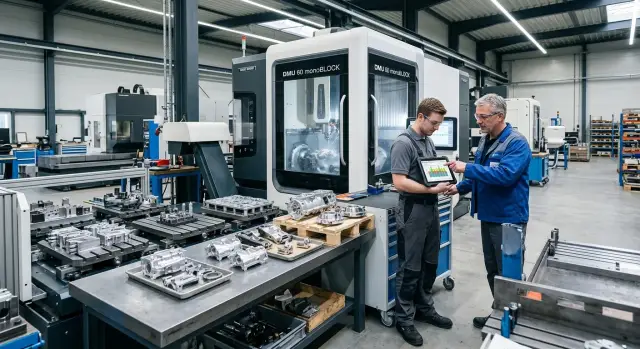
What problems shops face
The question “when do you need a pallet system” usually doesn’t come up when the machine cuts non-stop, but when the shop constantly loses time between operations. From the outside it looks like the machining center is busy all day. In reality the spindle runs noticeably less than a shift.
Most of the time is lost not to cutting itself but to everything around it. The operator removes a part, installs a new blank, searches for a fixture, waits for a crane, measuring tool or first-part inspection. If setup happens on the machine, the center doesn’t contribute a minute of cutting during that time.
This issue is especially visible where there are many different orders: one housing, then a small batch of flanges, then an urgent repair part. Each change breaks the rhythm: fixture change, base alignment, program tweak, then another first-part check. The machine seems to be working, but its actual utilization stays low.
Another common cause is that the operator is ready but can’t start: blanks haven’t been delivered, fixtures are in use on another center, or inspection hasn’t released the first part. As a result both the person and the machine wait.
From the outside it looks odd: the order queue grows, the dispatcher pushes the shop, yet there seems to be no free time. But if you break the shift down by hours, the picture is usually simple:
- cutting occupies only part of the day;
- the rest is eaten by setups and waiting;
- urgent orders break the plan;
- small batches create too many gaps.
This imbalance is common in shops with vertical and 5-axis centers where the range of parts is wide and deadlines are tight. The problem isn’t a weak machine or too few orders. The problem is an expensive center that too often acts as a place for waiting, setup and manual fuss instead of cutting parts.
What a pallet system changes
A pallet system doesn’t change the cutting itself but everything around it. While the machine cuts a part on one pallet, the operator can fasten the next blank on another. Preparation moves out of the cutting zone and the spindle waits for the operator less often.
This is most noticeable where the shop frequently switches between batches. Without pallets the machine stops while the operator removes a part, cleans the area, fits new tooling, aligns the base and only then restarts the cycle. With pallets some of these actions happen in parallel, so the pause between batches shortens.
In practice the difference is often not in cutting time but in losses between cycles. If a cycle is 12 minutes and changing the part takes another 6, the machine is not cutting for a third of the time. If a pallet system reduces that pause to 1–2 minutes, center utilization increases without longer shifts.
But pallets don’t fix a weak process. If fixtures are awkward, base alignment is lengthy, or post-process inspection takes too long, the effect quickly disappears. The machine will start waiting not on pallet changes but on measurement, setup or tool search.
The same goes for low volumes. When orders are rare and the center already stands idle for half a day, automation won’t give noticeable returns. Pallet systems work well where there is a steady flow of parts and frequent changeovers, not for infrequent one-off jobs.
Simple example: a small shop makes housings and flanges in small batches. The operator spends 8–10 minutes per order removing a part and installing the next. Those stops add up to more than an hour per shift. If preparation is moved to an external pallet, the shop gets that hour back. If the shop only has 2–3 orders a week, the pallet will be idle.
For companies like EAST CNC, which supply machining centers and automated lines, this is a common decision point. First you should see how much time is lost between cycles, and only then calculate investments. If downtime sits elsewhere, start with that, not with pallets.
What numbers to collect before calculation
A pallet system pays back by numbers, not impressions. Look not at the machine’s spec sheet but at how many hours it actually cuts metal and how many hours are spent on everything else.
Start with typical parts. Don’t pick a rare order that happened once a year. Choose 5–10 parts the shop regularly makes and record the pure cutting time for each. It’s better to take data from the NC program and verify it against the shift log because actual cycles are often longer than CAM estimates.
Then separate cutting from losses. Setup, tool approach, searching fixtures, first-part inspection, blank changeover, waiting for the crane or operator — these are different types of time. If you lump them into one line the calculation will be neat but useless.
Usually it’s enough to record five things:
- cutting time for each typical part;
- setup time per batch;
- blank-change time between cycles;
- downtimes per shift and per week;
- number of repeat and one-off orders.
Also note hours when the center truly runs under load. Don’t measure utilization by “machine on = working.” What matters are cutting hours and how much time you can recover for production.
How to calculate center utilization step by step
Utilization is counted in hours. With honest data it becomes clear whether you need a pallet table now or if the shop’s current workflow is sufficient.
For the first estimate it’s convenient to take a month. That reduces distortion from random failures or one long job.
- Take the total available time. For example, 22 shifts × 8 hours = 176 hours.
- Subtract time when the center definitely doesn’t produce parts: planned maintenance, geometry checks, mandatory inspections, waiting for tooling, lack of blanks, or approvals.
- Add up all working intervals by orders: cutting, setup, tool changes, part approach, short stops between cycles. These are often forgotten but add up over a month.
- Separately count hours when the spindle actually cuts metal.
- Compare regular weeks and peak periods when orders are higher than usual.
The formula is simple: machining center utilization = occupied time / available time × 100%. If you want to see production density, add a second indicator: cutting time / available time × 100%.
The gap between these two numbers explains a lot. Suppose the center is occupied 78% of the time, but the spindle cuts only 46%. That means the machine spends too much time on setup, repositioning or waiting. In that case a pallet system might help, but only if downtime is caused by part and fixture changes.
Small example. In a month the center was available 176 hours. Maintenance and inspection took 14 hours, waiting for blanks 10 hours. That leaves 152 hours. Of those, cutting took 88 hours, setup and short pauses 64. Formally utilization looks high: 152 out of 176 hours, or 86%. But real cutting is only 50%. That’s a reason to look beyond the machine itself at cycle length, batch size and order count.
Look at the numbers in two modes. If in a normal week utilization is 55% and in peak weeks 92%, automation pays only with a stable order flow. If even quiet weeks stay above 80%, the bottleneck is already visible.
How cycle length affects the decision
Cycle length often decides more than machine power. When a part takes 3–5 minutes, even a short stop for changing a blank, blowing off, checking or restarting eats a noticeable share of the shift. In that rhythm the operator constantly distracts the center from cutting and losses accumulate quickly.
With long cycles the picture changes. If a part takes 40–60 minutes, manual preparation between runs has a smaller impact on output. A pallet system still saves time, but the return may be lower than a simple calculation suggests.
It’s useful to classify cycles like this:
- up to 10 minutes — gaps between parts are especially costly;
- 10–30 minutes — the decision depends on flow stability and number of changeovers;
- 30 minutes and above — first check night operation and overall load, then calculate automation.
If the shop runs mixed parts, don’t reduce everything to one average. That’s a common mistake. Parts with 6-minute cycles and parts with 45-minute cycles behave differently even on the same center. It’s better to group them: short series, medium series and long runs. Then you can see where pallets really increase output and where they change little.
Night shifts matter too. During the day an operator can reload manually. At night that mode usually falls apart: the center either stands idle or runs only long cycles. If you want the machine to run unattended for several hours, even one additional pallet can bring more benefit than all daytime minute-savings.
Batch size also matters. A batch of 5 and a batch of 500 produce different results. Small series spend a lot of time on setup and fixture change, so pallet systems don’t always pay back quickly. In long runs every saved minute becomes tens of hours per month.
The decision usually depends on three things: cycle length, night operation and order repeatability. For shops with frequent short cycles it’s not just a convenience — it’s a direct increase in output.
How many orders are needed for steady operation
Automation needs not just volume but a steady flow. A pallet system works when you can pre-load similar parts instead of stopping after every new task.
Start by looking at repeat orders per month. The total number alone says little. If 25 orders arrive but 18 are one-offs with different fixtures, there’s no stability. If there are 12 orders and 8 repeat with similar routing, the situation is very different.
Check a few simple things:
- how many orders repeat each month;
- how often the operator changes fixtures;
- whether you can queue similar parts for 1–2 shifts;
- how much time urgent small batches consume;
- what buffer time is needed because of uneven incoming flow.
Frequent fixture changes quickly eat the benefits. If fixtures are changed almost for every order, a pallet system won’t remove the most painful part. It helps where the operator prepares the next part off the machine rather than starting a long setup from scratch.
Another quick test: are there enough similar parts to build a queue? If you can group several orders that share a base, similar tooling and operations, the system runs smoothly. If similar parts are rare, the pallets will wait with the machine.
Count urgent small batches separately — they often break the best-laid plans. One urgent job that takes 20 minutes of cutting can cost half a day if you must remove the current setup, change jaws and recheck dimensions.
So for uneven flow plan a time buffer. In practice shops often need a reserve of 15–25% of available machine time. Otherwise any urgent insertion destroys the queue and the pallet system performs worse than expected.
As a rough guide, the pallet question usually becomes serious when repeat orders already keep the center loaded for several shifts ahead and similar batches arrive regularly. For a small shop that’s often not 30–40 orders per month but 8–12 repeatable orders that can be combined without constant re-fixturing.
A simple good sign: you have not just a lot of work but a queue of similar tasks. Then pallets save time every day, not only in rare busy weeks.
A simple example for a small shop
Imagine a small shop with one machining center. It runs three typical parts in rotation: housings, flanges and bushings. There are enough orders, but the machine doesn’t cut for the full 8-hour shift. Pure cutting takes about 6 hours and almost 2 hours are lost to setup, blank installation, measurement and waiting.
On paper the center looks busy. In reality it often stands idle. The operator removes a finished part, looks for the next fixture, aligns the blank and tweaks the base. If this repeats each shift, a pallet system ceases to be theoretical.
With two pallets some work moves out of machine time. While the center cuts a housing on the first pallet, the operator installs and checks the next blank on the second. When the cycle ends, swapping pallets takes minutes instead of tens of minutes.
In this example the picture is:
- without a pallet system — 6 hours of cutting and nearly 2 hours of losses per shift;
- with two pallets — preparation runs in parallel and cutting may rise to about 7–7.5 hours;
- the gain only makes sense if similar parts are run regularly, not randomly.
Suppose the shop repeats batches of 20 flanges and 50 bushings each week. Tooling is familiar, the program is proven and the operator knows the sequence. Then the second pallet helps almost daily. If today it’s one housing, tomorrow a one-off bushing, and the day after a new long-alignment part, the benefit quickly fades.
Owners often focus only on pallet-change speed and not on order character. If the shop runs many repeat series and setups cut into machine time, a pallet system can noticeably increase output. If orders are fragmented and every part is new, it won’t solve the main problem.
For a small shop the takeaway is simple: first check how many hours per shift the center actually cuts and how much time goes to preparation. If losses approach 2 hours and series repeat, two pallets are worth serious consideration.
Where shops often go wrong
Many shops look only at cutting time. On paper the center is busy all day, but in practice hours are lost to fixture changes, tool swaps, first-part inspection and waiting for the operator. If you don’t include these losses, the pallet system will seem more profitable than it really is.
A common mistake is calculating based on the best month. That number is misleading. If one month had many similar parts and few urgent setups, it doesn’t represent normal operations. For investment decisions use an average over several months.
Another frequent error is mixing repeat parts with one-off orders. Pallets work best where there’s a steady stream of identical or similarly fixtured parts. If today is a batch of housings, tomorrow a single repair part, and the day after a completely different geometry, automation won’t remove the chaos.
What’s checked too late
Before buying pallets many shops hardly look at fixtures. That’s a mistake. If fixtures take a long time to set, standard bases are lacking, and tools are assembled from scratch every time, pallets won’t solve the main problem. They just move the delay from one place to another.
Ask these four questions:
- how many minutes are spent on preparation per batch (not cutting);
- which month was normal rather than record-breaking;
- how many orders repeat at least once a quarter;
- is the shop ready to run an extra shift if output increases.
The last point is often underestimated. A manager expects output to rise after automation but doesn’t define who will load pallets in the evening, who will receive parts in the morning, and who will handle inspection. Without a plan for shifts and people part of the effect is lost.
In a small shop this becomes obvious fast. One center can cut faster but the blank warehouse is empty, the process engineer can’t provide programs in time, and QA only arrives in daytime. In that case it’s too early to buy a pallet system. First eliminate simple losses, tidy up fixtures and confirm a steady order flow.
A quick check before investing
You can assess whether a pallet system is needed without a complex model. Review the center’s work for the last 4–8 weeks. If the numbers repeat week to week, the decision will be calm rather than based on a couple of bad shifts.
First check live utilization, not the nameplate. If the machine is nearly busy all day and free windows are short and random, that’s a serious signal. One-time overloads mean nothing. What matters is sustained high utilization and an order queue that doesn’t shrink.
Then check how much output is eaten by pauses between batches. Often the issue isn’t cycle length but the gaps: remove a batch, bring the next, change fixtures, tweak the program, perform first-piece control. If these pauses are 20–40 minutes several times per shift, losses become too noticeable.
A short test looks like this:
- the center is highly loaded for more than one week in a row;
- transitions between batches cut output noticeably;
- there are repeat parts with similar fixtures in the workload;
- the shop can manage order queues and pallet sequencing;
- the calculation shows saved hours per week, not just a nice idea.
Pallet systems work especially well where parts return regularly. If the shop produces small series of similar housings, flanges or shafts, part preparation can be moved out of machine time. The operator preps the next position and the center spends less time idle.
But if orders differ each time, fixtures are unique and the week’s plan changes by client request, the effect can be weak. In that case automation won’t solve the main problem; it will add another element that needs planning.
Do a simple hour calculation: take the average number of setups per shift, multiply by time lost per setup and compare to monthly output. If the saved time gives a visible increase in parts or lets you take more orders without adding a second shift, the investment is worth discussing with an equipment supplier. If the numbers don’t add up on paper, they rarely improve on the shop floor.
What to do next
Don’t buy a pallet system based on the vague feeling that the machine is “often busy.” You need numbers for at least a typical month. Otherwise it’s easy to overpay for automation that won’t deliver noticeable returns.
Start with 10–20 typical parts. Choose parts that are neither the easiest nor the hardest but those that truly run through the shop. For each part record processing time, setup time, batch size, repetition frequency and how long the machine waits for the operator between cycles.
Then put everything in a simple table. Usually four lines are enough:
- how many hours the center actually cuts metal;
- how many hours are spent on setup and fixture changes;
- how many hours are lost waiting for people, materials or the next order;
- how many orders per week or month keep the center occupied.
After that create two scenarios. First — how the shop works now. Second — how it would work with pallets: fewer manual pauses, some setup outside the cutting zone, more continuous work during shifts or at night. If the paper difference is only a few percent, don’t rush. If you gain tens of hours per month, the discussion becomes concrete.
Also check the order flow. Pallet systems pay off best where there are repeatable parts, frequent changeovers and steady utilization. If orders come in bursts and the center is idle half the time, a new system may look convincing but the money will return slowly.
Decisions usually rest on three numbers: current center utilization, share of setup in the shift and number of orders in the shop. When utilization is high, setup eats a noticeable part of the day and order flow is steady, a pallet system is worth modeling in detail.
If you want to test this on your parts and shifts, discuss the task with real shop data. EAST CNC handles machine supply, commissioning and service, so such a calculation can be tied to your actual utilization and order profile.
FAQ
What does a pallet system actually provide?
A pallet system removes part preparation from machine time. While the center cuts a part on one pallet, the operator can fixture the next blank on another pallet, so the spindle spends less time waiting between cycles.
In which shops does a pallet system pay off fastest?
Most effective where repeat batches, frequent changeovers and high machine utilization coincide. If several minutes per part are lost to unloading, loading and base checks each shift, pallets typically recover that time and increase output.
When is it better to delay the purchase?
Wait if the machine is idle for half the day, orders arrive in bursts, or every part requires long new setups. In those cases pallets won’t remove the main losses and will only add cost.
What figures should I gather before calculating?
Collect cutting time for typical parts, setup time per batch, pauses for changing blanks, and downtimes caused by people, tooling or materials. Also mark which orders repeat to see whether there’s a steady flow for pallets.
How to understand how much the machine really cuts?
Measure hours when the spindle actually removes metal, not simply when the machine is powered. Use shift logs, program data and recorded stops over a month to see the gap between overall occupancy and real cutting time.
How much does cycle length affect the decision?
Very much. With 3–5 minute cycles even short pauses for part changes or checks consume a large share of the shift. With 40–60 minute cycles manual reloading matters less. So cycle length is key for the expected benefit.
Is a pallet system useful for night shifts?
Often yes, if you want the center to run unattended for several hours. During the day operators can reload manually; at night even one extra pallet can be more valuable than the daytime savings of minutes.
How many orders are needed for pallets to make sense?
Look at repeatability and similar tooling rather than absolute order counts. Even 8–12 repeatable monthly orders can be enough if they form a queue for several shifts and don’t require new fixtures each time.
Where do shops most often make mistakes?
Common mistakes are using the best month as a baseline and looking only at cutting time. Real losses are often in setup, first-part checks, waiting for tooling and searching fixtures — these must be included in the calculation.
What's a simple sign that pallets are worth considering?
If the center is consistently busy and you lose about 1.5–2 hours per shift between cycles and batches, it’s time to seriously evaluate pallets. With repeat series such losses quickly add up to tens of hours per month.