
When to Change the Oil in a Hydraulic Chuck Station
We explain when to change the oil in a hydraulic chuck station: what color, smell, foam, pump noise, and clamping behavior can tell you before a failure.
Why the problem is noticed too late
The question of when to change the oil in a hydraulic chuck station is often asked too late. The reason is simple: a hydraulic station can keep working for a long time even with tired oil. Pressure is still there, the chuck still seems to clamp, and the machine does not stop. That makes the problem easy to dismiss as a minor issue.
The first signs rarely feel alarming. The clamp engages a fraction of a second slower. The pump gets a little louder than usual. After startup, a small amount of foam appears, and the hydraulic station housing heats up more than before. In a workshop, these things are often blamed on a cold morning, a different workpiece, or the usual shift load.
The chuck clamping system is especially tricky. It loses stability before the system fails completely. Today the jaws clamp evenly; tomorrow there is a slight jerk; then the pressure starts to fluctuate from cycle to cycle. The machine is still running, so the repair gets postponed. Yet that is exactly the moment when the oil is no longer protecting the components properly.
On a CNC lathe, this looks ordinary. The operator notices that one part needed a second clamping attempt, then the work continues. If this happens less than once an hour, it is easy to miss. But small failures add up, and the system wears out without noise and without a clear breakdown.
If you skip oil checks, wear progresses faster. Contaminants scratch the friction pairs in the pump. Deposits prevent valves from moving freely. If air gets into the oil, pressure holds worse, and the chuck starts clamping in jerks. Later, simply changing the oil is no longer enough: the pump and valves may need repair.
That is why you should not look for a complete failure, but for repeated small deviations. If the clamping behavior has changed, the noise is different, and the oil is old by age or by appearance, do not delay. A breakdown usually starts with exactly these "not scary" signs.
What the color, smell, and foam tell you
If you are not sure when to change the oil in a hydraulic chuck station, start with a simple inspection. Oil often shows a problem before the machine gives a clear signal.
Fresh oil looks clean and even in color. It may be light or slightly amber, but the shade is usually calm, without cloudiness, flakes, or sharp unevenness.
Dark oil almost always points to poor operating conditions. Most often, the cause is overheating, fine dirt in the system, or running too long without replacement. If the fluid has become noticeably darker than it was after filling, waiting for scheduled maintenance is already risky.
The smell is even easier to read. Normal oil has a faint odor. If you smell a strong burnt smell, the station has clearly been running at high temperature. Oil like that loses its properties, and the chuck may start behaving unstably.
Cloudiness should not be ignored either. A milky or grayish color usually points to water in the system. This can happen after temperature swings, condensation, or sealing problems. In this condition, the oil lubricates components less effectively and damages parts faster.
What should raise concern right away
- the oil has turned dark in a short time
- a burnt smell has appeared
- the fluid looks cloudy or milky
- foam remains on the surface after startup
Foam has a simple rule of thumb. If a few bubbles appear after startup and disappear quickly, that is not always a reason to worry. But if the foam stays, builds up in a layer, or keeps coming back, air is likely getting into the system. Sometimes the cause is a leak at a connection, sometimes it is the wrong type of oil.
For a CNC lathe, this is especially unpleasant because the chuck hydraulic station must run smoothly. Oil with air transfers pressure poorly, heats up more, and ages faster.
It is better to look at all the signs together. Dark color without smell can still be checked again after a short interval. But dark oil, a burnt smell, and persistent foam in the same hydraulic system are no longer minor issues — they are a clear signal to stop and inspect.
How clamping behavior changes
It is often easier to understand when to change the oil in a hydraulic chuck station not by the color, but by the clamping behavior. The machine itself gives signals: first weak, then obvious.
The first common sign is this: the chuck does not clamp the part immediately. The operator gives the command, but clamping starts after a short pause. Sometimes the delay lasts only a fraction of a second, but in production you can feel it clearly, especially in repeated cycles.
Next, the clamping force itself changes. In one cycle the part sits tightly; in the next, the clamp feels softer. That means the operator has to check the part more often and sometimes adjust settings without a clear reason. This kind of behavior rarely points only to mechanics. More often, it is old oil, air in the system, or contamination that prevents the valves from working smoothly.
Another noticeable symptom is jerky clamping. The chuck does not move into position smoothly; instead, it moves in short jumps or seems delayed. On CNC lathes, this is especially annoying: the cycle looks normal, but the sense of stability is gone. If clamping used to be quiet and predictable and now feels jerky, the hydraulic system should be checked without delay.
The problem often becomes more visible after warm-up. On a cold machine, everything seems acceptable, but after an hour of work the clamp starts behaving worse. That is a typical sign that the oil has lost the right properties. When it heats up, it becomes too thin, internal leakage increases, and pressure is no longer held as confidently.
The pump gives a separate signal. If it has become louder than usual, that is not just background noise. The sound can indicate air being drawn in, foaming oil, a clogged filter, or oil that no longer lubricates the components properly. Sometimes the operator notices the sound first, and only later the chuck delays and jerks.
The most common mistake here is assuming the machine will "still run a bit longer." The damage builds slowly: first the clamping becomes inconsistent, then the load on the pump and valves rises, and after that downtime begins. If the chuck behavior has changed without another obvious reason, oil should be one of the first things to check.
Where oil deterioration comes from
In a chuck hydraulic station, oil rarely goes bad "on its own." Usually the reason is simple: something that should not be there gets into the tank and lines. Fine chips, abrasive dust, dirt from the tank cover, leftover old oil after a careless change — all of this gradually changes the fluid and speeds up wear.
Even a small amount of contamination creates a chain reaction. Particles move through the system with the oil, clog the filter, and rub against working surfaces. The pump has a harder time delivering flow, pressure holds worse, and the chuck no longer works as smoothly as before.
Overheating also ages oil very quickly. On CNC lathes, this is often seen after a long shift or under heavy load. If the oil constantly runs at elevated temperature, it loses viscosity and no longer lubricates the parts properly. From the outside, it may look minor: the machine gets slightly louder, the chuck clamps with a delay, and the system heats up faster than usual. But the problem is already well underway.
Water in the hydraulic system is more common than many think. It does not only enter through an obvious leak. In a cold workshop, condensation collects inside the tank, and moist air can pass through weak seals. If there is a loose point in the system, moisture builds up gradually. Then the oil becomes cloudy, foams, rust appears inside, and clamping becomes unstable.
Mixing different oils is also dangerous. After topping up with another product, the fluid can change viscosity, and the additives may start interfering with each other. You may not notice this right away from the outside. For several days everything may seem normal, then the pump gets noisy, pressure fluctuates, and the chuck begins to jerk.
A dirty filter makes every one of these causes worse. It does not clean the oil properly and at the same time increases the load on the pump. That creates a vicious cycle: the oil gets dirtier, the pump works harder, the temperature rises, and the oil ages even faster.
In most cases, oil deterioration starts because of several causes at once:
- dust and fine chips get into the tank;
- the oil overheats during long operation;
- moisture enters the system;
- different oils are mixed after topping up;
- a clogged filter traps dirt inside the circuit.
If the hydraulic station used to run quietly and smoothly, but now the oil darkens faster, foam appears, or the clamping feels nervous, the cause should be looked for not in one symptom, but in the whole system.
How to check the oil step by step
Do not inspect the oil right after the machine has been running. Stop the machine, remove the load from the clamping unit, and let the hydraulic station cool for 15–20 minutes. In a hot system, the oil seems thinner, and foam or suspended particles can hide its real condition.
First, check the tank level against the mark. Look on a level surface and with the equipment in its normal position. If the level is below normal, that is already a reason to be alert: oil may have escaped through a leak, and air often enters the system with it.
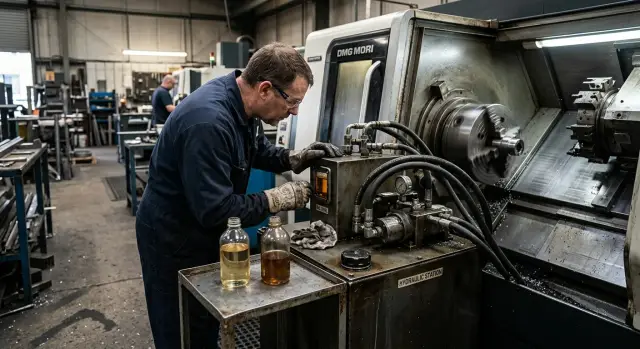
Then take a small sample in a clean transparent container. A glass jar or a lab beaker will do. Dirty containers ruin the result: dust and old residue can easily be mistaken for sediment from the system.
Place a fresh sample of the same oil brand and viscosity рядом. Compare not only the color, but also the transparency. Fresh oil usually looks clean and even in tone. If the sample is noticeably darker or has a gray or milky tint, that is a bad sign.
The smell also tells you a lot. Normal oil smells faint and even. A burnt odor, a sharp acidic smell, or a heavy "chemical" odor often appears after overheating, oxidation, or contamination.
Now gently swirl the container and watch how the fluid behaves. Persistent fine foam, cloudiness, flakes, or sediment at the bottom indicate a problem. Foam often points to air being drawn in. Cloudiness is often linked to water. Sediment suggests dirt, wear, or mixing incompatible fluids.
After the inspection, do not rely on memory. Write down your observations right away:
- inspection date
- machine runtime
- oil brand
- level, color, smell, and whether foam or sediment was present
This kind of log quickly shows changes. If the oil was clear a month ago but is now cloudy and smells burnt, there is no point waiting for the next scheduled maintenance. For servicing a CNC machine hydraulic station, this simple inspection is often enough to catch a problem before the chuck starts clamping in jerks.
When it is better to stop the machine
If the chuck starts losing clamping force on its own, it is better not to "stretch it until the end of the shift" and stop immediately. Even one such case is already dangerous. The part may shift, ruin the dimensions, damage the tool, or fly out of the chuck.
The same approach is needed if pressure in the hydraulic station builds up noticeably slower than usual. Operators often get used to a slow clamping start and think it is a minor issue. In reality, it is a sign of leakage, contaminated oil, or worn components, and the problem usually grows quickly.
A recent oil change does not always solve the issue either. If the oil darkens again within a few days or shifts, the problem is probably not the service interval itself. Dirt, chips, water, or wear particles are likely entering the system. Continuing to run in that condition is risky: the new oil is no longer protecting the components as it should.
Another warning sign is metal dust in the tank or on the filter. That is no longer just "old oil" — it is a direct clue that something inside the system is wearing out. If the pump or valve starts shedding metal into the circuit, every minute circulates abrasive through the entire hydraulic system.
The machine should be stopped without argument if clamping problems appear:
- the chuck does not hold force steadily
- clamping starts with delay or jerks
- the system throws a clamping error
- pressure fluctuates for no clear reason
- the problem returns quickly after restarting
The logic here is simple: if the hydraulic station is already affecting part holding, this is not a comfort issue — it is a safety issue. This is especially important on a CNC lathe, where the part rotates at high speed.
In one workshop, after an oil change, the oil darkened almost immediately. The operator decided to finish the batch even though clamping had become slower. A few hours later the machine started throwing errors, and fine metal dust was found on the filter. The pump repair cost more than a short stop and inspection on the first day.
If you are deciding when to change the oil in a hydraulic chuck station, treat it as a boundary: any signs of lost clamping, rapid repeat oil wear, or metal in the system call for not observation, but stopping and diagnosing.
Mistakes made when changing oil
The most common mistake is simple: the old oil is not truly replaced, only "freshened up." New oil is added to the tank, the noise temporarily fades, and it seems like the problem is gone. But if the real cause is overheating, air leaks, dirt in the tank, or worn seals, the fresh oil will quickly become just as bad.
This is especially noticeable when the chuck is already clamping unevenly. If it closes with a delay or jerks, a top-up alone rarely solves it. First find the cause, then change the oil.
Mistake number two is choosing oil based only on price. A cheaper option may work sometimes, but guessing is not the way to do it. For a CNC machine hydraulic station, viscosity, additive package, and seal compatibility matter. Oil that is "almost the same" may foam more, hold pressure worse, and darken faster.
A similar mistake is mixing oils that look the same. Color says very little here. Even fluids that look close can conflict with each other. After such a mix, foam, sticky residue, and unstable clamping can appear in the system.
Another common error is leaving the old filter in place. The logic seems reasonable: if the oil is new, it should get better anyway. In reality, the filter is still holding old dirt, fine chips, and wear particles. You pour in clean oil, and it almost immediately picks up a fresh load of debris. The savings are questionable.
Level checks also cause mistakes. Many people look only at the mark in the tank: if the level is normal, everything must be fine. But oil can still be dark, smell burnt, cloud up from moisture, or foam during operation, even when the level is correct. For a hydraulic system, that is a bad sign.
In practice, a simple routine helps:
- confirm the oil type against the machine requirements;
- do not mix leftovers from different brands or bases;
- replace the filter together with the oil;
- look not only at the level, but also at the color, smell, and clamping behavior.
In machine service, these mistakes happen all the time. After a "quick change," the problem often returns within a few shifts. The real result comes not from the new oil alone, but from a proper replacement with a check of the reason the old oil went bad.
Short checklist before replacement
Before changing the oil, do not just drain the old fluid and pour in new oil. First gather the simple signs. They often show not only oil wear, but also the reason it wore out early.
It helps to go through a short checklist:
- Look at the oil color, smell it, and check whether there is foam on the surface.
- Assess how the chuck clamps: how quickly it reacts, whether there are jerks, delays, or uneven clamping force.
- Inspect the tank, filter, hoses, and connections for dirt, leaks, and signs of air ingress.
- Check the oil brand and viscosity against the machine manual.
- Prepare a clean container for draining and a new filter before starting the job.
Color and smell often give the first warning. If the oil has become noticeably darker, smells burnt, or foam remains on the surface, the problem is no longer just age. This can happen because of overheating, air entering the system, or mixing different oils. If you simply replace the fluid and do not remove the cause, the new batch will quickly go bad too.
Then look at how the chuck behaves in operation. If clamping has become slower, moves in little jumps, or holds the part unevenly, the hydraulic station is no longer working as it should. Even an extra second for clamping and unclamping is not a minor issue — it is an early sign of trouble.
Also check the tank and filter. Dirt on the tank cover, cloudy sediment, a clogged filter, and oil traces around connections often go together. A leak is not always visible. Sometimes oil barely drops at all, but air still gets into the system, causing foam and unstable clamping.
A common mistake is buying oil from memory or on a warehouse recommendation. The chuck hydraulic station has a viscosity and fluid-type specification, and it is better to verify it against the machine manual. If the documentation is missing, it is worth checking the requirements with the equipment supplier or service provider.
And one last thing: do not use random buckets or old cans. Dirty containers cancel out the whole replacement. A clean container, a new filter, and careful filling usually save more time than having to flush the system again a week later.
Example from the workshop
In one CNC lathe workshop, steel bushings were being turned. In the morning, the chuck clamped the part evenly, without delay, and the operator saw no reason to stop. By noon, the picture changed: clamping became slower, and a short jerk appeared when opening and closing.
At first, this can easily be blamed on normal warm-up after several hours of work. But the operator noticed two details that rarely appear without a cause: the oil had a sharp smell, and fine foam appeared in the tank. The foam was not thick enough to stand out, so it could have been missed. Small signs like these often warn about a problem before the machine gives a clear failure.
The foreman did not wait until the end of the shift and checked the hydraulic station. The oil temperature had risen above the normal range, and the filter was clogged. The pump had to draw oil against extra resistance, so pressure no longer held as evenly as it had in the morning. Because of that, the chuck worked unevenly: at first the clamping seemed normal, then it closed sluggishly and with a delay.
After stopping the machine, they replaced the oil and filter, flushed the tank, and ran the system again. The clamping evened out almost immediately. The chuck started opening and closing without jerks, and the response returned to normal speed.
The point of this example is simple: the fault was found before the part came loose from the chuck. If the shift had kept running for a few more hours, the workshop could have ended up with scrap, a broken tool, and machine downtime. When to change the oil in a hydraulic chuck station is often suggested not by the schedule, but by the behavior of the unit. If the chuck clamps in jerks, and there is foam and an oil smell in the tank, it is better not to delay inspection.
What to do next
If the oil has only just started to darken, smells slightly burnt, or foam appears on the surface from time to time, do not wait for a convenient "sometime later." Set a specific replacement date and check the station again after a few shifts. This simple control often helps catch the problem before the chuck starts disrupting the work rhythm.
When clamping is already jerky, pressure is fluctuating, or the chuck holds the part stronger one moment and weaker the next, you cannot wait. The issue may not be in the oil alone. Often the filter, seals, pump, or valves are also affected. If you only top up the fluid, the machine may calm down for a while and then return to the same fault.
A sensible order is usually:
- replace the oil completely, not just "freshen up" part of the volume
- replace the filter right away
- check for overheating, air ingress, and dirt in the tank
- watch how the clamping behavior changes after startup
These steps are better done together, not one by one. Otherwise, it is easy to remove the symptom and miss the cause. For example, a workshop changes the oil because of smell and foam, but leaves the old filter in place. A few days later, the foam returns, and the chuck starts jerking again.
If the signs are mild, write down three things: the oil color, the smell, and how the chuck behaves on the same part. Then compare the results after a couple of shifts. When changes happen quickly, the answer to when to change the oil in a hydraulic chuck station is already clear — it needs to be done now, not when the calendar says so.
If the machine is not holding the part reliably, it is better to stop work for inspection than to deal later with scrap, chuck damage, or an emergency stop. This is especially important on CNC lathes, where clamping repeatability directly affects dimensions and safety.
If you need help with your machine and hydraulic system, you can contact EAST CNC. The company works with CNC lathes and helps with selection, commissioning, and service, so it is easier to carry out this inspection not "by eye," but with a proper check of the oil, filter, and the hydraulic station itself.