
Weldon or Thermal Shrink Holder: Which Is Safer for Holding an Endmill
When to choose Weldon or a thermal shrink holder: heavy roughing, long reach and finishing with small endmills — practical advice without extra theory.
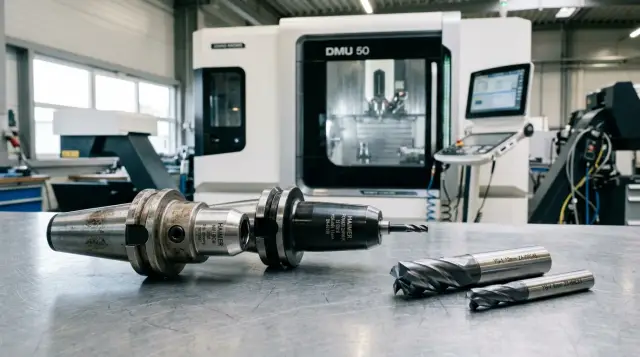
What's at stake
When comparing a Weldon holder and a thermal shrink holder, people usually look only at clamping force. But the risk is broader. If an endmill shifts in the holder by just a few millimeters, you lose size, the surface quality suffers, and sometimes the part is ruined. Often the tool is lost too.
On roughing this becomes visible fastest. Cutting is done with high forces, impact loads increase, and the weak point in the clamping shows up right away. If the cutter starts to pull down or rotate slightly, the machine still cuts, but the result is already poor: dimensions wander, the edge chips, and chips become heavier.
There is a less obvious problem — runout. It’s not always visible immediately, but you see it in marks on the part and in tool wear. One cutting edge takes more load, heats up and dulls earlier than the others. Because of that the cutter life drops, the surface gets rougher, and on finishing the mistake is expensive.
Long reach amplifies nearly all these problems. The farther the tool extends from the spindle, the easier it deflects under load. Even a small play or a few microns of runout become vibration, wall taper and exit chipping. What you can tolerate on a short tool quickly becomes scrap with a long reach.
Small tools have their own issue. Cutting forces are lower, but the cutter is thinner and more sensitive. Small runout is enough to reduce tool life dramatically. So “safer” isn’t always the one that holds dead-solid under heavy load. Sometimes the safer choice is the one with less runout and steadier guidance.
One holder does not solve every task. Weldon often feels more reliable where the tool risks being pulled or rotated under heavy load. Thermal shrink usually wins where a calm run, low vibration and a clean surface are needed. The mistake begins when one clamping method is used for all operations without considering reach, cutter diameter and cutting mode.
How both types work
It’s better to compare holders by their clamping principle rather than body shape. That principle determines how the tool behaves under shock, vibration and long runs.
Weldon holds the cutter with a side screw. The screw bears on a flat on the shank and prevents rotation. The scheme is simple: for heavy, interrupted or impact-prone cutting, this support works reliably.
But this scheme has a downside. The screw presses from one side, not around the circumference, so the cutter doesn’t always sit perfectly on axis. On roughing this is often acceptable. On small tools and finishing, extra microns already cause runout, noise and marks on the surface.
Thermal shrink works differently. The bore is heated, the shank is inserted, then the holder cools and clamps the tool around its whole circumference. The pressure is even, without side offset.
Because of that the thermal shrink holder usually gives more accurate rotation. This is especially noticeable in finishing when the cutter is small and wall or floor passes need precise control. The tool runs calmer and the surface is often clean on the first pass.
Under load the difference becomes clearer. Weldon withstands high torque and interrupted cuts better because the screw mechanically prevents rotation. Thermal shrink holds by radial compression, so it requires a precise fit, a clean shank and a non-impactful cutting mode.
On the bench both holders can seem equally reliable. In cutting the difference quickly appears. If the cutter removes heavy chips, Weldon often behaves more confidently. If the task is accuracy, low runout and a clean surface, thermal shrink usually wins.
Where Weldon is stronger in roughing
In heavy roughing the cutter is usually pulled off not by average load but by short sudden impacts. These occur with large material removal, uneven castings, interrupted cuts or rough entry. The clamping must hold the tool not only concentrically but also rigidly.
Weldon usually performs better in these modes. The screw bears on the flat, so the cutter is less likely to rotate in the holder. If the cut jerks the tool, that simple mechanical stop often prevents displacement at the worst moment.
This is especially noticeable where feed is high, depth is large and cutting sound changes in jerks. Thermal shrink holds by tight contact over the shank, but under impact it depends more on clamping force and shank condition. If the mode is severe and the entry rough, Weldon usually provides a larger safety margin against rotation.
Another advantage appears with heavy cutters and large diameters. When the tool removes a lot per pass, load acts not only on the axis but also as torque. The flat on the shank lowers the risk of the cutter creeping or slightly rotating. For roughing this matters: even a small rotation quickly ruins size, the cutting sound and the tool itself.
But there is a trade-off. Weldon more often shows higher runout than a good thermal shrink. On roughing that is not always critical, because the primary goal is to remove volume safely. On small diameters and on finishing, extra runout becomes harmful: edges load unevenly, surface worsens and the cutter wears faster.
If the picture is: large cutter, hard mode, possible impact entry, and the allowance must be removed quickly, Weldon is usually more reliable. If surface quality, small cutter and calm cutting are top priorities, the choice leans toward thermal shrink.
What long reach changes
Long reach changes not only access but the mechanics of cutting. The farther the cutter protrudes from the holder, the more the assembly bends under load. That increases vibration, then size loss, surface deterioration and reduced tool life.
On a short assembly the difference between holders often seems small. On a long one it becomes noticeable. If the cutter is thin and the pass is finishing, the lower runout of thermal shrink often helps: teeth cut more evenly, load is distributed calmly, and the tool paints less waviness on the wall.
This is especially true for small cutters. A 6 mm cutter with 40–50 mm reach behaves very differently than the same cutter with 20–25 mm reach. In the first case even a careful mode can give ringing, surface marks and size that drifts from part to part.
But long reach doesn’t make thermal shrink a universal solution. If cutting is harsh, material is heavy and removal is large, the risk remains. Under impact roughing Weldon holds the cutter better against rotation and pulling. The problem is that a long assembly will still vibrate. The holder does not eliminate the primary cause.
So with large reach you start not from the holder but from the assembly itself: reduce reach first, then pick the holder. That usually helps more than swapping holders.
If you can’t shorten reach, simple measures help: use a shorter cutter, seat the shank deeper, reduce radial load, separate roughing and finishing into different setups and check runout at the working extension, not at the holder nose.
Simple example: you need to finish a deep pocket with a small cutter. In that work thermal shrink often gives steadier size and a cleaner wall. But if you try to remove metal aggressively with the same cutter and reach, the risk remains high with any holder. In that case change the assembly or the machining strategy.
When thermal shrink is more convenient for finishing
In finishing a small cutter shows every flaw: extra microns of runout, weak balance, uneven clamping. Because of that one edge starts cutting harder than the others and the surface quickly loses quality. When diameter is 3–6 mm and the allowance is small, thermal shrink usually behaves calmer than Weldon.
Thermal shrink clamps the shank around its circumference. The cutter more often sits on axis, the spindle is quieter at high speeds, and the pass leaves a cleaner trace. This is obvious on pocket walls, finishing contours and any operation that needs a gentle entry without extra vibration.
Why this is especially noticeable on small tools
A small cutter tolerates even small runout poorly. What is almost unnoticed on a 16 mm tool quickly becomes surface ripple, extra noise and accelerated edge wear on a 4 mm cutter. When working with a small step or removing the last allowance, steady clamping often matters more than reserve holding force.
Weldon’s strong suit is different. It holds the cutter very confidently in heavy roughing, but on small tools the side screw more often displaces the shank off axis. Even a small offset leaves marks on the part. In finishing this appears immediately: the surface becomes rougher and the operator must reduce feed to hide the stripes.
The difference is stronger with long reach. A thin cutter is already prone to oscillations, and extra runout only makes it worse. In a thermal shrink such a cutter usually cuts quieter and more predictably.
Simple example: a 4 mm cutter cleans a contour after roughing. In thermal shrink it often leaves a smooth wall in one pass. In Weldon the same tool can create a slight wave or marks, especially with hard material and high rpm.
If it’s finishing with a small diameter, thermal shrink is often the more comfortable choice. It helps hold size, gives a smoother surface and reduces noise where every little thing shows on the part.
How to choose for your task
Start by looking at the cut, not the holder. Steel, stainless and heat-resistant alloys load the tool more than aluminum. If you plan large metal removal, deep cuts and high feed, the risk of rotation grows and Weldon usually gives more holding margin.
For light finishing the picture is different. When allowance is small, the tool is thin and a smooth surface is required, low runout is more important. In that work thermal shrink often behaves calmer: the cutter cuts softer, the finish is cleaner and small tools last longer.
Then check the shank itself. If the cutter has a flat for a side screw, Weldon fits the design. If the shank is smooth, thermal shrink usually looks more logical. And always compare the shank diameter with the holder bore. Even a small mismatch quickly shows up as runout, heating and poor surface.
Evaluate reach separately. The farther the cutter protrudes, the more it bends and the higher the load on the clamping. For long reach and heavy roughing many choose Weldon for rotation protection. But if reach is long and the machining is thin and precise, thermal shrink can provide steadier performance if you don't overload the tool.
Ask yourself one useful question: what is more dangerous in this operation — cutter rotation or extra runout? For heavy power cutting you fear rotation more. For finishing with small diameters you fear runout and edge breakage.
A short rule: for roughing hard materials and large removal pick Weldon; for finishing, small tools and high spindle speed pick thermal shrink. And with long reach think first about the assembly stiffness, not just the holder name.
A final answer comes from a trial pass. A short test at the working mode usually says more than theory. Watch the sound, the chips and the mark on the part. If the sound is even, chips are consistent and the surface is clean, the choice is correct.
Common mistakes
Problems usually start not with the holder itself but with small setup decisions. The same holder can work fine for months or break a cutter in one shift if you leave too much reach or clamp the shank too shallowly.
A common mistake is shallow clamping. It seems easier to reach the part that way. In reality a short clamping length reduces stiffness: the cutter vibrates, size wanders and it dulls faster. With long reach this shows immediately: cutting sound roughens, part edge quality drops and spindle load increases.
Another habit is leaving extra reach “just in case.” Access to the cutting zone becomes easier, but stability is lost. Removing just 10–15 mm of reach often helps more than any small parameter changes.
Many people habitually use Weldon with small finishing cutters and don’t check runout. For rough removal this sometimes passes unnoticed, but on finishing a few tenths of a millimeter of runout already ruins the surface and breaks thin tools quickly. Thermal shrink usually behaves steadier in that case.
The opposite mistake occurs as well. People use thermal shrink for heavy roughing, set a high removal and then get shank rotation. After that not only size suffers; the shank shows marks and sometimes the holder is damaged.
Also check the condition of the shank and seat. Dirt, burrs, oil and marks from previous rotation reduce clamping force. Even a good holder won’t help if the shank is worn or out of tolerance.
Before judging the holder, check four things: is clamping depth sufficient, can you shorten reach, is there runout after installation, and are the shank and seat clean. Often the issue is exactly here.
A shop example
In a machining area they take a steel casting. The surface is uneven, with hard spots, and allowance must be removed fast. In this work the holder choice is determined by the machining stage, not habit.
First the operator puts the cutter in Weldon and runs a rough pass. Metal removal is large, load spikes and the tool occasionally hits an impact on entry. In this situation the holder is useful because it holds the cutter securely. If the mode is heavy, the risk of pulling is lower, which matters for both resources and safety.
After roughing a small allowance is left for finish. The task changes: no more aggressive plunges, but a smooth contour and a clean surface. Then the operator switches to thermal shrink. It usually shows less runout, so the small cutter cuts calmer. It’s easier to hold size and the edge lasts longer.
Long reach is a separate problem: for instance, reaching a pocket bottom or clearing a tall flange. In the shop they don’t rely solely on the holder. They first reduce reach as much as geometry allows. Then they lower feed and don’t try to remove the same volume as with a short tool. Otherwise the cutter will drift and walls will become wavy.
In practice the scheme is simple: keep Weldon for rough and impact work, and thermal shrink for finish and small cutters. With long tools shorten reach and soften the mode. This saves not only cutters but also time spent dialing in sizes.
Pre-run checklist
Before the first cut it’s not critical whether you use Weldon or thermal shrink. What matters is removing little things that make the cutter chatter, heat or shift in the holder. That takes a few minutes and can save both tool and part.
A short check before start is enough. Inspect the cutter shank and the holder seat: there must be no oil, chips, rust or burrs. Leave only the reach needed for the operation. Check runout with an indicator at the working length. And be sure to match cut parameters to the real capability of the holder, especially for heavy roughing or long assemblies.
Run the first part under observation. Listen to the sound, watch chips and the pass mark. Sharp whine, matte stripes or sudden heating rarely happen without reason.
On roughing errors show up quickly: the spindle hums, the cutter leaves torn marks, chips come irregular. On finishing signs are subtler: the surface loses even sheen, stripes appear on radii, and size drifts by a few hundredths.
If this happens on the first part, don’t run the batch on luck. First shorten reach, clean the shank, check runout again and revise parameters. Often that’s enough for the holder to start behaving.
What to do next
If you choose tooling only from a catalog, it’s easy to buy the wrong one. Instead list the operations that actually run in your shop weekly: rough stock removal, finishing to fits, long cutter work, small tools, series parts and rare heavy passes. For each operation note three things: cutter diameter, reach and type of load. After that the choice between Weldon and thermal shrink becomes much clearer.
In practice one holder for everything usually gets in the way. For rough and risky passes keep a separate setup with Weldon. For finishing, small tools and long series thermal shrink is often more convenient when low runout and a smooth surface matter. This approach is usually cheaper than constant losses from broken cutters, extra changeovers and scrap.
If you change machines or build a new process, pick tooling together with spindle type, power, rpm range, part types and cooling. Otherwise a good machine won’t deliver results and the right tool will underperform.
Look at the system as a whole. EAST CNC helps selecting machines for machining, commissioning and service, so the holder choice can be discussed together with real modes, part types and finishing requirements. This approach usually leads faster to a working scheme without unnecessary trial and error.
FAQ
Which is safer for heavy roughing: Weldon or thermal shrink holder?
For heavy roughing, Weldon is chosen more often. The side screw bears on the flat of the shank and better prevents the cutter from rotating during shocks, interrupted cuts, and large metal removal.
Why is a small endmill so sensitive to the type of holder?
Because small tools suffer even from tiny runout. If the shank shifts off axis, one cutting edge takes more load, heats up faster and wears out sooner than the others.
When is long reach more important than the choice between Weldon and thermal shrink?
With long reach you first try to reduce the reach itself, then pick the holder. If the assembly is long and flexible, any holder will struggle with vibration, size drift and wall waviness.
Can a thermal shrink holder let the cutter rotate?
Yes — it can, if the cutting mode is too severe, the shank is dirty, or the fit is out of tolerance. Thermal shrink works well for accurate, calm cutting, but it has less reserve against rotation under shocky roughing.
How do I tell that the problem is runout?
Look at the finish, listen to the sound and check edge wear. If the surface gets rougher, the spindle becomes noisy, and one edge wears faster, the issue is usually runout or the tool setup.
What to choose for finishing with a small endmill?
For finishing with 3–6 mm cutters, thermal shrink is often more convenient. It usually provides steadier rotation, quieter cutting at high speeds and helps keep walls and sizes cleaner.
Can one holder cover all operations?
Usually not. Weldon covers forceful roughing better, while thermal shrink commonly wins on finishing, small diameters and high spindle speeds.
What to check before the first cut?
Clean the shank and the seat, remove excess reach and check runout at the working length. Then set cutting parameters appropriate to the actual task, not by habit.
What to do if size drifts on a long cutter?
First reduce reach and seat the cutter deeper if geometry allows. If the issue persists, lower radial load and separate roughing and finishing into different assemblies.
How to choose by default if there’s no time to compare?
A simple rule: take Weldon for heavy removal and shocky cutting, and thermal shrink for finishing, small tools and smooth surfaces. Then run a short test and judge by sound, chips and the mark on the part.