
Vibration Mounts or Rigid Installation: What to Choose for the Floor
Vibration mounts or rigid installation: we break down how the floor type affects accuracy, machine maintenance, and performance under load.
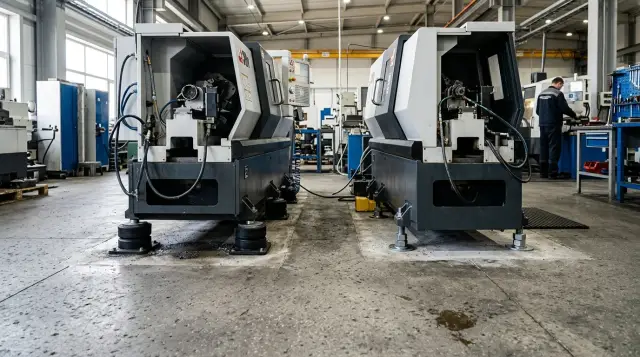
What the choice is really about
The choice between "vibration mounts or rigid installation" rarely comes down to price or the habits of the installation crew. The same machine can run smoothly in one part of the workshop and become temperamental in another. The reason is simple: the machine does not rest on an abstract "floor" but on a specific base with its own rigidity, flatness, and safety margin.
On a dense concrete slab, the machine bed keeps its geometry better. On an old floor with cracks, voids under the screed, or height differences, misalignment appears as soon as the machine is installed. From the outside it is almost invisible, but under load the difference shows up quickly.
During operation, the load changes all the time. The spindle speeds up and slows down, feed is not always even, a heavy workpiece shifts the center of mass, and the cutting tool enters the metal with different force. If the base flexes or the supports work unevenly, vibrations return to the cutting zone. Then the size starts to drift, the surface gets waves, and the tool wears out faster.
Vibration mounts are useful when you need to reduce vibration transfer into the floor or avoid anchors altogether. But they have limits. They add elasticity, and under heavy cutting conditions this can sometimes make stability harder to maintain.
A rigid installation usually holds the machine better under serious load. But it does not forgive a weak floor. If the concrete is crumbling, the screed is thin, or the anchors pull the bed in different directions, rigidity alone is not enough. Expensive supports will not fix a bad base by themselves.
A mistake in the choice leads to very real losses. First, the operator keeps adjusting the size more often. Then surface defects increase. After that, the machine is stopped, the level is reset, the anchors are checked, or the support scheme is changed. Hours of downtime are lost, and sometimes an entire batch of parts.
For a CNC lathe, the question usually sounds like this: what kind of floor do you have, what loads will the machine face every day, and how much would even a small size drift cost? If you answer that honestly, the choice becomes much easier.
What to check in the floor before installation
The condition of the floor often matters more than the fastening method itself. That is why the choice between vibration mounts and a rigid installation starts not with the machine, but with the slab beneath it.
First, look at the slab thickness and the condition of the concrete. If the slab is thin, crumbling at the edges, or noticeably dusty, careful installation will not save you from problems later. For a heavy machine, the danger is not only visible damage, but also weakened areas where the concrete has already lost strength because of moisture, old load, or poor repair.
Check the surface at the support points separately. Even a small height difference between points can tilt the bed. Because of that, the machine is harder to level, and under load it behaves differently than expected. For the first check, a long straightedge, a level, and measurements at several points are usually enough—not just a quick look.
Floor problems rarely stop at one crack. More often, a whole set of signs is worrying: construction and shrinkage joints, old patches, areas of concrete with a different color, cracks running across the installation zone, a dull sound when tapped, signs of settling, and local repairs.
It is also important to consider what is happening nearby. If a press is operating close by, a forklift is moving around, or a crane travels overhead, nearby vibration can travel into the base and affect machine accuracy under load. On paper the floor looks fine, but in a real shift, when other equipment starts up, the picture changes.
The most difficult case is a floor on an upper level, above a basement, or on a thin slab. Such a base is more likely to flex under the machine’s weight and under changing load during machining. In these conditions, you cannot rely on appearance alone. A smooth floor can still hide a weak structure.
A simple example: in a workshop, a machine was placed on an area with an old patch, and a forklift regularly passed nearby. The installation went smoothly, but a few weeks later the level shifted, and re-leveling took almost a full day. The problem was not the machine, but the base.
If there are doubts about the slab’s strength or structure, it is better to stop before installation and inspect the base more deeply. That is almost always cheaper than redoing the machine installation on a concrete floor and trying to recover the geometry later.
How vibration mounts behave
Vibration mounts are placed between the machine and the floor as an elastic layer. They absorb part of the vibrations coming from below and keep the floor from "kicking" the machine as much during operation. This is useful in a workshop where a forklift passes by, a compressor runs, or other heavy equipment is installed.
For a CNC lathe, this is often convenient on an already finished concrete floor. Installation is faster because there is no need to drill anchors into the floor and wait for final fixing. If the layout changes a few months later, the machine is easier to move.
But an elastic support always changes how the machine behaves under load. When the machine cuts calmly, with moderate feed and without strong impacts, this usually does not get in the way. During heavy material removal, side loads increase and the machine may rock slightly. You may not always see it with the eye, but the problem shows up in other ways: fine ripples appear on the surface, the cut gets noisier, and the tool wears faster.
This is especially noticeable on large workpieces, during interrupted cutting, and in modes where the spindle and carriage are constantly changing load. For light and medium-duty tasks, vibration mounts often work well. For heavy roughing, they require more caution.
The most common problem is not the supports themselves, but the weight distribution. Each mount must carry its share of the load. If one is overloaded and another is almost hanging in the air, the bed becomes twisted. After that, the machine starts performing worse: vibration grows, the level shifts, and axis behavior changes.
After installation, one leveling check is not enough. It is useful to check the load on the mounts again after the first few days of operation. Rubber and other elastic elements settle a little. They are also affected by oil, chips, and dirt, so periodic inspection is essential.
If a workshop values quick machine installation on a concrete floor and the option of moving the machine later, vibration mounts offer a clear advantage. If the machine will constantly run with heavy material removal, this option requires more careful adjustment and monitoring.
How rigid installation works
Rigid installation means the machine is anchored to the floor and prevented from shifting during operation. This method is often chosen where machining is heavy, the workpiece is large, and loads change sharply. For a CNC lathe, this usually gives more stable cutting behavior.
When the cutting tool enters the metal with a large force, the machine receives a jolt. If the base is weak or the fastening is loose, the body shifts slightly, and that already affects size and repeatability. Anchors keep the machine in place and transfer the load into the concrete more effectively.
This is especially noticeable in long cycles. The machine moves less, changes position less often, and handles a series of identical operations more calmly. If the workshop machines heavy workpieces or removes a large amount of material, rigid installation usually behaves more confidently than a free-standing setup.
But this solution has a price too. The floor must be flat, strong, and clearly understood, with no weak spots or hidden voids. The installers first make exact markings, then drill anchor points, level the machine, and only after that tighten the fasteners.
If there is even a few millimeters of error during marking, problems start right away. The machine becomes harder to level, and fixing it takes time. On poor concrete, anchors will not save the situation either: they hold only when the floor itself can carry the load.
There is another drawback. Moving the machine later becomes much harder and more expensive. You need to remove the fastening, check new installation points, and sometimes repair the old spot in the floor. That is why rigid installation makes sense when the machine is meant to stay in place for a long time, not for a trial period.
For heavy machines that work with large parts and high loads, this is often the calmest option. If the floor is well prepared, the machine stands firmly and does not waste its accuracy margin on unnecessary movement.
What changes in accuracy under load
Accuracy depends not only on whether the machine stands on vibration mounts or has a rigid installation. The level of the machine matters just as much. If the bed was even slightly distorted during leveling, it will show up quickly: taper, out-of-roundness, or size variation on repeated parts will appear. For finishing work, this is noticeable right away.
During heavy cuts, a rigid connection to a good concrete floor often holds size more consistently. The machine shifts less under cutting load, and the tool sees more stable conditions. This is especially visible when a large allowance is removed, hard metal is machined, or a long production run is carried out without adjustment.
Vibration mounts have a different strength. If the floor is weak, uneven, or other machines are working nearby, they sometimes give a cleaner surface. The mounts block part of the outside shaking, so the part has less ripple. But under changing load, the machine on them may take a little longer to settle after a sudden tool entry or a mode change. In rough machining, that can be worse for size than a rigid base.
You should not look only at the number on the measuring tool. The part often shows the problem before the micrometer does. If a repeating pattern, wave, or fine ripple appears on the surface, the cause is often vibration, not just tool wear.
After installation, it is useful to check several things:
- the machine geometry after leveling;
- spindle and tooling runout;
- size repeatability on several identical parts;
- machine behavior during light and heavy cuts.
A simple example: a lathe machines a shaft. On a rigid installation, after roughing, the diameter usually stays more even along the full length. On vibration mounts, the same machine may produce a cleaner surface during finishing if the floor transmits vibration from nearby equipment. That is why the choice between "vibration mounts or rigid installation" cannot be made based on one factor alone. First assess the floor, then the cutting modes, and only then look at machine accuracy under load.
How to choose the right option
Relying only on the machine specification or on the experience of the neighboring workshop is risky. The same model can behave differently on two different floors. That is why choosing a machine base is best done by checking the real conditions in a simple way.
First, calculate the total weight. Include not only the machine itself, but also the chuck, tooling, fixtures, coolant system, and the heaviest workpiece. Then look at the workshop during a normal shift: when forklifts move, neighboring machines run, doors open, and material is being delivered. This will help you understand faster whether outside vibration will interfere with the work.
Then evaluate the machining modes separately. Roughing with large material removal gives the machine one kind of load. Finishing, where size and surface matter, requires a different level of stability. If the cycle is long, even a small shift in level or extra vibration can create a noticeable variation by the end of the shift.
After that, compare the part requirements. If tolerances are tight and surface quality matters, the base must keep the machine calm and predictable. If the parts are simpler and the focus is on fast startup and easy maintenance, the choice can be less strict.
Only then should you choose the installation scheme. At the same time, plan a follow-up check after startup. The machine should be checked again for level, behavior under load, and fastening condition during the first weeks of operation. That is when you can really see how the base, supports, and machine itself behave.
The rule of thumb is simple. If the floor is flat and solid, the loads are clear, and the machine needs very stable geometry, rigid installation is often the better choice. If there are outside vibrations in the workshop or you need to isolate the machine more gently from the floor, vibration mounts are often the better option. But the final decision is best made after calculating the weight and doing a test run, not by guesswork.
A real workshop example
In a small machine shop, a lathe is installed on an old concrete slab that has been in place for many years. The floor looks level, but a press works nearby, and a forklift carrying blanks passes through the aisle every half hour. That is already enough reason not to choose the base at random.
At first, the machine is used to turn thin finishing parts: bushings with tight diameter tolerance and a clean surface. In this kind of work, the floor starts to matter more than it seems. The impact from the press and the light shaking from the forklift are not always noticeable to the operator, but during finishing they can cause surface ripple or shift the size by hundredths. In this mode, vibration mounts often perform better. They block part of the outside vibration, and the machine runs more calmly.
A week later, the shop switches the same machine to heavy roughing. Material removal increases, cutting becomes more aggressive, and the load on the base rises. Here the picture changes. On vibration mounts, the machine may move a little more under the cut, and the operator notices it quickly from the sound, the chips, and the size spread. For this task, the shop more often chooses rigid floor mounting. It protects less from outside shaking, but under heavy load it gives more controlled behavior.
In such cases, the final decision is made not by argument in the shop, but by checking the parts. Usually, a short series of test cuts and a few simple measurements are enough: size on the first and fifth part, the surface after finishing, machine behavior during a deep roughing cut, vibration level near the machine and at the floor, and whether the level stays the same after several shifts.
If finishing work is more common, vibration mounts may give the better result on this floor. If the machine mostly chews through metal in heavy modes, rigid installation is usually more reliable. On an old slab, there is no universal answer. It is easier to spend one day on test parts and measurements than to spend a month looking for the cause of defects and leveling the machine again.
Common mistakes
Problems usually start not with the machine, but with the floor. The equipment is placed on a base with height differences, and people hope the supports will fix everything. That will not work. Vibration mounts and adjustment help level the machine, but they do not repair weak concrete, local settling, or a noticeable slope.
The second typical mistake appears even before installation. People often count only the weight of the machine itself and forget the workpiece, chuck, tooling, bar feeder, coolant system, and everything else that adds weight during operation. For a CNC lathe, the difference can be significant. Then the machine behaves differently under real load, and the shop looks for the problem in the wrong place.
Another mistake happens after leveling. The machine is set to level, a few light passes are made, and then it is immediately switched to a heavy mode. After that, the level and seating can change. That is why machine maintenance after installation always includes a repeat check, especially if the machine works with a large workpiece or abrupt changes in cutting force.
Fresh concrete is another common trap. After floor repair, production wants to bring the equipment back into service as quickly as possible, and that is understandable. But the concrete is still gaining strength and may shrink. Even careful machine installation on a concrete floor will not give a proper result if the base is still moving under load.
A lot of trouble is also caused by tightening the anchors without a clear sequence. One corner is tightened hard, the second is pulled later, the third is tightened "by eye." The frame gets extra stress, the level shifts, and machine accuracy under load drops. Rigid installation needs a clear tightening order and a check after each pass.
When comparing vibration mounts and rigid installation, the fastening type itself will not save you from these mistakes. First, check the floor, calculate the real operating weight of the machine, and measure the level again after a trial load. That is often what decides whether the machine will hold size steadily or start acting up in the first shift.
What to check before startup
Before serial production begins, it is worth inspecting the machine again, even if the installation went without remarks. This rule is equally useful for vibration mounts and rigid installation.
First, look at the floor at the support points. It should be dry, solid, and free of fresh chips. If the concrete crumbles at the edge of the contact area, the load is already being distributed poorly, and the situation usually only gets worse from there.
Then let the machine run through the first shift or at least a trial cycle with a typical load. After that, return to the basic checks:
- check the machine level again;
- make sure each support is actually carrying weight;
- inspect the anchors, if there are any;
- listen to the machine at working speed;
- check the surface of the first batch of parts.
If a new hum, body vibration, wave, or fine ripple appears on the part, it is better to find the cause right away, not after the tenth or twentieth blank.
It is also useful to compare the machine’s behavior at idle and under cutting. If everything is calm without load, but the machine starts "doing its own thing" under feed, the problem is often not the spindle, but the base, supports, or tightening.
In practice, this inspection takes little time, but it saves re-leveling and unnecessary wear. In EAST CNC service work, these things are usually checked right after installation, because they often determine whether the machine will hold size from day one.
What to do next
The decision is better made based on workshop data, not habit. The debate over "vibration mounts or rigid installation" usually ends quickly if you gather three things in advance: the floor condition, the machine weight, and how it will work every day.
Before ordering, it is useful to check the thickness and condition of the concrete floor, the presence of joints, slope, old cracks, and areas with local settling. Separately note the machine weight, the workpiece weight, the machining type, and the duration of heavy modes. For a precision lathe, the difference between a solid slab and a tired floor later shows up in downtime and repeat adjustments.
It is more convenient to discuss the installation scheme while selecting the equipment. Then you can immediately understand whether vibration mounts are enough, whether rigid fixing is needed, whether the base needs preparation, and how much space should be left for maintenance. That is cheaper than rebuilding the floor after the machine is delivered.
A practical order is simple: collect the floor data, agree on the machine weight and cutting modes, include commissioning in the schedule in advance, and plan geometry checks after installation and after the first few weeks of operation.
The last point is often underestimated. The machine may stand perfectly level on installation day, but after load and mount settling, the picture changes. That is why geometry checks are better done not just once, but on schedule: after startup, after the first shifts under load, and then according to workshop procedure.
If you are choosing a CNC lathe, EAST CNC can help you discuss not only the model, but also the workshop conditions: the floor, the installation scheme, delivery, commissioning, and service. That kind of conversation is useful before purchase, when the decision can still be made without extra cost or rework.
FAQ
How can you tell if the floor is too weak for a rigid installation?
Look for cracks across the installation area, old patches, crumbling concrete, and a dull sound when tapped. If the floor is dusty, sinking, or has a noticeable difference in height between support points, anchors will not solve the problem.
When do vibration mounts really help?
They help when the floor transmits outside vibration from a press, forklift, crane, or nearby equipment. They are also convenient when the machine may need to be moved later and you do not want to drill the floor right away.
When is it better to install the machine on anchors right away?
Anchors are usually chosen for heavy roughing, large workpieces, and sudden load changes. On good concrete, this setup holds the machine position better and reduces size drift over long production runs.
Can vibration mounts reduce accuracy?
Yes, they can. An elastic support adds a little movement, and during heavy metal removal this sometimes causes surface ripples, extra noise, and faster tool wear.
Do I need to check the level again after startup?
Yes, and it is better not to delay it. Mounts settle a little in the first few days, and under working load the bed may take a different position than it had on the day of installation.
What signs on the part show that the base was chosen poorly?
Look not only at the size but also at the surface. A wave, fine ripple, taper, or variation across identical parts often shows a foundation problem before a simple machine inspection does.
Can a machine be installed on an old concrete floor?
You can, as long as the slab can carry the load and has no weak areas. Old concrete often looks fine from the top, so before installation it is better to check the level, strength, and what is happening under the screed.
What is most often forgotten when calculating the load?
People often count only the machine weight and forget about the chuck, tooling, coolant, heavy workpiece, and feeder. Because of that, the support scheme looks fine on paper, but the machine behaves worse in real operation.
What should I choose if a press works nearby or a forklift passes often?
If there is constant external vibration nearby, vibration mounts are the first thing to consider. But if the machine cuts heavily every day, it is worth testing both options on trial parts, because isolation and rigidity do not always give the same result.
Can vibration mounts later be replaced with a rigid installation, or vice versa?
Yes, but it is cheaper to decide before production starts. Switching from vibration mounts to anchors or back requires new leveling, floor inspection, and another geometry check under load.