
Vertical or Horizontal Lathe: Choosing the Right Layout
A vertical lathe isn't always the right choice. We examine part mass, loading and chip evacuation to understand when it outperforms a horizontal lathe.
Common mistakes when choosing
The most frequent mistake is simple: people look only at the part diameter. If the part is large, they immediately think of a vertical lathe. If the diameter is moderate, they pick a horizontal one. That approach is too rough. Two parts with the same diameter can require different layouts because of mass, shape, clamping method and loading.
Weight changes the picture faster than the drawing size. A heavy blank is easier to place where it rests on the table by its own weight. But if the part is long, relatively thin and needs axial machining, the horizontal layout is often more convenient. Shape also matters: disc, ring, hub and shaft behave differently in clamping and cutting.
Another oversight is loading. A machine is chosen from the catalogue, and later it turns out a crane, gripper or trolley can't approach the part comfortably. On paper everything looks fine. In the shop, an extra 10–15 minutes per setup quickly adds up to lost hours. If the blank is heavy, check the loading path early.
Chip evacuation is often underestimated. With some materials chips pile up in awkward places, block the view, scratch surfaces and force the operator to stop for cleaning. So layout should be chosen not only for the part, but for how chips will flow in real work.
Usually mistakes happen in four areas: basing the decision only on diameter, ignoring weight and center of mass, forgetting loading and unloading method, and treating a one-off job the same as a regular series.
The last point is especially important. For a single complex batch you can accept an awkward setup. For daily production that becomes expensive: setups take longer, tilt risk rises and manual operator work increases. Layout is almost never chosen by a single parameter. It’s the combination that matters.
How mass and shape change the choice
Blank mass affects the decision more than the declared accuracy. A light part can be mounted confidently on either vertical or horizontal machine if stiffness and clamping are adequate. With a heavy blank the cost of a mistake is higher: loads on the spindle, chuck and supports increase, and so do runout and tilt risk.
When a part is heavy but not tall, a vertical lathe often runs more calmly. The blank rests downward on the table or faceplate rather than hanging on the axis. This is noticeable on large flanges, rings, flywheels and housing parts where the mass helps seat the part stably.
Wide discs for the same reason are usually easier in a vertical setup. They have a large diameter but relatively small length, so a horizontal clamping works more in bending. In a vertical layout the weight goes down and the machine holds geometry with less stress.
For long and relatively light parts the situation is often reversed. Shafts, axles or thin-tube blanks usually perform better in a horizontal layout where they are easier to support with centers or a steady rest. If placed in the wrong layout they can deflect and dimensions will "drift" along the length.
Shape can be more important than weight. Thin-walled parts, large overhangs or uneven bases increase tilt risk even at moderate mass. This is obvious on cast housings, hubs, discs with windows and rough blanks where support surfaces are not ideal.
A separate case is an off-center mass. That happens with asymmetric housings, parts with a heavy boss or flanges where one zone is noticeably heavier. In a horizontal layout such a blank often creates uneven loading on the chuck and spindle. Vertically it is usually easier to seat more stably.
In practice it helps to look not only at kilograms but at how mass is distributed. A heavy, wide blank tends to favor a vertical layout. A long and relatively light part is usually better for horizontal. Thin-walled and asymmetric parts always need individual clamping and tilt checks.
If your shop regularly processes large discs, rings or flanges, a vertical layout often removes problems before the first cut. It doesn’t solve everything, but for heavy and wide parts it typically looks like the more sensible option.
How loading affects the layout
Loading method often influences the choice more than spindle power. The same part behaves differently if set by hand, lifted by crane or placed by a manipulator. So start with how the part will get into the working area, not with the spindle.
For hand loading a horizontal lathe is usually more convenient for light shafts, bushings and short blanks. The operator feeds the part into the chuck and immediately sees the face and jaws. If the part is light, seating takes 20–40 seconds. Hands-on work is possible on a vertical machine too, but aligning the part to the table is not always faster.
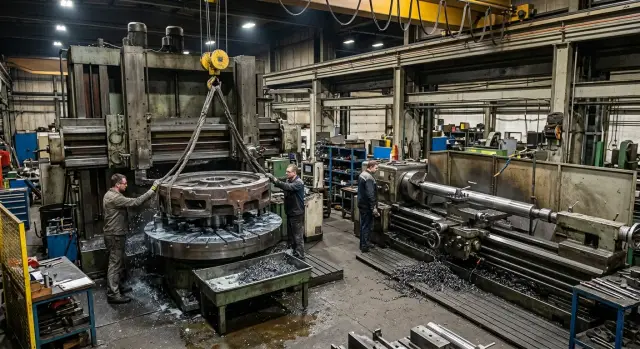
With a crane everything changes. A heavy washer, ring or housing on a horizontal lathe must be held in the air, aligned with the chuck and coaxially positioned. Even an experienced operator may spend 2–5 minutes or more on that if the part is massive or awkward. On a vertical lathe the crane simply lowers the part from above. It seats under its own weight and the operator can more easily catch the base without extra adjustments.
This is especially clear for wide, large-diameter parts. In a vertical layout the part stands stably, doesn’t try to rotate and doesn’t hang in the air. On a horizontal machine the operator often watches the sling, the jaws and runout at the same time. Mistakes then cost time and risk contact with the chuck, table or tooling.
With a manipulator it depends on part shape and production rhythm. For series production with compact, uniform blanks a horizontal layout integrates easily: the manipulator picks the part from the side and feeds it to the chuck repeatedly. For heavy flanges, brake discs, rings and housings a vertical layout is usually calmer: the robot or crane lowers the part from above without complex rotations.
Safety differs too. Risk is lower where the operator does not have to hold the part in the air and the crane/manipulator motion is shorter and simpler. For heavy parts top loading almost always gives a more predictable setup.
If a shop regularly handles massive blanks, a top-loading layout saves not seconds but hours per shift. So check the loading path before the option list.
How chip evacuation changes things
In turning, chips often affect the process more than spindle power or the number of axes. If chips don’t leave the cutting zone, the tool cuts already detached metal, surface quality suffers and the operator must stop to clean.
Vertical layouts have a simple advantage: chips fall down. You don’t get the dense "collar" of chips that appears in some horizontal setups. A vertical lathe therefore often behaves more calmly on heavy discs, rings and flanges where large metal removal takes place.
On a horizontal lathe chips more often wrap around the part, the chuck or the toolholder. The problem is worse with gummy materials, long continuous cuts and an ineffective chipbreaker. In the shop it looks familiar: everything runs fine at first, then a curled ribbon starts to catch and after a few minutes the operator is cleaning the work area.
Long curly chips especially interfere during roughing passes with large allowances, low-carbon steel or stainless steel, long continuous cuts, weak coolant flow and poor insert geometry.
On roughing the cost of a mistake is higher. Chip volume is large and it quickly clogs the cutting area. Coolant reaches the cutting edge worse, temperature rises, inserts dull earlier. The shop then loses time to stops, cleaning and restarts.
Coolant is not only for cooling. Proper flow flushes chips away from the part so they don’t return under the tool. If the flow is weak or misdirected, even a suitable layout won’t save you. Cleanliness of the workspace affects surface finish: fine chips scratch a finish, large chips can obstruct clamping and destabilize the process.
So the choice between vertical and horizontal shouldn’t be driven only by dimensions. If the part produces a lot of heavy chips and roughing is most of the cycle, chip evacuation alone is a practical reason to prefer a vertical layout.
When the vertical layout wins
Vertical lathes are chosen where the part itself suggests the solution. Usually these are heavy flanges, rings, discs and housings with large diameter and relatively small height. On a horizontal lathe such parts still need reliable clamping and retention; on a vertical lathe they simply sit on the table by their weight.
This is especially convenient when the shop loads blanks by crane. The operator lowers the part from above into the working area and spends fewer unnecessary moves. There’s no long coaxing of a heavy blank in the chuck or worrying how to safely rotate it during setup.
Vertical layouts perform well when the main machining is on the face and OD. That’s common for large rings and flanges. The part stands steadily, the tool can reach the required surfaces more easily and the setup is generally calmer and more predictable.
Another plus: when the blank is heavy its mass helps rather than hinders. It presses the part to the support and gives a stable seat. This is useful in roughing where cutting forces are high and any movement immediately spoils the result.
Vertical layouts often win in four cases: large-diameter flanges and rings, cast housings that are awkward to rotate horizontally, parts loaded by crane and series where quick mounting and removal matter.
In series work the difference is felt strongly. If an operator mounts dozens of identical parts per shift, every extra minute becomes lost production. Vertical layouts often shorten that step: the part is easier to present, easier to seat by reference and easier to remove after machining.
If the blank is heavy, wide and not too long, the vertical option usually makes shop work smoother. Less fiddling during loading, lower tilt risk and more benefit from the part’s own weight.
When a horizontal machine is more convenient
A horizontal layout often causes fewer headaches when the part is long and not too heavy. Shafts, spindles, rods or tubes are easier to machine along the spindle axis than to mount vertically and then figure out how to support the length without vibration.
On those parts the tailstock works well. If a single support is not enough, the operator adds a steady rest and gets calmer cutting. This is especially important on long passes where runout, surface finish and dimensional repeatability matter.
A horizontal lathe is usually better when the part is noticeably longer than its diameter, when tailstock or steady rest support is needed, when production runs from bar stock without manual loading, and when the shop already has chucks, jaws and tooling for that layout.
Bar feeding is another common argument. For many small and medium parts a horizontal layout keeps a steady rhythm: feed the bar, run the cycle, remove the finished part or move it to a collector. For bushings, fittings, pins, adapters and similar items this is often easier than organizing individual loading for each blank.
There’s also a practical reason rarely mentioned: shop habit. If setup staff are used to horizontals they already have proven techniques, established cutting modes and tooling for typical jobs. That matters. On a new machine people often lose time learning rather than cutting.
In a small shop this is noticeable. Today you turn short shafts, tomorrow a tube with bores, the day after a small batch of flanges. If parts are not very heavy, one horizontal machine often covers such mixed work without much fuss.
If you compare layouts directly, a vertical machine is better where the part’s mass needs bottom support. But for long blanks, bar-fed series and general-purpose work the horizontal layout is often more convenient and cheaper in daily operation.
Example from a typical shop
A repair shop received a flange for construction equipment. Diameter about 900 mm, the part is wide, heavy and not long. It was lifted from the pallet by crane and the main question became clear: the issue isn’t power but how quickly and calmly to get the blank into work.
You can machine that flange on a horizontal lathe, but the setup takes longer. With the crane the flange is brought to the chuck or faceplate and the operator must carefully catch the seating, check runout and then re-adjust the clamp. If the part is massive and awkward to grasp, the setup alone easily takes 35–45 minutes.
On a vertical lathe the same flange is lowered from above onto the table. It sits under its own weight, the operator can align it more easily and the tilt risk during placement is lower. In a similar job the setup often takes 15–20 minutes. On paper the difference seems moderate, but over a shift it becomes significant.
Then roughing begins. A large allowance is removed, chips are many, heavy and hot. On a horizontal machine some chips may collect in the cutting zone, wrap and block visibility. The operator must stop more often to clean.
On a vertical layout chips usually fall away. In rough turning this changes the process: the cutting zone stays cleaner, pauses are fewer and it’s easier to monitor the tool.
For that flange the choice typically leans to vertical for three clear reasons: crane loading from above without extra moves, faster setup and simpler chip evacuation. If the shop repeatedly takes parts like that, a vertical lathe saves real hours otherwise spent on setup and cleaning.
Step-by-step layout selection
The layout decision often breaks down not by machine price but by one awkward part that’s hard to mount, clamp and machine reliably in series. If you’re choosing between vertical and horizontal, look at your actual part mix, not the catalogue.
Start by collecting data for the worst problem part, not the average. If one batch weighs 80 kg and another 900 kg, orient toward the heavier case.
Three groups of data are enough to start. First — dimensions and mass: maximum weight, diameter and height. For discs, flanges and housings this often rules out some options quickly. Second — loading method: manual, hoist, overhead crane or robot changes the decision more than you might expect. Third — the chip type during roughing. Short chips behave calmly; long, gummy chips create problems in the workspace faster.
Simple example: a 900 mm flange weighing 700 kg is usually easier and safer placed from above. In that case a vertical lathe often gives more convenient loading and less extra operator work. The same mass in a long shaft often performs better in horizontal.
Next, compare not only the machining but everything between cycles. Most time is lost there. Measure setup and changeover times. A 10–15 minute difference per batch quickly becomes many lost shifts per month. Check tooling requirements: do you need driven tooling, a steady rest, tailstock, special jaws, a faceplate or custom clamps? Count downtime costs separately. A cheaper machine that takes longer to set up and stops more for chips or loading will lose its savings.
If in doubt, make a simple table for each part: mass, size, loading method, chip type, setup time, required tooling and downtime cost. After that the choice usually becomes much clearer. Heavy, wide parts tend to favor vertical. Long parts and general-purpose work favor horizontal.
Pre-purchase mistakes
A common mistake starts not with brand choice but with picking the wrong representative part for calculations. Buyers take a rare complex blank that appears a few times a quarter and pick a machine for it. Later the machine spends most of the month on other throughput and the theoretically perfect layout gets in the way.
A second error looks small but costs a lot. People read diameter, power and rpm in the spec sheet, but nobody times the loading. If a part needs crane setups every time, the difference between 2 and 7 minutes per setup quickly eats any gains from nice specs.
Chip issues are also often misjudged. On light cuts problems might not show, but in deep cuts long hot chips start to collect where they interfere and slow the cycle. For heavy machining this is not a small matter but part of realistic shift output.
Another frequent mistake is buying extra diameter "just in case." But with diameter you must also consider the mass of the blank, fixtures and chuck and how the part behaves during setup and the first cuts. Otherwise the machine fits by size but runs too close to its limits.
Before buying check a few simple things: which parts actually flow every month, how many minutes are used for lifting, setup and removal, where chips go at the heaviest regime and what the total weight is including tooling and chuck.
One more issue surfaces too late: commissioning and service. Many discuss this after payment when the machine is already on the way. It’s wiser to know in advance who will install the equipment, who will train operators and who will come if questions appear during the first weeks.
A simple table with three columns — part, mass, loading time — often yields more value than a thick catalogue. After that the choice between vertical and horizontal usually becomes much clearer.
What to prepare before the next step
To avoid buying blind, assemble a short dossier on parts and actual shop practice. One general drawing without notes usually gives a too-rough picture. You need facts that show where a vertical lathe will work better and where a horizontal layout is wiser.
For the first talk with a supplier the basic set is enough: part dimensions, mass, material and 2–3 photos or a drawing; loading method — crane, by hand, from a roller track or from a feeder; batch size — one-off, small series or repeat flow; list of operations — roughing, finishing, boring, face trimming, drilling, threading; and most important — what currently causes trouble: long setups, chips, vibration, scrap or operator downtime.
Better to show not just one part but the whole nomenclature that will actually go to the machine. If you send only the easiest housing, selection will favor that case. Later you may find a heavy flange or a long blank does not fit a normal working mode.
Describe loading separately. It often decides the choice faster than the catalogue. If the part is heavy, wide and easier to lower from above, a vertical layout usually gives calmer work. If the blank is long, comes from a bar feed or requires tailstock support, a horizontal lathe is often more convenient.
Don’t forget chips and coolant. From photos and the operation list you can often predict whether chips will clog the cutting area, fall freely or wrap around the tool. That affects both process cleanliness and time between stops.
A good request is not "pick a machine" but "compare both layouts for our nomenclature." Ask for a calculation for several parts: what changes in loading, cycle time, maintenance convenience and scrap risk.
If you want practical help, East CNC in Kazakhstan provides selection, supply, commissioning and service for CNC lathes. That lets you discuss not only machine models but how they will work in your shop after startup.