
Is a vertical turning center justified for flanges?
Learn when a vertical turning center pays for one family of large flanges by calculating workload, setups, tooling, and backup orders.
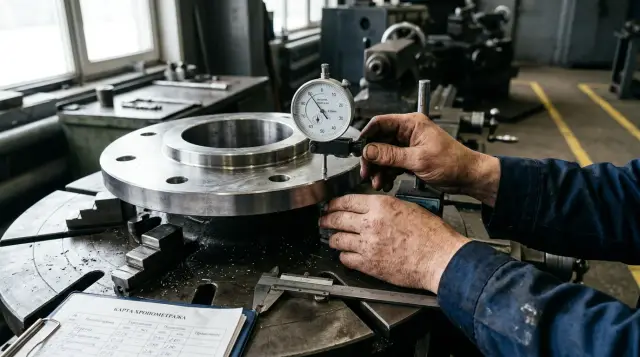
Buying a dedicated machine for one family of large flanges is justified by the number of billable hours the family actually occupies after setups, inspection, downtime, and scrap, not by the annual part count. If the calculation relies only on catalog cutting time and hoped-for new orders, a vertical turning center will almost certainly look better on paper than it performs in the shop.
A vertical layout has a genuine advantage: it is easier to place a heavy disc-shaped blank on a table and locate it under its own weight than to hold it on a horizontal spindle. Convenient loading does not create profit by itself. The answer comes from comparing three routes: retain the current process, outsource some operations, or move an agreed set of operations to a new machine.
I use the calculation below before requesting a commercial proposal. All figures in the example are hypothetical. Their purpose is not to prove the purchase, but to show where a weak assumption changes the answer.
First define what the machine is buying
A vertical center is worth considering when it removes a specific process constraint, not simply when it turns faster. For a flange family, that constraint is often the safe setup of a heavy blank, repeated location after flipping, waiting for a crane, a queue at a large boring machine, or lost concentricity between surfaces. State the constraint in one sentence and attach a measurable loss to it.
The phrase "we need more output" cannot be calculated. "Each part needs two 42-minute setups on the horizontal machine, plus 28 minutes for realignment" can be compared. If the new center leaves the same two setups and the same alignment work in place, its higher power will not help much.
Start by fixing the boundaries of the family. A shared drawing envelope must cover outside diameter, height, mass, material, allowance, forged or cast blank shape, accuracy classes, surface finish, holes, slots, and inspection requirements. Two parts with the same diameter can belong to different manufacturing families if one arrives as a flat forging while the other has an unstable cast skin and needs a different clamping scheme.
Then define the final operation assigned to the machine. These are three different investments: two-axis turning with holes transferred to another machine, driven tooling that finishes holes and slots in one setup, or a combination center for more complex milling. Buying the third configuration when paid demand requires the first means charging every machine hour for functions that production does not use.
Okuma's official material for the V760EX and V100R vertical machines connects the vertical layout with stable machining of thin and awkwardly shaped workpieces and easy chuck access. That is a sound physical argument, but it is not economic proof. For your part, it must become a measured reduction in alignment time, less distortion after unclamping, or the removal of one setup.
Before doing the calculations, answer an awkward question: if a simple tooling change removes the current process constraint, why buy a machine? A plate, quick-change jaws, a proper alignment sheet, and a reserved crane window often deliver most of the desired effect for a small fraction of the capital cost. That outcome is not a failed project. It is a purchase correctly prevented.
Convert annual volume into good parts, not promises
Start with confirmed good output for each variant, not the total number of inquiries. Use shipments across at least the latest complete production cycles, open contracts, agreed framework volumes, and the actual conversion of inquiries into orders. Sales can provide a forecast, but the base case must survive without unsigned volume.
Create one row for each flange variant. Record annual good quantity, typical batch, number of batches, seasonality, share of urgent releases, and the probability of an engineering change. An annual 420 parts produced in twelve batches creates a very different workload from the same 420 parts released in sixty short batches. In the second case, the machine sells far more time to changeovers and the first part.
Do not automatically carry scrap from the current route into demand for the new machine. If the customer buys 400 parts and you start 420 because five percent are lost, the project's goal is 400 good parts. The base model needs its own expected yield for the new route. Until it exists, use a cautious assumption and show sensitivity separately.
It helps to split demand into four buckets:
- firm volume under contracts and stable repeats;
- likely repeat volume from current customers;
- insourced parts that are currently sent to a subcontractor;
- new orders with no price, drawing, or date yet.
The base case includes the first bucket and the confirmed part of the third. The second belongs in a moderate case. The fourth remains backup demand and does not service debt. I have seen plenty of calculations where the same future part filled spare capacity, supplied the margin for payback, and justified a larger machine configuration. That counts one hope three times.
An annual total is not enough for seasonal demand. Break volume down by month, or at least by week. If 55 percent of the parts are due in four months, average annual utilization conceals a seasonal overload and an empty table afterward. The machine can have free hours across the year and still miss the contracted lead time without a second shift, a buffer of semi-finished stock, or a transfer of some operations.
Calculate the smallest batch the customer actually collects. A large vertical center pays poorly on a paper series of hundreds if production receives five-piece orders with separate acceptance each time. For short batches, first-piece time, warm-up, tool setting, and the inspection report often matter more than faster cutting.
Calculate utilization from the operations calendar
Cutting hours are not the hours occupied by an order. For every part, add the automatic cycle, manual loading and unloading, cleaning of locating surfaces, on-machine measurements, scheduled insert changes, chip removal, and expected offsets. Then add the changeover, trial part, and final inspection for every batch.
Sandvik Coromant's turning guide gives the basic machining-time formula at constant spindle speed: machining length divided by feed per revolution times spindle speed. It is useful for checking an individual pass. It knows nothing about approaches, tool changes, speed limits during facing, acceleration of a heavy table, interrupted cuts, or inspection. The sum of ideal passes is therefore a lower bound for the cycle, not an output promise.
Use one transparent structure for the preliminary calculation:
H_parts = good_qty / yield * (auto_cycle + load_unload + in_cycle_manual) / 60
H_batches = batches * (setup + first_piece + final_inspection) / 60
H_family = H_parts + H_batches + planned_tool_service + planned_cleaning
H_required = H_family / availability
All durations are in minutes and final values are in hours. yield is a good-part fraction, such as 0.97. availability applies only to time when the machine is scheduled for production, not to the entire calendar year.
That distinction is easy to lose. The Siemens Performance Insight manual defines OEE through availability, performance, and quality, while TEEP also includes calendar time and planned stops. Do not multiply future hours by an attractive overall OEE without breaking it down. Quality is already in yield, reduced speed can be included in the actual cycle, and availability is needed for failures and unplanned delays. Applying the full OEE again would charge the model twice for the same scrap or slow cycle.
Build the available calendar from the bottom up. A single shift, for example, is working days multiplied by shift length. Subtract planned maintenance, training, mandatory checks, days without an operator, and a permanent allowance for urgent work. The result is planned capacity. Then apply availability measured on comparable machines, not a universal figure from a presentation.
If no comparable equipment exists, show a range such as 0.70, 0.80, and 0.88, and do not call the middle case a fact. Add a separate first-year ramp-up line for programming, test cuts, shift training, postprocessor corrections, chip-breaking trials, and customer approval of the process. Those hours are real even though accounting cannot see them in the part cycle.
Verify setup time with a crane and a stopwatch
Setup savings cannot come from a promotional video. Time the current route and run a trial simulation of the new one, starting while the previous finished part is still in the chuck and ending at the stable automatic cycle of the next part. Include finding slings, waiting for the crane, cleaning, changing jaws, alignment, tightening, runout inspection, closing the guard, and returning the tooling to storage.
A vertical layout usually makes it easier to place a large disc-shaped part because the table supports it while the operator arranges the clamp. Gravity does not correct a crooked datum, casting draft, or uneven stiffness in a thin ring. Excessive clamping force distorts a flange on a vertical machine just as readily as on a horizontal one. Savings appear only after approving the force application scheme and checking size after release.
Separate four times that people often hide under the word "setup." Batch preparation covers retrieval of the program, tools, jaws, and inspection equipment. Physical changeover occupies the machine. The first part includes a cautious start and offsets. First-part approval may wait for the laboratory or customer representative even when the machine is ready. If the center cannot switch to other work during that wait, all of it consumes capacity.
Run at least five repetitions on the current process and record the spread as well as the mean. One staged run by the best setup person says nothing about the second shift. For the proposed route, ask the supplier to simulate it with a mass and size mockup or your own blank and an agreed list of actions. A video without a continuous timer is not evidence.
Check the flip separately on a large flange. If both sides need machining, a single-table vertical center does not remove the second setup by itself. Driven tooling does not remove the flip either when datum faces and shoulders lie on both sides. Draw the route and mark datums for every operation. The claim of "complete machining in one setup" will then either survive the geometry or disappear before the order.
Crane time must appear in the calendar as a constrained resource. Two machines may need the same overhead crane at once, while one rigger serves the whole area. If the calculated cycle falls to 70 minutes but the crane arrives every two hours, the crane sets output. A lifting beam, buffer table, or queue change can then produce more parts than an expensive machine option.
Tooling needs its own budget and service life
The base machine price rarely equals the amount that must be funded before the first accepted part. A flange project can include a chuck or faceplate, sets of soft jaws, supports, stops, clamps, holders, boring bars, driven tools, measuring equipment, chip conveyor, coolant system, probe, tool setter, postprocessor, and lifting gear. The list depends on the route, but there should be no empty "miscellaneous" line.
Split spending into three groups. The first is required to start any part in the family: base chuck, common holders, programming, and acceptance. The second belongs to a specific variant: special jaws, a ring, supports, or an inspection gauge. The third appears later: inserts, jaw refurbishment, repairs to driven units, and consumables. The first group is part of the investment, the second can be allocated by variant, and the third belongs in the hourly or part cost.
A cheap universal faceplate sometimes creates an expensive setup. If the operator assembles clamps, avoids them with the tool, and spends a long time aligning every blank, the company saves on hardware and sells machine hours on every order. A dedicated fixture is justified when the present value of saved changeovers and more stable yield exceeds its fabrication and maintenance cost.
Count tooling life in launches and parts. Soft jaws can be recut only a limited number of times, locating faces suffer dents, and special supports get lost or remain tied up in another batch. Include spares for critical elements and storage space. A set that exists only in a three-dimensional model and arrives weeks after the machine delays revenue while financing charges have already started.
Do not calculate the tool budget by multiplying turret stations by an average holder price. Make an operation map and assign each operation an assembly, spare insert, expected life, number of cutting edges, and replacement time. Include a separate ramp-up regime for unstable cast skin. If a toolmaker proposes a faster cutting condition, confirm it with your rigidity, overhang, and clamping scheme.
Remember the infrastructure: floor load, foundation, door openings, unloading route, electrical power, air, coolant, chip removal, and service access. A large machine that fits within its outline on a plan can block an aisle when the conveyor is open or require partial roof removal during installation. These works belong to the project regardless of which accounting line receives them.
The worked example must survive a bad year
Consider a hypothetical family of three flanges. Customers accept 420 good parts a year, and the typical batch is 14 parts, so 30 releases are expected. The proposed center's preliminary cycle is 155 minutes, while loading, unloading, and manual actions take 25 minutes per part. A changeover takes 180 minutes, and the first part with its inspection takes another 90 minutes per batch. Expected yield is 97 percent.
Substitution gives about 1,345 hours for parts and 135 hours for batches. Add 90 hours of planned tool service and cleaning to get 1,570 family hours before failures. At 0.80 availability, about 1,963 planned hours must be reserved. This is no longer "155 minutes per part." It is nearly a full single-shift calendar after normal deductions.
Check the arithmetic with this table:
INPUT                         BASE
Good parts/year               420
Yield                         0.97
Auto cycle, min               155
Manual per part, min           25
Batches/year                   30
Setup per batch, min          180
First-piece control, min       90
Planned service, h             90
Availability                 0.80

OUTPUT
Started parts                 433.0
Part hours                   1299.0
Batch hours                   135.0
Family hours before losses   1524.0
Reserved planned hours       1905.0
The table differs slightly from the rough estimate above because it forces unrounded arithmetic and exposes an error: 433 parts at 180 minutes produce 1,299 hours, not 1,345. That is why the calculation must live in auditable cells rather than in a narrative. First-year ramp-up should be added separately to the 1,524 hours if 90 hours covers recurring service only.
Now create three cases. In the bad year, volume falls to 300 good parts, batches shrink to ten, availability is 0.70, and the accepted cycle remains at 170 minutes. The base case uses the table inputs. In the strong year, confirmed volume grows and the cycle reaches its target only after trials, while a second shift and operator become available. Calculate both hours and cash flow for each case.
Suppose the complete investment including startup is I, annual fixed cost of the new work center is F, variable cost per part is V, and avoided subcontracting or contribution toward overhead is M. Annual impact is then:
Annual_cash = good_qty * (M - V) - F - financing - extra_working_capital_cost
Simple_payback = I / Annual_cash
Break_even_good_qty = (F + financing) / (M - V)
Do not replace M with revenue. If the part is already made in-house, count only the contribution that truly changes: released hours on the constrained machine, reduced subcontracting, less scrap, a removed operation, and the variable-cost difference. Depreciation belongs in financial reporting, but the cash case separately includes payments, financing, taxes, and residual value. Use discounted cash flow for a long project and keep simple payback as an understandable cross-check.
The bad case must cover debt service and mandatory expenses without backup orders. If it does not, the decision may still be sensible, but management is consciously accepting demand risk. That risk cannot be hidden inside an average.
Evaluate backup orders by compatibility and contribution
Free hours have a price only when the company can sell them to a suitable part. A list saying "we can turn any ring up to one meter" is not backup demand. Every candidate needs a drawing or stable size range, material, mass, accuracy, annual volume, typical batch, requested date, likely price, and inspection route.
Apply the technical filter first. The part must fit maximum cutting diameter, height, table load, torque, spindle speed, axis travel, tool access, and chip removal. A catalog maximum diameter often states a geometric possibility but does not guarantee that the turret clears the jaws with the required holder. Run a digital collision check and a physical test for the riskiest areas.
Then apply the calendar filter. A backup order helps only if its delivery window matches spare capacity. An order for 200 rings in the same season when the primary flange occupies the machine does not fill a reserve. It creates another shortage. Low-contribution work with a fixed date can displace the family for which the center was purchased.
The third filter is financial. Use contribution per constrained hour, not margin per part:
Contribution_per_bottleneck_hour = (price - material - variable_process - outside_services) / constrained_hours
If the inspection department, crane, or heat treatment is already constrained, the denominator must represent that resource. A part with excellent margin per machine hour can still be a poor order if it occupies the only measuring machine for a week.
Assign a probability to the reserve, but do not turn probability into a contract. A useful stage list is: technically suitable, cost calculated, proposal sent, sample agreed, order signed. Only signed volume enters the bank case. In the management case, a probability pipeline shows whether tooling and a program should be prepared early.
Concentration risk also has a cost. If one family supplies 85 percent of required workload, a drawing change, customer loss, or switch to another blank affects the whole project. Backup from two or four compatible families reduces that risk better than a long list of random inquiries. A less specialized configuration with a slightly longer cycle can be the better purchase when it accepts a real adjacent product mix.
Compare the new center with the best available alternative
Investment projects are often compared with today's awkward route even though the current process can be improved. That overstates the purchase benefit. The baseline should be the best realistic option without a new center: updated tooling, a revised schedule, an extra shift on an existing machine, unit refurbishment, subcontracting, or a combination of these measures.
Use the same horizon and the same good-part volume for every option. Compare initial spending, variable costs, permanent staffing, required floor area, work in process, launch time, quality risk, and residual value. A subcontractor may charge a high part price, but turns fixed load into variable spending and assumes some risk of falling demand. An owned machine gives control over timing, but the bill continues in an empty month.
Evaluate released capacity with particular care. If the vertical center removes flanges from a horizontal boring machine, the financial gain appears only when paid parts use those released hours or the company avoids another purchase. An idle old machine without a queue creates no savings by itself. Name the order that will move into the freed window and state its contribution.
Do not sell labor savings to the model when staff cannot actually be reassigned. Cutting 40 minutes from manual setup reduces labor content per part, but annual payroll does not fall automatically. The saving becomes cash when the operator tends a second process, the company avoids a hire, or overtime ends. Until then, it is capacity reserve rather than cash flow.
The same applies to floor space. A compact layout is useful, but released square meters have a cash value only when there is another use for them or rent can be avoided. A new foundation, moved utilities, and a safe lifting area, however, require real cash immediately.
Put the comparison on one page. Columns are the options; rows contain confirmed output, constraint hours, annual cash impact, launch time, maximum working-capital need, and the three largest risks. If the new center wins only on catalog cycle time, the project is not ready.
The acceptance test matters more than a promised cycle
Before ordering, write an acceptance protocol for a representative blank. It should reflect the family's worst combination of diameter, mass, imbalance, material, allowance, and thin wall. A convenient flat part proves only that the machine works in convenient conditions.
The protocol must time the interval from a ready blank to the next completed part, not just the green cycle indicator. Specify number of setups, tool list, cutting data, edge life, power draw during the heavy pass, chip shape, chip-removal time, measurements before and after release, temperature, and operator actions. If holes or slots are part of the business case, make them in the same test.
Agree on criteria in advance:
- every dimension and geometric tolerance passes the drawing after release;
- cycle time stays within the calculated value at the agreed allowance;
- a trained staff operator performs the changeover from the work instruction;
- chips leave without unsafe manual cleaning during the cycle;
- a repeated program run needs no unplanned rework.
Do not demand one magic accuracy figure without conditions. State the measurement method, temperature, part position, datum, soak time, and number of repetitions. On a thin flange, inspection while clamped can conceal elastic distortion that returns after removal.
Ask for the program, tool sheet, parameter list, clamping diagram, and measurement report. These records reduce ramp-up and show whether the demonstrated cycle used a cutting condition that destroys an insert after one part. The contract should separate factory acceptance, acceptance after installation, and process acceptance of the part.
EAST CNC supplies equipment with selection, commissioning, and service, so the discussion should begin with this acceptance sheet and your source data rather than a model name. A supplier can propose a suitable configuration, but the payback decision remains with production because only production knows the true queue, batch pattern, and price of the constrained hour.
Make the decision by thresholds, not impressions
The purchase is justified when the confirmed family uses a meaningful share of the available calendar, the new route produces a measured cash benefit against the best alternative, and the bad case does not depend on unsigned orders to pay mandatory expenses. Technical ability to machine the flange is necessary, but says nothing about the investment by itself.
Set thresholds before receiving the final price. They may include a maximum discounted payback period, minimum seasonal capacity cushion, maximum share of one customer, acceptable ramp-up months, and minimum contribution per constrained hour. The company chooses the actual values from its cost of capital and risk. If they are set after the calculation, criteria are easily adjusted to fit a favored machine.
I use four decision outcomes. "Buy" means the base and bad cases pass the thresholds. "Buy subject to" requires signed volume, a successful test cut, or a fixed infrastructure cost. "Defer" means the technical route is clear but demand data or timing evidence is weak. "Do not buy" applies when an improved current route removes the constraint at lower cost.
Before the investment committee, check the model against a short list:
- Volume is stated as good parts and batches for every variant.
- Cycle includes manual time, inspection, changeover, and crane demand.
- Tooling, infrastructure, ramp-up, and working capital are in the complete investment.
- Backup orders pass technical, calendar, and financial filters.
- The acceptance test is tied to the drawing and complete production time.
If even one item rests on a verbal promise, delay the decision instead of moving the risk into fine print. A vertical center works well for large flanges when its layout removes an expensive setup and releases a genuine constraint. It works badly as a physical expression of a sales forecast. Make the table survive a bad year and a second review by the process engineer, finance manager, and shop supervisor. Model selection then becomes an engineering task rather than a bet.
FAQ
At what annual volume is a vertical turning center worth buying?
There is no universal part count. The threshold depends on cycle, batch size, changeover, yield, and contribution per occupied hour, so calculate required hours and cash flow.
Can one flange family justify the machine?
Yes, if confirmed family volume covers mandatory costs even in the bad case. The larger one customer's share, the stronger the contractual assurance or technically proven reserve of other parts should be.
Why not calculate utilization from machining cycle alone?
Loading, alignment, inspection, tool changes, cleaning, and batch changeover all occupy the machine. Leaving them out overstates output and understates the calendar required.
Is a vertical machine always faster for large flanges?
No. It often simplifies the setup of a heavy disc-shaped part, but actual cycle depends on power, rigidity, number of setups, tooling, and holes. Only a test cut on the same route confirms the comparison.
How should unsigned future orders be treated?
Do not include them in the case that services financing and fixed costs. Keep them in a separate pipeline with technical fit, probability, timing, and contribution per constrained hour.
What belongs in tooling cost for a large flange?
Usually include a chuck or faceplate, jaws, supports, stops, holders, boring bars, driven units, probes, and inspection equipment. Also budget spares, storage, refurbishment, and variant-specific tooling.
Should OEE be applied to calculated machining time?
Applying one overall OEE is risky when quality and slower speed already appear elsewhere. Break it down and use availability only for losses not already included in cycle and yield.
Which flange should be used for the acceptance test?
Choose the representative with the worst combination of mass, diameter, allowance, imbalance, and distortion risk. The test should include all operations, measurement after release, and the full interval from setup to completed part.
How do I value capacity released on the old machine?
Tie the free hours to specific paid orders or an avoided investment. If the old machine has no queue, the released capacity adds flexibility but does not automatically create cash.
When is it better to defer the purchase?
Defer when setup timing, confirmed good volume, full infrastructure cost, or an acceptance test is missing. A few weeks of data collection costs less than years of paying for an empty calendar.