
Vertical Lathe: Which Parts Is It Suited For?
When a vertical lathe is more convenient than a horizontal one: by part type, loading, chip flow and access to the cutting area.
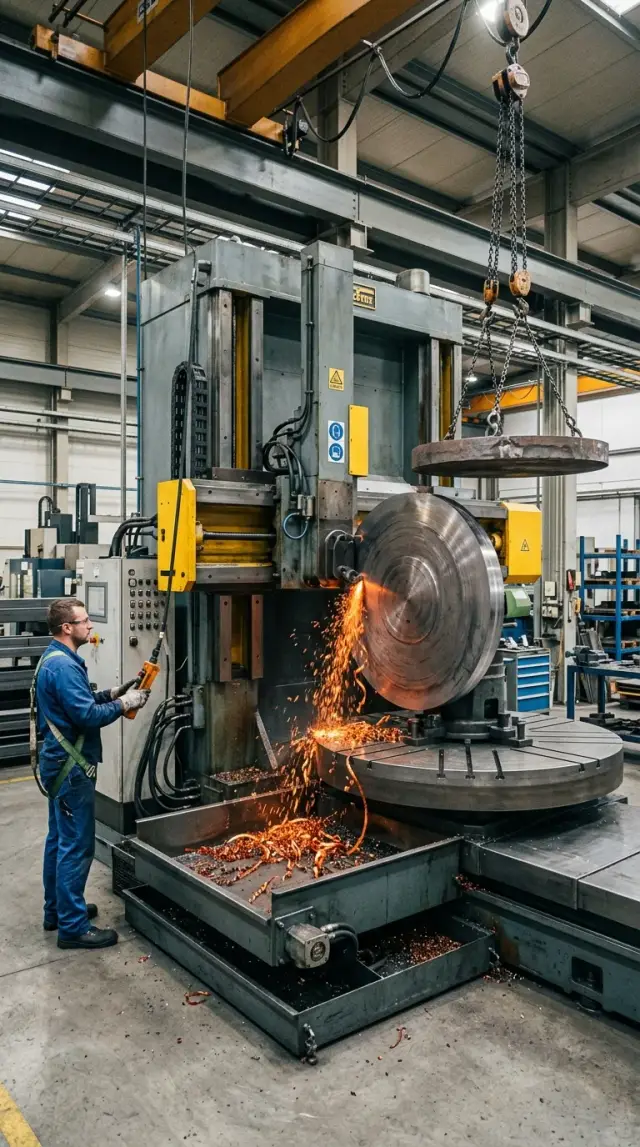
Why machine layout affects the job
The layout changes more than just component placement. It immediately affects how the operator loads the blank, how the part carries loads and where chips go after cutting. That’s why vertical and horizontal lathes behave differently even on similar tasks.
When a blank is placed from above, its weight helps the mounting. A heavy part simply rests on the table or faceplate. A ring, disc or housing is easier to seat without extra maneuvers. With side loading, the same blank must be fed more precisely into the chuck and held until clamping. On a drawing the difference looks small, but on the shop floor it often saves noticeable time on each setup.
Equal diameter does not mean equal behavior. Two blanks with a 500 mm diameter can require different approaches. A thin ring is easy to deform, while a massive hub already imposes significant load during mounting. One dimension doesn’t show how convenient a part is to work with or how it will behave during cutting.
So it’s better to assess shape and mass separately. Shape shows how to grasp, support and clamp the part. Mass shows what loads the machine components, fixtures and operator will get during setup. If you look only at diameter or only at weight, the choice often misses the real task.
In daily work this becomes clear quickly. Loading and unloading times change, the cutting area looks different, chips fall in different places, and the blank’s stability may differ from expectations. That’s why parts for vertical configuration aren’t chosen by a single criterion. First check if the blank stands under its own weight, whether it’s convenient to feed from above and whether its shape interferes with normal clamping.
For flanges, rings, discs and large housings a vertical layout is often more convenient. For long shafts it’s usually the opposite. Size matters, but shape and mass influence the job more than they seem at first.
Which parts are commonly mounted on a vertical lathe
Vertical setups are more often used for parts with a large diameter and relatively small height. If a blank looks more like a washer, bowl or short housing than a long shaft, it’s usually more convenient to mount it vertically.
Typical examples are familiar to most shops: rings, flanges, discs, heavy housings, covers and parts with a wide support area. These workpieces have a large face dimension and small axial length. For them a vertical lathe often provides a calmer mounting.
The reason is simple. The center of gravity works in the operator’s favor. The part rests downward on the table or faceplate instead of hanging to the side as on a horizontal spindle. That makes it easier to hold a heavy wide blank without extra strain on fixtures and people.
This is particularly visible on large rings and flanges. On a horizontal setup such parts often require more careful centering and support because the mass shifts sideways. If the diameter is large but thickness is small, any mounting inaccuracy is felt immediately.
The picture is similar for housings. If a housing is wide, heavy and hollow, a vertical layout is often more convenient. The blank stands stably and the operator finds it easier to control its position during clamping.
Formally, many of these parts can be machined on a horizontal lathe. In practice the setup is often more temperamental, especially for heavy parts. So the question usually isn’t “can it be mounted?”. A more useful question is: on which layout does the part mount faster, calmer and with fewer adjustments.
If a blank is long and relatively narrow, a horizontal layout is usually more logical. It benefits from lengthwise support, axial work and predictable clamping.
Where loading is easier
A vertical layout is convenient when the part is heavy, wide and not too long. A crane lowers it from above onto the table or into the chuck. The operator doesn’t have to hold the part sideways and catch the seating while it’s suspended.
This is especially noticeable with large washers, flanges, rings and housing blanks. These parts’ center of gravity is usually closer to the axis, so they simply settle downward under their own weight. In that case the machine helps instead of creating extra trouble.
With a long shaft it’s different. It’s more convenient to feed it horizontally, using supports and a clear mounting axis. Trying to put such a shaft vertically makes it harder for the operator to hold position, and the crane has more difficulty delivering a long blank without oscillation.
A simple example shows the difference. A heavy washer is often mounted on a vertical lathe with a few simple motions: bring the crane, lower from above, align, clamp. You don’t get that with a long shaft. It takes longer to position, watch for overhang and avoid axial displacement.
With side loading the risk of tilting is higher. The part hangs or rests less stably, and even a small feeding error causes tilt when seating in the chuck or arbor. The greater the mass, the worse this becomes. Time is lost, fixture loads increase, and the operator must make extra corrections.
The vertical layout has a clear advantage here: the feed trajectory is simpler, the seating location is easier to see and the blank doesn’t need to be supported sideways for long. For “heavy disc” type parts this is often the decisive argument. For “long shaft” type parts it isn’t.
How the vertical layout helps with chips
A vertical lathe has a simple benefit: chips fall down under their own weight. They don’t have to swirl around the part or accumulate near the chuck. This is most noticeable in roughing when chips are produced in large quantities and in a dense stream.
On a horizontal lathe some chips often remain in the work area longer. They catch on the jaws, lie on the carriage or pack up near the tool. A vertical layout is usually cleaner because gravity moves the chips away.
Because of this the operator has fewer short stops for cleaning. There’s less need to open the work area, untangle chip nests and remove chips from under the part. If the blank is heavy and large in diameter, these pauses are especially annoying: time is spent not cutting but cleaning.
There’s one more plus. With less chip buildup near the chuck and tool the operator sees the cutting zone better. It’s easier to notice unstable feeds, vibration marks or poor chip flow. That helps catch problems earlier rather than after the cycle ends.
A good example is a large ring or flange. On a vertical lathe chips more often fall into a tray instead of winding around the part. The area around the chuck stays clearer and is easier to inspect.
But don’t treat the vertical layout as a complete solution. Long, stringy chips still need control. That often happens when machining stainless steels, some alloyed steels and ductile alloys. If the cutting mode is poorly chosen, even a vertical lathe won’t prevent a chip “beard.” It just improves chip removal in normal work. Everything else still depends on tooling, feeds, speeds and coolant.
What you can see in the cutting zone in real work
On a vertical lathe the operator often looks down onto the part. That changes not only posture at the machine but also process control. It’s easier to see how the tool approaches the face, where contact occurs and how chips behave on the top surface.
For large discs, rings and flanges that view is especially useful. The top of the part is exposed, so the operator notices runout, tool marks or excess stock more quickly. On a horizontal layout part of the cutting area often falls toward the chuck or below the sight line, making monitoring less convenient.
The difference is immediately visible with facing. When trimming the face it’s easier to judge where the tool has already passed and where material remains. If the part is wide this advantage becomes even clearer.
Internal boring is a bit more complex. The entrance to the hole on a vertical setup is often more visible and the tool approach is easier to control. But if the hole is deep or coolant is applied heavily, visibility drops quickly. Then not only layout but also good lighting, a clean viewing window and a clear trial cut are important.
Measurements are also often calmer. It’s easier to reach the top of the part and check diameter, face or groove depth without awkward postures. One operation’s difference may be small, but over a shift it becomes noticeable.
A new operator usually learns faster on this layout. When the turret and contact zone are in a clearer field of view there are fewer small errors during approach, trial cuts and first-piece checks.
Of course, perfect visibility doesn’t exist. If a machine is enclosed and coolant sprays heavily, the viewing window gets dirty fast. So good visibility depends not only on vertical vs horizontal, but also on lighting, a clean screen and overall workplace organization.
How to decide without excess theory
If you must choose between vertical and horizontal layout, don’t start with machine power. The mistake usually happens earlier: the part itself already indicates which option will reduce unnecessary motions.
First analyze geometry. A disc, flange, ring or short large-diameter housing is often more convenient to mount vertically. A long shaft or thin axle usually behaves better on a horizontal layout.
Then compare three things: diameter, height and mass of the blank. If a part is heavy and wide it’s easier to lower it from above onto the table than to feed it precisely into the chuck from the side. At this step it often becomes clear when a vertical lathe is needed.
Next look at loading. Who feeds the part — a crane, lifter or the operator by hand? If the shop regularly handles heavy construction parts, large flanges or housings, vertical loading is frequently calmer and less likely to damage fixtures.
After that evaluate chips. If machining steel, cast iron or deep cuts produces chips that tend to gather around the part, a vertical layout is usually cleaner in everyday work.
Only then does it make sense to check tool access and required accuracy. A machine can meet size requirements, but a tool may have trouble reaching a groove, face or bore. It’s better to picture the real operation instead of looking only at the specs on a data sheet.
There’s a quick test. Take one typical part from your shop and answer four questions: how it’s mounted, where the mass hangs, where the chips fall and whether the operator sees the cutting area. If vertical handling simplifies these points, the answer is close.
A simple shop example
A lot of large flanges for a pump assembly arrives. Diameter about 700 mm, the part is wide but not tall. The weight requires an overhead crane.
On the warehouse the flange lies flat on a pallet. For a vertical machine this is already convenient. The crane lifts the part, brings it to the machine and lowers it directly onto the table or into the chuck.
The operator doesn’t have to catch the part in the air or hold it sideways. The blank seats into a predictable position under its own weight. That’s calmer for both the person and the fixtures.
With a horizontal layout the procedure is usually longer. The flange must be brought to spindle axis, rotated, carefully aligned with the jaws and monitored so the heavy part doesn’t drop during clamping. That’s where extra minutes are often lost.
The time difference is noticeable even for one setup. On a vertical lathe an operator may take about 4–5 minutes for lift, seating and clamping. On a horizontal machine it often takes 8–10 minutes because more small adjustments are needed.
After machining another difference appears. Chips on a vertical layout usually fall down rather than staying near the chuck and cutting area. The workplace is tidied faster and with less effort.
For a large flange this is especially clear. The operator can more easily check the groove, face and internal boring because visibility is cleaner. There’s less need to interrupt the cycle for intermediate cleaning before measurement.
That’s why vertical lathes are often chosen for heavy flanges, rings and large discs. They don’t speed cutting by themselves. They simply remove some extra actions: fewer rotations of the part, simpler loading, faster cleanup after the cycle.
Common selection mistakes
The most common error is looking at a single spec on the machine sheet. Diameter capability alone rarely decides if you don’t consider the part’s mass, height, shape and how the operator will mount and remove it.
Many pick a vertical lathe by simple logic: “the part is large, so we need vertical.” That’s too crude. A short heavy housing, flange or ring is indeed easier to mount vertically. But a long blank of the same diameter behaves differently. For a shaft or long tube stability along the length, support and a familiar clamping scheme matter more.
Another mistake is confusing a heavy short part with a long one. On paper both might fit the size specs. On the shop floor the difference is huge. A 600 kg disc can be lowered from above and supported on the table. A long part needs to be held, aligned and supported along its axis — a different workflow.
People often forget about loading. If the shop only has manual handling or a small crane, an attractive machining layout quickly turns into extra pauses and operator risk. Sometimes the choice between vertical and horizontal is decided not by cutting but by how the part gets to the chuck and how it’s removed after the cycle.
Chip handling is another frequent oversight. On a single part this may not matter much. On a series it’s obvious. If the material produces a lot of heavy chips and cycles are long, poor chip removal impairs visibility, slows maintenance and adds cleaning stops.
One more pitfall is buying an overly complex layout without a clear reason. If the parts are simple and volume moderate, there’s no point in overpaying for a capability you won’t use. A complex machine requires a clear understanding of tasks.
What to do next
Make the decision based on your parts, not a catalogue. If you’re choosing whether to buy a vertical lathe, gather facts in a single table about the items that repeat most often.
Usually you list not only diameter and height but also weight, material, batch size, required accuracy and real setup time. At this stage it often becomes apparent that heavy, large blanks are easier to place from above than to feed into a chuck from the side.
Then honestly review current loading: who places the blank, how it’s fed, whether a crane is needed and how often the operator repositions it before clamping. If a part needs long alignment, that’s a direct sign the layout hinders work.
It helps to measure where time is lost between cycles: cleaning the machining area, removing chips, bringing the part and reclamping. Differences between vertical and horizontal layouts often show up in these pauses rather than in catalogue numbers.
A quick checklist usually suffices:
- part dimensions;
- weight and material;
- loading method;
- time to align and clamp;
- accessibility of the cutting area.
If you regularly process flanges, rings, short housings and other heavy large-diameter parts, discuss these data in detail. At EAST CNC such conversations are done not by general catalogues but by specific blanks and shop conditions. The company supplies CNC lathes for metalworking, helps with selection, commissioning and service, so you can evaluate the whole process, not just the machine specs.
The more precisely you describe part shape, weight and actual loading scheme, the easier it is to understand when a vertical machine is needed and when a horizontal layout is wiser. That’s the stage where the right decision is made.
FAQ
Which parts are best suited for a vertical lathe?
Usually chosen for flanges, rings, discs, covers and short housings with a large diameter. These blanks stand stably under their own weight, so they’re easier to lower from above, align and clamp without many adjustments.
When is a horizontal lathe a better choice?
A horizontal layout is usually better for long shafts, axles and tubes. Such parts are easier to feed along their axis, supported over their length and clamped in the familiar orientation.
Why are heavy flanges and rings easier to mount vertically?
Because the part’s weight helps during mounting. A flange or ring rests down on the table or chuck, so the operator doesn’t have to hold the blank sideways and try to seat it while it’s suspended.
Where does loading usually go faster?
Loading tends to be faster on a vertical machine for heavy, wide parts. A crane lowers the blank from above and the operator makes fewer small movements to seat and clamp it.
Is chip evacuation easier on a vertical lathe?
Yes, in many operations. Chips tend to fall down into a tray instead of collecting around the chuck and tool. However, sticky or long chips can still form with certain steels and alloys or if cutting parameters are poor, so tool choice and feeds still need attention.
Is the cutting area easier to see on a vertical lathe?
For large discs, rings and flanges the view is often better because the operator looks down onto the part. It’s easier to see the face, the tool mark and chip behavior. If cutting fluid is heavy and the viewing window gets dirty, this advantage can quickly diminish.
Is a vertical lathe suitable for long shafts?
It’s possible, but usually not ideal. A long part is harder to feed without swinging, harder to keep on axis and requires lengthwise support. Shops normally prefer a horizontal layout for such work.
What’s more important when choosing: diameter, shape or weight?
Look at shape, weight, height and loading method together. Diameter alone rarely decides: two parts with the same diameter can behave very differently during setup and cutting.
What mistakes are often made choosing a layout?
Common mistakes are focusing only on a machine’s diameter rating and ignoring real setup. Another is picking a vertical layout just because a part is large, despite it being long and unsuitable for that configuration. The result is lost time on positioning, clamping and cleaning instead of cutting.
How to quickly determine if we need a vertical lathe?
Take a typical part and check four things: how you feed it, where its mass is located, where the chips fall, and what the operator can see in the cutting area. If vertical handling makes these steps easier, consider a vertical machine first.