
VDI or BMT Turret: What Changes in Real Tooling
We compare VDI and BMT turrets by rigidity, changeover time, and holder choices for turning, drilling, and boring in everyday shop work.
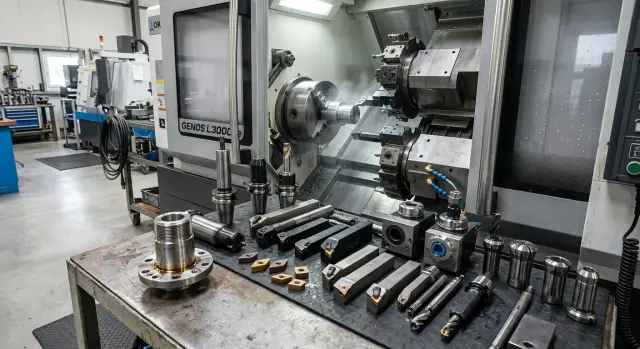
Where the difference shows up in real work
People rarely understand the difference between VDI and BMT from a table. Usually, they notice it at the machine, when the same cutting tool cuts calmly on one machine but starts to chatter on another, leaves a fine ripple, and forces you to lower the feed. The cause is often not the insert, but how the holder sits in the turret, how it carries load, and how accurately it returns after being removed.
If you discuss VDI and BMT away from the shop floor, the conversation quickly turns theoretical. In practice, it is simpler. The operator listens to the cutting sound, looks at the surface finish, checks edge life, and watches how much time it takes to get back to size after a tool change.
The difference is most obvious where the tool already has a hard job: deep boring, parting, grooving near a shoulder, working with long overhang, and cutting under variable load. Any extra movement in the seat quickly turns into vibration. First the tool starts to sing, then a wave or dull trace appears on the part, the insert edge chips earlier than usual, and the setter takes longer to bring the size back after repositioning the holder.
On simple external turning, the difference may be modest. But as soon as the part requires accurate repeatability, quick changeovers, and reliable work close to the limit, seating and clamping stop being a minor detail.
A catalog almost never shows this part of the picture. It lists turret size, number of stations, and compatible holders. But it does not know what parts you machine every day, how often you remove the tooling, what overhang you need for internal work, or who is actually setting up the machine on the shift. It also does not account for a simple fact: a cheap holder can ruin the impression made by a good system.
In a shop making parts for construction equipment, this shows up especially fast. A short shaft made from plain steel goes through both systems without surprises. But if the same machine then has to bore a deep hole and quickly move on to the next station, the difference starts affecting the whole shift rhythm: one setup holds the cut more calmly, while the other makes you play it safe.
At the same time, the system alone does not solve everything. If you use short rigid tools, simple passes, wide tolerances, and infrequent changeovers, you may not feel a noticeable difference at all. In that case, the machine condition, chuck, part overhang, and the quality of the holders themselves matter more.
How seating and clamping differ
When VDI and BMT are compared, the difference starts with the point of support. In VDI, the holder is inserted into the turret with a cylindrical shank and clamped by an internal mechanism. In BMT, the holder does not go inside; instead, it is pulled against the turret face with bolts on a flat base, with precise location on the mating surfaces.
Because of that, load flows differently through the two systems. In VDI, the force passes through the shank, the clamping zone, and the holder body. In BMT, the load goes straight into the turret face and bolted joint. On paper, both options work. On the shop floor, the difference is easiest to see in heavy turning, boring, and driven-tool operations.
VDI is usually seen as more convenient to install. Insert the holder, set the position, clamp it, and you are ready to work. That is useful when tooling is changed often. But this layout has a longer lever arm between the turret body and the cutting edge. If the holder itself is tall, or if an adapter or long arbor is added, the overhang grows fairly quickly.
With BMT, the holder sits closer to the turret body. In general, there are fewer intermediate elements, and the base is wider and shorter from a force standpoint. So extra overhang appears less often. When it does appear, it is usually because of the tooling itself: a long boring bar, a drill chuck, or an angled head.
Where this is more noticeable
On ordinary external turning, the difference is sometimes invisible as long as cutting conditions are moderate. But with driven tooling, the seating and clamping begin to matter right away. In VDI, the driven unit often has a longer chain: seat, block body, transmission, tool. Every extra millimeter adds load to the assembly and can reduce hole accuracy or surface finish.
In BMT, the driven unit usually sits tighter against the turret. That helps it hold torque better and handle side loads more calmly during drilling, slot milling, and offset-hole machining. That is why, on machines for serial metalworking and more complex parts, BMT is often chosen where the priority is rigid tooling performance rather than simply easy holder changes.
If the part is short and the operations are simple, VDI handles the job comfortably. If the work involves a lot of driven tooling, long arbors, and tight cutting conditions, the clamping method starts affecting not convenience, but the result itself.
Rigidity in everyday operations
On a typical part, the VDI vs. BMT debate rarely decides everything on its own. There is a difference, but it is not visible on every pass. If you machine ordinary shafts, bushings, and flanges at moderate cutting conditions, the overall chain matters more: machine bed, chuck, tool overhang, and the holder itself.
During rough turning with a heavy stock removal, BMT often behaves more calmly. The rigid face-mounted seating and clamping create less micro-shift under load. You can hear it in the cutting sound, see it in a cleaner trace on the surface, and feel it in how the tool holds size on a heavy pass. VDI also works well, but at the edge of the range it tends to show vibration sooner, especially if the tool sits with extra overhang.
The difference is usually felt even faster in parting and grooving. The tool is narrow and sensitive by nature, and long overhang only makes things harder. If the part is thin or the material is gummy, any weakness quickly shows up as squealing, deflection, and insert chipping. BMT often gives more stability in such jobs. But if the holder is weak, poorly clamped, or too long, no turret can fix it.
With driven tooling, the gap between the systems becomes even clearer. When drilling, milling a keyway, or machining holes off-center, the load acts not only along the axis but also to the side. In this mode, turret rigidity affects runout, repeatability, and tool life. With BMT, these operations usually allow a higher feed and are less likely to fight the geometry. On VDI, these operations are also possible, but the cutting-condition reserve is often smaller.
Boring small diameters is a different story. There, the first thing to give way is not the turret, but the thin boring bar. If the diameter is small and the depth is large, the tool starts to spring before the difference between VDI and BMT becomes obvious. In that operation, it is more useful to shorten the overhang first, choose a stiffer bar, and check the clamping.
Turret rigidity matters, but it should not be overrated on its own. A poor holder ruins the job faster than a good system rescues a weak setup. The limit is often not the turret itself, but the combination of holder, overhang, and cutting conditions.
What changes during changeover
During changeover, the difference between VDI and BMT is felt not in the catalog, but in the extra minutes spent by the machine. The setter counts not only rigidity, but also the number of actions: remove the old tooling, install the new one, tighten the clamp, check the overhang, set coolant, and correct the tool offset.
With VDI, the holder is usually changed faster, especially on small and medium batches. Pull one holder out, insert another, and there are fewer steps before the test cut. If the cabinet already contains assembled VDI holders, the changeover time drops noticeably.
With BMT, the block itself often takes more time to install. It has to be seated precisely, tightened, and, for driven tools, the alignment and coolant supply also need to be checked. On paper the difference looks small, but in real work it can easily become an extra 8-15 minutes if the machine changes parts several times a day.
Most time is usually spent not on removing the old block, but on bringing the tool back to its previous position. If the setter adjusted the holder once, labeled it, and recorded the overhang, the next installation goes much more smoothly. That is why the VDI vs. BMT debate often comes down to a simple question: does the shop keep ready-made holders, or does it build the tool from scratch every time?
When tooling is stored fully assembled and the offset table is maintained properly, the pause between batches shrinks more than it would from the clamping system difference alone. A set of pre-adjusted blocks for turning, grooving, parting, and drilling can save not just minutes, but sometimes half an hour per shift.
A good example is a shop that machines a short shaft in the morning and then switches in the afternoon to a bushing with a groove and drilling. With a ready-made VDI set, manual changeover is usually faster. With BMT, the difference can also be small if each operation already has its own assembled block and the machine works for a long time on one part family.
If the batch is short and changeover happens almost every day, look not at the turret spec sheet, but at the time between the last good part and the first good part after tooling change. That interval honestly shows which system is more convenient for your shop.
How to choose the system for your parts
It is better to choose between VDI and BMT based on your own parts over a normal month, not on a catalog. Don’t use the nicest batch; use the real mix of work: what you machine most often, which turning tools, drills, and driven heads you use, and how many times per shift you change the tooling.
It helps to list 10-15 parts the shop makes regularly and note the operations next to them: external turning, grooving, parting, drilling, boring, threading, and driven-tool milling. After that, the picture becomes much clearer. Sometimes the shop does not need a “universal” option, but a system that calmly handles two or three heavy operations every day.
If you do a lot of rigid turning, deep boring, large drills, and frequent driven-tool work, BMT is more often considered. If you make many parts, batches are short, and the VDI holders are already familiar to the setters, VDI may be more practical at the start. The difference shows not on a poster, but in how the machine behaves on a difficult pass and how long tooling replacement takes.
There is another point people often underestimate: tool overhang. On paper everything may add up, but if the boring bar has to extend beyond normal in real work, rigidity drops in any system. So you should compare not only the seat, but also the actual setup for each operation.
People also matter. If there is one setter, experienced and long familiar with a certain system, switching to another setup brings not only benefits, but also a pause for adaptation. If the shop has several shifts and needs a clear, repeatable assembly routine, that should also be considered in advance.
A simple example: a shop machines shafts and flanges in small batches, and once a week makes a part with side drilling. In that case, the decision is based not only on the machine price, but also on the initial tooling package plus the time spent on daily changeovers. That is usually where the choice becomes clear.
One-part example
Take a common shaft: rough turning of the outer diameter, one groove for a retaining ring, and a cross hole. On paper, the task is simple. In the shop, the difference between VDI and BMT is not seen in one operation, but across the whole sequence.
If the batch is small, the operator is more likely to think not about the cutting limit, but about how long it takes to change the tooling and set it up again. If the batch is long, the picture changes. Then turret rigidity is felt more strongly, especially on roughing passes and when using driven tooling.
For VDI, a setup for this part usually includes an external roughing tool, a grooving holder, a driven radial holder with a drill for the cross hole, and, if needed, a spare holder for finishing or facing. In real work, this is convenient. The holders can be prepared in advance, removed, swapped, and returned to position. When one shaft runs today and another part runs tomorrow, that arrangement often saves time on CNC lathe changeover.
With BMT, the set is similar in composition, but it feels different in operation: a block for external turning, a block for grooving, a driven block for cross drilling, and, if needed, a separate block for the finishing tool. This layout usually gives more composed performance during heavy cutting. The assembly moves less when a large stock allowance is removed or when a long driven holder is installed. On gummy steel, that shows up in the sound, surface trace, and size stability.
On one part, the difference may be small. On a hundred identical shafts, it adds up. That is why VDI more often wins where the product mix is wide and the machine is retooled frequently, while BMT more often pulls ahead where extra rigidity is needed. But that does not mean one option is always better. If the batch is 20 shafts and cutting conditions are moderate, VDI may provide a more convenient and less expensive process. If the batch is 500 pieces, stock allowance is large, and the hole is drilled close to the part shoulder, BMT usually gives calmer cutting and fewer surprises.
Common mistakes when choosing holders
A miss often starts before the machine is even bought. People look at a nice diagram in the catalog and decide it will fit everyone. But if you machine short bushings at calm cutting conditions, you do not need the same tooling package as a shop doing heavy roughing, deep boring, and driven-tool work. When the system is chosen by advertising, problems appear in the first week of use.
Another common mistake is buying rare holders “just in case.” On a shelf, such a set looks impressive, but in the shift you almost always use a few standard positions: external turning, grooving, parting, drilling, boring. Rare blocks cost more, are harder to replace quickly, and the money ends up tied up in tooling that almost never goes into production.
Many people underestimate overhang and build a long chain of adapter, block, spacer, and holder. On a drawing, everything looks fine. On the machine, such an assembly handles load worse, vibrates sooner, and eats away at accuracy, especially on steel and during boring.
Driven blocks are their own story. They are often chosen by diameter or price, and then it turns out that the seating, rotation direction, coolant supply, overall size, or required tool height does not match. Externally the block fits, but in real work it interferes with nearby stations or does not allow the required cutting conditions.
There is also a more down-to-earth mistake: comparing only the machine price. But a machine without a set of holders, driven blocks, arbors, sleeves, and spare stations is rarely ready for proper work right after startup. Sometimes the machine is cheaper at the beginning, but the full tooling package makes it noticeably more expensive.
A short check before deciding
The choice usually breaks not on the catalog, but on the shop rhythm. The same machine can seem convenient or inconvenient simply because your part flow, tool change frequency, and downtime cost are different.
Before deciding, it is useful to answer a few direct questions:
- do you run heavy cutting almost every day;
- how many times per shift does the operator really change the tool or move the tooling;
- do part families repeat, where the same setup lives for weeks;
- who is responsible for order in the tooling storage;
- where does downtime hurt most — on an expensive machine, on an urgent order, or on a long run.
If heavy machining happens almost every day and the parts are similar, a more rigid and stable setup usually wins. In that case, it matters more that the tool holds the load without surprises than that it is slightly easier to swap.
If you run small batches and CNC lathe changeover happens several times per shift, pay attention to ease of tooling work and shop discipline. Fast changeover is useful only when holders are in their place, sizes are recorded, and the operator does not spend 15 minutes searching for the right station.
The tooling store often decides more than the turret type. When VDI holders or BMT holders have already accumulated in production, the cost of a mistake rises. Buying a new system is not only about the turret, but also about spare stations, driven tools, and backups for standard operations.
If the shop machines similar shafts and bushings all week, rare changeovers and constant load usually justify choosing rigidity. If the shop runs six different orders of 20-30 pieces in a day, changeover convenience may bring more value than rigidity reserve that you will not fully use anyway.
What to do next
It is better to make the decision based on your parts and shift operations, not on a picture in a catalog. First, build a simple working picture of the shop: what you machine every day, what sizes you hold, how often you change tools, and where you most often lose time.
Then compare both options on your own operations. Look not only at the machine spec, but also at the practical things: how quickly the operator can install the holder, how easily the tool can be set, whether the tooling will interfere with adjacent stations, and whether the needed sizes are available. One trial run on a real part usually gives more value than a long discussion of specs.
If possible, ask for the full tooling package for the first batch to be calculated right away. That way you will see not only the machine price, but the complete start-up set. Sometimes the turret system itself looks attractive, and then the budget rises noticeably because of holders, driven blocks, and spare stations for future jobs.
It is also worth discussing commissioning and service before you buy. For the shop, this is not a minor detail. You need to know who will start the machine, who will help with the first tooling setup, how quickly you can get support if a setup problem appears, and which consumables are worth keeping in reserve.
If you need help selecting a machine and tooling for real tasks, you can discuss it with EAST CNC engineers. East CNC - ТОО Метиз is the official representative of Taizhou Eastern CNC Technology Co., Ltd. in Kazakhstan, and works through the full cycle: from consultation and selection to delivery, commissioning, and service support. For this kind of decision, that is more useful than a general scheme, because the choice is based on your parts, cutting conditions, and shop load.
FAQ
What is the practical difference between VDI and BMT?
In the shop, the difference usually comes down to two things: rigidity during cutting and the time needed to change tooling. BMT more often holds up under load, while VDI is usually easier and faster when holders are swapped often.
When is VDI good enough without noticeable drawbacks?
If you machine simple shafts, bushings, and flanges at moderate cutting conditions, VDI often does the job without extra cost. It is especially convenient where batches are short and the setter often changes pre-assembled holders.
When does BMT give a clear advantage?
BMT tends to show its advantage in heavy turning, grooving, parting, deep boring, and work with driven tools. In these operations it usually vibrates less and holds size more steadily.
Which is faster to change over: VDI or BMT?
Usually VDI is quicker, especially if the cabinet already has assembled and labeled holders ready to go. BMT can also be changed without long delays, but installing and checking the block often takes more time.
Why does the machine start vibrating after a holder change?
Most often the cause is not the insert itself, but the seat, overhang, or a weak holder. If the holder is not seated securely, even a small extra millimeter quickly turns cutting into noise, surface waviness, and size drift.
What affects the result more: the turret type or the holder itself?
On ordinary operations, a poor holder hurts results faster than the clamping system itself. If the tooling is weak, too long, or built through extra adapters, neither VDI nor BMT will save the cut.
How do I choose the system for my parts?
Look at your regular month of work, not the catalog. If you have a lot of heavy cuts and driven tooling, BMT is often the better fit. If you make many parts, batches are short, and tooling changes happen all the time, VDI is often more convenient.
Which system is more convenient for driven tools?
BMT usually performs better here because the block sits closer to the turret and handles side load more calmly. For drilling, slotting, and offset holes, that often means cleaner geometry and more feed reserve.
Is it worth changing systems if the shop already has its own tooling inventory?
If you already have holders, blocks, and spare positions built around one system, switching abruptly rarely looks profitable. First count not only the machine, but also the full tooling package, the time to get used to it, and the cost of downtime during the transition.
What should I check before buying a machine with VDI or BMT?
Before buying, take your real parts and run through the operations: turning, grooving, parting, drilling, and boring. Then calculate the full start-up tooling package and see how many minutes pass from the last good part to the first good part after changeover.