
Unloading a Machine Tool: Crane, Forklift, or Rigging Crew
When unloading a machine, choosing between a crane, forklift or rigging crew matters. We cover weight, access, risks and common mistakes.
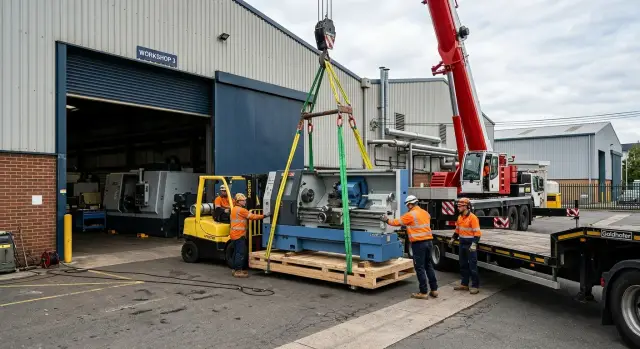
Why unloadings fail on site
Unloading usually breaks down not because the vehicle is late, but because of poor preparation. Many people look only at the machine’s weight and think that’s enough. In reality, weight is only part of the problem.
Two machines of 4 tonnes each can behave very differently during a lift. Size, height, length, packaging, lifting points and the way the load sits in the truck all matter. A compact machine is easier to remove than a long, narrow one that tends to swing.
A separate issue is the center of gravity. If it’s shifted upward or to one side, the load will quickly tip. A forklift loses stability, and a crane may no longer be able to operate in a safe configuration. The crew starts changing slinging on the spot and delay grows by the minute.
Often nobody checks the route to the installation point in advance. On paper the machine fits through the gate, but in reality the crate, protruding parts, the turning angle or a low lintel get in the way. Sometimes it’s worse: the load is taken off the truck but then simply won’t fit into the workshop.
The floor is also underestimated. It may safely bear the machine after mounting, but not withstand loads during movement. A heavy forklift, rollers or a pallet jack create a very different load pattern. If the concrete is weak or has voids, the risk jumps.
In practice the problems are very mundane: the crane needs more outrigger space than available, the forklift doesn’t clear the height, the floor cracks under the wheels, or the slinging plan isn’t at hand. Each small issue alone doesn’t look critical, but together they derail the unloading.
This happens especially often with CNC lathes. They are heavy, sensitive to tilting and don’t tolerate abrupt movements. So an unloading is rarely ruined by one big mistake — usually it’s a chain of small oversights that nobody checked beforehand.
What information to collect before the vehicle arrives
Unloading problems usually start with inaccurate data, not equipment. If the driver is already at the site and you’re just then asking about weight, crate height and gate width, a mistake is almost inevitable.
You need precise parameters from the certificate, packing list and installation drawing, not general figures. Gather them in one file or print them on a single sheet so the driver, foreman and riggers can all refer to them instantly.
Before the vehicle arrives, check the machine’s net weight and the weight with transport packaging, the length, width and height of both equipment and packaging, lifting points and fork support areas, gate and internal passage dimensions, and the exact installation spot in the workshop.
People constantly get weight wrong. The certificate often lists the base configuration, while the delivered machine includes a chuck, chip conveyor, coolant tank and protective crating. That difference matters — for a crane or a forklift it becomes part of the calculated load.
The story is the same for overall dimensions. The machine itself may pass through the gate while the crate does not. Another common mistake is assuming you can pivot inside the workshop. A 3-meter-wide opening is useless if a narrow corridor follows and the long crate must be turned almost in place.
Find lifting points only in the manufacturer’s documentation. Never hang the machine "by eye", on a cover or a part that just looks strong. For CNC lathes this is especially dangerous: outer panels keep shape but aren’t rated to support the machine weight.
Also know the installation place—not in vague terms, but exactly. Mark the final point on the floor, leave clearance for a pallet jack or forklift, inspect the floor and free space around it. If the machine will be set on foundation pads, prepare them before the vehicle arrives.
Suppliers like EAST CNC usually ask for this data in advance. It’s not bureaucracy — one correct gate measurement or a proper slinging diagram often saves a full day and prevents repairs before the first startup.
When to choose a crane
A crane is chosen when the machine must be lifted off a lowbed and placed near the installation point. For heavy equipment this is often the shortest solution: fewer intermediate moves and fewer turns in tight areas. If the unloading takes place in a yard with poor access, a crane is often safer than a forklift.
A crane is particularly useful when the transport cannot be positioned right at the gate. This happens when the driveway is narrow, other equipment is nearby, there’s a high curb, ramp or drainage channel. A crane can move the load over obstacles in a single lift rather than drag it across uneven ground.
A typical example: the machine arrives on a lowbed, there are 8–10 meters to the gate with a curb and soft ground after rain. A forklift may lose stability or simply not make the turning radius. A crane solves the problem—if the site is prepared.
Before ordering a crane you need more than the machine weight from the certificate. Provide load dimensions, lifting points, trailer height and the distance from the parked vehicle to the installation point. Check whether there’s space for outriggers, whether the boom reaches the required radius, if there are overhead cables or canopies and whether the ground will bear the outrigger loads.
The most common mistake is to look only at the crane’s rated capacity. Lifting capacity depends on boom extension, machine position and site conditions. On paper there may be margin, but on site the crane often cannot safely lift the machine at the required outreach.
When a forklift is appropriate
A forklift is convenient when you need to take the machine off the truck and move it a short distance to the installation point. This works if the route is straightforward: no holes, steep slopes or tight turns. For many workshops it’s the fastest unloading method, but only when the site is properly prepared.
The main condition is a level, hard floor. If the path has broken asphalt, drainage grates, curbs, thresholds or soft ground, the forklift will start to sway the load. That’s a bad scenario for the machine: even a small jolt can shift the center of gravity or damage the base.
Do not choose a forklift with nominal capacity that matches the machine weight exactly. You need buffer. Otherwise the vehicle may lift the load on paper but lose stability in a turn or on uneven ground. Many people look only at the nameplate number and ignore load center, packaging and attached accessories.
Fork length also matters. If the forks are too short, the machine won’t be supported across its base and will tip forward. If lift height is insufficient, you can’t safely remove the machine from the trailer or set it down precisely. Before the equipment arrives, compare the machine weight including packaging, fork support length, trailer bed height and passage widths.
A forklift works well where the маршрут is nearly straight. If a heavy machine must be turned in a tight spot, risk increases sharply. The operator ends up maneuvering millimeter by millimeter and the load can easily be pushed off line. In such cases it’s often cheaper to call riggers than to repair a machine or the floor later.
A common scenario: a CNC lathe arrives on a trailer, there are 8 meters from the gate to the installation point, the floor is level, the opening is wide and the turn is gentle. A forklift usually manages this comfortably. The same machine moved through an old storage area with uneven floors and a narrow corridor would be a poor choice.
For equipment supplied by EAST CNC, a forklift often suits the short final leg inside a prepared workshop. But decide based on real site conditions, not habit.
When you need a rigging crew
Just because a crane or forklift can remove a machine from the transport doesn’t mean they can bring it to the installation point. A rigging crew is required when the load must be brought into the workshop, turned in a passage, guided through a tight gate and set down without jolts.
This is common for heavy CNC lathes. Outside there is room; inside there may be columns, cable trays, old machinery and uneven floors. In those conditions unloading becomes a precise, centimeter-by-centimeter operation.
When the machine can’t be delivered straight to its final spot—say it must be moved 15–20 meters through the shop, turned and aligned with other machines—riggers are usually called in. A forklift often cannot operate in such spaces.
Riggers use rollers, jacks and spreader beams. Jacks lift the machine safely, rollers let them move it smoothly across the floor, and a spreader beam keeps the load level and prevents overloading lifting points.
You typically need riggers in four situations: narrow passages and tight turns, limited headroom under gates or beams, precise installation on foundations or anchors, and handling sensitive equipment that cannot be tipped abruptly.
Another often-missed point: one person must give commands to the whole group. If the foreman, forklift driver and fitters all shout different instructions, errors start quickly. You need one responsible person who watches the route, monitors clearances and stops the operation if something goes wrong.
In practice a rigging crew reduces risk more than time. That is especially true during final placement, when the machine must be set exactly, without tilt or extra attempts.
How to choose the unloading method step by step
Unloading rarely depends only on which equipment is available today: crane or forklift. Errors usually begin earlier, when no one verified weight, measured the passage or split two different tasks: removing the machine from transport and moving it inside the shop. The same method that works well outdoors may be unsuitable indoors.
Follow a simple checklist.
-
Pull the documents for the machine and packaging. You need total weight, dimensions, lifting points and center-of-gravity data. If the center of gravity is shifted, a habitual lift can cause immediate tilt.
-
Measure the entire route, not just the gate area. Check passage widths, gate height, turning radii, floor condition, slope, thresholds and places where equipment cannot turn. For a heavy CNC lathe this is often more important than the lifting capacity of the truck.
-
Split the work into stages. Decide separately who will remove the machine from the transport and who will move it inside the shop. A crane is convenient for getting a machine off the truck but does not solve narrow internal passages. A forklift moves quickly on a firm surface but loses stability on poor flooring. Call riggers where the machine must be turned carefully and placed accurately.
-
Choose equipment according to real site conditions. If the ground under the vehicle is soft, asphalt settles or there is little outrigger space, a crane can cause more problems than it solves. If the shop floor is weak, do not bring a heavy forklift inside without a load-bearing calculation.
-
Align the schedule. Delivery, unloading, internal movement, installation and commissioning should proceed without long gaps. When the machine is off the truck but the place isn’t ready, the risk of damage rises immediately.
A short job map helps in practice: who commands the unloading, which equipment arrives, where it stands, which route the machine will take and when the installation team starts work. For complex equipment handled by EAST CNC this discipline is especially useful. The heavier the machine and the tighter the space, the less room there is for improvisation.
Where mistakes happen most often
Unloading rarely fails for one big reason. More often small unchecked details let it down. People often order a crane or forklift based solely on the nameplate weight. That calculation breaks on site.
The certificate weight almost never equals what’s actually in the truck. Transport crates, a chuck, hydraulic units, chippers, fasteners, tooling, spare parts and fixtures add weight. Sometimes the difference seems small, but when lifting from the truck bed and turning in a tight passage the lifting capacity margin disappears fast.
The floor causes no fewer problems. Many check gates and then forget about the concrete slab, old coverings, cable ducts, manholes and patched areas. A forklift can roll through empty, but under full load a wheel overload may occur. The equipment is on site and yet no one can safely deliver the machine to its final spot.
Inside the workshop people also skimp where they shouldn’t. They don’t lay protective boards over the floor, they don’t remove extra doors, and they don’t shield column corners or jambs. The result can damage not only the premises: you can scratch a housing, hit a control cabinet or damage a precision part during a turn.
The most nerve-racking error happens while moving the load. The team is there but lacks a common plan. One person waves at the crane operator, another pulls a trolley, a third asks to shift half a metre. When a load moves by voices instead of a plan, risk rises instantly.
Before work start, record five things: the real weight of each consignment, the route from the truck to the installation point, allowable floor loads, floor and opening protection along the route, and one person responsible for commands.
For a typical workshop that’s enough to avoid most failures. Walking the route a day before the vehicle arrives will reveal a threshold, a tight corner or a weak floor patch. Such inspection often helps more than hiring oversized equipment.
A short checklist for the day of unloading
Many problems don’t start on the road or at the machine. They start on site because a pallet was left in the way, a car is parked by the gate or floor protection wasn’t prepared. Such small oversights can stretch unloading into half a day.
First, clear the entire path from the vehicle to the installation point. Check gates, passages, turns, thresholds and the place where equipment will turn. Remove cars, trolleys, boxes, pallets and loose tools. Even one item in a narrow passage can spoil a safe forklift approach or the riggers’ operation.
Then prepare what is usually hunted for at the last minute: pads, slings, spreader beams and floor protection sheets. If the floor is screed, tiled or already occupied by other equipment, cover it with plywood or steel plates along the route and under outrigger points. That’s easier than repairing the surface afterward and arguing about damage.
Check personnel and timing. Everyone must know the exact delivery time and the sequence of actions: who meets the driver, who opens gates, who shows the installation spot, who signs off the external inspection. When people wait for each other and call around, downtime grows quickly.
Fresh photos of the site help. Photograph the entrance, the route, turns and the installation place. Add door sizes, opening height, passage widths and distances to columns or walls. For machines supplied by EAST CNC these photos and measurements help decide in advance whether a forklift is enough or whether you should prepare a crane and riggers.
A short pre-departure checklist:
- the route to the installation spot is clear and free;
- floor protection, slings and pads are prepared;
- all participants know delivery time and the responsible person;
- photos and dimensions have been sent to those organizing the unloading.
Usually that’s enough to keep the job calm and avoid unnecessary stops.
Example for a typical workshop
A CNC lathe arrives on a lowbed at a small workshop. From the outside everything looks simple: wide gates, a flat apron and enough room for a truck-mounted crane. The problem starts inside, immediately after the gate, where a narrow turn sits between a column and already-installed equipment.
In that situation unloading typically happens in two stages. First the crane lifts the machine off the trailer at the entrance and places it on a prepared pad near the gate. Then the rigging crew puts rollers under the machine, controls the center of gravity and gently brings it inside along the required path.
A forklift often seems the simplest option but hits two limits: mast height and turning radius. If the passage is narrow and the turn sharp, the forklift’s rear swing can hit the gate, a column or a control cabinet.
Even if the forklift’s capacity is sufficient, that doesn’t guarantee it will deliver the machine to the place. A heavy lathe’s mass is mostly low, but you still cannot yank or abruptly turn its cabinet. In tight areas forks may have to be raised higher than preferred, which increases risk.
The crane-plus-riggers combo has a clear advantage in such a workshop: each tool does its part. The crane handles the outdoor lift where it has reach and outrigger space. The riggers handle the indoor move where precision matters more than speed.
A typical sequence:
- the crane lifts the machine off the truck by the gate;
- the machine is set on sturdy pads;
- riggers bring it inside on rollers;
- on the turn they rotate the machine little by little, a few centimetres at a time;
- at the installation point they set and prepare it for mounting.
This scenario is often cheaper than a second attempt after a failed forklift entry. One wrong manoeuvre can eat half a day or leave a dent in the housing, cracked tiles or a shifted base geometry. For a workshop with a tight entrance it’s better to split the job between a crane and riggers than try to do everything with one vehicle.
What to do after unloading
When the machine is on the floor and slings are removed, the work isn’t finished. This is often when dents are found, components are missing from the kit or it becomes clear there isn’t room to reach connection points.
Inspect the machine immediately with the delivery team. Don’t postpone checks until evening or the next day. Later it becomes harder to determine whether damage occurred in transit or on site.
What to check right away
Start with a visual inspection. Look at housings, doors, the electrical cabinet, packaging, fastening points and supports. Search for scratches, impact marks, distortions, cracks in the cladding and any sign the machine was struck during unloading.
Next compare what’s on site with the packing list. The delivery should include not only the machine but everything required to avoid delaying startup: supplied tooling, cables, certificates, manuals, fasteners and any additional parts that were part of the delivery.
Take 6–10 photos from different angles. If there’s damage, take both an overview and close-ups. That documentation saves time later when resolving disputes.
A short acceptance checklist:
- external inspection of the housing and packaging;
- check completeness against the delivery note;
- photos of the installation place and machine condition;
- record the exact position for levelling;
- agree on the commissioning schedule and responsibility.
Do not move the machine around the shop several times “by eye.” Fix the exact place for levelling and connection right away. Check passages, distance to the wall, access to the control cabinet and room for maintenance, and the routes for electricity, air and coolant if required. One extra relocation easily eats half a day and increases risk to rails and housings.
Before the first start
A first run without a clear plan often ends in minor but costly mistakes. First the machine is levelled, then power and utilities are connected, transport locks are removed, fluid levels are checked and only then is a trial start performed.
If commissioning will be done by a contractor or supplier, agree the sequence in advance: who is responsible for levelling, who connects the machine, who checks the electrical system, who signs the acceptance report and when the operator may start. The earlier these points are agreed, the less rush on the day of startup.
If EAST CNC supplies the machine, discuss weight, dimensions, unloading method and exact installation point before shipment. The company supports selection, delivery, commissioning and service, so these details are easier to align beforehand than when the vehicle is already at the shop.
One simple order works almost always: accept the machine, position it precisely, and only then switch it on.
FAQ
What should I choose to unload a machine: crane, forklift or riggers?
First split the task into two parts: get the machine off the transport and bring it to the final location. Use a crane to lift from a trailer and move the load over a curb, drainage channel or soft ground; use a forklift for a short move on a flat, solid floor; call a rigging crew for narrow passages, turns and precise placement. In many shops a combination works best: the crane handles outdoor lifting and a rigging crew finishes the move inside.
Why can’t I rely only on the machine’s weight?
Weight alone doesn’t give the full picture. Unloading depends on dimensions, crate height, center of gravity, lifting points and how the machine sits in the truck. Two machines with the same weight can behave very differently: one may lift smoothly while the other starts to tilt right away.
When is it better to order a crane right away?
Order a crane if you need to lift a machine off a trailer and move it over an obstacle, or place it near the gate without long maneuvers. A crane is often the right choice when the transport cannot get close to the building. Before ordering, check boom reach, outrigger space, ground bearing capacity and any overhead obstructions. Otherwise the crane may arrive and be unable to lift the load safely.
When is a forklift actually convenient?
A forklift is suitable when the path is short, mostly straight and runs over a flat, solid surface. This is often the quickest option inside a prepared workshop if openings are wide and turns are gentle. Do not size a forklift exactly to the machine’s weight—allow a safety margin. Also consider fork length, lift height and how the load affects stability.
When can’t you do without a rigging crew?
Riggers are necessary when a machine has been removed from transport but then must be moved through the workshop carefully and without jolts. They are indispensable in narrow aisles, at tight turns, under low beams and when the machine must be set precisely onto supports or anchors. They work slower than a forklift but control every centimeter of movement.
What data should be prepared before unloading?
Before the machine arrives, gather weight in transport, equipment and crate dimensions, lifting points, recommended fork support locations, gate and passage sizes, and the exact installation spot. Mark the final position on the floor. If something is missing from the documents, clarify it with the supplier well before the arrival—don’t wait until the driver and lifting crew are on site.
What usually causes unloading to fail?
Unloading fails most often because of small oversights. People don’t check the real loaded weight, forget about the crate, skip measuring internal turns, ignore the floor condition and start changing slinging plans on the spot. Another common reason is conflicting commands: when several people give instructions at once, mistakes happen quickly.
Do I need to check the floor in advance?
Check not only whether the floor will bear the machine after installation but also whether it will withstand loads during movement. Wheels of a forklift, rollers or a pallet jack concentrate load differently and weak concrete can crack under transit even if it would later hold the installed machine. Walk the route, inspect covers, cable ducts, patched areas and any voids. If in doubt, change the route or strengthen the floor before unloading.
What should be done right before the machine arrives?
On the day of unloading, clear the entire path from truck to installation point. Remove pallets, trolleys, cars and any obstacles that could impede turning or passage. Prepare slings, pads and floor protection in advance and appoint a single person who issues commands to the whole team. This greatly reduces confusion and downtime.
What should I check immediately after unloading?
Inspect the machine from all sides immediately and photograph the housing, control cabinet, supports and packaging. Then reconcile what’s present with the packing list to avoid searching for missing items days later. Fix the exact mounting position for levelling and avoid moving the machine around the shop unnecessarily—each extra move increases the risk to guides and panels.