
Universal Fixture: When It's Time to Make a Custom Fixture
A universal fixture is useful at the start, but frequent changeovers, scrap, and downtime show when it is better to make a fixture for one part.
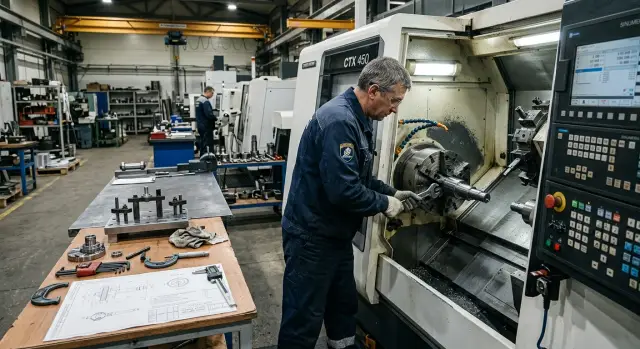
What is the problem with constant adjustments
At the beginning, a universal fixture is really convenient. It helps you start work quickly without a separate project for every part. It is a reasonable choice when the product mix changes, batches are small, and the shop is still gathering data and does not yet know which parts will repeat.
The problems start later. The part is already familiar, the route is clear, but before every batch the operator again moves the stops, changes spacers, checks the overhang, verifies the clamping, and makes trial passes. Formally, the fixture is the same. In practice, every machine changeover starts almost from scratch.
The most unpleasant loss here is made up of small things. Five minutes to tighten, seven minutes to check runout, another ten minutes to get the first good part — and half an hour disappears between batches. If there are several such changes per shift, the shop loses hours even though the machine is fine and the program has not changed.
There is a second problem too: quality. The more manual adjustments there are, the more the result depends on the person and their fatigue. Today the operator set the blank precisely, tomorrow they shifted the base slightly, the day after they over-tightened the clamp. That is how a drifting size, jaw marks, misalignment, extra measurements, and stops appear when the first part fails inspection.
On CNC lathes, this is especially noticeable in series production. The machine itself may hold repeatability, but the universal fixture breaks it before the first cut. The machine does the same thing every time, while the blank sits a little differently each time.
A one-time complicated setup is normal. A new material, a new geometry, or the first test batch almost always needs more attention. The real problem starts when the same hassle repeats every time the same part is started.
A simple example: a shop turns the same bushings in batches of 60–80 pieces. The cutting time is shorter than the time spent setting up the blank and checking the first two parts. At that point, the universal fixture is no longer providing flexibility. It is simply forcing the team to keep turning adjustments where the process should already have been locked in.
Signs that the universal fixture is already getting in the way
The problem does not begin when the fixture completely stops working. Usually it starts earlier, when the shop has already gotten used to the extra motions and considers them normal. If the operator turns the same screws on almost every batch, moves the stops by a couple of millimeters, and searches for the right position again, the universal fixture is already eating time.
Look not at the promised flexibility, but at how the process behaves. If the size shifts after changing the part or the clamping method, the fixture gives too much freedom. On paper, that looks convenient. In real work, it means the result depends not on the process setup, but on how accurately the person repeated the last adjustment.
The first part after a changeover is especially revealing. When it too often fails inspection, the shop pays twice: for setup time and for the risk of scrap. Sometimes the part can be “pulled into spec” by fine adjustments, but that is a bad sign. The process itself does not hold repeatability.
There is an even simpler rule: compare cutting time with fixture handling time. If the setter spends longer positioning, clamping, and checking the base than the machine later spends actually cutting, you are already close to the point where a fixture for one part will bring more benefit.
Usually this is visible without complex calculations. Batches are small, but setups are frequent. The first part after a change often raises questions from inspection. The operator keeps notes and “proven” screw positions near the machine. The supervisor already builds in an extra 15–30 minutes for the next adjustment. If setup time has already become normal, the shop has quietly admitted that the universal fixture is slowing the work rhythm.
A simple example: on similar parts, the seating area differs only a little, but that is enough for the size to drift after every clamping change. People get used to it, inspection gets used to it, planning gets used to it. There is no savings here.
What to calculate before deciding
The decision almost always comes down to numbers. If you look only at the price of a new fixture, the universal one seems cheaper. But shops usually lose money not on the purchase itself, but on small stops, adjustments, and scrap.
It is better to take not a month, but a normal work week. Over a long period, the numbers get smoothed out and the real losses are hidden.
Count the losses for a week, not the fixture price
First, write down how many minutes one machine changeover takes. Then multiply that time by the number of part changes in a week. Right there, it often becomes clear that the setter and the machine spend several hours on setup, even though it felt like it “did not take long.”
Next, look at the length of the stable run. How many parts does a batch go through without adjustments? If after 20–30 pieces the operator again chases the size, tweaks the stop, or changes the clamp position, the issue is not the person. The fixture simply does not hold repeatability the way this part needs it.
Count scrap and rework separately. Even 2–3 parts per shift can add up to a noticeable amount if the part itself is expensive or the second pass takes a lot of time. It also makes sense to include tool wear if unstable locating makes the cutting insert work harder.
You can reduce the calculation to five lines: minutes per setup change, number of part changes per week, number of parts made without adjustment, number of scrap and reworked parts, and the hourly cost of machine downtime and setter time.
Count machine downtime separately from the setter’s wage. These are different losses. If a CNC lathe sits idle for 3 hours a week without cutting, while the setter is busy adjusting it, you are paying twice.
A simple example: a part change takes 18 minutes, and there are 10 such changes per week. That is already 180 minutes, or 3 full hours of pure machine setup time. If the batch also needs two 5-minute adjustments per day, add another 50 minutes per week. Plus a few parts for rework. Against that backdrop, a special fixture often pays back faster than the price list suggests.
If your work involves series parts of one size and one base, do not ask, “Can we live with a universal fixture?” Ask how much that patience costs every week.
How to make the decision step by step
The decision to build a special fixture is better made from numbers, not from the feeling that the setup is dragging on again. If the universal fixture needs constant fine-tuning, the shop pays with setup time and scrap on the first parts of the batch.
-
For 2–3 weeks, record the actual losses. Simple data is enough: how many minutes a machine changeover takes, how many parts the operator sends for the first check, and how many pieces have to be reworked or scrapped. Often, even at this stage, it is clear that the same operation eats up 15–20 minutes every time it starts.
-
Choose one part that comes up more often than the others. Not the most complex one, but the most repeatable one. If the part is launched every week or several times a month, even a small saving adds up quickly.
-
Break down what this specific part actually needs. Which bases must be fixed, where a stop is needed, and at which point it is better to clamp so the size does not drift. If the project again ends up with long slots, interchangeable spacers, and adjustment reserve for every case, you are just moving the old problem into a new body.
-
Make a simple sketch. The fewer adjustments, the better. Usually a clear locating scheme, one or two stops, and a convenient clamp that the operator repeats the same way every shift are enough. It helps to show the sketch to the setter right away: they will quickly spot where the tool will be hard to reach or chips will be hard to clear.
-
Compare the manufacturing cost with the current losses. Suppose a setup takes 25 minutes and the start is repeated 10 times a month. That is already more than 4 hours of pure time, not counting inspection measurements and scrap from the first parts. If the fixture pays back in a few months, the decision is usually justified.
A good sign of the right choice is very simple: the first good part appears almost immediately, and the operator does not turn adjustments blindly. For CNC lathes and machining centers, that is often more important than the fixture price itself. The money is lost not at the moment of purchase, but at every repeated batch start.
A shop example
On one CNC lathe in a shop, three types of parts were being run. All of them went through a universal fixture because that was the habit: one set, a familiar scheme, minimal storage. On paper, it looked reasonable.
The problem was one part. It was scheduled almost every week, usually in batches of 40–60 pieces. Every new start went the same way: the setter again adjusted the stops, tightened the clamp, checked the locating, and chased the size on the first parts. That took about half an hour, and sometimes more if the previous batch differed a lot in geometry.
The 30 minutes themselves did not seem like a big issue. But they repeated every week. On top of that came 2–3 trial parts, extra measurements, and a tense start to the shift, when the operator had to keep turning adjustments. In the end, the universal fixture was no longer saving time; it was eating it.
For this part, they made a separate fixture. No complicated structure, no unnecessary components: a fixed base, a clear clamp, and minimal adjustments. After that, the start became noticeably smoother. The setter installed the fixture, checked the first part, and moved on to the batch.
The difference was not only in time. Before that, the size often drifted at the start of the batch, and inspection stopped the run for another adjustment. After switching to the special fixture, the first part became more stable, and extra corrections almost disappeared. That was the main result: less manual uncertainty, less fuss, and fewer reasons for scrap.
When a special fixture will not help
A special fixture does not always solve the problem. Sometimes it just freezes the current process, which is already working fine. In that case, the shop spends money on manufacturing, tuning, and storage, but gets no noticeable return.
This is most often seen in small and rare batches. If a part is launched once every two or three months in lots of 20–30 pieces, the savings on each setup are too small. A new fixture may take years to pay back, and by then the order may already be gone or changed.
It is also a bad time for this decision when the drawing is still moving. Today they change the base, next month they change the diameter, then they shift the tolerance. Making a fixture for one part in that situation is risky: you may not even get used to it before it has to be redone.
There is also a simpler case. The universal fixture already holds the size without extra hassle. The operator is not hunting for position for hours, does not add shims, and does not turn adjustments blindly. If the part comes out stable and scrap is not growing, a special fixture may bring almost nothing except new costs.
For shops with varied orders, this is especially noticeable. On CNC lathes, it is often more important to switch between parts quickly than to save a few seconds on one item. If the machine is not fully loaded, the losses from changeover are still small. In that case, a narrow fixture only reduces flexibility.
It also makes sense to stop if the part is close to being removed from production. Sometimes sales is still collecting leftover orders while the process engineer already wants to make a separate fixture. Usually that is a bad idea. The fixture will end up on a shelf and take up space.
It is useful to answer a few questions honestly. Does the batch repeat often, or is it a one-time demand? Is the drawing stable for at least a few months? Does the universal fixture already give the needed size? Does the machine really lose a lot of time on setup? Will the part stay in production for a long time? If the answer to most of these is no, there is no need to rush.
Sometimes it is more sensible to improve the current setup: change the soft jaws, refine the locating, simplify loading for the operator. That is cheaper, faster, and often gives the same result without a new special fixture.
Mistakes when switching to a special fixture
When a shop is tired of constant adjustments, a special fixture looks like a quick fix. But new fixtures often inherit old habits. In the end, more money is spent, and the machine changeover barely improves.
The most common mistake is building a complicated structure for a simple part. If the part is always the same and its geometry is clear, there is no need to make a fixture with a set of interchangeable elements, screws, and fine adjustments. The more parts there are in the fixture itself, the higher the chance that the operator will again be turning something, chasing the size, and losing time.
Another mistake is to take the old bases and simply move them into a new body. That is convenient at the sketch stage, but not always right in practice. A universal fixture often forces the part to be located in a way that is convenient for the chuck or vice, not for the operation itself. If you copy that scheme without checking it, the new fixture will lock in the old problem instead of removing it.
People often think only about clamping. The part can be held very tightly, but then it turns out that the insert or drill approaches at an awkward angle, the mandrel hits the body, or chips pack into the stops. Then the operator starts working around the limits manually, and the point of the project is lost.
In practice, the misses are usually simple: the tool does not have enough room for a proper approach, chips are hard to clear without stopping, the part is awkward to load, the operator cannot feel the stop and finds the seating point after several attempts, and the adjustment screw left “just in case” creates play.
The last point is especially often underestimated. If the part needs one stable position, do not leave adjustment as a backup. Adjustment is useful on a prototype. In series production, it almost always becomes a source of variation, especially when shifts are different and the pace is high. To reduce scrap, rigid fixing is usually better than extra flexibility.
A good check is simple too: give the fixture drawing not only to the designer, but also to the operator and setter. Let them show step by step how to load the blank, clear chips, bring in the tool, and remove the part after machining. If at any stage the person reaches for a wrench, a screwdriver, or starts searching for a comfortable position by hand, the design is not ready for the shop yet.
What to check before launch
Before the first run, the new fixture should remove unnecessary motions. If, after abandoning the universal fixture, the operator is still searching for the part position by hand and spending a long time tightening it in place, the point of the redesign is lost.
On a CNC lathe, this is visible right away. A good fixture sets the part so the person does not have to guess where to place it or how hard to clamp it. A bad fixture seems to hold the part, but each time it does so slightly differently.
The check does not take long. The part should sit in one clear position and rest against the bases without any “caught it or not” attempts. The operator should load it quickly, without turning it, rocking it, or reseating it. The clamp should hold firmly, but not pull the size after tightening. The tool needs open access to all machining zones, and the jaws, stops, and fixture body should not interfere. Chips should leave the locating area and not pack under the supports, otherwise the next loading will already be different.
Check the first part separately. If after measurement the process engineer, setter, and operator each start making a series of small corrections, the fixture is not yet ready for production. A normal start is calmer: load the part, machine it, measure it, make one clear correction or none at all.
There is another useful test. Ask a different operator, not the one who helped with setup, to load the part and run the cycle. If they do it without hints and get the same result, the fixture is assembled correctly.
What to do next
Do not try to redesign everything at once. Start with one part where the losses are already visible in the numbers: long machine changeovers, repeated approaches, extra measurements, and noticeable scrap for the same reason. If the problem does not show up in the shift report, it is almost always underestimated.
Then check whether you really need a complex project right away. Often a special fixture does not require an expensive design. Sometimes a simple base, a stop, a template, or a clamp is enough to remove the extra adjustments and stabilize the setup. If a fixture for one part removes one frequent error and saves even 10–15 minutes on each changeover, that is already a strong reason to take the idea seriously.
It is better not to make the decision alone. The machinist sees where time is lost by hand. The setter understands where the universal fixture no longer holds repeatability. Inspection can quickly show which size drifts most often and where scrap reduction really starts, versus where people only talk about it.
To avoid arguing by feel, record simple metrics before and after launch: how many minutes go into setup and the first good part, how many corrections the operator makes per shift, how many parts go to scrap or rework, and how many times the fixture has to be reset for the same batch.
If, after that, it turns out that the issue is not only the fixture but also the machine or the process layout itself, it may help to discuss the task with EAST CNC specialists. The company works with CNC lathes, machining centers, and automated lines for metalworking, and also helps with selection, delivery, commissioning, and service. In that kind of discussion, it is easier to look not at general advice, but at the specific part, the series, and the real workload of the shop floor.
The next good step is simple: take one problematic part, make a trial solution, run a short series, and compare the setup time and scrap. If the numbers improve, the approach can be expanded. If not, you still get a honest answer without a long and expensive project.
FAQ
How can you tell that a universal fixture is already getting in the way?
Watch for the same repeated hassle between batches. If the operator moves stops every time, checks overhang, makes trial cuts, and takes a long time to get the first good part, flexibility has already turned into lost time. Another clear sign is when the machine cuts less than people spend setting it up. If the first part after a setup change regularly raises questions from inspection, the universal fixture is already slowing the series down.
When does it make sense to build a fixture for one part?
The need usually appears when the same part comes back often and always needs the same base setup. If you run it every week or several times a month, even saving 10–20 minutes per start quickly adds up to hours. If the batch is rare and small, do not rush. In that case, a new fixture often just takes up space.
What should you calculate before deciding?
Take an ordinary work week and count the real losses. You need the minutes for one setup change, the number of part starts, the number of adjustments within the batch, scrap, rework, and the hourly cost of machine downtime. Do not look only at the price of the fixture. Money is more often lost on stops, trial parts, and extra measurements.
Why does the first part after a setup change often fail inspection?
Most often the problem is not the program, but how the blank is seated. A universal fixture leaves too much room for manual adjustment, and the operator places the part a little differently each time or tightens the clamp differently. Because of that, the size drifts even before the first cut. The machine itself may keep repeatability, but the fixture breaks it at the start.
Can you improve the current fixture first instead of making a new one?
Yes, and it is often the smartest option. If the problem is soft jaws, a bad stop, or awkward loading, improving the current setup can remove the extra adjustments without a new project. This approach is useful when the part is still changing or the batches are still small.
When will a special fixture not pay off?
Do not expect a gain with rare starts, a changing drawing, and a short part life cycle. If the order comes once every few months or the part design is still changing, the fixture may never pay back. Another bad case is when the universal fixture already gives a stable size without extra hassle.
What should a good special fixture look like?
The best solution is a simple setup with a fixed base, a clear stop, and a convenient clamp. The fewer adjustments there are, the easier it is for the operator to repeat the same setup every shift. A complex design is not always needed. For one stable part, it is usually better to remove extra flexibility than to keep reserve options for every case.
What mistakes are most common when switching to a special fixture?
The most common mistake is building a complicated fixture for a simple part. After that, the operator still turns screws and hunts for the size, only now inside a new body. Another common mistake is copying old bases without checking the tool approach and forgetting about chip removal. In the end, the new fixture preserves the old problem instead of removing it.
What should you check before the first run of a new fixture?
Check how the part seats on the bases, how the clamp works, and whether the fixture blocks the tool. The operator should load the blank quickly, without rocking, reseating, or searching for position by hand. A useful test is simple: let another operator set it up. If they get the same result without help, the solution is good.
Where should you start if you do not want a big project right away?
Start with one part where the losses are already visible in the numbers. Make a simple sketch, run a short series, and compare setup time, the number of corrections, and scrap before and after. That way you will quickly see whether the idea is useful. If it is, you can then scale the approach to other parts.