
Machining Hardened Steel: Turning or Grinding?
Machining hardened steel: we explain when to choose turning and when to choose grinding, by tolerance, roughness, cycle time and operation cost.
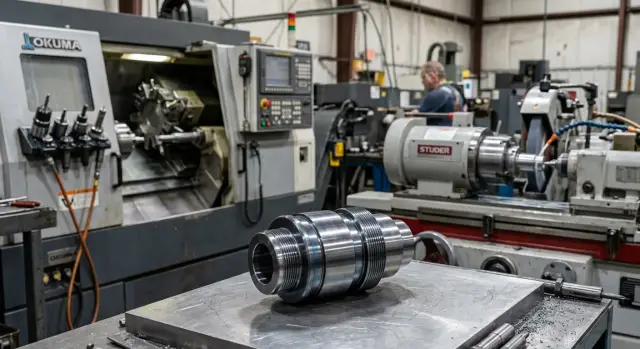
What the choice involves
The same final dimension on a hardened part can be achieved in two ways: finish turning or grinding. On the drawing the result looks identical, but on the shop floor these are different requirements for the machine, tooling, cycle time and scrap risk.
After hardening, steel cuts very differently. Cutting forces on the insert increase, temperatures rise, and any vibration, chuck runout or uneven stock shows up immediately. A grinding wheel removes material very thinly and usually holds size and surface pattern better, but it has its own conditions: dressing the wheel, steady feed and temperature control to avoid overheating the surface layer.
So the rule “hardened = grind” doesn’t always apply. If the part is short and stiff and the tolerance is moderate, hard turning often meets the spec in one setup. If you need a very clean bearing fit or you’re dealing with a long thin journal, grinding more often gives a smoother outcome.
A wrong process choice quickly hits delivery and cost. When a shop tries to chase a surface with turning that really needs grinding, time is spent selecting an insert, finding regimes and compensations, and the size still “wanders.” The opposite mistake is also costly: sending a part to grinding unnecessarily adds an operation, setup and another inspection step.
Before launch it’s better to answer a few simple questions: what is the hardness after heat treatment, how consistent is the batch, what tolerance and roughness are required on that specific surface, how much stock remains after heat treatment, and does the part distort after hardening. Equally important is the economic question: which is more expensive for this batch — an extra minute of cycle time or an extra operation?
In practice the choice is rarely black and white. You can mostly turn a shaft and grind one seating. That route often gives a reasonable price, a short cycle and fewer surprises at final inspection.
What tolerance and roughness decide
When machining hardened steel the decision often boils down not to the material itself but to two numbers on the drawing: dimensional tolerance and surface roughness. Looking only at the cost of one operation can mislead. A part may reach size but fail on Ra, roundness or straightness.
Turning hardened steel holds size well where the part is stiff, the datum is clear and the stock after heat treatment is even. With a good match of machine, chuck, tool and cutting parameters, turning can often achieve tolerances on external cylindrical surfaces on the order of 0.01–0.02 mm. For many shafts, bushings and fits that’s enough.
Roughness becomes a limiting factor sooner. After turning you can realistically get surfaces around Ra 0.8–1.6. With careful finish passes and stable tool geometry you can go lower. But if the drawing calls for a very smooth finish — for example Ra 0.2–0.4 — grinding usually delivers a more even result. It’s also preferred where the customer inspects the tool mark closely.
Part geometry changes the picture as much as tolerance. A short, stiff roller will be turned more accurately than a long thin shaft. The higher the length‑to‑diameter ratio, the higher the risk of bending, runout and shape deviation. On a long part you might catch diameter at one point with a micrometer, but roundness and cylindricity begin to “drift.” In those cases grinding wins more on form than on single‑point size.
A simple rule of thumb: if you need about 0.01–0.02 mm and a regular working roughness, turning often covers it. If you need very tight scatter, low Ra and strict geometry, look toward grinding. And if the part noticeably distorted after hardening, the route usually needs rethinking.
Stock left after heat treatment matters too. If hardening caused distortion, scale or an uneven layer, turning is convenient as an initial finish operation: it removes excess quickly and evens the geometry. If the stock is small and uniform, grinding can be placed right on the finish.
Simple example: a shaft comes out of hardening with 0.3 mm stock per side and a Ra 1.6 requirement. Turning often closes that in one route. If the same shaft requires Ra 0.4 and a tight bearing fit, grinding typically reduces scrap risk.
When turning is more advantageous
Turning usually wins where the part does not require ultra‑tight size and the stock after heat treatment is small. If the tool removes that layer in one pass, the operation is quick and consistent. For a series this is often the easiest way to shorten cycle time and avoid overloading the route with extra operations.
This approach works best on simple geometry. Cylindrical surfaces, faces, grooves, external journals and steps on a shaft — these are convenient to machine with a cutting tool if they are accessible. When the tool reaches the zone without interference, the machine can hold a stable regime and setup is simpler.
Hard turning makes sense when the size doesn’t fall into a very narrow tolerance and the surface doesn’t require grinding‑level smoothness. In plain terms: when a good working result is needed rather than grinding‑clean finish for its own sake. For many parts that’s sufficient: the fit assembles normally, the surface functions as required, and the cycle is shorter.
Turning tends to have four clear advantages: small stock after hardening, open surface access, a tolerance achievable by turning, and a batch size where time savings matter. A good example is a hardened shaft with one external journal and a face. If only a little material remains on the diameter, a CNC lathe often finishes the job faster than grinding. The size is obtained in one setup, the part isn’t moved between operations, and less time is spent on re‑setup.
On series parts this is especially noticeable. A 30–60 second difference on one operation may seem small but becomes hours across a batch. If the shop already runs CNC lathes, the gain shows in both time and part cost.
Turning is not always better. But when the shape is simple, stock is small and requirements don’t chase microns, it usually provides the best balance of time and cost.
When grinding is better
Grinding is chosen not by habit but by part requirements. If a very precise diameter is needed on a seating after hardening, a single turning pass is often insufficient. A tool can reach size on hard material, but holding a few microns across a batch is noticeably harder.
The most common case is a bearing, bushing or seal seat. If the diameter must be even along its length and ovality or taper are unacceptable, grinding generally produces a smoother result. For these surfaces shape matters as much as diameter.
The second reason is roughness. Turning leaves tool marks on hardened steel. Sometimes that’s acceptable. But if the surface must be smooth, with low Ra and without a pronounced pattern, grinding is preferred. This is especially important on seats where micro‑roughness accelerates wear or interferes with consistent assembly.
Another frequent scenario: the part distorts after hardening. A shaft may bend slightly, a ring may change shape, or the surface may have uneven stock. In that state turning is often used as an intermediate step to remove the bulk and straighten the blank, leaving grinding for the finish. That way you reach size without nervous final adjustments.
Grinding is also more reliable on long, thin sections that are sensitive to deflection. There the issue is not just hitting diameter at one point but achieving uniform geometry along the length. That’s where the difference between the two processes is most obvious.
The downside of grinding is straightforward: it almost always adds time and an extra operation. You need wheel dressing, a separate setup, inspection and space in the route. But if the drawing is strict, that cost is often justified. Rework or scrap usually costs more.
How to choose the process step by step
The choice between turning and grinding is rarely made on a single point. For hardened steel you usually consider hardness, stock, part shape, required accuracy and the cost of failure. Missing even one item can lead to long cycles, fast tool wear or unnecessary cost.
A practical sequence is helpful. First check the part itself: hardness after heat treatment, actual stock, presence of long thin areas, grooves, bearing journals or interrupted surfaces. A small, even stock gives more freedom. Large stock after hardening immediately changes the calculation for time and wear.
Next look at the drawing. Important are not only dimensional tolerance but requirements for roughness, runout, roundness and cylindricity. Often size can still be held by turning while surface or form push the process toward grinding.
Then inspect setups. A route may look cheaper on paper but require extra handling, re‑dressing of datums or additional finishing in the shop. If the part can be done in one setup on a CNC lathe, that often wins on time and repeatability.
After that calculate the economics — not in generalities but with simple numbers: cycle time per part, tool or wheel life, setup time, inspection workload, scrap risk across the batch. Sometimes turning is faster but the tool wears out too quickly. Sometimes grinding is slower but produces steadier results and fewer reworks.
Only then choose the scheme. If turning reliably holds tolerance and surface, don’t complicate the route. If requirements are on the edge, it’s wiser to use turning for bulk removal and grinding to take the final skim to dimension.
In practice the winner is often a combination. Rough and semi‑finish turning removes most metal, and grinding closes the tightest requirements. For shafts, bearing seats and parts where scrap is costly, this is a practical path.
Example on a simple part
Take a typical shaft after hardening with a 40 mm bearing journal. After heat treatment a part often distorts by a few hundredths and the surface is no longer as predictable as before hardening. So the choice usually reduces to one question: will hard turning be enough or should the seat be finished by grinding?
A common route: the turner removes the main stock after hardening and brings the diameter close to nominal, and the grinder removes the last 0.02–0.05 mm per side. This route is chosen when the seat must be very even, with a tight tolerance and a calm surface for the bearing.
Suppose the drawing requires a tight tolerance and Ra 0.4–0.8. After hard turning it’s possible to reach size, but holding it stably across a batch is harder. Also a tool mark may remain on the bearing journal. On one part that’s not critical, but across a batch it increases scrap and variation. In that case grinding is usually calmer.
If the tolerance is wider, say 0.02–0.03 mm, and Ra 1.6 is acceptable, the part is often left after hard turning. That removes a grinding operation, saves setup and shortens the route.
On a batch the difference is immediate. Hard turning only might take about 6–8 minutes per part in one setup. A route with finishing grinding often looks like: 5–6 minutes for the turning operation and another 4–6 minutes for grinding. Adding in inter‑operation waiting and inspection, the batch runs noticeably longer.
Costwise the picture is similar. For a batch of 100 pieces a turning‑only route might cost roughly 1,800–2,200 tenge per piece. A route with finish grinding can raise the price to 2,500–3,200 tenge because another machine, another operator and more inspection are involved.
Rule for a simple shaft: if the bearing seat is strict, prefer grinding on the finish. If the drawing allows slack in tolerance and roughness, hard turning often completes the job cheaper and faster.
Common mistakes when choosing
The first mistake is focusing only on the cost of one operation. That calculation often fails on the first batch. Cheap turning may produce more scrap, while grinding eats the budget through long cycles, wheel dressing and extra inspection. It’s better to count the cost per acceptable part.
The second mistake is forgetting that the part may distort after heat treatment. This is most visible on long shafts, thin walls and parts with uneven cross‑sections. If you plan a finishing operation without checking actual geometry after hardening, size and runout will drift in series.
The third mistake is specifying grinding by habit. Hardened steel doesn’t always require it. If tolerance and roughness are within what hard turning can hold, an extra step only adds time, cost and the risk of overheating the surface.
Stock errors go both ways. Too little stock won’t remove distortion marks, scale or defective layers after heat treatment. Too much stock overloads the tool, lengthens the cycle and increases size variation. You’ll see it quickly: the machine cuts longer, the insert life drops and stability still isn’t achieved.
Before choosing, do a short check: inspect how the part shape changes after hardening on a few samples, measure the actual stock (not just the planned value), and compare not only cycle time but scrap percentage. Also test tool life on a series, not just on a single good part. One trial blank may pass, while by the twentieth the insert gives worse roughness or dimensional drift.
A simple guideline: if hard turning reliably meets the drawing requirements on the batch, don’t send the part to grinding “just in case.” If the part visibly distorts and dimension wanders, saving on the finish often costs more.
Quick check before launch
Spend ten minutes verifying the drawing and route before launching a batch — it’s better than arguing over scrap later. In hardened steel machining, an error often starts not at the machine but when someone decides a turned finish will be acceptable.
Check the part in order. First inspect the working surfaces. If the strict tolerance applies to a specific surface, you must evaluate the process for that zone alone. The decision is made by the feature that really functions in the assembly.
Then open the roughness requirements. If after turning the surface must be noticeably cleaner than the usual level — for example Ra 0.4 or lower — grinding is the more likely answer.
Next, honestly ask: will turning produce the required geometry in one pass, or will you still need to correct runout, taper or ovality after heat treatment? Then calculate the batch. On one or two parts grinding may seem expensive, but on a stable volume it sometimes pays off through lower rework and steadier inspection results.
Finally check the whole route: heat treatment, datuming, stock, finish operation and final inspection. If any step is unclear, it’s too early to start.
Simple example: a hardened shaft with a bearing journal where the external diameter needs a tight tolerance while other surfaces are less critical. It makes no sense to grind everything. Usually it’s better to turn the auxiliary zones and grind only the working journal.
Also verify cycle time. Sometimes an engineer looks only at the cost of one operation and forgets about re‑setup, inter‑operation inspection and waiting at the grinding area. Then a cheap solution on paper stretches the whole batch lead time.
If doubts remain, make a trial part and measure after each stage. A short test quickly shows where the process holds size and where it becomes a lottery. For a series this is more useful than any debate between a turner and a technologist.
What to do next
For hardened steel the decision almost always starts with numbers on the drawing, not the machine brand. If you gather them up front, the dispute between turning and grinding usually narrows to a couple of real options.
First list four parameters: hardness after heat treatment, tolerance, required roughness and batch size. That’s enough to rule out unnecessary routes. The same shaft for a batch of 20 and for 20,000 pieces can require different approaches even if material and nominal size are identical.
Then check your equipment capabilities, not only process theory. Can your machine hold size on the finish pass without a second operation? Is there enough stiffness, thermal stability, spindle accuracy and suitable tooling? If the machine reliably hits size in one setup, don’t add grinding by habit.
If the answer is unclear, discuss the part before buying tooling. A short route review on borderline tasks often saves more than trial runs in the shop. This is especially true for hardened parts, where a mistake quickly turns into scrap or an extra hour of cycle time.
Do a simple paper calculation: how many minutes per operation, how much time for setup, what is the tooling cost per part and what is the risk of leaving tolerance. After that comparison the choice usually becomes calmer.
If your shop plans to select a CNC lathe for such tasks, discuss the part with EAST CNC engineers. The company supplies metalworking machines and helps with model selection, commissioning and service. For Kazakhstan and other CIS countries this is a convenient option when you need to evaluate a specific part, tolerance and future loading rather than an abstract machine.
One sheet with these numbers will be more useful than a long argument about what “usually works.”
FAQ
When can I get away with turning only after hardening?
Usually yes — if the part is short and stiff, the stock after heat treatment is even, and the tolerance is not extremely tight. For external cylindrical surfaces, hard turning often holds roughly 0.01–0.02 mm and gives a working roughness around Ra 0.8–1.6.
In which cases should I plan grinding right away?
Grinding is typically chosen for bearing, bushing or seal seats where a very even diameter and a calm surface are required. It also helps on long, thin sections and when the part distorts after hardening.
How does the dimensional tolerance affect the process choice?
If the drawing calls for about 0.01–0.02 mm and the part and machine are stiff, turning often suffices. When the allowable scatter must be even smaller and the customer inspects roundness, taper or cylindricity strictly, grinding is the safer choice.
What matters more for the choice: size or surface roughness?
The limit often follows the surface. After turning you typically get about Ra 0.8–1.6; for very smooth finishes like Ra 0.2–0.4, grinding is more commonly used.
What should I do if the part noticeably distorts after hardening?
First measure the actual geometry and stock, not just the theoretical values. Often it makes sense to remove the bulk by turning to straighten the part, then finish by grinding to the final size.
Why is turning often more cost‑effective for series?
Usually turning is more economical on a series, especially if a CNC lathe hits the size in one setup. You avoid an extra operation, part transfers and additional inspection — even saving half a minute per piece adds up quickly over a batch.
Can I combine turning and grinding on the same part?
Yes — that’s a common route. Often the shaft is mostly turned, and only the critical journal is ground to meet tighter form or surface requirements.
Why are long thin shafts more often ground than turned?
Because the challenge there is not only the diameter but maintaining geometry along the length. It’s usually easier to hit diameter at a single point than to keep roundness and cylindricity over a long thin shaft without grinding.
How do I know if the stock left after heat treatment is reasonable?
Too small a stock won’t remove distortion marks, scale or defective surface layers after heat treatment. Too large a stock increases tool load, cycle time and dimensional instability. It’s best to check stock on actual hardened parts.
What should I check before starting a batch?
Verify hardness, actual stock, tolerance, roughness and the working surface shape. If unsure, run a trial part and measure after each stage — this quickly shows whether the process holds size in practice.