
Turning Superalloys: How Not to Burn the Cutting Edge
Turning superalloys requires precise cutting parameters and stable coolant delivery. We cover depth, feed and coolant placement to avoid overheating the cutting edge.
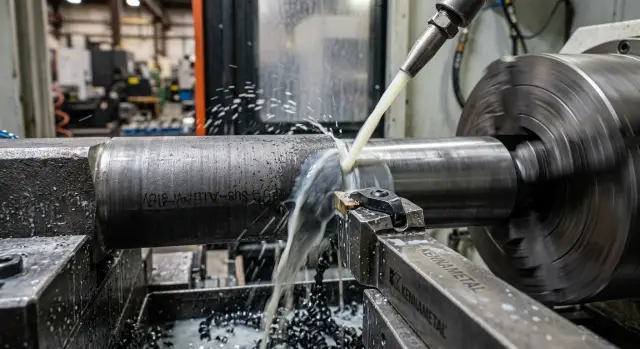
Why the tool burns on superalloys
Superalloys cut very differently than ordinary structural steel. The cutting edge darkens quickly, loses sharpness and starts rubbing the metal instead of cutting. Sometimes you see signs after the first passes: the part surface has shiny patches, chips are inconsistent, and the cutting sound becomes heavy and dry.
The main reason is simple: these materials conduct heat poorly. Most of the heat stays right in the cutting zone where the edge and the workpiece rub under high pressure. If the alloy is also ductile, it sticks to the cutting part. Temperature rises faster and wear happens in jumps rather than smoothly.
Cutting parameters that work fine on steel often harm the process here. On steel you can increase speed and get a clean surface without a big drop in tool life. On a superalloy the same tactic quickly overheats the insert. First the edge darkens, then it loses geometry, and finally it tears the surface and overloads the spindle.
Early signs are usually visible right away: the edge changes color and dulls quickly, the chip turns blue or too fine, the part shows burnishes and matte strips, and cutting force grows even during a short pass. If the insert lasts noticeably less than expected, that’s a clear signal.
There is another unpleasant feature: many superalloys work-harden with deformation. If the tool takes a too-thin layer or the feed is too low, it doesn’t cut cleanly but smashes the metal. The next pass then hits a harder zone and temperature spikes again. So the edge can burn even on a regime that looks calm on paper.
A different approach helps here: trust usual regimes less and watch the actual heat in the cutting zone more. If the edge dies almost immediately, the cause is usually not a single insert. Most often three things act together: speed was chosen like for steel, feed was too low, and coolant misses the cutting spot.
What in the material makes machining difficult
The problem is not that the alloy is "too hard" by itself. The edge suffers from a combination of properties: the material retains strength at high temperature, conducts heat poorly and often deforms plastically rather than breaking into chips.
Sticky chips are typical for nickel-based superalloys, heat-resistant stainless steels and some titanium alloys. They cling to the cutting edge especially if speed is unfortunate and feed is too low. Buildup forms on the insert, chips discharge inconsistently, and the part surface deteriorates quickly.
Ordinary steel often loses some resistance when heated in the cutting zone. Superalloys behave differently: even at high temperature they keep carrying load. As a result cutting requires more force, and heat does not go into the chip as quickly as you’d like. The load stays near the edge, and the tool overheats.
Another difficulty is springback: the tool enters the metal, pressure rises, then the workpiece springs back and presses the edge again. This repeating pressure accelerates micro-chipping. If the machine, chuck or holder has even small vibration, wear grows noticeably faster.
In practice this means one simple thing: too "soft" regimes harm as much as aggressive ones. If depth of cut is too small the tool rubs more than cuts. If feed is too cautious the material work-hardens and the edge already operates on a hardened layer.
Usually it’s better not to reduce depth to the point where the tool just slides over the surface, and not to choke feed without reason, especially on a ductile alloy. The regime should be steady, without sharp jumps, and the chip must evacuate stably instead of wrapping. Superalloys prefer confident, calm cutting. When the tool actually removes a layer rather than rubs it, tool life is usually higher even if the regime looks heavier.
Where to start choosing the tool
Mistakes often begin not with speed but with the first pair: insert and holder. If the edge is weak and overhang is large, the material quickly raises temperature and the tool fails before you find the cause.
Look not only at the alloy grade but at the part’s behavior. A short rigid workpiece with a uniform allowance lets you use a more productive geometry. If the part is thin, long, has interrupted cuts or an uneven surface after roughing, pick an insert with a tougher edge. It cuts heavier but lives more steadily.
A sharp geometry looks attractive: cutting forces are lower and chips leave easier. But on a ductile superalloy a thin edge often overheats faster. Instead of even wear you get micro-chips or plastic deformation. So the sharpest option does not always give the best tool life.
The nose radius follows the same principle. A large radius strengthens the edge and helps get a cleaner surface, but it presses more on the part and the holder. If the system has any tendency to vibrate, such a radius can turn the job into chatter and extra heating. A small radius reduces load but is weaker by itself. At the start it’s wiser to choose a medium value and then move in one direction based on results.
Before starting, quickly check four things: remaining allowance and presence of interrupted cuts, how rigidly the part is clamped, the holder overhang, and whether the assembly will handle the chosen nose radius.
Holder rigidity is often underestimated. Even a good insert won’t save you if the tool is set with too much overhang. A simple rule works almost always: the shorter the overhang, the calmer the cut and the lower the risk of burning the edge. If you must reach far, reduce metal removal and build a more stable scheme.
Begin tool selection with the stiffest, shortest layout the part allows. After that, tune feed, depth and cooling. This order usually saves both inserts and setup time.
How to choose depth, feed and speed step by step
Most mistakes start with speed. You want to shorten the cycle, but extra meters per minute heat the edge fastest. So set up from a calm regime the tool can hold without blues, buildup or chips failing.
Don’t change everything at once. If you adjust speed, feed and depth together it’s hard to know what ruined the result.
- First set a safe speed. For a new insert or unfamiliar alloy take the lower bound of the manufacturer’s recommendation. If the workpiece is long, overhang large or the machine not very stiff, start even lower.
- Then choose depth of cut by the allowance and the stiffness of the whole assembly. Consider not only how much metal to remove but how the part is clamped. Don’t load a thin or long workpiece with too deep a pass.
- After that increase feed. Too small a feed feels safe but on superalloys it often causes rubbing instead of cutting. The edge heats; chips run irregularly. Raise feed little by little until chip formation is stable.
- Make a short trial pass and inspect the insert immediately. Look not only for a big chip. Built-up material, darkening at the edge, a wide wear land or torn chips also indicate the regime needs correction.
- Change only one parameter at a time and record the result. A simple notebook or spreadsheet helps you reach a working regime faster than trying to remember everything.
A small example: if you have a workpiece with 2 mm allowance per side and noticeable overhang, don’t remove the whole allowance in one pass. First set a moderate depth, check chip behavior and the edge condition on a short section, then raise feed slowly. Change speed last.
This way regimes are found more calmly and accurately. A couple of short trial passes usually cost less than one burned insert and a machine stop.
How to set coolant without extra harm
Superalloys don’t give heat away easily. So opening the coolant valve is not enough. If the jet is weak or hits aside, the fluid doesn’t cool the edge but only causes sharp temperature swings.
That shortens tool life. The edge heats up and then cools abruptly, which quickly induces microcracks. On ductile material this regime is especially harmful: the chip rubs on the rake face for longer, heating increases, and a weak jet cannot penetrate the hot layer.
Where to aim the coolant
Aim not at the insert itself but at the place where the chip clears the edge. The jet should hit the contact between chip, insert and workpiece. If it flows above or aside you cool the holder and air, not the hottest point.
For external turning a simple rule helps: feed the coolant slightly forward in the cutting direction so the flow goes under the chip. If there’s a second nozzle, aim it at the flank where the material also heats the tool. One precise jet almost always outperforms a broad weak shower.
Sometimes the problem is not the coolant volume but cutting speed. If the pump cannot provide enough pressure, don’t try to save the process by increasing flow. First reduce speed slightly. Often that has a greater effect than extra liters per minute because the edge simply receives less heat.
A practical sign: if you see steam, dark chips and hear a sharper sound, the edge is already overheating. In that moment it’s more useful to remove heat by changing the regime than to only open the coolant valve.
During machining coolant delivery often shifts due to vibration, chip buildup or an imprecise tool change. You’ll notice quickly: steam increases, chip color changes and it breaks worse, cutting sound becomes drier and harsher, a matte strip appears on the part or roughness grows. If you see any sign, stop the cycle and check the nozzles. On the line it takes a couple of minutes but can save an insert for a whole shift.
Mistakes that make the edge die early
On superalloys the edge often dies not because of one gross error but a set of small things that together create overheating. The most common is too small a feed. The tool no longer cuts the material but rubs it. Temperature rises fast, chip runs in jerks, and the insert loses life before the operator notices.
This often happens when people try to improve surface finish and reduce feed below a reasonable level. On ordinary steel that can sometimes pass. On superalloys this trick often hits the edge harder than a slightly heavier cut.
Another common mistake comes after a good first pass. The part went calmly, sound was even, and you want to add speed. But superalloys don’t like sudden increases. A small increment that seems harmless can sharply raise temperature in the cutting zone. The first pass was fine, but on the second the insert starts breaking on the rake face.
Trying to squeeze one more part with a worn insert is equally harmful. If the edge already has a shiny wear land, small chips or darkening, the reserve is nearly gone. The last attempt is usually the most expensive: dimension errors, higher load on the holder, and sometimes a ruined workpiece.
Long chips also kill the tool faster than you might think. They catch on the part, come back under the tool and reheat the cutting zone. If the chip doesn’t break, correct feed, depth or chipbreaker immediately instead of changing the insert after a few passes.
Many miss vibration signs on the surface though they’re early warnings. Waves, a chattery sound, a faint ripple on the diameter — all these give the edge small impacts. At first surface quality suffers, then micro-chips appear, and finally the tool burns out quickly.
If chips get longer than usual, the sound changes or the surface starts to ripple, stop immediately. Five minutes to check the regime almost always costs less than a new insert and a ruined part.
Example setup on a real part
Take a common shop case: a thin-walled sleeve made of a ductile superalloy. Outer diameter 80 mm, wall thickness 3 mm, small finishing allowance. On such parts the tool often fails not because of metal hardness but due to heat and friction concentrated in one spot.
On first run an operator chooses a cautious regime. Speed seems safe and feed is mild to avoid distorting the wall. But after a few seconds the chips become shiny and sticky, wrap worse than usual, and buildup forms on the insert. The surface first looks clean, then bands and a slight ripple appear.
This is typical when the tool doesn’t cut but in places rubs the metal. An overly careful regime often harms more than a moderately firm cut. The material stretches, heats and starts to stick to the edge.
Fix the situation not all at once but in sequence. First lower cutting speed a bit. Then raise feed slightly so the edge confidently enters the layer instead of sliding over it. After that adjust coolant: the jet must hit the contact zone, not just splash the part from above.
In practice this might look like: reduce speed from 55 to 40–45 m/min, raise feed from 0.06 to 0.09 mm/rev, keep depth steady (avoid too fine a cut), and point the coolant nozzle closer to the cutting edge.
After these changes the picture shifts quickly. Chips lose the sticky shine and exit more evenly. The edge heats less, buildup appears later, and the thin wall avoids extra scuffs from friction. The surface also calms down: instead of random bands you get a steadier tool trace.
The most noticeable change for the operator is simple: the tool lasts longer not because the regime was softened but because extra friction was removed and coolant was directed where it really works.
On CNC machines the logic is almost always the same: don’t chase speed on the first pass, don’t choke the feed, and watch the chips from the first seconds. They quickly show whether the cut is normal or the edge has already begun to live less than it should.
Short pre-start checklist
The first seconds of cutting often decide the fate of the edge. Spending two minutes on checks before start can avoid overheating, chipping and an unnecessary machine stop.
- Check tool overhang and part clamping. Excessive overhang quickly causes chatter; weak clamping turns a normal pass into vibration and overheating.
- Ensure coolant hits the cutting zone precisely. If the jet strikes aside, heat remains on the insert.
- After the first seconds stay close to the machine. Watch the chips and listen. Long, torn or bluish chips, squeal, rattle and pulsing immediately hint at trouble.
- Before the next pass quickly inspect the insert. Built-up material, darkening at the cutting edge, small chips on the nose and a shiny wear land mean settings are already drifting bad.
It’s useful to compare the current run with the last stable one. The same material rarely forgives small deviations. If before the machine cut quietly and chips were even but now the sound changed, a problem already exists even if part dimensions still hold.
This checklist doesn’t replace regime selection but helps catch the problem before the tool burns. On ductile superalloys it’s usually the cheapest way to preserve tool life and avoid losing a shift.
What to do next on your shop floor
To make superalloy machining less of a lottery you need a simple system on the shop floor. Not one lucky setup but proven regimes you can repeat quickly on a new part.
Start with a working card. Break it down not by general words but by what affects the result daily: alloy grade, diameter, insert type, depth of cut, feed, speed, coolant delivery and actual edge life in minutes or pieces. Even one such table often saves more time than long arguments at the machine.
For a new batch require a mandatory trial pass even if the material looks similar to the previous one. Superalloys from two melts can behave quite differently and the cutting edge will be the first to feel it.
A simple approach works: begin with a safe speed and working feed, make a short trial pass on a typical area of the part, immediately check chips, sound, heating and surface trace, then inspect the edge under magnification and record wear. Only after that change one parameter at a time.
Without recording wear all this work falls apart quickly. Agree in advance who checks the insert, when and how they record results. If one operator writes "it’ll go a bit longer" and another changes the insert at the first shine, comparing regimes is pointless.
One uniform recording format across shifts works best. For example, after the trial pass the operator notes length cut, wear type and stop reason. The foreman reviews logs weekly and removes regimes that give a nice first part but quickly burn the tool.
If the shop constantly struggles with weak coolant supply, vibration, lack of rigidity or an unsuitable machine layout, the problem is not only in the regime. In those cases it’s useful to look wider — at the machine, tooling and process launch. EAST CNC, the official representative of Taizhou Eastern CNC Technology Co., Ltd. in Kazakhstan, works with such tasks: they help select CNC lathes, supply equipment, commission and service it.
A good result looks simple: a new material doesn’t scare you, the trial pass follows a clear rule, and the regime decision is based on records rather than memory.
FAQ
Why does the cutting edge burn so quickly on a superalloy?
Most often the tool burns because of overheating in the cutting zone. Superalloys conduct heat poorly, and if you use speeds suitable for ordinary steel, reduce feed too much, or miss the coolant jet from the cutting spot, the cutting edge quickly darkens, dulls and starts rubbing the metal.
How to tell the tool is already overheating?
Watch the chip color and behavior, the sound and the surface trace. If the chip turns blue, runs in jerks, the surface shows burnishes or matte strips, and the cutting sounds dry and heavy, the cutting edge is already overheating.
Can too small a feed damage the tool?
Yes. Too small a feed often causes exactly that. If the feed is too low the tool doesn’t cut the layer properly but smears it, the material work-hardens, temperature rises, and the next pass becomes heavier.
Where to start when choosing an insert and holder?
Start with the stiffness of the whole setup. Reduce unnecessary overhang, check workpiece clamping, then choose the insert and holder for the actual allowance, interrupted cuts and workpiece behavior. For thin or long parts pick a tougher edge rather than the sharpest one.
What to adjust first: speed, feed or depth?
Set a conservative cutting speed first, not the maximum. Then choose depth of cut according to the allowance and the stiffness of the assembly. After that raise feed gradually until the chip becomes stable. Change speed last.
Is a sharp insert always better for superalloys?
A too-sharp insert cuts easier but on a sticky superalloy it can overheat and get micro-chips. Usually it’s better to start with a medium nose radius and avoid the thinnest edge if the machine or part has any vibration.
Where should coolant be directed when turning superalloys?
Aim the jet not just at the insert but where the chip leaves the cutting edge. If the flow hits above or aside, you cool the holder and the air but not the hottest point. One well-directed jet usually beats a broad weak spray.
How much does tool overhang affect tool life?
Excessive overhang almost always worsens cutting. The tool starts to vibrate, the edge receives small impacts, temperature rises and tool life drops. If you can’t shorten the overhang, reduce the cut and design a more stable setup.
When is it better to change the insert rather than squeeze one more pass?
Don’t push the last pass with a worn insert. If you see a shiny wear land, small chips or darkening at the edge, the reserve is nearly gone. One last attempt usually costs more: dimension errors, higher load on the holder, and sometimes a ruined workpiece.
What should be recorded after a trial pass?
Keep a simple working card for each material and detail. Record alloy grade, insert type, speed, feed, depth, coolant delivery and actual tool life in minutes or pieces. This helps repeat a successful regime and avoids arguing from memory.