
Turning and Drilling in One Setup: Hubs and Flanges
We break down when turning and drilling in one setup reduces part re-clamping, and when live tooling only adds setup time.
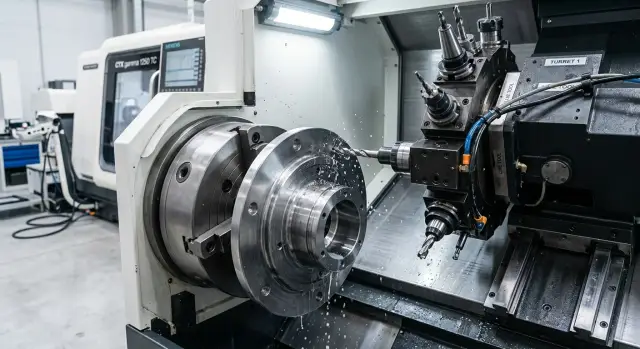
Why hubs and flanges end up in a second setup
Most often, a part is removed after turning for a simple reason: that’s how people are used to working. On a lathe, they machine the main diameters, faces, and fits, while holes, slots, or the bolt circle are moved to a drilling machine or another department. For many shops, that route is clear and convenient, especially when the turning operation has long been dialed in and drilling is handled separately.
There is also a very practical reason. Live tooling is not available on every machine, and where it is available, it still has to be set up properly. For an operator, it can be easier to take a flange off after turning, move it to a second machine, and drill the holes in familiar fixturing than to rework the whole CNC process route.
The problems start with the second clamping. In the second setup, the hub or flange is no longer supported from the same datum as in the first. Even with good jaws, small things affect the result: chips on the face, a burr, a different stick-out from the chuck, different clamping force, jaw wear, or a small mistake in the fixture.
Because of that, concentricity between the turned surfaces and the holes is lost. On the drawing, everything looks simple, but in the shop you get runout, the bolt circle shifts, or the hole position moves relative to the fit diameter. Sometimes the error is small, but for a hub it is already enough to make the bearing seat worse. For a flange, it can be enough to make assembly start to pull on the bolts.
Hubs and flanges are especially sensitive to these shifts because they almost always have a central base and elements that need to sit around one axis. If the turner made an accurate fit and then the part moved by a few hundredths during the second clamping, part of that careful turning work loses its value.
Time-wise, the second setup is not always cheaper either. Moving the part takes little time, but you also add waiting for a free machine, new work offset setup, fixture checks, a trial part, and inspection. On short runs, that often takes longer than it seems. That is why the idea of doing turning and drilling in one setup appeared not for convenience, but to preserve the datum and cut out unnecessary handling.
What live tooling really gives you
Live tooling on a lathe removes the second setup only where the required holes and pockets can be reached from the current clamping. For hubs and flanges, that usually works for standard bolt-circle holes, axial drilling, countersinking, tapping, and shallow face pockets.
If the part is already held in the chuck and the machine indexes the spindle accurately, the operator can complete both operations without moving the part to a separate drilling or milling machine. On simple parts, that removes one extra re-clamp, saves time on setup, and reduces the risk of hole-spacing errors.
Where it pays off
Live tooling pays back fastest where drilling is simple and the access to the machining area does not interfere with the holder or the tool body. A typical example is a flange with holes on a bolt circle and small countersinks on the same side.
Usually, without moving the part, you can comfortably do:
- axial holes in the center and on the face;
- bolt-circle holes with C-axis indexing;
- shallow pockets and countersinks;
- simple tapping in accessible locations;
- cross holes, if the machine and fixturing allow proper access.
On these operations, the benefit is obvious right away. The route is shorter, and the operator spends less time on re-clamping and rechecking the datum.
Where the benefit disappears quickly
If the hole requirements are strict, the idea of just “drilling it on the lathe” is not enough. Hole position, concentricity, perpendicularity, bottom finish, and size after drilling depend not only on live tooling, but also on rigidity, machine kinematics, and available power.
Problems usually begin in four places. Either the machine lacks power and torque for a large diameter or hard material. Or there is not enough travel, so the tool simply cannot reach the point. Sometimes the part geometry gets in the way: a tall boss, a long hub, or the chuck jaws. And sometimes the operation takes less time than the preparation for it, so the machine with live tooling ends up wasting time on just a couple of holes.
For hubs and flanges, the conclusion is simple. Live tooling is good for drilling, countersinking, and simple pockets in areas with confident access. If you need deep holes, a large pocket, tight geometry, or a difficult approach, a second setup often remains the calmer and more predictable solution.
When one setup is truly justified
One setup is not a win for every part. It works best where the turning datum and the holes live in the same logic: first the outer and inner surfaces are machined, and then the holes are made from that same base. For a hub, that is a common case if you need to keep the fit, face, and bolt circle concentric without reclamping.
The biggest gains come on parts with simple geometry and clear tool access. If the drilling area is open, the chuck does not get in the way, and the part does not require a long overhang, the route becomes shorter and calmer. When the drill or live tooling block reaches the machining point without a long holder and without a risk of hitting the jaws, one setup is usually justified.
There is also a simple overhang rule: the shorter it is, the better. If the part is held securely in the chuck and the working section sticks out only moderately, without a long, weak cantilever, rigidity is preserved. On short flanges and compact hubs, that is especially noticeable. If the overhang starts pulling on the part, causes chatter, or requires support from the tailstock, combining operations quickly loses its point.
The number of holes matters too. For one or two holes, the savings are often modest: time goes into setting up live tooling, checking the angle, adjusting offsets, and running a trial. But on a flange with six, eight, or ten holes, the second setup often eats more time than the drilling itself.
In general, one setup makes sense when several conditions line up: the holes are referenced from an already machined face or diameter, the drilling area is open, the overhang is short or moderate, there are several holes, and concentricity matters more than a small difference in pure machine time.
Sometimes it is not even about seconds. If the part later goes into an assembly where the face, fit, and holes must come together without fitting work, it is better to keep one base until the end of the operation. Even if the cycle becomes a little longer, the shop saves time on scrap, corrections, and repeat setup.
When it is better to keep the second setup
One setup does not always save time. On hubs and flanges, that becomes clear quickly if the holes, slots, or threads are located where live tooling approaches at an awkward angle. The holder has to stick out too far, rigidity drops, and even a small amount of runout starts affecting size and surface finish.
Often, the problem is not the cutting itself, but how the part is held. To combine turning and drilling in one setup, the technologist sometimes has to build complicated fixturing: soft jaws with a deep pocket, a long mandrel, or an unusual tool layout. If setup takes two hours and the extra operation takes seven minutes, there is no real savings.
That can happen on simple parts too. For example, a flange may only need a few holes on the face after turning. On paper, it looks like a strong candidate for one route. But if the operator spends a long time dialing in the tool, checking overhang, finding a safe clamp, and still ends up with poor rigidity, the second setup on a drilling or milling department is calmer and cheaper.
The second setup is usually better to keep in these cases:
- the tool reaches the machining area with a large overhang;
- the fixture becomes too complex and expensive for a single part or a small batch;
- the changeover takes longer than the drilling operation itself;
- the part has thin walls, and clamping easily distorts the geometry;
- the diameter is large and vibration starts during drilling or milling.
Thin-walled hubs and large flanges are especially sensitive. When the jaws do not hold the part on a rigid datum, the wall springs, and live tooling adds side load. In the end, the hole can be made in one cycle, but then you still have to correct the offset, fight ovality, or scrap the part.
In such cases, the second setup is not a weak point in the route; it is a normal solution. If it gives easy access, simple inspection, and a predictable size, it is better to keep it. In metalworking, the shorter route is not always the better one. The better route is the one that consistently produces a good part without extra setup.
How to build the route step by step
For a hub or flange, it is better to build the route from the base, not from the tool. First, decide which surfaces define the dimension chain: the face, the fit diameter, or the center hole. If the datum shifts at the beginning, one setup will not save it. It will just get you to scrap faster.
Then it helps to follow a simple sequence. First choose the datum and clamping method so the part does not move after roughing and the reference does not have to be rebuilt. Then arrange the steps from rough to precise: rough turning, facing, machining outer and inner diameters, and then finishing passes. After that, place drilling and milling operations where the tool can see the required plane and does not hit the jaws, chuck, or a neighboring shoulder. Only then calculate cycle time and setup time separately. People often mix those up, even though they matter differently for the decision.
After the roughing steps, it is worth doing a quick access check. On paper, live tooling on a lathe often looks easier than it does in the real setup. For example, holes on a flange can be drilled without a second setup, but only if the tool length is enough, there is no axis collision, and the jaws do not block the approach.
You should not count machine time alone. If the one-setup scheme saves 40 seconds per part but adds two hours of setup and requires another special tool block, the benefit disappears quickly. On small and medium batches, that becomes very clear. On large batches, the picture can be the opposite.
It helps to test the route on a simple scenario. Suppose a flange has an outer diameter, a face, a center bore, and six holes on the pitch circle. If all holes are accessible from the first clamping and the position tolerance is tied to the already machined center, working in one setup usually makes sense. If access requires a long tool, weak overhang, and complex indexing, turning the part over may give a calmer and more predictable result.
A good CNC process route usually looks boring. There are no unnecessary moves, questionable approaches, or clever ideas that get in the way of holding size.
A simple flange example
Let’s take a simple flange: outer diameter 160 mm, thickness 28 mm, center bore 62 mm, and eight holes on a 120 mm bolt circle. This is exactly the kind of part where it is easiest to see when one clamping really helps and when it brings little value.
A two-setup route looks familiar. First, the turner clamps the blank, faces it, turns the outer diameter, machines the bore, and adds basic chamfers. Then the part is removed and moved to a drilling machine, rotary table, or another area, where the bolt circle is marked out and drilled.
This route has weak points. After re-clamping, it is easy to get a shift in the hole position relative to the bore. Even if the error is small, it becomes visible in assembly. Another common issue is the extra time spent on transfer, datum setup, and first-part inspection. On a batch of 30 to 50 parts, that adds up quickly.
If you use a lathe with live tooling and a C-axis, the same flange can be made in one clamping. The blank is held in soft jaws, faced, turned on the outer diameter, bored in the center, and then the spindle is indexed without removing the part and eight holes are drilled on the circle. If needed, chamfers are added right away.
On a part like this, one setup usually gives a clear advantage. The bore and the bolt circle are in the same coordinate system, so the scrap risk is lower. The operator does not carry the part between machines, and the setter does not waste time on a second datum setup.
In terms of time, the difference often looks like this:
- two setups: 12-14 minutes of cutting plus another 5-7 minutes for transfer, setup, and inspection;
- one clamping with live tooling: 15-17 minutes for the whole cycle.
Pure machine time may hardly change. But the manual handling is gone, and with it, part of the errors.
That said, this solution has a cost. The setter must align the C-axis carefully, check chuck runout, verify the live tool lengths, and make safe approaches. If they miss the drill height or ignore jaw overhang, a simple route can quickly become nervous and slow.
For an ordinary flange with shallow bolt-circle holes, one clamping is usually justified. If the tolerance on hole position is tied to the bore, this scheme usually makes production calmer, not just prettier on paper.
Where people most often make mistakes
The idea of combining turning and drilling in one setup sounds simple. In practice, the shop usually loses time not during cutting, but because of bad decisions made before the machine even starts.
The first mistake is to use live tooling for a single short operation. If the part needs just two shallow holes without tight angle or pitch tolerances, the cycle-time benefit may be tiny. And the setup, tool check, and first test run can easily eat that margin before the first batch is done.
Another common mistake is to look only at the drawing and forget about clamping. A hub or flange may hold well enough for turning, but behave much worse during side drilling or overhang work. If the part is thin and the jaws grip a short base, the tool starts pulling the hole off course, and the turned surface drifts out of size.
Quite often, the mistake is not in the machining itself, but in the tool path. On paper, everything looks clean: approach the tool, make the hole, retract. In the machine, things are tighter. The chuck, jaws, protruding shoulder, and neighboring tool in the turret all require clearance and safe approach planes. If the technologist does not leave that margin, the setter ends up rewriting the route at the machine.
Usually the problem shows up in a few signs: the cycle is shortened by only a few seconds, but setup stretches to nearly an hour; the part behaves normally during turning but chatters during drilling; the tool has little room to approach the work area; the scheme makes sense on the drawing but is awkward for real clamping and tool changes.
That is exactly how CNC process routes get broken. First, a nice sequence of steps is built, and then the fixture is forced to fit it. It is better to go the other way: first see how the part sits in the chuck, where the rigid datum is, and which tool really fits, and only then decide whether the second setup is needed.
People also often underestimate the first setup. For a batch of 20 to 30 parts, an extra 40 minutes on a trial run can wipe out the benefit of combining operations entirely. For a long production run, the same route pays back quickly. So you need to count not only machine time, but also setter time, first-part inspection, and the risk of early scrap.
If, after that calculation, the scheme still looks simple, one setup makes sense. If not, the second setup is not a loss; it is a normal process decision.
A quick check before production
Before a trial batch, it helps to ask a few direct questions. They quickly show whether one setup will really pay off or simply add more setup work.
First, does the second clamp damage the datum? If concentricity shifts after turning the part over, the hole moves, or face runout changes, one setup is often justified on that alone. For hubs and flanges, that is a very common reason to rebuild the route.
Second, look at the time for the whole batch, not just one part. Sometimes the second setup takes less than a minute, while live tooling setup takes half a day. For a batch of 20 parts, that is a bad trade. For a batch of 500 parts, the calculation may be completely different.
The third question is whether the machine has enough power and travel in the required area. Drilling on a bolt circle, working near the outer diameter, and machining close to the jaws require not only spindle speed, but also proper access. If the tool approaches the part almost too closely, it is better to simplify the route right away.
The fourth question is about tooling. On paper, the turret often looks spacious, but in a real setup a long drill, an angled block, and a turning tool start interfering with one another. Then the operator spends time not on production, but on repositioning and checking safe approaches.
And the fifth question is whether another operator could repeat the setup without long corrections. A good route is not built around one strong setter, but around clear logic. If every tool change means finding zero again, adjusting overhangs, and rewriting offsets, the scheme is too fragile.
It helps to take one part and honestly calculate not just machine time, but everything around it: setup, approach, first-piece inspection, tool changes, and corrections. After that, it becomes easy to see where live tooling really removes the second setup and where it only makes the route more complicated.
If you already have doubts on several points, do not force one setup. For a simple flange, the second clamp is sometimes cheaper and calmer than a beautiful but finicky scheme.
What to do next
The best way to decide is to keep it simple: leave one setup only where it truly removes extra part movement, not where it adds hours to setup. For hubs and flanges, this can be checked quickly if you look not at the nice idea of the route, but at datum setup, tool access, and the real cycle time.
If all holes and faces are accessible without a questionable tool overhang, the datum is preserved, the batch repeats, and live tooling really removes a separate drilling operation without a long changeover, one setup is usually justified. If some holes require awkward access or a long tool, if turning the part over makes size and runout easier to control, and if setup eats the whole benefit, it is smarter to keep two setups.
It is better to test this on a typical part from the batch, not the most complicated one. That makes it easier to see whether combining operations really helps. A rare flange with complex geometry almost always distorts the conclusion, because it has too many special conditions.
During such a check, it is useful to count three things: how many minutes go into setup, how long the cycle takes, and where the risk is highest for runout, concentricity, and repeatability. Sometimes the second setup looks old-fashioned, but on a batch of 50 parts it turns out to be calmer and cheaper.
Before a trial run, it is worth listing the questions about clamping, drilling rigidity, the tool set, first-setup time, and how convenient the route is for everyday shop work. That quickly cuts through the noise and helps remove solutions that only look good on paper.
If, after that calculation, the limiting factor is no longer the process itself but the capabilities of the machine and fixture, it makes sense to review the task with the equipment supplier. EAST CNC, the official representative of Taizhou Eastern CNC Technology Co., Ltd. in Kazakhstan, provides CNC lathe selection, commissioning, and service support. That conversation helps you understand which layout and option set will suit your part without unnecessary problems in real production.
FAQ
When does one setup for a hub or flange really make sense?
Use a combined setup when the holes are based on the same datum as the bore or fit diameter, and the tool can reach the machining area without trouble. This route usually makes the most sense for flanges and compact hubs, where you need to keep concentricity without reclamping.
What operations can really be done on a lathe in one setup?
Usually you can do bolt-circle holes, axial drilling, countersinking, tapped threads, and shallow face pockets in one clamping. If the part is tall, the chuck jaws block access, or a long holder is needed, some operations are better done separately.
When is it better not to remove the second setup?
Keep the second setup if the tool reaches the part with too much overhang, the fixture becomes too complex, or the setup takes longer than the machining itself. On thin walls, large diameters, and awkward access, that route usually gives less risk and less stress.
Does one setup reduce the risk of hole misalignment?
Yes, because the part does not lose its base between turning and drilling. The holes, face, and fit remain in the same reference system, so the bolt circle is less likely to shift relative to the bore.
What usually gets in the way of using live tooling?
The most common issues are weak rigidity, not enough travel, awkward approach angles, and excessive tool overhang. Even a simple flange starts to behave badly if the drill nearly hits the jaws or the block has to be extended too far.
How does batch size affect the choice of route?
For short runs, one setup is not always worthwhile because the setter spends a lot of time on the first setup and checking the part. On repeat batches, the picture often changes: you set the route once and then save time on every part.
What should you do if the hub is thin-walled?
With thin-walled parts, it is usually better not to force a combined setup at any cost. If the jaws deform the wall or side load pulls the hole off course, keep the second setup with a more comfortable clamp and calmer cutting.
How can you quickly check the route before starting?
First check the datum, clamping, and tool access on the real part, not just on the drawing. Then count the whole route: setup, trial run, first-part inspection, tool changes, and only then compare the options.
Is one setup always faster than two?
Not always. Machine time may change very little, and the gain often comes from not moving the part, not re-datuming it, and not waiting for another machine.
How do you know if a machine is suitable for hubs and flanges with live tooling?
Look at repeatability of the C-axis, power and torque at the required diameter, actual axis travels, and space in the turret for the full tool set. If the machine holds indexing, provides proper approach, and does not force a complicated fixture, it is a much better fit for these parts.