
Trochoidal Steel Machining: Where It Reduces Load
Trochoidal machining of steel does not always help. Let’s look at slots, cutting depth, and machine rigidity so you don’t waste time or overload the spindle.
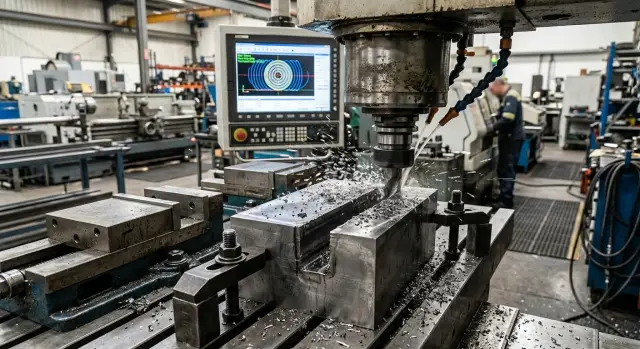
What is the issue here
Trochoidal machining in CAM often looks like the perfect answer: smooth arcs, even load, fewer sharp entries. But in steel, a nice-looking toolpath is not enough. If the slot is narrow, the tool sticks out too far, and the part is clamped too softly, the cut is still hard on the machine.
People usually expect a clear result from trochoidal machining: the spindle will stop bogging down, the tool will last longer, and the cycle will get shorter. Sometimes that is exactly what happens. But the margin disappears quickly if the step is too small, the depth is too large, and the "machine - holder - tool" setup is not rigid enough. Then the tool is cutting almost as hard, only by a longer route.
You do not see overload on the CAM screen. You see it in the machine’s behavior. The spindle loses speed in the arcs and at the bottom of the slot, the cutting sound comes and goes, chips flow unevenly and turn darker, and the feed starts to jerk even though the path looks smooth.
There is another trap too. CAM can easily create neat loops with a small radial engagement. On screen, everything makes sense, but the toolpath gets longer and the material removal rate hardly changes. In the end, the operation takes longer, while the load drops only a little.
A simple example: a 14 mm slot cut with a 10 mm tool in steel. If you program a large depth, a long stickout, and small loops, the program looks convincing. In the cut, the tool is still flexible, the chips are cramped, and the spindle sees peaks exactly where the toolpath can no longer save you.
The problem is not trochoidal machining itself. It works when slot width, cutting depth, and system rigidity fit this mode. If they do not, CAM draws a nice geometry and the metal quickly brings you back to reality.
Where trochoidal machining really helps
A standard slot in steel usually fails not because of average load, but because of short peaks. The tool enters full engagement, chips pack up, the spindle gets noisy, and the edge overheats. In that situation, a trochoidal path is useful not because it looks elegant, but because it runs more evenly.
This is easiest to see in a deep, narrow slot. When the slot is almost the same width as the tool diameter, a normal pass keeps the tool in heavy contact almost all the time. Trochoidal machining reduces side engagement, the spindle sees a steadier load, and chips escape the cutting zone more easily.
The same effect helps with a long stickout. A long tool is less rigid on its own, and any sharp entry into the metal quickly causes chatter at the edge. If the path leads the tool through arcs with a small bite, the tool bends less and the machine sounds calmer. That is especially useful where you cannot use a shorter setup or position the part differently.
Material matters too. Some steels heat the cutting edge very quickly under full engagement. On paper, the cutting conditions still look acceptable, but the edge loses life after just a few minutes. A trochoidal path shortens the time spent in heavy contact, so heat is spread more evenly and wear grows less abruptly.
Another common case is a machine that does not handle load peaks well. It may be in good condition, but not quite rigid enough for an aggressive slot. Then you get a humming sound, light vibration, marks on the wall, and spindle sound swings. Trochoidal machining smooths out those peaks. That is its main advantage. It does not always make the job faster.
The check is simple. If the sound becomes smoother after switching to a trochoidal path, the chips come out cleaner, and the spindle current stops jumping, the method was chosen for the right reason. If only the CAM picture changes, the benefit is small.
When it only wastes time
A trochoidal path does not create a gain by itself. If the steel is cut shallowly, the cutting zone is open, and the chips already clear easily, the arc path often just makes the cycle longer.
This is easy to see in shallow pockets and open cavities where the tool is not squeezed by the walls. The load there is already moderate, so the gain in force is too small to justify the extra movement.
When a straight pass is faster
The picture is similar in a wide slot. If the tool is not cutting in full engagement, a normal path already keeps a reasonable load. CAM may draw a neat trochoid, but the machine simply travels more distance without a clear benefit for the tool.
On a rigid machine with a short tool, this is especially obvious. The machine handles cutting calmly, the spindle does not dip, there is no vibration, and the direct path often gives better part time. In that situation, trochoidal machining solves a problem that does not exist.
Often the loss comes not from the method itself, but from making the step too small. The tool cuts more gently, but a noticeable part of the time is spent just moving along the path without removing much material. On screen, the toolpath looks neat. On the shop floor, it is simply slower.
A practical shop-floor rule is easy to follow. If spindle current barely changes after switching to trochoidal machining, the sound does not become smoother, and the cycle time grows, the path should be simplified. A typical example: a wide slot, moderate depth, and a short tool. A straight pass finishes the job in about 2 minutes, while trochoidal machining stretches it to 2 minutes 40 seconds and gives almost nothing back.
How slot width, depth, and rigidity change the result
The same trochoidal pass can give a different result on different machines. On one setup the spindle runs smoothly and chips come out cleanly; on another, noise and cycle time increase. Usually the reason is three things: slot width, cutting depth, and the rigidity of the whole system.
Slot width changes the situation first. If the slot is close to the tool diameter, normal milling quickly increases the share of engagement and the load starts to jump. In that case, trochoidal machining often helps. If the slot is noticeably wider than the tool, the benefit is much less obvious. Often it is easier to use standard passes with a sensible material removal rate than to spend time on extra arcs.
Depth cannot be judged separately from tool stickout. In CAM, 3xD may look fine, but on the shop floor a long tool starts to bend before the spindle shows a clear overload. On the control panel, you see acceptable current, while the part already shows chatter marks and faster edge wear. The longer the stickout, the more you need to reduce both depth and feed.
The rigidity of the machine, holder, and workholding matters just as much. On a good machining center with a solid holder, trochoidal machining often removes load peaks and evens out the cutting sound. On a softer setup, the effect is quickly lost. If the chuck, holder, or the part itself moves, the tool starts to oscillate even on the arcs, and the load reduction is weak.
The slot shape also affects the result. A through slot forgives more because the chips have somewhere to go. In a blind deep slot, they stay near the tool longer, get cut again, and heat the tool. In that case, even a gentle toolpath will not fix everything at once.
It helps to ask a few direct questions. Is the slot almost the same width as the tool, or much wider? Does the cutting depth match the real stickout, not just the CAM calculation? Do the machine, holder, and clamping keep the cut stable without chatter? Can chips leave the slot freely? If the answer to some of these is no, trochoidal machining usually hides the problem rather than solving it. First remove unnecessary stickout, improve clamping, and clear the chips. Only then does the toolpath start working properly.
How to check the process
It is better to start checking not in CAM, but at the slot itself. Width and depth immediately show whether it makes sense to try trochoidal machining or whether a straight pass will give the same result faster. In steel slots, this becomes clear quickly: a shallow slot rarely gives a big benefit, while a deep slot with poor chip evacuation almost always needs a more careful approach.
Then look at the mechanics. If the tool sticks out too far and the part is clamped loosely, even a good toolpath will not fully solve the problem. Often the issue is not the program, but a 4D-5D stickout, a soft fixture, or a thin wall that starts to sing before the spindle does.
A simple check sequence works well:
- First measure the slot width and depth and compare them with the tool diameter.
- Then check tool stickout, the condition of the collet or chuck, and the rigidity of the part clamping.
- Start with moderate radial engagement. Often 8-15% of the tool diameter is enough.
- Run a short test pass and watch spindle current, cutting sound, chip shape, and cycle time.
- Change only one parameter at a time and write down the result. Otherwise the conclusion will be random.
Trochoidal machining in steel is useful only when you see real load reduction, not just a neat animation. If spindle current dropped by 10-15%, the sound became smoother, chips come out freely, and the cycle time grew only a little, the process is healthy. If the load hardly changed and the cycle became one and a half times longer, it is better not to keep that mode.
A simple observation table also helps: cutting depth, radial engagement, feed, spindle current, notes on sound and chips. After 3-4 short tests, the picture is usually clear. For example, with an 18 mm slot and a 12 mm tool, reducing radial engagement from 20% to 12% may immediately remove chatter, while going down to 8% only stretches the time.
A simple shop-floor example
A steel plate needs a 12 mm wide slot to a depth of 18 mm. The tool is a 10 mm end mill. The slot is narrow, deep, and chips have a hard time getting out.
First the operator starts a normal pass almost across the full width. The first few millimeters go smoothly, then the sound gets rougher, spindle load jumps, and small chatter marks appear on the wall. The part is acceptable, but the process margin is almost zero.
Then the operation is switched to a trochoidal path. The tool no longer cuts with the full side all at once, but in short arcs with less side engagement. The force peak drops, the machine sounds smoother, and the wall comes out cleaner.
But there is a price. The tool path gets longer, and cycle time grows. If the slot used to take about 40 seconds, trochoidal machining can easily push it past a minute, even with a more aggressive feed.
The limit of usefulness is easy to see here. If the tool has a long stickout, the plate is not clamped very rigidly, and the slot is deep and narrow, trochoidal machining protects the process from sharp load peaks. It does not make cutting fast, but it lowers the risk for the spindle and the tool. But if you shorten the stickout by a few millimeters and clamp the part more firmly, the picture changes. Rigidity improves, vibration goes away, and the straight pass wins on time again.
So the same 12 mm slot can lead to different conclusions. On a soft "machine - setup - tool" combination, trochoidal machining really does unload the spindle. On a rigid one, it sometimes just adds pretty arcs and extra seconds.
Mistakes that make the path look better than it works
The most common mistake is simple: trochoidal machining is switched on because CAM suggests it by default. On screen, it looks safe and neat. On the part, it can be the opposite. If the slot is shallow, the tool is short, and a normal pass runs smoothly, the complex path only slows things down.
The second mistake is making the step too small. The tool cuts more gently, but a noticeable part of the time is spent just moving along the path instead of removing material. The load drops, but productivity drops even more.
The third mistake is not about the program, but about rigidity. A long tool stickout often ruins the value of trochoidal machining. If the tool sticks out too far, it starts to spring, heat up, and chatter. Then the problem is not the path. The problem is the machine, holder, and tool combination.
There are also simpler misses. A test pass is done without watching the chips, sound, and spindle current, and then the result is judged by one number on the control. Or the modes are compared under different conditions: a standard slot is cut at one depth and feed, while trochoidal machining is tested at another. That tells you nothing.
To know whether the path really reduces spindle load, the conditions must be the same: material, tool, depth, and feed per tooth. Only then can you see where the real benefit is and where there is only neat geometry in CAM.
A quick check before starting
Before starting, it helps to spend a couple of minutes not on the screen, but on the real setup. Many problems are visible before the first chip is made.
Check how much wider the slot is than the tool and how much room there is for chip evacuation. If chips will rub against the walls and come back into the cut, trochoidal machining will not remove the overload. Check tool stickout. A long tool almost always needs a smaller depth of cut, even if the path is soft. Check the workholding. If a thin wall is already singing at idle, it will not become stable in the cut. Compare the estimated cycle time with the real shop plan: sometimes the path protects the edge, but makes the cycle too long. And look at spindle current in the first seconds of entry. A sharp jump usually means the entry is too aggressive or the rigidity is lower than expected.
A short trial section is better than any debate. Run a short stretch at the same depth and simply listen to the machine. A smooth sound and stable chips usually tell you more than a single load number on the screen.
It is useful to look at the whole chain at once: spindle, holder, stickout, part clamping, and slot shape. A slot 35 mm deep may run calmly on a rigidly clamped workpiece, but the same program will start shaking the spindle if the part is set on tall supports and held down weakly.
If you already have two weak points at the start, do not run the process at full size. First reduce depth, shorten stickout, or simplify the entry. That makes it faster to see whether the path helps or just creates a feeling of safety.
What to do next
Start by defining the goal. If spindle load peaks are rising, a trochoidal path can calm the cut and remove sharp hits. If the spindle is already running smoothly and the section is short, it often only stretches machine time.
Next, do not change everything at once. Take the same slot or a repeatable section of the part and compare two modes: a normal pass and a trochoidal pass. Keep the test short, save the program, and record load, time, sound, vibration, edge condition, and chip shape. Then these numbers will show whether it is worth keeping trochoidal machining in production.
If rigidity is the bottleneck, a path change alone will not fix the problem. A stickout that is too long, weak clamping, a soft holder, or backlash in the feed system quickly cancel the benefit. In that case, you need to look at the whole setup at once: machine, tooling, tool, and the part in the fixture.
Trochoidal machining in steel is usually justified in deep slots and where a standard pass sharply raises the load. In a shallow slot, a short section, or a rigid part, the difference is often too small. Then it is simpler to remove the extra complexity and keep the process clear.
If the test shows that the limit is no longer the toolpath but the setup itself, it may be time to discuss the equipment. EAST CNC’s blog and east-cnc.kz include equipment reviews and practical machining materials. That is useful when the question is not about CAM, but about the machine, tooling, startup, and service.
Keep only the mode that gives a clear result in numbers: lower load peaks, less vibration, or shorter machining time. If none of that happens, trochoidal machining is not needed right now.
FAQ
Should I use trochoidal machining for every steel slot?
No. Trochoidal machining makes sense where a standard slot creates load peaks: in narrow and deep slots, with a long stickout, or when the overall setup is not very rigid. If the slot is shallow, open, and chips clear freely, a straight pass is often faster.
In which slot does trochoidal machining make the biggest difference?
It usually helps most in a deep, narrow slot, when the slot width is close to the tool diameter. In that case, the path reduces side engagement, the spindle runs more steadily, and chips leave the cut more easily.
When is a straight pass faster than trochoidal machining?
A straight pass usually wins in a wide slot, an open pocket, and at shallow depth. If the machine is rigid, the tool is short, and the spindle does not dip, the extra arcs only make the cycle longer.
How can I tell that trochoidal machining really reduces spindle load?
Watch the machine, not the animation. If spindle current drops by about 10–15%, the sound becomes smoother, the chips look cleaner, and the time increase is modest, the process is working as intended.
What radial engagement should I start with?
For a starting point, 8–15% of the tool diameter is often enough. Then make a short test and change only one parameter at a time, otherwise you won’t know what actually caused the result.
Why doesn’t trochoidal machining save the cut when the tool stickout is large?
Because a long tool bends and starts to chatter before the toolpath can help much. First remove unnecessary stickout, check the holder and the workholding, and only then adjust the arcs and feed.
What matters most: the slot, the depth, or the rigidity?
You can’t separate them. A narrow slot increases engagement, a large depth with a long stickout adds deflection, and weak clamping increases vibration. If even one of these factors is weak, the toolpath often only hides the problem.
What should I do if trochoidal machining made the cycle much longer?
Don’t leave that mode in production. Simplify the toolpath, increase the step, check the stickout and clamping, and then compare time, sound, and load again on the same section.
Do I need trochoidal machining on a rigid machine with a short tool?
Not always. On a rigid machine with a short tool and smooth cutting, it often solves a problem that isn’t there. In that setup, a straight pass often gives better time with less complexity.
Where should I start checking the process before cutting?
Start simple: measure the slot width and depth, check chip evacuation, verify tool stickout and clamping rigidity. Then run a short test section and note spindle current, sound, chips, and time.