
How to Choose a Trial Batch for the First Run on a New Machine
A trial batch for the first run on a new machine should quickly show rigidity, ease of setup, and size variation. Here’s which part to choose.
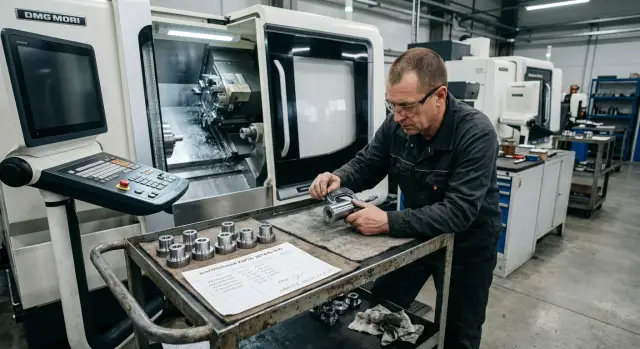
What the first run should show
The first run is not about a nice report or a single good part. Its purpose is simple: to understand how the machine behaves in normal work, when the operator loads the blank, brings in the tool, adjusts the offset, and runs a series without long pauses.
If you look only at the first part, the conclusion can easily be false. After careful tweaking, it often comes out fine, but that still doesn’t mean the process is stable. It is much more important to know whether the fifth, tenth, and twentieth parts will be the same.
A good trial run answers several practical questions. How much time does full setup take, not just the first cut? Does the machine hold size across the series without constant adjustments? How does it behave under normal load: with several passes, tool changes, and repeat clamping? And where does the operator lose time on unnecessary movements?
Rigidity deserves special attention. A part that falls within tolerance after the first setup proves very little. Rigidity shows up another way: does the size drift as material is removed, does taper increase, and does the result change after several identical blanks?
It is also important to track time. CNC machine setup often only seems fast in conversation. In reality, the operator may spend forty minutes finding the base, adjusting offsets, and rechecking a dimension that still drifts during the series. A trial like that quickly reveals the weak point.
If you are turning a simple stepped bushing in a batch of ten, you should not look only at the diameter of the first part. It is much more useful to assess the spread across the whole batch, the time needed to adjust the tool, and how easy it is to reach the measurement points. Then the trial part shows the real picture: can the machine make one good part, or can it hold size comfortably across a series.
Which part works best
For the first run, it is better to choose not the simplest part, but a moderately complex one. A plain cylinder shows almost nothing. The program may run without issues, but you still won’t know how the machine holds size at transitions, how the tool behaves, or how much time setup takes.
A part with diameter steps, a clean face, and one hole works well. That shape gives a solid check in several zones right away. You can see how the machine cuts at different diameters, how it holds length on the face, and how the axis performs during drilling.
It is better to leave 2-3 dimensions that can be measured quickly and in the same way right on the shop floor. Usually, an outside diameter, step length, and hole diameter are enough. If the inspector or setup technician spends ten minutes measuring each piece, you are no longer testing the machine, but the team’s patience.
Thin walls are best avoided on day one. They depend too much on clamping, tool sharpness, feed, and even how long the part sat after machining. In that situation, it is hard to tell whether the real cause of the deviation is machine rigidity, cutting conditions, or the part itself.
A part with many setups is also a poor choice. As soon as the blank has to be repositioned several times, one check mixes several factors at once. The error gets masked, and the conclusions become weak.
On a CNC lathe, a simple stepped bushing or a short shaft with a hole usually works best. Such a part is easy to understand, quick to program, and easy to measure. It does not overload the first run, but it still shows whether the machine holds size from part to part.
If the first few parts repeat in diameter, the face stays put, and the hole does not wander, then the trial part was chosen well. After that, you can move on to more complex geometry.
Why you should avoid extremes
A part that is too simple often creates a false sense that everything is fine with the machine. If it has few transitions, a short tool overhang, and loose tolerances, it will not reveal weak points. You won’t see how the machine holds size across a series, how it behaves with a deeper cut, or where geometric drift starts.
A short bushing made of ordinary steel with only one or two outer surfaces is machined with almost no load. It is hard to judge whether the rigidity is enough, whether the bases are easy to reach, and how the size changes after several parts in a row. For the very first check of motion and program, such a part is fine, but not for evaluating real production behavior.
A part that is too complex creates problems too. If it has many setups, thin walls, tight tolerances, and a long machining route, the setup technician can spend almost the entire shift on one run. Then you are not testing the machine, but how willing the team is to endure constant adjustments. It is hard to find the source of the error in that situation because there are too many variables.
It is better to choose a part from the actual product range you plan to make on this machine. It should be a working part, not a demonstration piece. Usually, a moderately complex part is best: with several working surfaces, at least one dimension with a clear tolerance, and a normal spindle and tool load for the shop. At the same time, the setup technician should be able to finish the run without a rush.
There is another simple criterion: a clear drawing. If the dimensions are easy to read, the bases are clearly defined, and the tolerances do not raise questions, the team will understand faster where the problem is: in the machine, the fixture, the tool, or the process itself.
This approach usually gives the most honest picture. Not an extreme case, but a normal working part shows rigidity, ease of setup, and size stability best on the first pieces.
How many pieces to include in a trial batch
For the start, 20-50 pieces is usually enough. This size already shows how the machine behaves, how well the size holds, and how smoothly the setup goes. A smaller batch often gives too little data, while starting the full order right away is simply risky.
The first 1-3 parts almost always go into adjustment. The operator corrects offsets, checks the surface, takes real measurements, and looks for any extra vibration. That is a normal part of the startup, not scrap in the usual sense.
Then comes the useful part of the series. On parts four through ten, it becomes clear whether the machine repeats the same result. If the size starts drifting here, it is better to look for the problem right away rather than hope it will level out later.
By the tenth or fifteenth part, what was not visible at the beginning often becomes obvious. The spindle and machine components warm up a little, the tool starts working in a more realistic mode, and the size may shift by a few hundredths. That is why a trial batch of just five pieces says almost nothing.
For a simple part, twenty pieces are usually enough. If there is a long overhang, a thin wall, tight tolerances, or several transitions with different tools, it is better to aim for 30-50 pieces. Then you can see not only the first result, but also stability throughout the entire series.
It is not worth launching the full customer order right away. Even if the first two parts came out well, that still does not mean two hundred pieces will go just as smoothly. It is much cheaper to stop at a trial series, adjust the cutting conditions, replace a weak tool, or rethink the clamping than to sort through a large volume of finished parts later.
If you want a simple rule of thumb, it looks like this: the first 1-3 parts are for adjustment, parts 4-10 are for repeatability, by part 10-15 you can already see heating and wear, and a batch of 20-50 pieces lets you judge stable operation.
What to check before starting
Before startup, it is worth preparing not only the machine, but also the way you will check the result. Otherwise, the first series will create a lot of noise and little value: the parts will be done, but the cause of the deviations will still be unclear.
First, mark the dimensions that show rigidity and repeatability. You do not need to measure everything. Choose the zones where the machine most often shows its character: the diameter after the heavier pass, the length from one base, the size near a shoulder, or a thin section. If something starts to drift from part to part, you will notice it right away.
The blanks should also be prepared in advance and taken from the same delivery. Different material, different hardness, or even a small spread in stock allowance can easily spoil the picture. Later it may seem like the problem is in setup, when the real cause was the blank itself. For a trial run, it is better to use identical blanks of the same length, the same diameter, and the same allowance.
Measurement should be agreed on before startup. If one operator measures with a micrometer and another with a caliper, you will get an argument about the numbers instead of an evaluation of the process. It is better to agree in advance on which dimensions you check on each part, what tolerance they have, which base is used, and in what order the measurement is carried out.
It helps to write all this down right away on one sheet or in a simple table: dimension number, nominal value, tolerance, measuring tool, and the person responsible for checking it. Then every part follows the same control route.
A very simple set of control points works well too. If you are turning a shaft, mark the outside diameter after roughing and finishing, the length from the base face, and the runout at the finish. That is already enough to quickly understand whether the machine holds size, whether the tool drifts, and whether the operator can repeat the measurement without extra fuss.
If you skip this stage, the trial part stops being a test and turns into a guess. Proper preparation saves hours on the very first day.
How to run the startup step by step
It is better to run the first trial batch calmly, even if the machine has already gone through commissioning. The goal is not to reach full pace right away, but to understand how it holds size, how the tool behaves, and how much time each action takes.
- Start with one part at moderate settings. Do not use maximum feed and do not try to shorten the cycle in the first hour. If vibration, a surface mark, or an unusual sound appears, stop and find the cause.
- Right after the first part, measure the dimensions that affect fit, runout, and repeatability. It is better not to start the next part until you know which dimensions are already within tolerance and which need correction.
- Then make a small series and take measurements at the same points each time. Compare the first, fifth, tenth, and last part. This makes it easier to see the effect of heat, insert wear, or blank variation.
- Record setup time, every adjustment, and every tool change separately. Often these numbers show whether the process is ready for regular work, not just whether the machine cycle itself is fine.
- Look at more than the size. Surface finish, tool marks, burrs, and a clean chamfer often say more about rigidity than a single good measurement.
If the size is already drifting after five parts, it is not worth just continuing the series. The cause is usually quite straightforward: weak clamping, too long a tool overhang, poor cutting conditions, or an inaccurate base.
On a CNC lathe, this shows up quickly. The first part may be within tolerance, while the sixth already shows a different result because of heating or a tool that has shifted. It is better to spend an extra fifteen minutes on measurements than to sort through a dozen questionable parts later.
A good sign is simple: the operator adjusts offsets less and less, tool changes happen without surprises, and the last parts match the first ones after setup. Then you can gradually increase the settings and move the trial part into regular production.
A simple example of a trial batch
For the first run, a batch of 30 steel bushings for series production works well. It is not too simple, but it is not a trap for the setup technician either. On a batch like this, you can quickly see how the machine holds size, how the clamping behaves, and how much time is needed between operations.
A bushing has an outside diameter, a hole, a face, and a groove. That is already enough to check several weak points at once. The outside diameter shows whether there is any drift from tool wear. The hole helps reveal coaxiality and the behavior of the drilling or boring tool. The face shows any length drift, and the groove shows how easy it is to bring the tool in and whether the cutting zone has enough rigidity.
This kind of trial batch gives an honest assessment. The part does not hide mistakes. If the chuck clamps inconsistently, you will see variation in the outside diameter and runout after repositioning. If there is a base-setting problem, the length will drift. If the setup is inconvenient, it becomes clear within the first 5-7 pieces: the operator starts spending extra minutes on tool approach, chip removal, and dimension checks.
It is convenient to review the batch at several points. The first 1-3 parts show the start of setup. The tenth part shows whether the process has settled. The twentieth and thirtieth parts make size drift much easier to see.
This example is also useful because it is easy to analyze after the run. Suppose the first bushings came out straight in diameter, but the length drifted by 0.03 mm by the end of the batch. Then the cause should be sought not in clamping, but in axis correction and thermal behavior. If the length holds but the hole wanders, you need to check the tool, feed, and overhang.
For commissioning, this is also a convenient format from the equipment supplier side. At EAST CNC, this approach works well for evaluating a machine in real use: not by a single showpiece part, but by a short series where size stability, ease of setup, and the need for service adjustment are visible right away.
Where mistakes happen most often
When choosing a trial batch, many people want an answer too quickly: does the machine hold size or not? Because of that, conclusions are drawn too early. And the problem is often not the machine at all, but the way the check is done.
The most common mistake is to look at one good part and assume that is enough. The first piece sometimes comes out well simply because the tool is new, the spindle has not heated up yet, and the settings were conservative. By the third or fifth part, the size may already drift.
Different stock allowance also causes a lot of confusion. If one blank is almost to size and another needs significantly more material removed, the load on the tool changes. With it, cutting force, deflection, and surface finish also change. After such a series, it is hard to tell what exactly you tested.
There is also a simple but expensive mistake: measuring the part immediately after machining. The metal is still warm, especially after passes with noticeable material removal. On a hot part, the size often seems fine, but after cooling it can shift by a few hundredths. With a tight tolerance, that is already enough to lead to the wrong conclusion.
Another trap is trying to test everything at once on one batch. Feed, speed, depth of cut are changed, another tool is tried, and the result is assessed right away. That only mixes the causes. For a trial run, it is better to choose one machining route and change one parameter at a time.
Many problems start after a tool change. The operator installed a new insert, slightly adjusted the offset, increased the feed at the same time, and did not have time to write it down. After a few parts, the size drifted, but the source is no longer easy to find. That is why you need at least a short log: which tool was installed, what overhang it had, which offset was entered, and after which part it was done.
Mistakes usually appear where discipline is lacking. Identical blanks, one machining path, time for cooling, and a short record of all changes give more value than a long trial batch without order.
Short checklist
Before calling a trial batch successful, it helps to quickly go through a few points. The blanks should come from one material batch and have the same allowance. The critical dimensions should be measurable right at the machine without long preparation. All offsets and setup times should be recorded immediately, not from memory. And you should compare not only the first part, but also the middle of the series and the end.
After that, the decision is usually clear. If the size holds, the operator hardly touches the offsets, and the cycle time does not jump around, the series can continue. If the size drifts, adjustments keep coming one after another, and the process stays nervous, it is better to stop and find the cause.
For a turned part, it looks very simple: the first bushing fell within size after adjustment, the fifth stayed the same, and the tenth drifted by two hundredths. That is already enough to understand that it is still too early to release the machine or cutting conditions into regular production.
A good trial batch does not have to be large. It only needs to give a clear answer about whether the process holds size without constant human intervention.
What to do after the trial batch
After the trial batch, you need to make one of three decisions: start the production series, make a few process adjustments, or stop the launch for now. You should look at the whole picture, not the most successful part.
If only two out of ten parts came out exactly right, that is not yet a result. A good sign is when the size holds repeatedly, without constant offset corrections, and the operator does not spend extra time on repeat setup.
If the size drifts, the cause should be checked step by step. First, inspect the clamping. The part may shift slightly in the chuck, collet, or fixture, and then the machine is not the issue. Then look at the tool: wear, runout, too much overhang, or incorrect cutting conditions. After that, assess heating. On a new machine, the spindle, components, and the part itself may behave differently after warm-up, and that becomes obvious quickly on a series of identical parts.
It is useful to write down short conclusions right away: which dimension drifted, on which part it started, how long the changeover took, and whether the run was interrupted by chips, vibration, or poor access to the machining zone. A week later, these details are easy to forget, even though they decide whether the process is ready for regular work.
It makes sense to choose one standard part and use it for future startups. It is better if it is neither too simple nor too complex: with a couple of precise dimensions, ordinary material, and clear referencing. Then each new startup can be compared with the same benchmark. This helps you quickly understand whether the machine’s behavior has changed after transport, service, or a tool change.
If doubts remain after the trial batch, it is better not to put off the review. At the commissioning stage, this is always cheaper than on a real order. Here, what matters is not only the machine itself, but also proper support with selection, startup, and service. For such tasks in Kazakhstan, many people turn to EAST CNC: the company supplies CNC lathes, handles commissioning, and provides service support, so the trial series can be reviewed based on facts rather than guesses.