
Tooling Master: When the Shop Needs One
When setups drag, tools go missing and tool life varies, a tooling master often fixes the issue more effectively than hiring another operator.
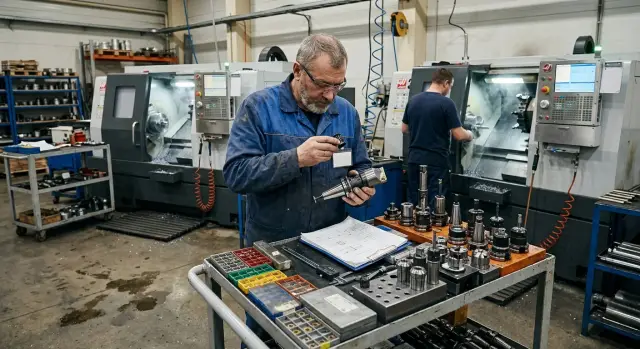
What the real problem is
The problem doesn't start when a tool runs out. It starts earlier, when a CNC lathe shop loses 3–7 minutes dozens of times per shift and the reports barely show it. Setups may seem to meet standards, the machine isn't standing for hours, production goes on. But time disappears in pieces, and by the end of the shift those pieces add up to too much.
In that situation the operator is doing work they shouldn't. Instead of controlling the process and the part size, they search for an insert of the right grade, match a holder, check runout, remember what was used on the last batch and recheck things that should have been recorded once. From the outside it looks small. In reality those pauses consume more time than one obvious downtime.
Because of this the same part behaves differently across shifts. One operator changes the insert early, another waits until the last moment. One quickly finds the right assembly, another spends 15 minutes searching. One records the actual dimension and offset, another leaves a verbal hint. As a result the shop gets different outcomes on the same program and material, even though it's neither the machine nor the part.
Another imbalance is growing stock but no needed item nearby. The shop buys tools in surplus to avoid missing production. But order doesn't appear by itself. Common items lie around in cabinets and drawers, rare items pile up unused, some tools exist only on paper, and no one can find them quickly. Money is already spent, yet the operator still waits or looks for a substitute.
That's when a tooling master is needed. Not a person "just in case," but someone responsible for cutting tool inventory, clear storage locations, tool life and consistent rules across all shifts. Without that, tooling management breaks down into individual habits. Then reducing setup time remains a nice goal, while machining losses continue every day, quietly and steadily.
Signals visible during a shift
The first signs are usually obvious. If at the start of a shift operators lay out not one kit but several assemblies "just in case," that's already a bad sign. On the surface this extra stock seems convenient. In practice it shows people aren't sure which tool will actually be needed, what condition it's in, or where the right tooling is stored.
The second signal comes from insert changes. One operator replaces them too early because they're afraid of scrap and stoppage. Another waits to the last moment until the size shifts or surface quality degrades. In the report this looks like ordinary consumption. On the floor it's different: extra stops, arguments about the cause of scrap and constant "check again" requests.
Size drift after nearly every setup is also noticeable. If the setup person repeatedly fine-tunes the first parts, the problem is often not the machine. Usually there is no single clear procedure for assembly, tool offset, recording corrections and storing already prepared positions. For a CNC turning shop this quickly turns into losing hours instead of minutes.
Another simple sign: every operator has their own set, their own boxes, their own marker notes and their own sequence of actions. One knows where a holder is, another searches nearby cabinets, a third keeps a personal stash because they don't trust the shared inventory. This breaks cutting tool accounting even if it exists on paper.
Urgent purchases also point to a recurring problem. If procurement keeps ordering the same items "for yesterday," the shop lives in firefighting mode. Usually that means consumption isn't tracked by fact, stocks aren't visible, and nobody analyzes the cause of overuse.
You often hear the same phrases:
- "Where's my working assembly?"
- "This insert can still do a few parts."
- "Size drifted again after the setup."
- "I'll take it from my drawer, it's faster."
- "Order this item urgently."
When such small things repeat daily, the shop needs a tooling master, not another operator. Their task is simple: remove inconsistencies, introduce one procedure and return the time currently lost between setup, search and rework.
What the operator ends up doing extra
Operators aren't paid to be storekeepers, tooling assemblers and tool dispatchers at once. But in many shops they do exactly that. The shift goes on, the machine waits, and the person manually solves other people's problems.
It usually starts small. A tool wears out earlier than usual and the operator picks a replacement during the run. Then it turns out the right insert isn't at the machine, nobody tracks the actual stock, and the cabinet holds similar items with different geometries. Searching takes 10 minutes or sometimes 20. This rarely appears in reports as a loss.
Then cutting tool inventory lives "in the head" or in a notebook. One remembers two boxes left, another is sure the stock is gone, a third takes from someone else's kit. The shop ends up guessing. The operator repeatedly verifies what a simple, clear system should show at a glance.
In CNC turning setups this is especially visible. Instead of starting the part, the operator assembles the mandrel, mounts the tool, checks runout, repositions the assembly and spins the indicator again. If tooling is assembled sloppily or mixed up, they spend more effort on that than on the actual start.
Separate is the debate about tool life. A tool lasted 70 parts instead of 120 and people start guessing why: supplier, cutting mode, material or operator error. But nobody analyzes it step by step. There's no batch record, no clear history of replacements, no person keeping order. Talk happens, solutions don't.
Extra work looks like this in practice: an operator searches cabinets and storage for an item, improvises a replacement without rules, keeps inventory in memory, checks holders before start and spends time arguing instead of analyzing causes. If that becomes normal, the shop needs a tooling master. Otherwise operators will plug gaps rather than run production.
How to calculate hidden losses for a week
Don't take the whole shop at once. Choose one area and one normal week without emergencies or holidays. Best is a group of 2–4 machines doing similar work where shifts often change tools and assemblies.
You must track not only machine downtime. The quietest losses hide in small things: the operator searches for a holder, assembles tools from different places, adjusts runout, re-enters offsets after a change. In reports this often looks like "setup" or doesn't get recorded at all.
It's easiest to keep a simple sheet per shift. Record five things: minutes spent searching for tools and components, minutes for assembly and preparation, minutes for fine-tuning after installation, whether there was downtime due to a missing item and what caused the time loss.
Separate normal setup time from the extra. If process instructions say setup should take 20 minutes but the operator spends 34, count the difference. Otherwise the number will be diluted and you'll think everything is "within norms."
A simple example: a three-lathe turning area lost 11 minutes finding inserts, 18 minutes assembling holders from different cabinets, 23 minutes fine-tuning after changes and 40 minutes because the needed item wasn't available. That's 92 minutes per shift. Over six working days that's over 9 hours.
Compare that number to the cost of one staff position. If an area loses 9–12 hours a week just on tooling, over a month that's 36–48 hours — nearly a full workweek, and on a busy area more. At that point a tooling master often costs less than repeated small production disruptions.
Look not only at total minutes but at repeatability. If one cause dominates, that's where order breaks. Usually it's one of three places: no accurate cutting tool inventory, illogical storage, or inconsistent assembly procedures. A repeating cause matters more than the overall noise.
One honestly collected week is usually enough to reveal real machining losses and show whether an area needs dedicated tooling organization.
FAQ
When does a shop already need a tooling master?
A tooling master is needed when the shop loses time not to cutting, but to searching, reassembling and constant fine-tuning after tool changes. If these pauses happen almost every day and interfere with production more often than machine breakdowns, the role is already due. You usually see it in the first good part: startups drag on, sizes shift, and each shift has its own way of working.
How does a tooling master differ from an operator or a setup technician?
The operator makes parts, the setup technician starts and corrects the process, while the tooling master keeps order around the tools themselves. They are responsible for inventory, storage, ready assemblies, tool life and clear rules for all shifts. Without this role, these tasks spread among people and everyone solves them their own way.
What signs of the problem are visible during a shift?
The most common signals are simple: people search for inserts and holders in cabinets, keep personal stocks, argue about tool life and repeatedly chase size after setups. Another clear sign is urgent reorders of the same items. If this repeats during a normal shift, the problem is already systemic.
How quickly to calculate hidden tooling losses?
Pick one area and a normal week. Record minutes spent searching for tools, assembling and preparing tooling, fine-tuning after installation, and downtime caused by missing items. Count only the excess beyond the standard setup time. Even in 2–4 machines, a week often adds up to so many hours that a dedicated person costs less than repeated production hiccups.
What to do first if there is no dedicated position yet?
Start with one person responsible for four weeks, even temporarily. Give them an area, a losses log and the authority to set a simple order for storage and issuing. Begin by clearing chaos in the most used items and standard assemblies. After that it becomes clear whether a permanent role is needed or the temporary fix is enough.
Does a small area need a tooling master?
Yes. On a small area losses are often more visible because every extra 10–15 minutes of fuss immediately hits output. If two or three machines regularly wait for tooling or the first good part takes too long, the size of the area won't save you.
Why is there lots of tool stock but nothing at hand when needed?
Because stock alone doesn't create order. Tools sit in different places, items are duplicated under different names, and real quantities aren't visible at the moment of starting a batch. As a result, money is already spent on purchases, but the operator still searches drawers for a replacement.
How to tell if the problem is with tooling and not the machine?
Look at repeatability. If the machine runs steadily but problems appear after changing an insert, reassembling a holder or making a setup, the cause is usually the tooling and how it's handled. Another marker is that the same program gives different starts and sizes across shifts.
Who is best suited for the tooling master role?
Prefer someone from the shop who understands tooling hands-on and values order in details. They should be able to quickly assemble a standard setup, check runout, notice vibration and calmly explain what and when to change. If a candidate only talks about inventory but can't feel the work at the machine, they'll bring little benefit.
What should the tooling master do in the first month?
In the first month they should sort storage, identify frequently used items, build a base of standard assemblies and introduce simple records of replacements and wear. At the same time they should measure real losses before the first good part. A good result looks simple: tools are found quickly, assemblies are not rebuilt from memory, and batch start-ups run smoother.