
Operations by Tool or by Datum on a Housing Part
We’ll show when operations by tool or by datum on a housing part cut fewer setups, keep geometry cleaner, and shorten cycle time in series and small-batch production.
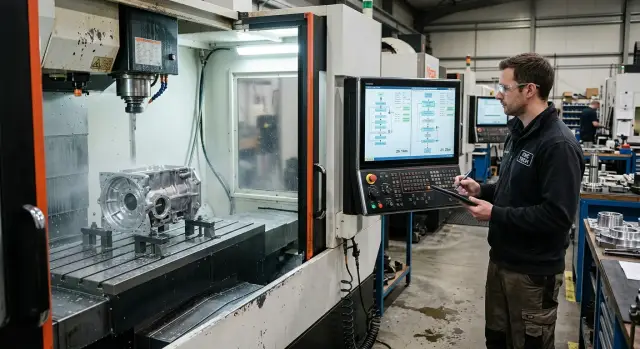
What the debate is really about in practice
The debate over whether to build operations by tool or by datum usually starts not in the CAM system, but at the machine. The process engineer wants to cut down on extra tool changes and idle moves. The setup operator wants to keep dimensions stable and avoid drift after every new setup. Both are right; they just look at the part from different angles.
If the route is built by tool, the program is arranged so the same tool does as much work as possible in one pass over the part or the batch. This often saves minutes on tool changes, especially when there are many operations and only a few tools. On a simple part, the difference is barely noticeable: one face, a few holes, a couple of chamfers, and both approaches give almost the same time.
If the route is built by datum, the logic follows the current setup and the reference surfaces. First you do everything that can be done while the part sits on one datum, then you flip it and continue. This approach usually keeps the relationships between holes, pockets, and faces better. For a housing part, that becomes obvious very quickly.
A housing rarely forgives a loose sequence. It has pockets, bores, threads, side holes, and sometimes thin walls. If you first chase tool convenience and then change datums several times, you may get a good size on each individual surface, but weak repeatability between them. On the drawing, all the tolerances sit next to each other; in the shop, the references start to drift.
A simple example: there is a housing with two pockets, a bearing seat, and side holes nearby. With a tool-based route, the drill and the end mill work almost without pauses, so the cycle looks shorter. But if some holes move to another setup, inspection may show coordinate variation. With a datum-based route, the cycle is sometimes longer on paper, but there are fewer surprises after repositioning.
So this is not a theoretical argument. One route cuts tool changes; the other keeps dimensions better from one datum. The more complex the housing and the more pockets, side areas, and linked dimensions it has, the faster the difference between these two logics grows.
When the route is built by tool
A tool-based route is chosen when reducing tool changes matters more than completing one setup all the way through. The programmer first groups all transitions done by the same cutter: for example, rough pocketing, similar slots, and outer passes. Then the next tool is loaded and it goes through all the areas where it is needed.
On a housing part, this often looks simple. First, a face mill removes the faces, then a 16 mm end mill roughs out all the pockets, then a 10 mm cutter reaches the narrow areas, and after that the drills finish the hole groups. The machine spends less time changing tools, and in series production that gives a noticeable saving in minutes.
Where it helps
This route is useful when the part has many repeated features and they all sit in one setup. Then one tool does a large amount of work without pauses, and it is easier for the programmer to adjust feeds and speeds for a group instead of for ten separate operations. If the cutter starts heating the material or leaves burrs, it is enough to correct the feed and spindle speed in one block, instead of hunting for those spots all over the CNC program for the housing part.
In the debate over “operations by tool or by datum,” this approach usually wins where the part is repeated batch after batch. Even a 15–20 second saving per cycle quickly turns into hours over a month.
Where the risk starts
The weak point appears after the part is flipped or the datum changes. As long as all areas are tied to the same datum, the tool-based logic usually stays clean and fast. But if some operations must be done from another datum, the program becomes less readable: the same tool works in different coordinate systems, and any offset error immediately affects the size.
That is why a tool-based route is good where the datum is stable and the geometry repeats. If a housing part has to be repositioned several times, the time saved on tool changes can be eaten up by extra checks and the risk of scrap on the second side.
When the route is built by datum
A datum-based route is chosen when geometry matters more than saving on every tool change. First, the technologist defines the reference faces, axes, and zeros, and only then lays out the operations. The logic is simple: the part should be located once, and as many dimensions as possible should be taken from that setup.
This approach is often used for housing parts with many holes, pockets, and seating surfaces tied to each other. If all these features are machined from one datum, the dimensional chains become shorter. There are fewer errors, and it is easier for inspection to understand where each dimension came from.
In practice, it looks like this: the part is placed on the chosen supports, the zero point is set, and everything accessible from the current setup is machined. First may come face milling, then drilling, boring, tapping, and then face milling again. Tools change more often, but the datum stays fixed.
What is faster in series production
In series production, speed is decided not by how elegant the route is, but by the time per good part. If identical housings are coming one after another by the dozens or hundreds, the tool-based logic usually wins. The machine spends more time cutting and less time on tool changes, idle moves, and repeated measurements.
You should not look at the total number of operations in the CNC program for the housing part, but at the cycle structure. If cutting takes 6 minutes and tool changes, probing, and travel take another 3, there is plenty of room to improve. If cutting already takes almost the whole cycle, changing the route will not help much.
It is useful to count four things:
- how many seconds are spent on pure cutting;
- how many times the machine changes tools per cycle;
- how much time is taken by probing, repositioning, and flipping the part;
- how many identical parts are produced without stopping or retooling.
In a long series, even 8–10 seconds on one tool change quickly turns into hours. If the route has 14 changes and grouping by tool can reduce that to 8, the difference on a batch of 300 housings is already easy to notice. That is why in serial CNC machining the tool-based route is often faster, especially when the tool magazine is large enough and the needed cutters, drills, and taps are already in the pockets.
But there is an important caveat. A housing part does not forgive extra flipping. If the tool-based logic forces you to remove the part, turn it over, and pick up the datum again, the time gain may disappear. Worse, you can get drift in hole coaxiality, face parallelism, or the distance between datums. Then a formally fast cycle will lead to more manual adjustment and more scrap.
A lot also depends on the equipment. On a center with probing, pallets, and stable workholding, the machine can keep pace more easily, and the tool-based route works better. If the magazine is small, there are no pallets, and the operator often changes tools manually, a datum-based scheme may be smoother and calmer for production.
A good rule of thumb is simple: the longer the series and the more stable the clamping, the more sense there is in grouping operations by tool. If the accuracy of the housing is kept only by strict datuming and every flip risks drift, the fastest option is not the shortest cycle, but the one with fewer reworks.
What works better in a small batch
In a small batch, time is often spent not on the machining itself, but on setup, checking the first part, and making local corrections. That is why in the debate over “operations by tool or by datum,” the datum-based route usually wins here.
It is easier for the setup operator to read the program when one setup is kept together in one place. He can immediately see which surface is used as the reference, which dimensions are tied to each other, and where drift can be caught quickly. In practice, that reduces unnecessary stops and repeated checks.
The first part is also easier to inspect. If the important dimensions come from one datum, they can be measured right after the cycle, and it becomes clear very quickly what needs to be corrected. There is no need to page through the CNC program, search for scattered transitions, and guess where the size started to drift.
In the CNC program for a housing part, this becomes especially noticeable. Suppose a trial run shows that a pocket needs to move by 0.2 mm and one face needs to be cut a little deeper. With a datum-based route, the programmer and setup operator adjust one section of the program inside the current setup, instead of touching several places all over the route. There are usually fewer mistakes that way.
This logic is even more convenient when the part mix changes often. Today the machine is making a pump housing, tomorrow a cover, then a plate with similar datums. In this kind of work, an extra tool change often costs less than having to untangle a complex sequence of operations and learn someone else’s program again.
A datum-based route is more likely to win if:
- the batch is small and the first part takes a long time to dial in;
- dimensions are closed within one setup;
- the drawing or model often changes after a trial run;
- different parts are switched quickly on the same machine.
A tool-based route can still give a good result, but in a small batch it usually demands more attention from the setup operator. And on a shop floor where parts are changing all the time, a clear datum is almost always more convenient than a beautiful grouping by cutters and drills.
How to choose the logic for the part
Look not at how you are used to writing the program, but at the dimension scheme of the part. If several critical dimensions come from the same datum, it is better to keep them in one setup. That way, you do not transfer the error from a flip into every next transition.
Then break down the tooling. It helps to list not only the cutters, drills, and boring tools, but also how many times each one is called in the program. Sometimes the question of “operations by tool or by datum” solves itself almost immediately: if the same cutter comes back 8–10 times in different setups, the losses from tool changes and idle moves are already noticeable.
There are also parts that break a nice-looking logic on paper. Flips, long tool overhangs, thin walls, weak clamping — all of these change the picture. If the wall starts to flex after roughing, a convenient tool-based route may leave too much stock for finishing and push the size off. In that case, it is safer to build the CNC program from the datum, even if the program ends up a little longer.
In practice, a simple rough calculation with two schemes helps. For each one, count the time for tool changes, idle movements, repositioning the part, and checking after critical operations. You do not need perfect accuracy down to the second. It is enough to understand where you are losing 6 minutes on the machine and where you are losing 20 minutes of operator time.
A simple example: a housing has a face, two precise holes, and a pocket. If the holes and the face are tied by a tight tolerance, the datum-based route is almost always calmer. If the tolerance between them is loose, and the part has many identical holes, threads, and chamfers, the tool-based scheme often gives a shorter cycle.
Before starting the first part, check five things:
- which dimensions cannot be carried across a repositioning;
- how many calls each tool has;
- where flips and long overhangs will occur;
- how many minutes each scheme takes in a rough calculation;
- what the first part shows in time and dimensions.
After the first part, do not argue with the plan if the facts say otherwise. If the cycle is shorter but the size is drifting, change the logic right away. If the size is stable and the losses come from tool changes, rebuild the route more boldly.
Example on one part
A good example is a pump housing. It has a reference face, a pocket, a row of mounting holes, and a bore for a fit. On a part like this, the debate over “operations by tool or by datum” quickly stops being theoretical: both approaches work, but for different priorities.
If the shop makes 500 identical housings, the route is often built by tool. After the first setup, the operator tries to group the passes so the same cutter does as much work as possible without extra changes. For example, the face mill machines the face, then the end mill immediately roughs the pocket, and the drill goes through the whole row of holes. On one part the gain is small, but in a series it builds up. Five extra seconds per tool change turn into noticeable hours by the end of the order.
For a batch of 20 pieces, the logic is usually different. Here the goal is not to squeeze out every second, but to get the size quickly without long debugging. That is why the technologist often keeps the dimensions from a common datum: first the base face and side supports are confirmed, then the pocket, holes, and bore are done within the same logic. This route is easier to check on the first part and easier to adjust if the stock varies.
There is also a hard limit. If the bore sets the fit for a bearing, bushing, or cover, you cannot push it to the very end just because it is more convenient to group the passes under one tool. That operation lives from the datum and the real position of the part. Otherwise you may save a minute in the route and lose the whole batch on coaxiality or offset.
On one drawing, you often end up with two workable routes:
- For series production — fewer tool changes, more repeatable passes, shorter cycle.
- For a small batch — tighter datuming, simpler setup, lower risk of size drift.
That is why a CNC program for a housing part is never the same for every case. For serial CNC machining, one route will give the better takt time, while for small-batch metalworking the same route will only make startup harder. The normal approach is to keep two versions and choose based on order size.
Mistakes that waste time
Most minutes are lost not on cutting, but on extra returns, checks, and rework. On a housing part, you can see it right away: the program seems to run fine, but the shift loses time chasing dimensions, rechecking, and doing unnecessary adjustments.
A common mistake is mixing roughing and finishing without a clear reason. For example, the programmer removes the main stock, then finishes a neighboring face, and later comes back to roughing on another pocket. The part heats unevenly, the tool works under different loads, and the finishing size starts to drift. If there is a reason to do it this way, it is better to name it clearly: zone stiffness, access limits, or deformation risk. If there is no reason, the route only confuses the operator.
The other extreme is to run everything by tool and ignore the dimension chain. On screen, such a route looks fast: one tool works through all similar features, then the next. But on a part with several setups, that often leads to extra fitting. Holes, faces, and seats may depend on one datum, not on how many tool changes you saved.
The opposite mistake is expensive too: building everything only from the datum and not counting the losses from tool changes. If you create extra calls, idle moves, and repeated approaches just to keep one logic, the cycle grows by minutes. In series production, that quickly turns into hours over a week.
Many people also forget about probe access and control points. In the CNC program everything looks neat, but on the machine the probe cannot reach the wall of a pocket or cannot touch the needed face after the part is turned. Then the operator removes the housing, takes it to inspection, and installs it again. Time is lost not in small amounts, but in jumps.
When moving from a series to a small batch, another problem often appears: nobody records what exactly changes in the route. Yesterday the part ran in a long series with one logic, today the batch is small, but the program and setup sheet stayed the same. As a result, people argue at the machine about whether transitions can be combined, where to measure the first size, and when to do the finishing pass.
Usually a short note in the process sheet is enough:
- what stays fixed from the datum
- which operations can be combined in a small batch
- where the part is measured directly on the machine
- which dimensions are checked after repositioning
If that is missing, the debate over “operations by tool or by datum” turns into lost shift time. If it is there, the result is clear from the facts: where you save minutes and where you are creating extra work yourself.
Quick check before startup
Before the first part, it is better to spend five minutes checking than to lose half a shift hunting for the cause of scrap later. This is especially important when you are still deciding what is faster for this batch: operations by tool or by datum. A mistake in route logic usually shows up not in simulation, but at the machine, when the first part is already in the vise or on the plate.
First, look at the part zero. It must match the setup sheet, not the value the operator “remembers from the last job.” If the CNC program uses one zero, the setup sheet another, and measurement uses a third point, trouble is almost inevitable.
Then check the dimensions that determine whether the part is acceptable. They should be tied to the datum you chose for the route. If you made the lower face and two side stops the datum, then the first dimensions should be checked from them as well. Otherwise you may get a part that holds size on paper but does not assemble properly.
A short check helps in practice:
- the zero on the control, in the setup sheet, and in the CNC program matches;
- dimensions with tight tolerance are measured from the chosen datum;
- the machine magazine can hold the full tool set without extra swapping;
- after flipping, the tools still reach the important surfaces.
The magazine is often a problem in small batches. The program is ready, but the magazine does not fit a pair of long drills, a boring tool, and a chamfer mill. Then the operator starts changing positions manually, and the gain from the tool-based route disappears.
It is also worth checking the flip in advance, at least mentally on the actual part. On a pump housing, it may look simple: after changing the datum, the long holder can no longer reach the deep hole, and the face for the cover is blocked by the clamp. That means the operation order needs to be changed before startup, not after the first trial part.
Another practical point: the operator must know exactly where to measure the first part. Not “check everything,” but take 3–4 dimensions that will immediately show whether the datuming scheme is alive and whether the zero has shifted. That kind of check is faster and more useful than a full inspection at the very beginning.
What to do next
It is better to close this debate with a short test on your own part, not with opinions. Take one real housing you make often and build two routes for it: one with datum logic and one with tool logic. You do not need a perfect CNC program for the whole day. Two working versions are enough to compare honestly.
Look not only at the “pure” machine time. Often the winning route is not the one where the spindle runs for fewer minutes, but the one where the operator repositions the part less often, the setup operator changes tools less, and inspection goes through without extra returns. In a small batch this is especially noticeable.
It is convenient to put the comparison into a simple table:
- cycle time per part
- number of setups
- number of tool changes
- amount of in-process inspection
- risk of error accumulation from datums
After such a run, it is usually clear where operations by tool or by datum bring real value, and where there is no real debate at all. For example, for a housing machined on two sides with a tight tolerance on the relationship between surfaces, a datum-based route often gives calmer inspection. For a part with a small run and many similar holes, the tool-based route often saves setup time.
After that, it is worth fixing a simple rule for your typical housings. Not “we always do it this way,” but a rule for choosing. For example: housings with two critical datums are run by datum, while parts without a tight link between sides are first checked for a tool-based version. That kind of note quickly saves hours on the next startup.
If at this stage you are no longer blocked by the CNC program, but by the machine itself, it is useful to check the route against the hardware. EAST CNC works with metalworking equipment and can help you assess which machining center, workholding scheme, and service approach are the best fit for your housing parts. Sometimes one conversation removes an error that would otherwise eat up months in retooling and corrections.