
Tool stock or frequent deliveries: how to choose
Tool stock or frequent deliveries — the right choice depends on import lead times, consumption rates and the cost of downtime. We explain the calculation and common mistakes.
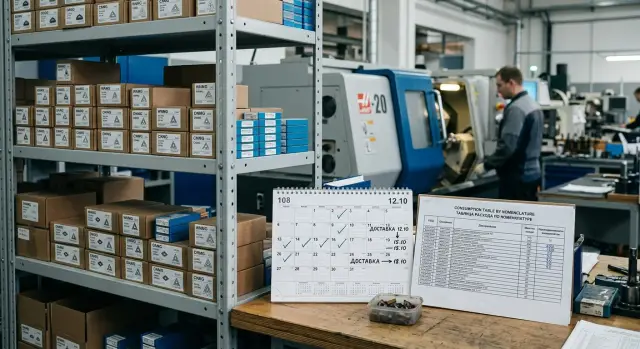
What's hard about this
Choosing between keeping a stock of tooling and ordering frequently rarely comes down to a single number. On paper it looks simple: either buy more in advance or take small amounts as needed. In the shop it doesn't work that way. Production suffers interruptions, deliveries are delayed, and each SKU is consumed differently.
Import increases the risk. A supplier may quote a lead time, but the actual delivery can arrive later because of shipping, customs, or changes in shipment schedules. For a turning shop this is not trivial. If the required insert or tool holder isn't available on the day a batch starts, the machine waits and the shift schedule moves.
The items themselves behave differently. Some SKUs are used every week with few surprises. Others are rare: they sit idle for a month, then are needed for two jobs at once. Applying one rule to the whole list quickly makes the warehouse pointless: either it stores too much irrelevant stock or it lacks the exact SKU needed on the right day.
Extra stock feels safe, but it has a cost. Money is tied up in inventory, bins fill with slow-moving items, and some tools become obsolete before they're used. For a company with CNC machines this is especially visible when the assortment is wide and purchases are for different part types and machining modes.
Frequent deliveries don’t solve everything either. They work when consumption is steady, the supplier is reliable, and lead times are short. But if lead times are long or vary by several days, a small balance quickly becomes a production stop risk. One missed SKU can disrupt output more than ten boxes sitting idle on a shelf.
So the issue isn't a buyer's preference but the picture for each group of items. You need to look separately at tool lead time, consumption frequency, cost of machine downtime, and the cost of excess stock. When you mix all that into one aggregate number, the decision is usually weak.
When stock is justified
Stock is needed where a new batch takes a long time to arrive and consumption never stops. For a CNC shop this is common: inserts, tool holders and drills often come by import over many weeks, while orders come in daily. If lead times are long and unstable, even a single delay quickly hits the schedule.
This is especially true for SKUs used in almost every order. Suppose a turning area regularly machines the same parts and the same insert is consumed predictably every week. In that case a safety stock of that tooling is not excessive. It simply bridges the gap between shipments.
Yes, cash is frozen in inventory. But machine downtime usually costs more. The shop loses work hours, delivery dates shift and there's overspend on urgent replacements. If the machine is continuously loaded, one missing item can stop not one operation but the whole area.
Stock also makes sense where a quick local replacement is hard to buy. On paper there may be an equivalent, but in practice it often proves different: wrong geometry, lower wear life, worse surface finish, extra setup time. Formally the tool looks similar, but in reality it breaks the established process. This happens often in metalworking.
Another clear signal is a supplier who regularly moves the shipment date. A one-time delay is not critical. If it repeats, relying only on frequent deliveries is risky—especially for imports to Kazakhstan and neighboring countries, where extra days in logistics are common.
Usually stock is reasonable when several conditions come together: long and variable lead time, the SKU is consumed in nearly every order, equivalents are hard to buy quickly, and one hour of downtime costs more than holding a small reserve.
For high-turn SKUs with long logistics, stock almost always wins. The steadier the consumption and the higher the cost of downtime, the calmer operations are with a clear on-hand balance instead of waiting for the next truck.
When frequent deliveries are better
Frequent deliveries are preferable when holding stock consumes cash faster than it helps production. This is especially visible at a CNC shop where tooling consumption shifts by order mix rather than day.
Today you may run simple serial parts, and in two weeks the plan includes small batches made from another steel. The picture changes instantly. Some SKUs are barely touched, others disappear fast. In that situation a large inventory often becomes a collection of expensive leftovers.
Frequent purchases usually work better for expensive, low-turn SKUs. There's no point in keeping a large lot of inserts, drills or special sizes on the shelf if they are used rarely and unevenly. Money sits in boxes instead of working in production.
This scheme works well when lead time is short and reliable. If the supplier consistently ships within a few days, you can order smaller batches and replenish based on actual consumption. The risk of slow-moving stock drops.
A backup supplier also helps. If you have two reliable supply channels, a failure at one won't stop the area. For imports this is not always possible, but with local availability or predictable logistics such a hedge greatly reduces risk.
Another sign: you can substitute size, geometry or brand without losing part quality. If substitutes work smoothly, carrying a wide safety stock for every SKU is unnecessary.
Typically frequent deliveries suit cases where consumption by SKU fluctuates widely, the item is expensive and slow-moving, lead time is short, there's a second supplier or a close equivalent that can be used without long approvals.
A simple example: a turning area machines one series for a month, then switches to a different material and cutting mode. Keeping stock for every scenario inflates inventory. Ordering small batches every one-to-two weeks keeps the shop flexible and avoids freezing budget in excess stock.
How to split SKUs by consumption
If you lump all SKUs into one list, the decision will be weak. Inserts with daily consumption, expensive rare holders and items for one-off jobs cannot use the same rule. This step usually makes clear where to hold stock and where frequent deliveries are better.
Start by exporting consumption for at least three to six months. One unusually good or bad month skews the picture. Look not only at total quantity but at withdrawal frequency: daily, weekly, monthly or rarer.
A simple grouping scheme
It's convenient to divide SKUs into four groups: daily consumption, regular but uneven consumption, rare and expensive items, and those driven by a single customer.
The first group is usually obvious. If inserts, drills or taps are used almost every day, they need their own safety stock. Otherwise even a short delivery delay will stop the area faster than expected.
The second group has consumption but it jumps. Two boxes of inserts one week, silence the next. For these SKUs keep a smaller reserve than for daily items, but don't drop to zero. Look at peaks, not averages.
Collect rare and expensive SKUs separately. These might be special holders, nonstandard inserts, or tooling for a narrow operation. Buying them “just in case” in the same volume as high-turn items is uneconomical. Often a single spare unit or made-to-order purchase is enough.
Check SKUs driven by a single client separately. If one customer accounts for most consumption of an SKU, that demand is not stable. If the customer postpones, the warehouse becomes overstocked. For such SKUs keep minimal balances and review the CNC procurement plan more frequently.
After grouping, set replenishment rules for each group. For daily consumption that means stock covering the full lead time plus a reserve. For rare expensive items buy to confirmed orders. For client-driven SKUs use a short planning horizon and manual checks before ordering.
If you group honestly, the warehouse calms down. Money stops being tied in slow items and the risk of downtime for daily-needed tooling drops.
How to calculate minimum stock
Minimum stock is calculated not by feeling but by two simple data points: how much tooling you use and how long it actually takes to get a new delivery. If you average across the entire warehouse, error is almost inevitable. Tool consumption must be counted per SKU. Inserts, drills and taps have different consumption rates.
First, record the average weekly consumption for each SKU. Better to take the last eight to twelve weeks, not a single lucky week. If the area used 20 inserts per week on average, that is your working baseline.
Then look at the real lead time. Not the one on the invoice or in the quote, but the full path from placing an order to arrival at your warehouse. For imports this often includes order confirmation, shipment, transport, customs, holidays and routine schedule shifts. On paper lead time may be 30 days, but in practice it could be 42.
The formula is simple:
Минимальный запас = расход на период поставки + страховой запас
If consumption is 20 inserts per week and lead time is 6 weeks, you need 120 inserts to cover the wait. But that's not the whole stock. Add a safety buffer for disruptions. It is calculated for potential delay beyond the normal lead time. If the supplier sometimes delays a week, keep another 20 inserts. The minimum on-hand becomes 140.
This approach works for a simple warehouse and for a CNC procurement plan where some SKUs are steady and others spike. If the assortment is large, start with the highest-turn SKUs since they cause the most expensive stoppages.
Recheck numbers monthly rather than set-and-forget. Batches, machine load, series length and logistics change. If consumption rises from 20 to 28 inserts per week, the old calculation no longer helps.
A good practice is to keep three numbers per SKU: weekly consumption, real lead time and safety buffer. That's enough to avoid overstocking slow items and to prevent running out when it matters most.
Example for a turning area
The area has two CNC lathes. They produce series parts, so some tooling is used steadily and predictably. But across the SKU list it's mixed: one insert is consumed weekly while another is only needed for a specific material.
Take a high-turn SKU. Both machines use that insert almost every day and the shop consumes one box per week. If lead time is six weeks, the foreman keeps six boxes in stock. That balance covers the waiting period without excessive reserve.
Cutting corners on this SKU is risky. If the box runs out before the next delivery, both machines stop. For the shop that's typically costlier than storing several boxes on the shelf. Losses include downtime, schedule disruption, extra setups and urgent purchases at higher prices.
For a rare SKU the logic differs. This insert is used only for one material that comes into production infrequently. Sometimes it sits idle for three weeks, then half a box is used in a couple of days. No need to buy stock for the full lead time. The shop checks the next month's CNC procurement plan, matches orders for that material, and buys small lots—usually one or two boxes.
In practice the area works simply: the foreman keeps high-turn SKUs stocked for the full lead time, the buyer orders rare SKUs in small lots to the plan, and the storekeeper checks balances against the start schedule weekly.
This approach avoids one rule for the whole warehouse. Where consumption is steady and downtime is costly, keep stock. Where demand is bursty and tied to a single material, frequent deliveries reduce excess inventory. It's more practical than keeping a blanket “just in case” stock and then staring at boxes that never move for months.
Where mistakes happen most often
The most common mistake is calculating consumption from a monthly average and stopping there. Average numbers are convenient in a table but often useless in practice. One big order or a material change can quickly eat up stock that looked sufficient on paper.
Peaks are especially dangerous for uneven SKUs: inserts, holders, small-diameter drills, and tooling for specific operations. If in March tooling hardly moved and in April a series began, the average will mislead. For calculations look at the busiest weeks as well as typical months.
The second mistake is trusting supplier lead times without adjusting for import realities. If a supplier promises 30 days, it doesn't guarantee the tool will be in your warehouse in a month. Customs, consolidation, holidays, payment, re-sorting, and transport between CIS countries all add days or even weeks.
Companies in Kazakhstan know this well. In metalworking a CNC machine's downtime often costs more than an extra box of inserts. So count lead time based on past deliveries, not the best-case scenario in a quote.
The third mistake is keeping the same stock rule for the entire SKU list. It's easier, but a bad habit. You can't apply the same norm to fast-moving and rare items. The result: high-turn SKUs run out early, rare ones sit for months, cash is tied to inventory, and you still lack the right tools.
Another issue is nobody clears slow-moving stock. Over time the warehouse accumulates items for old parts, one-off jobs and cancelled processes. Formally you have stock, but it doesn't help current production.
That leftover stock prevents making proper choices about where to hold stock and where to use frequent deliveries. On paper the warehouse looks large, but for the needed SKUs it's empty. A quarterly clean-up to see what's actually used versus what's just occupying space and money helps.
Finally, many look only at purchase price. Frequent deliveries seem cheaper per unit, but if a delay stops a machine or ruins a batch, those savings disappear fast.
A practical decision usually compares two numbers: how much excess stock costs and how much one day of downtime costs. When the second number is calculated honestly, a CNC procurement plan becomes calmer and more accurate.
A quick checklist before deciding
Before deciding, walk through each SKU and answer a few simple questions. They quickly show where the cost of downtime exceeds the cost of stock and where inventory is already bloated.
Start by looking at downtime, not price. One inexpensive insert can cost the shop more than a whole box of inserts if its absence stops the area for a day or two.
Check five things: how many hours or days a machine will be idle without the SKU, how often you actually consume it per month, whether a quick substitute exists, how much money is already stuck in slow stock for that group, and how often the supplier moves dates—especially for imports.
If downtime is expensive, consumption is steady and lead time varies, a safety stock is almost always needed. Even a small reserve covering two to three weeks is often cheaper than one lost production day.
If the SKU is used rarely, a substitute is available quickly, and old slow-moving stock already exists, frequent deliveries are better. Don't freeze money in boxes that will be opened in six months or not at all.
Calculate by SKU, not by the whole warehouse. You may have high-turn inserts for serial turning next to rare tooling for a one-off job. The first group needs clear stock rules; the second can be ordered to the work.
A simple example: the area uses 80 inserts a month, the supplier delays shipments by 10–15 days, and no local substitute exists. Stock is required. If a special drill is used once every two months and a substitute is available within a day, a large buffer is not necessary.
This quick filter works well for CNC procurement planning and for sorting an old warehouse. It typically leaves a short list of SKUs where the decision really affects cash and output, not just creates the appearance of order.
What to do next
Make decisions based on numbers from the last three months, not on the general feeling about the warehouse. If you choose between stock and frequent deliveries, start from actual consumption by SKU, not from the total monthly purchase amount.
Export consumption for all SKUs: inserts, tool holders, drills, taps, cutoff tools, and tooling for changeovers. Flag SKUs that were used outside the plan because of urgent orders, scrap or material changes—otherwise the picture becomes too smooth and useless.
Then split the assortment into three groups: high-turn SKUs used continuously, rare SKUs for specific parts or short runs, and problematic SKUs with variable lead time or no easy substitute.
This analysis quickly shows where safety stock is needed and where the warehouse just freezes cash. Often you only need stock for 15–20 of the most sensitive SKUs, not the whole catalog.
For imports, recalculate stock using real lead times rather than promised times. Include confirmation, payment, transit, customs and possible carrier delays. If on paper the tool takes 45 days but in practice arrives in 65, use 65 in calculations.
Link the CNC procurement plan to machine loading. If the turning area moves from one shift to two next month, consumption usually jumps for the most-used SKUs rather than increasing smoothly. It's better to spot that early than to scramble for urgent deliveries later.
If an area is being set up or the product mix changes, discuss these questions during equipment selection. EAST CNC, the official representative of Taizhou Eastern CNC Technology Co., Ltd. in Kazakhstan, works not only on machine supply but also commissioning and service, so future machine loading can be aligned in advance and tooling purchases won't be guesswork.
After that, the routine is simple: every two weeks check actual consumption, lead time and production plan. That's enough to increase stock for one group and safely reduce it for another in time.