
Tool Overhang in Milling: How to Choose the Length
Tool overhang in milling affects vibration, accuracy and cycle time. A simple approach helps pick the right assembly length without excessive margin.
Where the problem starts
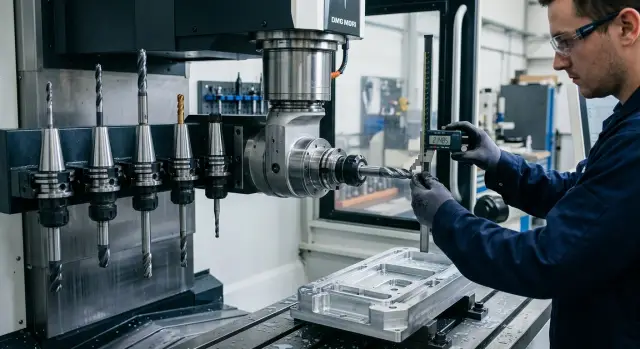
Tool overhang in milling seems like a small detail until the cutter starts to ring in the workpiece. In practice it's the distance from the clamping point to the cutting edge. The longer it is, the easier the whole assembly bends under load.
You can imagine it with a simple ruler. If it sticks out 20 mm from the table edge, deflection is almost unnoticeable. If it projects 80 mm, even a light press causes wobble. The cutter behaves in the same way.
The problem appears long before visible scrap. First, extra millimeters simply reduce stiffness. Then the machine and process parameters seem to "adjust": the operator reduces feed, the technologist decreases depth of cut, the program adds an extra pass. The part may still be acceptable, but the cycle gets longer.
So extra overhang is not a harmless margin. On a thin cutter or in side milling, an additional 5–10 mm quickly shows up. Usually the sound changes first, then ripples appear on the wall, dimensions start to "float", and the edge dulls faster than usual.
The chain is simple. Vibration comes first, then the surface trace degrades, and tool wear accelerates. If you keep working the same way, you may get a chip or breakage at the worst moment.
The most costly effect is often not scrap but lost time. A long assembly cuts less confidently, so machining is done more cautiously. Where a short tool would remove stock in two passes, a long one may need three or four. On a single part that's minor. On a series it's hours.
In practice the reason is usually simple. For a 30 mm deep pocket they take an assembly with 60 mm overhang "to be sure it will reach." It does, but the machine pays for that margin with slower work and extra vibration. Loss of stiffness begins the moment the margin stops helping and becomes excessive.
What determines the working overhang
Working overhang is rarely defined by a single dimension. It depends on cutter diameter, depth of cut, part shape and the whole assembly from spindle to cutting edge. An extra 10–15 mm may seem trivial but under load quickly becomes a noticeable loss of stiffness.
Start by looking not at absolute length but at the length-to-diameter ratio. A 12 mm cutter with 60 mm overhang behaves very differently from a 20 mm cutter with the same overhang. The thinner the tool at the same length, the easier it is to go into vibration.
Part geometry sets the lower limit. If you need to reach into a deep pocket, clear a tall wall or get into a narrow area, a too-short assembly simply won't fit. But taking extra length "just in case" is not a good idea either. Usually you need enough overhang for the cutter to confidently reach the deepest point and keep a small safe gap.
Material matters too. For aluminum a long assembly can sometimes still work acceptably because cutting forces are lower. For steel, stainless and heat-resistant alloys the same overhang may already be excessive. If the material is dense and tough, first shorten the assembly length before touching cutting parameters.
There is also a difference between roughing and finishing. Roughing has higher loads, so keep the overhang minimal. For finishing you can allow slightly more length to reach a wall or hold the profile. But it's better not to lengthen the whole assembly in advance. Split operations instead: a short assembly for roughing, a longer one only where strictly necessary.
Everything between the spindle and the cutter affects stiffness. A rigid holder maintains dimension better than a long chain of adapters. Collet, arbor, tool seating and spindle taper condition also change the result. If there's an unnecessary extender in the assembly, the working overhang increases even when the cutter itself looks short.
The practical order is simple: first choose diameter for the slot, pocket or corner radius, then check actual depth and possible obstacles, then take the shortest overhang that gives access to cutting. If the operation is heavy, try to shorten length once more. And almost always remove unnecessary adapters and recheck clamping.
A good starting rule: the minimal length that reaches the cut zone without touching walls and without unnecessary inserts in the holder.
How to tell stiffness is insufficient
Usually the problem starts with sound, not breakage. Cutting was steady, then a ringing, whistling or trembling metallic tone appears. If this sound repeats at the same section of the path, the tool is already working at its limit.
Next this shows on the part. Waves appear on the pocket wall or step, as if the cutter drifts out and back. Stripes or ripples remain on the bottom, even though program, material and parameters haven't changed.
With large overhang this happens often. The machine still cuts, but with extra oscillation. The part may come out within tolerance while cycle time and tool life are wasted.
Signs of insufficient stiffness
The most common signal is rapid and uneven edge wear. One cutter runs calmly while another shows small chips after a short pass. If tool life fluctuates for no clear reason, check not only parameters but also assembly length.
Operators often feel this before numbers appear in reports. They instinctively reduce feed, cut depth or add an extra finishing pass, even though material and tool are unchanged. Formally it looks like caution. In fact stiffness is already lacking.
Signs usually come together: sound sharpens with depth, waves repeat on the wall, the edge dulls faster, and parameters are quietly reduced. If two or three of these coincide, the cause is almost certainly not random.
A small example. A cutter ran a pocket reliably with 55 mm overhang. After changing the chuck the assembly grew to 70 mm and the machine immediately rang at the same parameters. The operator cut feed by 15% and reduced depth to finish the part calmly. Cycle time increased though the program stayed the same.
So look at the combination of symptoms. Uneven sound, surface waves, fast wear and self-reducing parameters almost always point to one thing: the assembly is too flexible for the operation.
How to choose assembly length
Most people err one way: they leave an overhang "just in case." On paper it's harmless, but on the machine an extra 15–20 mm quickly turns into vibration, surface marks and longer cycles. The working rule is simple: the tool must reach the cut zone without unnecessary overhang.
Proceed in steps. First measure the actual depth of cut. Look not only at pocket or wall depth but also where the lower point of the cutting portion will be. Often mentally tracing from the spindle face to the bottom of the cut makes extra millimeters obvious.
Then add a small allowance for safe approach and exit. You don't need a large reserve here. If the tool needs a few millimeters, don't turn them into tens.
Next choose the shortest holder that provides the required reach. If a short assembly solves the task, a longer one won't help. It will only reduce stiffness.
Then remove everything unnecessary: extenders, adapters, spacers. Each element adds length and weakens the chain. Before cutting, make a short trial cut and ensure the tool can enter the machining zone without risking collision with the part, vise or fixture.
Simple example: a 28 mm deep slot. If the cutting part and safe approach are covered by a 42 mm assembly, there's no point in building 55 mm. Those 13 mm seem small but often start the extra vibration. Then the operator lowers feed and depth and loses time.
What to check before choosing a holder
Sometimes the issue isn't the tool itself but the layout. Check how the workpiece is placed, the vise height, clamp positions, and whether you need side or top entry. Sometimes it's easier to change the workpiece setup than to switch to a much longer assembly.
If several tooling options exist, compare them by one criterion: which assembly gives the minimum length for safe work. This approach is especially useful before the first run. It helps remove extra overhang in advance, not after noise, scrap and lost minutes.
Example on a simple part
Take a common task: machine a pocket in steel 18 mm deep. No thin walls or complex geometry. An end mill, 12 mm diameter, standard setup for a vertical machining center.
Compare two nearly identical assemblies. In the first the cutter projects just enough to reach the bottom without the holder touching the top of the part. In the second they added only 6 mm "just in case."
On paper the difference is tiny. On the machine it shows up quickly.
The short assembly holds the cut steadier. Sound is calmer, feed runs without wobble, and the pocket wall comes out cleaner. If parameters are right, this length usually works without compromise.
The long assembly behaves differently. On the same steel and cutter a slight ringing appears, then a fine wave on the wall. The operator almost always does the same: reduces feed or depth to stop the vibration.
You usually see the difference in three things: cutting sound becomes uneven, marks remain on the wall and bottom, and the machine takes longer to pass the same section due to a gentler regime.
Say the short assembly runs at 1100 mm/min feed. The long one already hums at the same settings and the feed must be dropped to 850–900 mm/min. It seems small, but on a series it quickly adds up.
The point is simple. You don't need complex formulas to decide. Assemble the tool with the minimal safe overhang that clearly reaches the machining zone. Add length only where geometry makes it unavoidable.
Then overhang ceases to be an abstract number and becomes readable by real signs: sound, surface trace and how long the machine spends on the same work.
Mistakes that eat stiffness
Most stiffness loss comes not from the cutter but from the habit of taking extra length. The tool reaches the cut zone, and that's considered enough. But an extra 10–20 mm quickly creates vibration, dimension drift and longer cycles.
The most common mistake is a large "just in case" margin. Assemblies are left for future parts, possible regrips or simply for comfort. As a result the current operation is done with a longer-than-needed tool. In machining this habit usually costs more than expected.
Second mistake: a long holder where a short one would do. This is often seen on ordinary pockets and steps where access is only 25–30 mm but the spindle holds a much longer setup. From the outside everything looks fine, but stiffness drops and the machine must cut softer.
Third mistake: a chain of adapters. Each extra joint adds a weak spot. Even if runout stays within limits, such an assembly resists side loads worse. One shorter, simpler unit usually beats a long combination of chuck, extender and adapter.
People also confuse dimensions. Cutting length and overall tool length are not the same. If you pick only from a catalogue it's easy to choose a cutter "with margin" while the working part should be short. Working overhang is measured from the clamping point to the cut zone, not from a neat spec number.
One more common mistake: checking only reach. Yes, the cutter must reach the pocket bottom and not touch the wall. But that's not enough. Ask whether the assembly will withstand side load at the chosen feed and width of cut.
A good rule is simple: don't choose length "for a margin", choose the minimal length truly needed for clearance and a safe gap. Anything longer the machine pays for with speed, surface finish and tool life.
Quick check before start
Spend two minutes on checks before the first pass — it's cheaper than thirty minutes hunting a ringing source. Extra millimeters usually reveal themselves immediately.
First compare actual cut depth with the assembly overhang. If the pocket is 18 mm deep and the assembly projects 35 mm, the margin may already be too big. The part needs practical length for entry, work depth and safe exit, not a pretty reserve.
Then look around the tool. Often the problem isn't the cutter but the holder being too close to a wall, step or clamp. On screen everything looks fine but in metal there's only a couple millimeters clearance. With runout or deflection that's too little.
Also check chip evacuation. In a closed pocket or deep cavity the assembly may cut fine for seconds, then chips start to swirl near the tool. After that noise, heating and surface marks grow quickly.
Before start check five things:
- is the length just enough for the needed depth without a large reserve;
- is the holder not too close to a wall, edge or clamp;
- is there room for normal chip evacuation;
- does the assembly hold a test cut without ringing or surface marks;
- do you avoid having to reduce feed within the first minutes.
The last point is the most honest. If the operator reduces feed by 15–20% on the first run, the assembly length is likely wrong or stiffness margin too small. That sometimes saves a part but almost always lengthens the cycle.
Make the trial cut not in air but on a short real cut. A small section where you can hear the tool and see chips is enough. A steady sound, stable load and clean chips usually mean the setup is good.
If vibration appears during the test, don't rush to change parameters. First remove excess length, check tool seating and then alter feed or depth. These mistakes are easier to fix before start than after the first spoiled part.
What to do next
If the overhang proved too large, don't change everything at once. Start with operations that repeat most often. They have the biggest effect on cutting stability and cycle time.
It's useful to list them in a table: part, operation, current assembly length, actual cut depth and the real reserve needed for safe work. Even this step often shows where tools are kept longer than needed.
Then take 10–15 most frequent operations, measure actual depth and required clearance, compare with current overhang, shorten length where the margin is clearly excessive and record the result in a setup card or tool database. Once you find a working length, the setup technician won't size it by eye again.
Example: a 28 mm slot is machined with a 65 mm overhang. If geometry and fixturing allow 46–48 mm, the machine often runs calmer. Noise drops, vibration marks reduce and you don't need to cut feed so much. On one part the difference is small, but on a series it accumulates.
Use the same approach for tooling selection and machine setup. First calculate the working overhang, then choose holder, arbor and cutter. If you do the opposite, you can end up with a weak assembly even though the problem was not cutting parameters but excess length.
If overhang grows because of complex part geometry, check the whole chain: tool, holder, clamping method and the machine itself. When the issue isn't only the cutter but equipment capability, EAST CNC helps with machine selection, commissioning and service. For such tasks it's often better than endlessly treating symptoms on an old or poorly configured setup.
A good outcome is simple: for frequent operations you have fixed working lengths, the setup tech doesn't add extra margin by eye, and assembly stiffness is enough for the specific part. That removes unnecessary noise in the process and helps you avoid paying cycle time for a few extra millimeters.
FAQ
What is tool overhang?
The distance from the clamping point to the cutting edge. The longer it is, the easier the cutter and holder will deflect. That increases vibration, tool wear and cycle time.
Why do an extra 5–10 mm already cause trouble?
Because rigidity drops quickly, especially with thin cutters and side milling. In steel, even a few extra millimeters often cause ringing, wall waviness and the need for softer cutting regimes.
How much length allowance should I leave?
Leave only the allowance needed for approach, cut depth and a safe exit. If the pocket is 30 mm deep, don't stretch the assembly to 60 mm just for peace of mind. Excess reserve almost always costs you in speed and surface finish.
Which is more important — depth or cutter diameter?
Start from the part geometry, then consider the length-to-diameter ratio. A 12 mm cutter with a 60 mm overhang behaves much more flexibly than a 20 mm cutter with the same overhang. The same overhang affects different diameters differently.
Do roughing and finishing need different overhangs?
Yes. Roughing has higher loads, so keep the assembly as short as possible. For finishing you can allow a bit more length if needed, but better to extend only that finishing operation, not the whole process.
Why are long holders and adapters bad?
Each extra joint weakens the assembly. A long holder, an extender and an adapter together often cause more problems than the cutter itself. Use a short holder if it meets the task and remove unnecessary parts.
How to tell the assembly lacks stiffness?
Usually the sound changes first. Then waves appear on the wall or floor, and the cutting edge wears out faster. If the operator reduces feed right at the start of a pass, the assembly most likely lacks stiffness.
What to check before the first run?
Compare the actual cut depth with the assembly overhang and check clearances near walls, clamps and vises. Then make a short real cut rather than an idle run. A steady sound and clean swarf mean the assembly is likely correct.
What to do if the cutter already rings?
First shorten the overhang and check the tool clamping. Often this helps faster than trying to fix noise by changing feed or depth. Only after removing excess length and adapters should you change cutting parameters.
When should I look beyond the cutter?
If you've already reduced overhang and checked the holder and clamping but the issue remains, widen the search. Part geometry, workholding and machine stiffness also matter. For these cases EAST CNC helps with machine selection, commissioning and service.