
Tool overhang: how to choose a holder and length without losing stiffness
How to assess tool overhang and choose the holder and working length for deep pockets and thin walls without unnecessary risk.
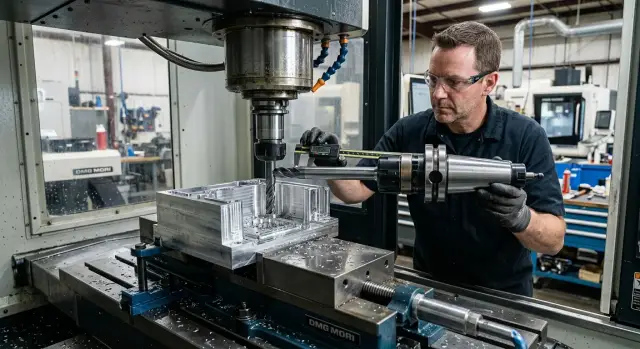
Why a long overhang quickly causes problems
A long tool behaves like a spring. The farther the cutting edge is from the clamp, the easier it deflects under load. Sometimes an extra 10–15 mm is enough to turn a quiet cut into noise, chatter and lost dimensional control.
Imagine a ruler: clamped short it barely moves; with a long free end it starts to vibrate even from small forces. The same happens with an endmill, but the consequences are costlier.
As overhang increases, cutting forces no longer follow the intended path. The tool pushes aside, returns, and then moves off again — and that’s how vibration starts. On the part you’ll notice it quickly: dimensions drift, walls show waves, and the pocket floor loses finish.
The problem isn’t only surface quality. Vibration hits the cutting edge in pulses. The edge alternately cuts, rubs and re-engages. It heats up, dulls faster and may chip. The tool might not break immediately, but it works unevenly and defects come in batches.
In narrow pockets the risk is higher. Chips are harder to evacuate, the holder body sits closer to the walls, and any rocking becomes more visible. For deep pockets operators often add length “just to be safe,” and in doing so they remove stiffness.
For thin walls the situation is worse: not only the tool but the part itself springs. The cutter pushes the wall away; the wall moves and then partially springs back. The final dimension no longer matches the calculation.
Therefore the allowance in length should be minimal. Extra millimetres seem safe—until the spindle whistles and the first batch shows dimensional drift.
Where to start before choosing a holder
Begin by examining the part, not the catalogue. For a pocket check the actual machining depth; for a wall check the height of the area the cutter will pass. If cutting happens only in the last 8–10 mm, a long assembly is usually unnecessary.
The most common mistake is simple: length is taken “just in case.” That’s how extra overhang appears. Every extra millimetre reduces stiffness, and the issue shows up sooner than expected: more noise, size wandering and waves on the wall.
Next, determine where the edge truly cuts and where the tool just passes through air. This is critical in deep pockets. A pocket may be 35 mm deep, but actual cutting may only occur in the bottom 12 mm while the tool moves in air at entry and exit. In that case working length is based on the cutting zone and safe clearance, not the full tool length from the catalogue.
Then compare cutter diameter to depth of cut. If a 6 mm cutter must work at 30 mm depth, a stiff short assembly is almost impossible. If a 12 mm cutter goes to the same 30 mm, the task is easier. The rule is simple: at the same depth, the smaller the diameter, the more important it is to minimize overhang.
Before choosing a holder, fix the material and surface requirements. The same length behaves differently in steel, stainless and aluminium. If no separate finishing pass is planned, you’ll need more stiffness.
In practice a short checklist is enough: geometry of the machining area, real cutting length, cutter diameter and surface requirement. Only after that choose the holder, not the other way around.
How to choose a holder
Choose the holder based on the cutting zone, not on what’s already in the cabinet. That way you keep overhang under control. A couple of extra centimetres often cause more vibration than the drawing suggests.
A typical sequence:
- Use the shortest cutter that confidently reaches the cutting zone. Allowance is needed only for entry and safe clearance.
- Pick a holder that gives the minimum extension from the spindle. If two assemblies provide the same access, take the shorter one.
- Check chip flow. In a deep pocket a long cutter won’t help if the holder body blocks chip evacuation.
- Make sure the holder body won’t hit a wall, step or pocket edge above the working area.
- Only then choose the clamping type and shank diameter. For heavy cuts prefer a stiffer option and the largest shank diameter the part geometry allows.
A useful guideline: decide length first, then holder envelope, and only then clamping. Doing the reverse often results in an assembly longer than needed.
Example: a pocket 45 mm deep with a 10 mm cutter. One assembly gives 80 mm working length, another 60 mm. If the shorter assembly doesn’t foul the wall and leaves room for chips, almost always choose it. It runs quieter, holds size better and loads the spindle less.
If a thin wall is nearby, don’t push a bulky holder body tight against the part. Even without direct contact, a close body often adds vibration. In such places a small clearance is preferable to extra length.
How to set working length without extra allowance
Measure working length from the clamping point to the farthest cutting area. Not to the tool tip on the drawing and not with extra “for later.” Extra millimetres quickly reduce stiffness and the overhang works against you.
Operators often leave extra length to avoid retooling. In reality that allowance causes vibration, worse dimensional control and poorer surface. If the part can be machined with a 45 mm overhang, there’s no point setting 60 mm for convenience.
A simple method works well. Find the farthest point where the edge actually cuts. Then check if the tool needs to clear a wall, step or fixture. Add length only for those real obstacles. If the holder body clears everything and the cutting zone is reachable, no extra allowance is needed.
If length is insufficient, first revise the tool path. Changing entry, splitting rough and finish passes, or using a shorter tool for the first stage often helps. One extra pass is almost always better than a long assembly that chatters constantly.
When extra length is unavoidable, calm the cutting mode: take smaller axial depths and don’t try to remove the same volume as with a short tool. That lowers load on the holder and cutter and reduces chipping risk.
A short example: a 40 mm deep pocket next to a tall flange. The tool was initially set to 65 mm to reach everywhere. It reached the bottom but produced noise and marks on the wall. After checking the path it turned out 48 mm and a narrower flange clearance were sufficient. The cut ran quieter and dimensions stabilized.
Keep this order in mind: first short, then sufficient, and only then longer if required.
What changes in deep pockets
A deep pocket behaves worse than it looks on the drawing. While the cutter works near the entry everything seems fine, but as it goes deeper the effective overhang grows and even a small weakness can turn into ringing, wall ripple and dimensional drift.
A narrow pocket adds chip evacuation problems: chips tend to spin inside the cutting zone, get under the edge, heat the tool and spoil the finish. If feed is too aggressive the cutter won’t cut cleanly but will impact and rub.
In these conditions don’t try to take full depth in one pass. A multi-pass scheme with smaller axial depths usually runs steadier. Yes, the cycle is longer, but the tool holds size, the edge doesn’t chip and the pocket floor stays even.
Often a stiffer assembly helps, even if achieving it requires an extra tool change or strategy change. One additional pass is almost always cheaper than a broken cutter, a wall defect or long rework after vibration.
Before starting check: does the length only cover the working depth, will the holder body hit the top of the pocket, is there space for chip exit, and does the assembly preserve stiffness not only at entry but at full depth. These checks may seem minor, but they’re where noise and wall marks often originate.
For a deep narrow pocket the best result usually comes from the shortest assembly that still reaches the bottom.
How to work with thin walls
A thin wall behaves like a spring. When the cutter enters the cut the metal deflects away, so the cutter removes less than programmed. After the pass the wall partially springs back, leaving waves, taper or wandering dimensions. If overhang is already large, both the wall and the tool bend, and the problem doubles.
The most common mistake is trying to reach final size immediately. On a thin wall that usually ends with bad geometry and ringing. Better to leave a small finish allowance after roughing and remove the final layer at the end, when the shape is set and loads are controlled. Even 0.2–0.5 mm per side often helps, if the part allows it.
Separate roughing and finishing not only by step but by cutting mode. In roughing you can take heavier cuts while the wall is still supported by extra metal. In finishing do the opposite: smaller radial engagement, calmer cutting and shorter contact time. Using the same settings for both stages is rarely the best approach.
If the wall starts to ring, don’t fight it with higher feed. That rarely helps. First reduce radial width of cut, shorten overhang if possible, and change the sequence so the wall stays supported longer.
The order of passes often solves more than a small tweak to parameters. If you remove support too early — for example by machining a neighboring pocket or clearing a support mass — the wall loses stiffness before finishing. After that even a good tool performs worse.
Simple example: when machining a housing with a narrow web the operator roughs first, leaves a finish allowance on the wall and doesn’t open the neighboring cavity until final. At the end a calm finishing pass produces an even surface without vibration marks. For thin walls sequencing usually beats trying to finish everything at once.
Shop example
A pocket 60 mm deep and 20 mm wide must be machined in steel. After cutting from one side there’s a wall about 3 mm thick. On the drawing both approaches look acceptable, but on the machine the difference is immediate.
In the first approach the operator uses a long tool to reach the bottom in one go and avoid tool changes. He roughs the pocket down to 60 mm and then tries to get the final dimension with the same assembly.
Problems start near full depth: the tool deflects slightly, cutting sound hardens, walls show waves and the floor is uneven. The pocket may remain within width tolerance, but depth and finish wander.
In the second approach the operator doesn’t try to solve it with a single long assembly. He uses a shorter tool to remove the upper part in several passes. As depth increases he extends length only as needed for the next zone. For finishing he leaves a small allowance and removes it with a calm pass.
This usually yields steadier dimensions and a better surface. A short tool flexes less, so the pocket wall is cleaner. The machine runs quieter and feed doesn’t need to be drastically reduced because of tool chatter.
With a thin wall the difference is more pronounced. A long tool presses the metal more, the wall deflects and then springs back, leaving marks and uneven thickness. Leaving an allowance and finishing with a shorter, stiffer assembly produces a more stable result.
The takeaway is simple: use a long tool only where you really must. For large depths it’s better to proceed in stages.
Common mistakes
Holder selection mistakes are usually simple but costly. Chatter and scrap often appear not because of cutting parameters but at the moment the assembly becomes too long.
The first mistake is a long holder “just in case.” If 55 mm reaches the pocket bottom, don’t fit 80 mm. Extra millimetres quickly consume stiffness and the surface degrades before the operator adjusts the cut.
The second frequent error is focusing only on cutter length and forgetting the holder. The machine cares about the whole chain. A short cutter won’t save you if it’s mounted in a long holder or given extra extension. On the CAM it may look fine, but in cutting the assembly already “sings.”
The third common mistake is trying to take the full depth in one pass. On paper it seems faster; in reality deep pockets often answer with squeal, wall ripple and dimensional drift. Multiple passes by depth are usually calmer and cheaper.
For thin walls the error is trying to hit final size on the rough pass without a finish allowance. The wall loses support and begins to spring under load. Even a good tool then can’t maintain geometry.
Another problem is ignoring early vibration signs. The machine usually warns in advance: first the sound changes, then slight ripple appears, and only after that dimensions drift noticeably. If you hear a bright or intermittent sound, see stripes on the wall or rising load without parameter changes, stop and check the actual overhang. Very often that’s the cause.
Quick checks before start
Spend a couple of minutes on a dry check before the first cut. This often saves the part faster than trying to fix problems after the ringing starts.
Check five things:
- Compare working length to actual machining depth. The tool should reach only the needed zone without extra allowance.
- Make sure the holder body will pass next to the part walls and won’t hit the top of the pocket.
- Evaluate chip evacuation. In a deep pocket simply reaching the bottom is not enough.
- Look specifically at thin walls. If the part is weak, a large single-pass removal can distort it even with a correct holder.
- Do a short test cut or a dry run at a safe height and listen. A steady sound is the best indicator.
For thin walls the rule is simple: the weaker the part, the calmer the cut should be. Sometimes it’s better to remove less per pass and keep the part stable than to finish everything in one move.
In the shop this check often changes the decision at the last moment. For example a 45 mm pocket was planned to be machined with a 70 mm overhang “to be safe.” A quick mock-up showed 52–55 mm was enough and the holder didn’t interfere. The difference may seem small, but the machine runs noticeably quieter.
If you’re between two options, it’s usually safer to choose the shorter one.
What to do next
For a first estimate three parameters are enough: cutter diameter, tool overhang and the real machining depth. Not the total depth on the drawing, but the exact zone where the cutting edge must reach without extra allowance.
If you must choose between “longer just in case” and “shorter but sufficient,” almost always pick the latter. A short, rigid assembly gives calmer cutting sound, a cleaner wall and fewer surprises on the first pass.
Before starting remember a simple scheme: choose the smallest diameter that fits the part geometry, set the shortest overhang that avoids contact, verify cutting depth along the tool path, and only then add length or change parameters. For complex parts plan tool, holder and sequence together as a system.
On complex parts the error rarely lies in one place. Often the cutter is chosen separately from the holder, and the pass order is decided at the machine. If deep pockets, thin walls and long overhangs meet in one operation, break the job into stages: short-tool roughing, then finishing where extra length is unavoidable.
Sometimes stiffness is not just a tooling issue but concerns the whole system — machine, spindle and fixtures. In those cases it helps to check selections in advance. At EAST CNC we assist with equipment selection, commissioning and service when an operation goes beyond a typical tooling setup.
Make these rules a routine check before each new part. Five minutes of calculating overhang and working length often saves hours of trials, scrap and trajectory rework.
FAQ
What is tool overhang and why is it important?
Overhang is the distance from the clamping point to the cutting zone. The greater it is, the easier the tool deflects, starts to vibrate and loses dimensional control. In practice, an extra 10–15 mm can already spoil cutting sound and the surface. Keep the overhang as short as the part geometry allows.
How do I know the overhang is already too large?
The machine usually gives the first signs. You hear a ringing or intermittent noise, see waves on the wall, and the dimension begins to "wander". If this appears without a change in cutting conditions, first check the actual overhang. Very often the issue is simply excess assembly length.
How should I calculate the working length?
Measure from the clamping point to the farthest point where the cutting edge actually cuts. Add only what’s needed to clear a wall, step or fixture. Do not size the length by the full depth of the part if part of the path is in air. That kind of allowance quickly robs stiffness.
Do I need extra length “just in case”?
No — that allowance usually hurts more than it helps. If a part can be machined at 45–50 mm, don’t fit 60–70 mm just for convenience. It’s better to make an extra pass or slightly change the path than to listen to chatter and chase dimensional drift.
What matters more: cutter length or the entire assembly?
Look at the whole assembly, not only the cutter. A short cutter won’t help if it’s mounted in a long holder or has unnecessary extension. Evaluate the assembly as a unit: length, diameter, holder body and clearance to the part. That’s how you find where stiffness is lost.
How to machine a deep pocket without heavy vibration?
Don’t try to take the full depth in one seemingly calm plunge. A multi-pass approach with smaller axial depths usually runs steadier. Also check chip evacuation and clearance for the holder body. A long cutter won’t save you if chips are recirculating inside the pocket.
What to do if there is a thin wall nearby?
Leave a finish allowance and remove the final layer at the end, when the wall is still supported by extra material. Going to final size on the rough pass usually leads to poor geometry and ringing. A short, rigid assembly and low radial load help. Often the order of passes matters more than tiny adjustments of cutting parameters.
When should I split roughing and finishing into different assemblies?
Split roughing and finishing when a single long assembly starts to make noise, heat the edge or distort geometry. A short tool often suffices for the upper pocket, while extra length is used only where strictly necessary. This keeps dimensions steadier and reduces spindle load.
What should I check before the first cut?
Before starting, check actual cutting depth, the real overhang, holder clearance and chip evacuation. If a thin wall is nearby, reduce cut depth and don’t try to finish in one pass. A short test cut or dry run is useful — a steady sound is the best early indicator.
What to do if ringing or vibration appears during cutting?
Don’t try to fix the problem by just increasing feed. First reduce the overhang if possible, then revise the tool path, reduce depth or width of cut, and only after that change cutting parameters. If length cannot be reduced, break the operation into stages. One extra pass is almost always cheaper than a chipped edge and scrapped part.