
Standard Tool Holder Overhang Length for Faster Tool Changes
A standard tool holder overhang length helps you change tools faster, keep the size right from the first pass, and adjust CNC offsets less often.
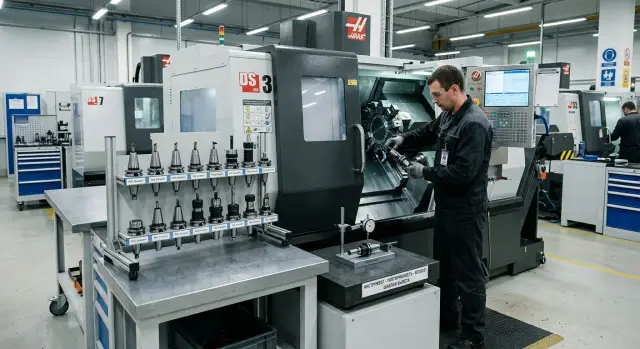
Why different overhang slows work down
When the same tool holder after a replacement sticks out of the turret a little farther or a little less, the part size changes. The program is the same, the cutting tool is the same, but the result is already different. On CNC lathes, you see it right away: the part goes off on diameter or length, and the operator has to set up the tool again.
Because of that, the main benefit of quick change disappears. Instead of a simple swap, a small setup begins. The operator makes an extra approach, takes a test cut, measures the part, enters an offset, and checks again. Even if one change takes only 10 to 15 minutes, the downtime adds up over a shift.
It usually looks the same every time. The first part after a change rarely comes in size on the first try. The machine spends more time in manual mode than in automatic cycle mode. Temporary offsets start piling up in the correction table, and the next shift no longer knows which values were left "for now" and which ones are meant to stay.
When offsets pile up, the order disappears quickly. One operator adds 0.12 mm, another removes 0.08 mm in the morning, a third changes the tool holder and does not know why the size drifted again. The problem is not the program. It is caused by different overhang lengths, which change the real cutting point every time.
This is especially annoying on short runs. A batch may include 20 to 30 parts, and the time spent on checks and re-setup eats up the benefit of fast changeover. The shop may look like it is running without major breakdowns, but the machine keeps stopping between cycles.
That is why a standard tool holder overhang length makes such a difference. When repeatable tool holders all stick out to the same length, the tool behaves predictably after a replacement. The size does not wander, there are fewer offsets, and the next shift gets a clean, easy-to-read table. In everyday work, that means fewer test parts, less stress, and more time making good parts.
What a single standard gives you
When all tool holders in one group have the same base overhang, a replacement stops being its own setup job. The tool is changed according to a clear rule instead of being adjusted from scratch every time.
This is most noticeable with repeatable tool holders. If one base size is chosen for a rough turning operation, the spare holder goes into almost the same position. The operator does not have to search for a new position for long, take extra measurements, or keep correcting the offset.
In practice, this saves real time, not just seconds. Say the insert wears out in the middle of a shift. If the spare tool is assembled with the same overhang, the operator removes the old holder, installs the new one, checks a couple of values, and gets the machine back to work quickly. Without this rule, a replacement often turns into a series of test cuts and new axis offsets.
A standard tool holder overhang length also helps when several people work different shifts. One operator leaves the tool in a clear condition, and the next one does not have to guess why the overhang is longer or shorter than usual. There are fewer mistakes, and startup is calmer.
There is another benefit too: the offset table stays cleaner. When the overhang changes from one setup to the next, random corrections quickly appear there. After a week, it becomes hard to tell normal wear from someone simply placing the tool farther out than usual. With one base size, the entries are easier to read, and finding the cause of scrap is simpler.
The practical value is straightforward. Spare tools go in faster, fewer test parts are needed, CNC offsets are shorter and clearer, and the shift crew can keep one process. For a shop, that is not a small thing. If the machine often runs similar operations, a single base overhang pays off quickly even without major process changes.
Where this approach works best
A standard tool holder overhang length helps most where tools are changed often and parts run in batches. If the operator swaps cutters several times per shift on the same operations, different overhangs quickly eat up time. After every change, the size has to be found again, offsets corrected, and an extra test cut made.
On batch parts, you see it right away. For example, a shop turns a lot of the same shafts or bushings, and several repeatable tool holders are needed for different steps. When all holders have the same overhang, the operator changes the setup with more confidence: the tool goes in predictably, and the machine does not need long fine-tuning. The savings from one change may be small, but over a shift they add up to hours.
This process also works well where similar operations run on two or more machines. That is common on metalworking lines with CNC lathes: the same part family is run in parallel so output does not fall behind. If the tool holders are built to one standard, the tooling is easier to move between machines. The setup technician does not start over each time and does not have to keep dozens of special corrections in mind for every machine.
Another good case is duplicate tools for the second shift. Often the day shift works with one set, and the evening shift takes the spare set. If the spare cutter is built with a different overhang, the shift starts with extra checks and tension. With the same overhang, the second set behaves almost the same, and startup is smoother.
The effect is especially noticeable in shops where downtime is counted in minutes. That may be a line with a tight schedule, a small batch of expensive parts, or production where one machine feeds the next operation. In those places, a standard tool holder overhang length brings not abstract order, but real practical value: fewer stops, fewer manual corrections, and less risk of ruining the first part after a change.
Usually, this approach pays off fastest where two conditions meet: tools are changed often, and the work repeats day after day. If both are already true, the case for setting a standard is immediate.
How to choose the base overhang length
The base length should not be chosen by eye. It is easier to tie it to the operation that repeats most often, such as rough turning of an outside diameter or boring a standard part. If the holder covers the most common job without spacers or new measurements, the area runs more smoothly.
Then look not only at the tool, but also at the machine itself. A holder may seem convenient on the bench, but in production what matters is axis travel, turret position, and access to the cutting zone. Sometimes a difference of 10 to 15 mm looks small, and then the cutter cannot reach the step or the holder sits too close to the fixture.
Check the length in the real work zone
It helps to take a typical part and run the full path without cutting: approach, machining, retract, and position change. This dry run quickly shows whether the overhang is enough for access and whether it is too long. A setup that is too long more often causes vibration, while one that is too short forces you to change offsets and move the tool every time.
It is also worth leaving clearance from the chuck, jaws, centers, and any nearby clamping parts. A small safety gap saves a lot of time. The operator does not need to approach the tool with extra caution or check every movement.
Usually, three simple checks are enough:
- does the tool reach the deepest point of the operation;
- is there a safe distance from the chuck and fixtures;
- does the assembly stay rigid at the working feed.
One length does not fit every tool holder. If the geometry is very different, it is better to set separate standards: one for outside turning, another for boring bars, and another for long, slender tools. Otherwise the common size will only work on paper, and the shift will end up with extra compromises.
That is how a standard tool holder overhang length works: not as one "perfect" number for every case, but as a clear base for similar tasks. For a turning department, that usually means fewer test approaches and fewer setup corrections. If you are choosing between two options, the one that gives access to the part with a little margin, without moving the tool too far from the holder, usually wins.
How to roll out the standard step by step
A standard tool holder overhang length is better introduced gradually, not all at once across the whole tool room. If you cover everything at the same time, the shop can quickly get tangled up in different holders, old operator habits, and disputed measurements. It is much easier to start with one clear group and get the first working result.
First, make a short inventory. You do not need every detail from the spec sheet, only the things that affect production: tool holder type, actual overhang, where it is used, and how often it is changed. Even at this step, you can usually see which items differ the most in size.
Next, choose one area to start with. It is usually easiest to pick a group where changes happen every day, such as facing or boring holders on a CNC lathe. That makes it easier to see whether the standard really saves time.
The rollout itself should stay simple. Measure the current sizes and put them into one table: tool name, current overhang, target overhang, and tolerance. Then assign a base size for the chosen group. It should be easy to measure and should not interfere with the tool during real operations. After that, set a clear tolerance that the operator can check quickly without arguments or extra calculations.
Then you need one measurement method. This can be a check gauge, a stop, or another clear template that everyone uses the same way. After that, add simple marking so the operator can see at a glance which holder has already been brought to standard and which one has not.
After the launch, do not change the rules for at least a week. Otherwise you will not know what worked and what did not. During this period, just track two things: how many minutes it takes to change the tool and how many times the operator adjusts the offset after installation.
If the numbers do not move, the reason is usually simple. Either the base size was chosen badly, or people are measuring differently. In that case, you do not need to scrap the whole approach. It is enough to review the reference point, the tolerance, or the measurement template itself.
A good sign is when repeatable tool holders start going into production with almost no adjustment. Then the reduction in CNC offsets is visible not just in the report, but right on the shift: tools are changed faster, the machine stops less, and the operator spends less time on small corrections.
A simple shift example
In the morning, the shop starts a batch of bushings on two CNC lathes. The part is familiar, the program has already been checked, but tool changes still used to break the pace. On the first machine, the main cutter wore out faster, and on the second, the spare one was kept on a different holder with a different overhang. Each time, the operator spent several minutes doing the same thing: checking notes, remembering old corrections, and carefully approaching the first part.
After the shop adopted a standard tool holder overhang length, the work became calmer. The main cutter and the spare one are assembled to the same overhang before the shift starts. If the first tool needs to be changed, the operator does not choose a new option by eye. They take the spare holder, install it in the turret, and run the test part with almost the same values.
On this type of operation, the difference is felt right away. Before, a change could lead to three small problems in a row: the outside diameter drifted a little, the face shifted, and then the finishing pass had to be corrected again. It is not a breakdown, but time disappears quickly. While the operator is making corrections, the second machine is also waiting for attention.
With the same overhang, the picture is different. The first bushing after a change usually needs just one small correction, for example on X by a few hundredths of a millimeter. After that, the size holds steady, and the batch keeps moving without extra stops. The operator does not search for the right offset among old notes and does not check several times whether the correct tool is in position.
On two machines, this order creates a noticeable effect over a normal shift. If the tool changes happen several times, the savings are not seconds but tens of minutes. There is another benefit too: the setup technician who comes in later can more quickly understand what was done on the shop floor. When repeatable holders are assembled the same way, there is less confusion between shifts and fewer random program edits.
For a batch of bushings, this is especially convenient. The part geometry repeats, cutting conditions change little, and tool setup on the machine stops being a separate task every time. The same overhang does not remove the need to check the first part, but it makes that check short and predictable.
Where mistakes happen most often
The most common confusion starts with the measurement reference. One setup technician measures the overhang from the end of the holder, another from the mounting base, and a third uses the edge of the assembled tool. On paper, the numbers look similar, but on the machine they produce different offsets and extra checking of the first part.
Because of that, a standard tool holder overhang length may exist, but it does not work. Without one common reference point, the standard quickly turns into a set of random numbers. If the shop has not fixed one measurement base and shown it on a simple sketch, the same mistakes will repeat every shift.
The second typical mistake is even simpler: similar holders are stored in one box without labels. From the outside they look almost the same, especially after a busy shift when everyone is in a hurry. The wrong holder gets picked, the tool is installed, the length shifts, and people start changing offsets when the real problem is somewhere else.
That is often how a failure starts. In the evening, the operator changes the tool, takes a holder from the shared case, and is sure it is the same size. The first part takes an extra pass, then a manual correction appears, and an hour later no one remembers which holder was in place before.
Another mistake is linked to regrinding. The tool was shortened by a fraction of a millimeter, but the tool card was left unchanged. After that, the system stores one length while the real assembly has another, and repeatable holders lose their purpose. After every regrind, the record should be updated right away, not at the end of the week.
Problems also begin when the shop tries to force one size onto every operation without looking at the fixture. On some parts the chuck gets in the way, on others a steady rest does, and on others the cutter simply cannot reach safely. A single overhang should be used where it truly works. Where there is a risk of collision or poor rigidity, it is better to write a separate exception right away than to try to save the tool and the part later.
If you remove these four causes - different measurement bases, unlabeled storage, old records after regrinding, and trying to fit every operation into one size - tool changes become much calmer.
A short checklist before startup
Five minutes before startup often save half a shift. Even if identical assembly sizes are already approved, a problem usually starts with something small: the wrong holder, the wrong offset, or a spare tool with a different overhang.
When a standard tool holder overhang length is in use, this check is quick and calm. The operator does not look for the cause at the machine itself, but removes the most common mistakes in advance.
- Check the holder marking and the assembled tool against the setup order.
- Verify the overhang with a gauge, template, or approved reference.
- Make sure the offset is entered in the correct magazine pocket.
- Run a dry cycle and check the approach clearance near the chuck, jaws, and neighboring tools.
- Keep the duplicate tool at the same length as the main one.
This checklist works well in a normal shift, when the pace is high and nobody wants to stop the machine over a trivial issue. If the main cutter wears out in the middle of the batch, the operator takes the duplicate with the same length, installs it in the right place, and keeps working without a long reset.
For companies that supply and commission machines, such as EAST CNC, these simple rules often create a noticeable effect in daily operation. That matters especially in shops with CNC lathes, where time is lost not on one big mistake, but on many small stops. At EAST CNC, this working approach fits naturally with consultation, selection, commissioning, and service, because order in tooling affects the result just as much as the machine itself.
What to do next
If you want to introduce a standard tool holder overhang length without extra noise on the shop floor, do not change everything at once. Take one repeatable operation where tools are changed often, and measure one simple thing: how many minutes the change takes now and how much time it takes after standardization. This kind of test quickly shows where time is being lost on approach, checking, and extra touches on the first part.
Then look not only at minutes, but also at offsets. For one week, record how many times the setup technician adjusts the offset on the first part after a tool change. If repeatable holders are assembled to one rule, the number of corrections usually drops. That is the practical value: fewer stops, fewer test cuts, and a calmer startup.
Next, make the rule part of the normal paperwork. Write the target overhang into the setup sheet, duplicate it on the tool board, and agree right away on which base everyone uses to measure length. Without that, the standard will not last. One setup technician remembers the right size, another uses habit, and after a few shifts the shop goes back to manual corrections.
The best result comes from a simple cycle: choose one operation, record the current changeover time, assemble duplicate tools to one size, and check how many corrections remain after the change. If the effect is there, move the same process to the next group of holders.
This approach does not require a major overhaul. It simply removes the extra movement between a tool change and a stable part. And in a shop, that is what matters most.