
Tool Change Speed: When the Extra Cost Doesn’t Pay Off
Tool change speed does not always affect output. We will look at which cycles benefit and where setup and inspection eat up the gain.
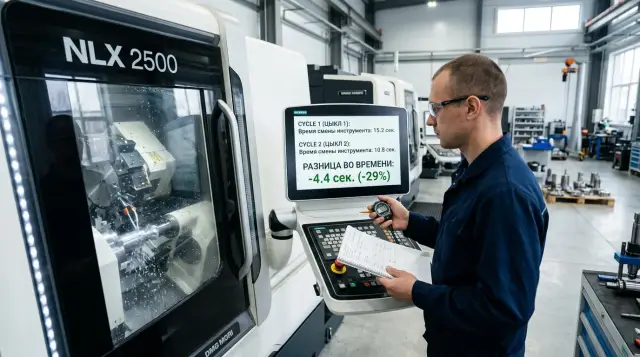
Where the mistake happens when choosing a machine by seconds
A catalog difference of 1–2 seconds looks convincing. On paper, it feels like an almost guaranteed boost in output. But in a real CNC cycle, tool change is only one part of the process, not the whole thing.
If a part takes 4–5 minutes to machine, saving a couple of seconds on one tool change rarely changes the picture. Suppose a machine saves 1.5 seconds, and the part has only four tool changes. The gain is 6 seconds per cycle. With a 300-second cycle, that is about 2%. The difference exists on paper, but on the shop floor it is easy to miss.
A lot depends on the part itself. For a simple bushing, shaft, or another part with only a few tools, an expensive fast change often does not give a noticeable increase in output. For a complex part where the tool changes many times per cycle, the effect is different. That is why looking only at seconds from the catalog is a bad habit.
Very often, the gain is not eaten by cutting or automation, but by the normal work of the shop. The setup person installs the fixture, dials in the dimensions, makes the first part, and then the first inspection starts. If the batch is small, these steps take more time than all the savings from a faster tool magazine.
The extra cost usually does not come back if the batch is short and setups are frequent, the part uses few tools, the operator often measures manually, loading and unloading take longer than the time saved, and output is limited by inspection rather than machining.
This is especially noticeable in shops with frequent product changes. There, the expensive part is not the slow tool change, but the lost 30–40 minutes when switching from one part to another. That is why, when choosing a machine, you should first calculate the structure of the cycle: how much time goes to cutting, how much to tool changes, how much to setup and inspection.
For EAST CNC customers, this kind of breakdown is usually more useful than comparing two models by one number in a brochure. Sometimes the more expensive option is really needed. But if your bottleneck is setup or the first inspection, it will not bring a noticeable increase in output.
When a fast tool change really increases output
Fast tool change does not help on every part. It works where the cycle is short and the program calls for different tools often. If cutting lasts 40–90 seconds and there are many changes per cycle, even saving 1–2 seconds on each change quickly adds up to hours over a month.
The clearest case is serial parts with a repeatable route. You set up the process once, start the batch, and leave the machine alone for a long time. Then the difference between, say, 2.5 and 1.2 seconds per tool change does not get lost in setup time. It goes straight into output.
You can see this clearly on parts where drilling, boring, milling, chamfering, and finishing all happen in one cycle with different tools. If the program makes 8–12 changes per part, tool-change speed affects cycle time not just on paper, but during real production. On batches of several thousand pieces, the difference becomes noticeable.
The effect is usually there when several conditions line up: the batch repeats without long pauses between runs, the operator spends very little time on changeovers between orders, inspection is built into the flow and does not keep the machine waiting, and the shop runs in two or three shifts with steady load.
A simple example: the part takes 70 seconds, and 10 seconds of that is spent on 6 tool changes. If the machine saves 1 second on each change, the new cycle is not 70 seconds, but 64. On 1,000 parts, that is about 100 minutes of difference. One batch may not sound dramatic, but when it repeats every day, it already affects the shift plan.
These kinds of jobs are common in serial metalworking for auto parts, hydraulics, and standard housing components. In this case, when choosing a machine, it is not enough to look only at power or axis travel. Tool change speed should be calculated together with the number of changes in the program, shift load, and how long the batch runs without stopping.
Where the difference is barely visible
The difference between a 1.5-second and a 3-second tool change often looks more important in a presentation than in the shop. If the shop works with short batches, those seconds are quickly lost against setup, checking, and waiting for the operator.
This is most often seen with small orders. Today it is a batch of 25 parts, and an hour later it is a different product. The operator changes jaws, installs the tool, adjusts the offsets, runs the first part, and checks the dimensions. If that takes 30–50 minutes, saving even 10–15 seconds per part barely affects output for the shift.
There is another situation: the machining itself is long, and there are only a few tool changes. For example, a part takes 9 minutes to cut, while tool changes take 12–18 seconds for the entire cycle. In that case, a very fast tool change hardly changes the total time. Most of the time is spent cutting, and the reserve is better found in machining mode, tool path, and tool life.
The same happens on parts with strict first-piece inspection. The operator makes a trial part, then waits for measurement, corrects the size, and checks again. While that process is happening, the machine is idle. A fast tool magazine changes almost nothing here.
Manual loading has the same effect. The operator removes the part, blows off chips, wipes the base, loads a new blank, clamps it, and closes the door. Even if the machine changes tools very quickly, it is still waiting for a person. In such places, the investments that pay back faster are usually not a fast changer, but automatic loading, better fixtures, or simply better shop organization.
A simple example: a batch of 40 parts, with 6 tool changes on each part. The difference between two machines is 1.5 seconds per change. That is 9 seconds per part, or 6 minutes for the whole batch. If setup took 45 minutes and first-piece inspection another 20, those 6 minutes almost disappear.
In such conditions, buying a more expensive machine just for this option is usually too early. First, it helps to honestly look at where the shop loses time every day.
How to calculate the effect on your own part
Do not use an average monthly mix of parts. It almost always distorts the calculation. Take one typical part that makes up a meaningful share of the machine load, and break its full cycle down by time.
On paper, cycle time is often calculated only from cutting. But tool-change speed affects only the part of the cycle where the machine actually changes tools. If the part is measured for a long time, changed over often, or waits for a blank, the expensive option will give much less than the catalog promises.
A practical way to calculate it is this:
- Write down the full cycle for one part: cutting, approach and retract moves, and all tool changes.
- Count how many times the magazine really switches tools during the cycle.
- Take the difference between the two machines for one tool change and multiply it by the number of changes in the part.
- Multiply that savings by output per shift, week, or month.
- Separately include setup, first-part measurement, in-process inspection, and downtime.
A small example. Suppose the part has 12 tool changes. One machine changes tools in 1.8 seconds, the other in 3.2. The difference is 1.4 seconds. On one part, that saves 16.8 seconds. If you produce 180 parts per shift, the gain is 3,024 seconds, or about 50 minutes.
That sounds good, but then the usual reality of the shop starts. If the same shift also includes 40 minutes of setup, 20 minutes of measurements, and another 15–20 minutes of small stops, the net gain no longer looks so large. And if the batch is small and changeovers happen twice a day, the difference in output is easily eaten not by tool-change seconds, but by organizational losses.
After that, compare the savings with the cost of the configuration. Do not look at abstract seconds, but at money per month or per year. If a faster tool change gives an extra 6–8 hours of pure machine time per month, that may be enough for payback. If it is 1–2 hours, the extra cost often will not return in a reasonable time.
If needed, it is better to check this calculation on a real part together with the process sheet and the actual cycle, not with machine spec numbers.
A simple example with two different batches
Let’s take two machines. On the first, tool change takes 4 seconds; on the second, 2 seconds. The difference is only 2 seconds, but when buying a machine, it is often presented as a major advantage.
Now take the same part. The program has 12 tool changes. That means the faster machine saves 24 seconds on every part.
For a batch of 200 parts, that is already noticeable. Across the whole batch, the savings come to 4,800 seconds, or 80 minutes of pure time. If the shop makes 100 parts per shift, that gives you about 40 minutes per shift. With a full schedule, that can mean a few extra parts or less rush at the end of the day.
With a batch of 20 parts, the picture is different. The same program gives 480 seconds, or 8 minutes for the whole batch. If this order is completed in one shift, the savings for the shift are only 8 minutes. Formally, the cycle time is better, but in real work the difference is hardly felt.
Why does a small batch rarely pay back the extra cost for tool-change speed? Because other steps eat it up: machine setup and tool setting, the test part and size correction, first-piece inspection and repeat measurements, changing jaws, fixtures, or blanks.
Even if the fast tool magazine cuts 8 minutes, setup can easily take 60–90 minutes. And you spend that time almost the same way on both machines. In that scenario, the extra cost goes not into output, but into a nice number in the spec sheet.
On a long run, the calculation is different. The machine repeats the same cycle for hours, and the savings build up on every part. On a short run, it is better to look not only at metalworking productivity, but also at how quickly the operator gets the first good part. For small batches, easier setup often brings more value than another 2 seconds on tool change.
What slows the cycle down the most
Very often, the cycle is not slowed down by tool-change speed, but by simpler things. If the machine changes tools 1–2 seconds faster, that looks nice in a catalog. But on the shop floor, output is more often lost to long idle moves, extra checks, and pauses between parts.
The first common bottleneck is long approach and retract moves. The program may be safe, but too cautious: the tool travels too far away, then takes a long time to come back to the cutting zone. On one part, that is almost invisible. On a batch of 300 parts, an extra 6–8 seconds per operation turns into hours.
A poor operation order hurts just as much. When the program sends the turret back and forth without a real reason, the machine spends time not on cutting, but on moves between steps. If you group operations that use similar tools and positions, the cycle often gets shorter without any investment.
A good example is a housing part with 10 tool changes. Suppose the fast change saves 12 seconds on the part. That sounds good. But if the operator spends 35 seconds loading the blank and another 20 seconds unloading the finished part, the gain no longer looks so large.
After a batch starts, many shops add time themselves, even though the machine is not to blame. The blank is fed slowly, the finished part is removed and stacked too slowly, the operator takes extra measurements after the first stable parts, the tool wears out earlier than expected and causes unplanned stops, and the program was never cleaned up after the old process. All of this affects output more than the difference in tool-change time from the spec sheet.
Inspection is a separate story. After setup, frequent checks make sense, especially on a new part. But sometimes the batch is already running steadily, and the operator still measures every second or third part. Then a few seconds saved on tool change are simply lost in constant stoppages.
Tool wear hits even harder. A dull insert reduces feed, ruins size, and forces a stop at the worst possible moment. In that case, tool-change speed helps very little, because the problem is not the change itself, but that the tool is being changed too late.
If you look at cycle time honestly, the first step is to remove the big losses. Only after that does it make sense to decide whether paying more for faster tool change is justified on your line.
Common mistakes in calculations and purchasing
When buying a machine, many people latch onto one number in the spec sheet and make it their main argument. Usually, that number is tool-change speed. On paper, a 1–2 second difference looks significant, but on the shop floor it does not always pay back.
The most common mistake is simple: people compare the spec-sheet time and do not look at how the machine lives during a normal shift. Manufacturers usually show the best-case scenario. It is an empty, short, perfectly repeatable cycle with no extra stops, no measurements, and no corrections. On a real part, the picture is almost always rougher.
If a part needs two tool changes and setup takes 30–40 minutes, a fast magazine will not save the economics of a batch of 20 or 50 pieces. The first good part also takes time. The setup person installs the tool, enters the offsets, checks the size, and sometimes makes a trial cut. While the shop is getting its first stable part, the savings in seconds have not even started to work yet.
Calculations are often broken by four mistakes: using the best cycle from the catalog instead of the average cycle per shift, forgetting the time to the first good part, forgetting the number of setups per month, and mixing up fast idle moves with the actual tool change.
The last point is especially common. Fast idle travel reduces axis movement. Tool change is the magazine rotation, position search, locking, and confirmation. A machine can move quickly in idle, but still not change tools that fast. Or the other way around. If you lump those times into one total number, the calculation will look nice but be weak.
Another mistake appears during purchasing. People choose the fastest configuration for every task at once, even though the part flow is different. For long cycles, where tools change rarely, the extra cost comes back slowly. For small batches with frequent setup changes, it may never come back at all. In those cases, it is more useful to look not at the spec sheet, but at the structure of the month: how many batches, how many setups, how many measurements, and how many real tool changes per part.
A quick check before deciding
Machine purchases are often justified with a catalog number: tool change is 1–2 seconds faster. But that difference does not pay off on every shop floor. First, calculate how many times it actually happens per shift and what else is taking time.
If a typical part uses 6–8 tools and the batch is small, tool-change speed may bring only a modest gain. If the part goes through 20–30 changes and the machine runs a long series without stopping, the numbers are different. Look not at the spec-sheet second, but at your normal working day.
You can check the main points in 10 minutes:
- How many tool changes does a typical part make in one cycle?
- How many batches do you start in a week?
- How many minutes does setup for one job take?
- Who performs inspection, and how long does it take?
- Where is the shop losing the most time right now?
After that check, the picture becomes clear quickly. Suppose the difference between machines in tool-change speed is 1.2 seconds, and the part makes 10 changes. The gain is 12 seconds per cycle. That sounds good until you learn that each new batch takes 30 minutes of setup and another 8 minutes for first-part inspection.
With three or four batches a week, the extra cost may take a very long time to pay back. And on long runs, where the tooling is stable and inspection is built into the flow, cycle time drops noticeably. There, a faster machine can give you extra parts within a single shift.
You do not need a complex calculation for this check. Take one typical part, one real week, and honestly write down all stoppages in minutes. Those numbers usually show right away whether the payback comes from speed or from order on the shop floor.
What to do next on your shop floor
Do not argue about tool-change speed away from real production. Take 2–3 typical parts that make up the shop’s load. It is better to choose different cases: a short cycle, a medium cycle, and a part where setup or inspection takes a lot of time.
For each part, collect the same numbers: pure cutting time, number of tool changes in one cycle, time to the first good part, inspection time, and the usual batch size.
Then compare two options. The first is a machine with faster tool changes. The second is a machine with slower tool changes, but easier setup, more familiar tooling, or a faster way to bring the part into size. On paper, the fast magazine often looks better. In the shop, the difference can be another story.
If the batch is small and the first part takes a long time, seconds saved on tool change barely move output. For example, with a batch of 25 pieces, even a 1-second saving per cycle gives less than a minute for the whole batch. If the setup person spends 30 minutes more on startup, that saving disappears right away.
It is better not to do this calculation alone. The technologist sees the route and understands where the cycle can be shortened. The setup person can honestly say which machine starts faster in a real shift. The supervisor can check that the calculation matches the actual load on people and inspection, not just the machine spec.
If it turns out that your shop really needs a new machine for your parts mix, it is useful to discuss not abstract seconds, but specific parts and batches. EAST CNC, the official representative of Taizhou Eastern CNC Technology Co., Ltd. in Kazakhstan, usually reviews these questions through the real cycle, setup, and shop conditions, not through one number from a catalog. That helps choose equipment more accurately and avoid paying for options that do not bring noticeable output.
A good next step is simple: take your real parts from the last month and calculate two scenarios in one table. After that, the decision usually becomes calmer and more accurate.
FAQ
Is it worth paying more if the tool change is 1–2 seconds faster?
Usually not. If a part takes several minutes to machine and the tool changes 3–4 times, a 1–2 second difference rarely changes output in a noticeable way. First calculate setup time, the first good part, inspection, and loading. On short batches, these usually eat up the gain.
Which parts really benefit from a faster tool change?
It pays off on short cycles with frequent tool changes. If a part runs for 40–90 seconds and the program makes 8–12 changes per cycle, the seconds quickly add up to hours over a month. It works best on long runs, where the machine repeats the same route for a long time without interruptions.
When is high tool-change speed barely noticeable?
The difference is almost invisible on small batches, frequent product changes, and long setup times. If the operator spends dozens of minutes on jaws, offsets, and the first part, a faster tool magazine changes very little. The same is true for manual loading and long inspection. The machine is waiting for a person or for measurement, not for a tool change.
How can I quickly calculate the effect on my part?
Take one typical part and calculate it like this: savings per tool change × number of changes in the cycle × number of parts. Then subtract the time spent on setup, first-part inspection, and small stoppages. That way you see the real gain per shift or per month, not just a nice number from the catalog.
What matters more than tool-change speed on short runs?
For small batches, easier setup, clear tooling, and a fast first good part are usually more important. If a batch is 20–40 parts, even a noticeable cycle-time improvement often saves only a few minutes for the whole order. In that case, it is better to shorten the startup process than to chase the fastest tool change.
Can first-part inspection eat up all the benefit?
Yes, easily. If the operator waits for measurement after the test part, makes corrections, and checks the size again, the machine sits idle longer than it saves on the tool magazine. When inspection holds up the flow, the first thing to remove is the pause in checking. Otherwise, the faster changer will not add much.
Does fast tool change make sense if the cycle itself is long?
On long cutting cycles, the benefit is often small. If a part takes 8–10 minutes to machine and all tool changes take 10–20 seconds, the total cycle hardly changes. In that case, the better place to look for savings is cutting conditions, tool path, operation order, and tool life.
What do people most often confuse in machine specs?
People often mix up rapid axis movement and actual tool change. Fast travel and the tool magazine are different things. Ask for separate numbers. Otherwise, it is easy to buy an option because the spec looks good, not because it really shortens the cycle.
Where should I start before buying a machine?
Start by choosing 2–3 parts that really load the shop. For each one, write down pure cutting time, number of tool changes, time to the first good part, inspection time, and the usual batch size. Then compare two scenarios: faster tool change versus easier setup. Those numbers usually show very quickly which one brings more value.
When does paying more for faster tool change usually pay off?
The extra cost usually pays off where batch sizes are large, the route repeats, and the machine runs steadily in two or three shifts. In those conditions, every second saved on tool changes creates a noticeable gain. If your shop runs on short orders and frequent setup changes, the money usually comes back too slowly, or not at all.