
Tool Cassette for a Family of Parts Without Extra Positions
A tool cassette for a family of parts helps reduce inventory, eliminate duplicates, and prepare repeat orders faster without rushing or spending extra.
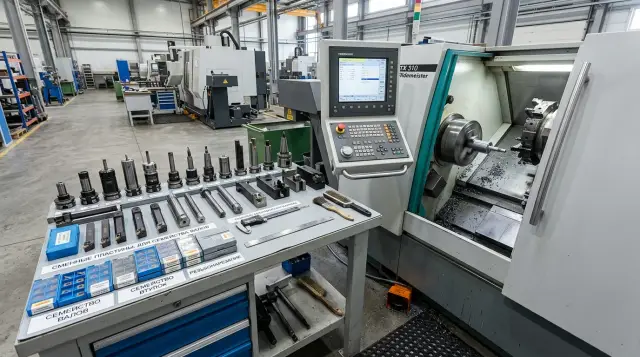
Why the set grows so fast
A tool cassette rarely gets bloated in a single day. Usually it happens quietly: a new order comes in, the process engineer adds one more tool holder “just in case,” the operator asks for a spare boring bar, and purchasing buys inserts from a different brand because the usual ones were out of stock. The next order is similar to the previous one, but not exactly the same. Old tools are not removed, new ones are added.
That is how a set for a family of parts grows. The material is similar, the diameters are close, the operations are almost the same, but each part has small differences. To cover those differences, the cassette gets a separate cutter, another drill chuck, another type of insert. A few months later, some positions are needed only rarely, but they take up space every day.
Duplicates build up unnoticed because they are rarely counted as duplicates. The same task may be covered by two similar tool holders, three boring bars with different overhangs, and inserts with almost the same geometry. On paper, these are different part numbers. In practice, the operator simply chooses between nearly identical options and wastes time where there should be no choice at all.
Extra positions hurt more than just storage. They create downtime and confusion. While a shift is looking for the right boring bar, the machine is idle. While the foreman checks which insert was used on the last order, the first part is delayed. If the cassette contains similar but not identical tools, it is easy to grab the almost-right one and end up with extra wear, a poor surface finish, or a repeat setup.
Most time is usually lost in four places: at the tooling cabinet, at the preparation area, at the machine while checking inserts, and in messages between the process engineer, the foreman, and purchasing. In each case, the cause is the same: the set is too large and not obvious.
If a plant often launches similar batches, the problem grows quickly. A large cassette does not make work easier. On the contrary, it makes it harder to repeat a good setup without unnecessary fuss. The sooner the team removes duplicates and keeps only what is really needed for repeat orders, the calmer the next launch will be.
What counts as a family of parts
A family of parts is not every item from one customer and not the entire shop assortment. One group includes parts that can be machined with almost the same tool set without constantly changing tool holders, boring bars, and inserts.
Start with the material and shape. If parts are turned from the same steel or from alloys with similar behavior, and the geometry is alike, it is easier to build a shared cassette. For a turning group, this usually means parts with similar diameters, similar grooves, the same thread type, and similar surface finish requirements.
But the name of the part matters less than the repeatability of the operations. Two different items can belong to the same family if they repeatedly go through the same steps: facing, external turning, boring, grooving, threading, parting off. Parts with a similar drawing but a different machining route are better kept separate.
Usually, it is enough to check four things: material, shape of the working zones, set of operations, and requirements for tool overhang and rigidity. The last point is often underestimated. If one part allows a short rigid tool, while another requires a long boring bar or a thin tool holder with a large overhang, that is already a different group. On paper, the parts may look similar, but in practice that mix quickly creates extra positions.
Rare orders are better separated from the start as well. If a part comes up once every six months, it should not be included in the permanent cassette just because it is somewhat similar to the main series. Otherwise, the set will contain inserts and tooling that take up space, confuse the setup operator, and bring almost no value.
A simple example: a shop regularly makes bushings and short shafts for mechanical engineering from one grade of steel. The diameters are close, the outside machining is similar, and boring and chamfering repeat. That is one family. But if you add a thin-walled part made of stainless steel with a large overhang, the common set is no longer convenient.
If there is any doubt, ask one simple question: can these parts be machined with one base set while changing only the cutting conditions or one or two positions? If not, you are looking at two different groups.
What data to collect before choosing
A cassette is rarely built from zero. Usually the needed positions have already appeared in repeat orders; nobody just brought them together in one list. If you choose a set from memory, extra tool holders almost always appear, and the necessary inserts are already missing on the second batch.
Pull the orders from the last 3-6 months. Do not take everything—take the ones that truly come back: similar parts, the same material, close diameters, one group of operations. One-off and urgent jobs are better set aside right away. They only distort the picture.
Next, it helps to build a simple table. Usually it is enough to record the part or order number, blank material, batch size, machine, sequence of operations, installed tool holder or boring bar, insert grade, and actual consumption. That is enough to see repeated solutions and remove random positions.
It is better to list the operations in the order the setup operator performs them. Not in general terms, but specifically: facing, rough turning, finishing pass, boring, grooving, threading, drilling. That makes it easier to see where the same tooling repeats from order to order and where the tool is needed only for one part.
Mark identical tool holders and boring bars separately. It often feels like there are many sets, but after checking, only 5-7 positions remain that cover most of the work. If one tool holder is used on several similar parts, it belongs in the cassette. If a boring bar is needed once a quarter, it is better kept outside the main set.
For inserts, not only the item code matters, but also consumption. One insert may appear in every order and still last a long time. Another may be used up box by box because of a heavy roughing pass. For a working cassette, that is a big difference.
It is useful to look not only at store issues, but also at setup sheets, replacement history, and operator notes. They show what really works on the machine and what is just sitting nearby “just in case.” For a shop with repeat turning orders, this data gathering usually takes one evening, but after that the cassette becomes much shorter and easier to understand.
How to build the cassette step by step
It is better to build the cassette based on what really repeats in the job, not based on the catalog. If a part runs in batches, the operations repeat too: rough turning, finishing, facing, drilling, boring, chamfering. That is where you should start, not with the attempt to cover every possible case at once.
First, take 10-20 recent similar orders and write down only what was used regularly. After that, it usually becomes clear which tool holders and boring bars are used in almost every batch and which ones are mounted once every few months and then forgotten in the turret.
- Start by listing the frequent operations across the whole family of parts. Note the material, diameter range, machining depth, and surface requirements.
- Then combine identical steps into one tool setup. If several parts turn the outer diameter in a close range, often one tool holder with the right insert is enough instead of two or three similar positions.
- Add backup only where machine downtime truly affects deadlines. Usually this means the most used turning tools, drills, and inserts that wear out faster than the others.
- Check compatibility by fit, overhang, and rigidity. A boring bar may fit on paper but still create chatter and ruin the dimension.
- At the end, compare the set with the number of turret stations. If there are more tools than positions, the cassette is already overloaded and needs to be simplified.
A practical rule is simple: the cassette keeps what is used almost every day. All rare positions are better kept separately as spare stock. That way, you do not lose space to a tool needed only once in a long run.
For example, if a shop regularly makes similar bushings and flanges, the set may include one roughing tool, one finishing tool, a parting tool, a drilling boring bar, and one boring holder. That is often enough for most repeat orders. Rare inserts for a special material or tooling for an unusual diameter are kept separately in reserve.
If you are choosing a machine and tooling for such series, it is useful to check right away how many tools will actually fit into the turret without unnecessary swaps. For typical metalworking tasks, that usually brings more value than buying yet another similar tool holder.
What to keep in the cassette and what to move to reserve
The cassette works better when it contains only what the operator installs all the time. If the same tool holder, boring bar, or insert is needed almost every week, it belongs in the main set. Anything that appears once a month or less usually just fills up the slots and makes the machine slower to prepare.
A good rule of thumb is this: the cassette should cover a normal repeat order without a trip to the storage area. That is why it keeps the basic tool holders for external turning, boring, parting off, and other operations that do not change from part to part within one family.
Rare boring bars are better kept separately. This usually includes special adapters, long overhangs, nonstandard boring solutions, and tooling for a one-off operation. They are needed, but not every day. If they stay in the cassette all the time, the operator spends extra minutes searching, and the foreman quickly loses control of the real set content.
For inserts, the approach should be even stricter. The cassette should keep stock for the main material that makes up most of the orders. If the shop mostly turns regular steels, there is no point in filling the set with inserts for a rare alloy that appears only occasionally. Those should be moved to reserve and labeled separately.
A common mistake is to place a second tool “just in case.” A duplicate needs a clear reason. For example, the main cutter wears out so fast that replacing it disrupts the shift pace. Or one operation runs on two neighboring machines, and duplication removes downtime. If there is no such reason, the extra position only bloats the cassette.
The check here is simple: do we install this tool regularly, does work stop without it, and can we quickly take it from separate reserve without losing pace? If the answer to two of these questions is no, the position is better moved out of the cassette.
Example for a repeat order
If a shop keeps making short steel bushings again and again, the cassette should not grow with every new part number. Let’s take bushings 18-30 mm long with similar outside diameters and similar internal bores. The material is the same, and the stock allowance is roughly the same too.
For such a group, a set for three standard operations is usually enough: facing, external turning, and boring. The point is to keep what works on almost every batch and remove everything that is needed only from time to time.
In practice, it may look like this: one external tool holder with an insert for facing and longitudinal turning, one boring holder for the diameter range in this group, one drilling holder for the starter hole, and one set of spare inserts for the most common step.
The workflow is simple too. The operator takes the external tool holder and completes two operations at once: faces the end and turns the outer diameter. Then the boring holder is installed to finish the internal size. If the blank comes without a pre-drilled hole, a drill holder for the required base diameter is added. For a typical batch of short bushings, that is often enough.
It makes sense to keep a spare insert not for every position, but for the most heavily loaded step. In such an example, the insert on the external tool holder usually wears out fastest because it works on both the face and the outer diameter. One spare position for that tool brings more value than one insert each for rare operations.
What should not be included in the main cassette? A threading tool, if only one out of ten parts has a thread. The same applies to a grooving tool, a reamer, and a separate boring holder for a deep hole if such jobs appear rarely. They take up space, complicate setup, and require extra stock.
The result is usually the same: a short and clear cassette works better than a “full” set for every situation. The operator assembles the machine faster, and the foreman can more easily see what is missing before the next batch.
Where mistakes happen most often
Most often, the cassette gets bloated because of one part that used to be convenient for setup. That is a poor foundation for the entire set. If the family of parts is similar in operations, size, and material, the cassette should cover the repeating flow, not a rare special case.
A typical situation looks like this: one long shaft needed a separate tool holder, a nonstandard boring bar, and another set of inserts. Then the order ended, but the positions stayed. That is why the cassette should contain only what works on most launches, while rare tools are moved to reserve right away.
Duplicate inserts for one task create just as many problems. When the cassette holds three similar roughing options, the operator wastes time choosing and more often grabs the wrong set. If the operation is the same and the material is stable, usually one main option is enough. A second one is needed only when it really covers a difference in material, tool life, or surface finish.
Another weak point is overhang and access to the cutting zone. On the drawing everything looks fine, but on the machine the tool holder hits the chuck jaws, cannot reach the shoulder, or creates extra vibration. This is especially noticeable on batch orders where several similar parts differ only by one groove or boring depth. Before fixing a position in the cassette, check not only the operation, but also the approach geometry.
It helps to go through a short checklist from time to time: are there positions in the cassette that were used only on one part; do two inserts duplicate one operation for no clear reason; is the rigidity sufficient at the required overhang; is each tool holder and boring bar clearly labeled?
Labeling is often postponed, and that is a mistake. Without a label, similar tool holders quickly get mixed up between shifts. A short system is enough: tool code, insert type, standard operation, and offset number.
Another common mistake is copying an old cassette without checking current orders. Over six months, the part list changes, but the set stays the same. If you review tooling for repeat work at least once a quarter, extra positions become visible right away.
A quick check before starting
Before a shift or a new batch, it is worth spending 10 minutes on a quick review of the set. This pause often saves you from a very basic problem: the machine is ready, but the needed insert or boring bar is not in the cassette. If the cassette is built correctly, each position is tied to a clear operation and not there out of habit.
The check is simple. Match each position to the process plan, look at the insert stock not only for the current part but also for the next orders, remove duplicates, check the free slots for quick tool replacement, and verify the labels. Usually that is enough to spot weak points before the start, not during the first part.
The first step is especially useful. If a tool holder, drill, or boring bar is not tied to a specific operation, it almost always got into the set by accident. Sometimes it is an old tool from a previous batch, sometimes a spare that is better stored separately. The cassette should cover the work, not copy the storage area in miniature.
When it comes to insert stock, it is better not to guess by eye. Calculate how many sets will be used over the next two or three batches. If the order repeats every week, an empty insert box will cause downtime before the tool holder itself wears out. For repeat orders, the reserve is better kept nearby, but not mixed with the working positions.
Check for duplicates too. In the shop, this is normal: one tool holder is in the cassette, and a second one is lying there simply because it was handy once. If the geometry and task match, keep one working position and move the other to reserve.
Another common issue is not the tool itself, but the slot. When there is no free station for replacement, the operator starts rearranging positions in a hurry. After that, overhang, offsets, and labels get mixed up.
A clear label on each slot solves many small problems. On a turning line that keeps making similar bushings or shafts, this saves several minutes on every setup. And if each position has its own place, extra items stand out immediately.
What to do next
After the first series, it almost always becomes clear what is unnecessary in the set and what is missing. Even a well-built cassette changes once you run a real order instead of a paper calculation.
Do not look only at whether the tool completed the operation. Check how many times the setup operator went back to the cabinet, which positions were left untouched, and where the operator lost time on replacements. If one boring bar sat through the whole series unused, it does not belong in the working cassette.
After the first 20-50 parts, a short review is usually enough: remove positions that were never used, keep only the insert reserve that is actually consumed in the series, note tools with accelerated wear, and write down which positions were missing during the shift. This kind of adjustment quickly brings results. Often there are two similar tool holders in the cassette for close operations, but only one is actually used. The second one is better moved to reserve, and its place can be filled with another set of high-use inserts.
After the revision, record the cassette content in one clear format. The foreman and the setup operator do not need a general warehouse list—they need a short working card: which tool holders are in the cassette, which boring bars are needed for startup, which inserts should be kept nearby, and what is stored outside the set as reserve. If shifts work differently, the argument will repeat every time. If the contents are written down, mistakes become less common.
There is no need to overcomplicate the document. Usually one table with clear names, codes, and a note on where everything is stored is enough. It is also helpful to add a short remark about repeat orders: which family of parts the set is built for, which operation consumes inserts fastest, and what should be checked before the start.
If you are planning a new turning line for repeat parts, it makes sense to discuss the base tooling and machine configuration with EAST CNC specialists in advance. The company provides supply, selection, commissioning, and service for CNC lathes, so it is easier to build a working set right away without extra positions and avoid bloating the tooling stock from the first months.