
Time from Finished Part to Shipment: Where the Hours Are Lost
Time from finished part to shipment can be reduced by removing delays in washing, marking, packaging, and final inspection.
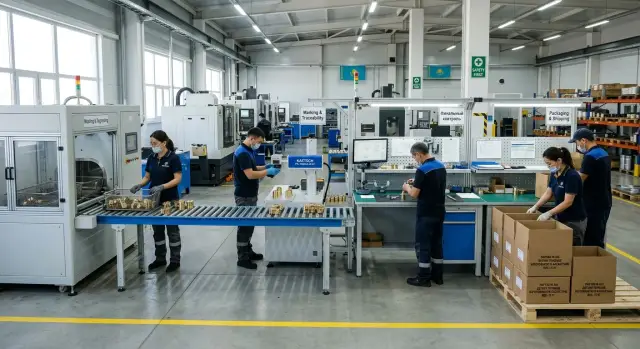
Where the hours disappear after machining
Losses do not start at the hard operation, but right after it. The part is already done, the machine has finished its cycle, but the batch does not move on. This is where the time from finished part to shipment often stretches into hours.
The most common delay is simple: there is no free container. Finished parts are put into a temporary box, then moved again, then they wait for proper packaging. At each of these pauses, the batch stands still and people waste time on extra handling.
Another stop appears when the operator does not know where to take the parts next. If the route is not fixed in advance, they look for the supervisor, call quality control, or take the batch wherever there is space. It sounds minor, but on a shift these pauses add up quickly.
Very often the washing station is far from the machine exit. Then the cart with parts travels across the whole area, waits in line, and after washing comes back almost the same way. If chips or oil remain on the parts, washing is repeated. One extra round can easily eat up 20-30 minutes.
The same thing happens with marking. When parts washing and marking are postponed until the end of the shift, the batch loses its rhythm. By then, other parts of a similar size and shape are already nearby, and the risk of mix-ups grows.
Quality control often receives a batch with no number, no clear status, and no note on whether it has been washed. The inspector cannot start the final parts inspection right away. First, they need to figure out what this batch is, which order it belongs to, and whether it can even be accepted for work.
Even in a shop with good CNC machines, losses appear not because of metal cutting, but because of gaps between operations. While washing, marking, inspection, and parts packaging before shipment live separately from one another, the finished batch will wait longer than it should.
How to build one route without extra returns
Extra hours are usually lost not on the operation itself, but in between. The part comes off the machine, gets placed on the nearest table, then moved to washing, then returned for marking, and after that it still waits for packaging at the far end of the shop. Every such loop adds delay and creates confusion.
First, define one exit point after the machine. The operator should always hand off the finished batch to the same place. Then the next station does not need to search for parts on carts, tables, or temporary storage areas.
It is better to place the stations in the order the batch moves. If after machining the part goes straight to washing, then to marking, then to packaging and final inspection, the route becomes short and easy to understand. People carry parts around the shop less and make fewer mistakes with sequence.
A simple flow looks like this:
- the batch number is assigned right after machining
- the start time of the route is recorded nearby
- the batch only moves forward, without returning to a previous station
- no extra batches are kept between stations
Temporary storage areas often seem convenient, but this is exactly where the batch disappears from view. If parts sit between washing and packaging "until there is a free minute," no one knows who should take them next. It is better to leave a small buffer, for example one cart, and pass the batch on as soon as the operation is finished.
Assign one person to be responsible for handing off the batch. They do not have to do all the work themselves. Their task is simpler: check the batch number, quantity, and start time, then pass the parts to the next station without a pause. In metalworking, this kind of order really cuts the time from finished part to shipment, because it removes small stops that are barely visible one by one, but together eat up half a shift.
Step-by-step order of actions
The most common time loss starts not in the warehouse, but at the machine. If the operator removed the part and set it aside "for later," the time from finished part to shipment quickly stretches into hours.
The post-machining flow should have one simple order:
- Right after removing the part, clean off chips and coolant residue at the machine. It takes less than a minute, but the dirt does not travel дальше with the batch.
- Take the batch straight to washing, with no stop in the aisle, at the supervisor's table, or at the neighboring area. The fewer pauses there are, the lower the chance the cart will get stuck in a queue.
- After washing, check the places where dirt tends to stay the longest: internal holes, threads, grooves, channels, and bearing surfaces. If any film or fine chips remain there, it is better to send the part back right away, not after packaging.
- Apply the marking immediately after the check and at once compare the batch number with the documents. When parts washing and marking happen one after the other at the same station, people mix up batches less often.
- Pack the parts, close the inspection card, and hand the batch over for shipment in the same cycle. If parts packaging before shipment is ready but the papers are lying separately, the batch almost always gets stuck.
This order works well even in a small shop. For example, a batch of bushings after turning moves along one line: removal, washing, quick check, marking, packaging, final parts inspection by the card.
The point is simple: do not pile up parts between operations and do not move them back and forth. When each next step starts right away, the reduction in the production cycle becomes visible in the very first shift.
Washing without queues and re-cleaning
A queue at the washing station almost always appears for one reason: everything is brought there together. When the operator mixes steel parts with an oily film, aluminum blanks after light machining, and parts with thick paste, the cycle breaks down right away. Some need a short rinse, others need longer, and others have to be washed again.
First, the supervisor sorts the parts by material and by type of contamination. This simple rule noticeably shortens the time from finished part to shipment. Each group needs its own clear route: its own basket, its own wash setting, and its own place for drying and checking.
Fixed times for each group also help. Not "by feel," but according to a simple shift standard. If steel bushings after emulsion usually wash clean in 4 minutes, everyone runs that cycle. If parts with blind holes need more time, that is recorded separately too. That way people do not argue at the washing station and do not send the batch around for a second pass.
Another small thing often steals an extra 10-15 minutes. Baskets, gloves, and wiping cloths should be next to the station, not at the far end of the shop. When a worker looks for containers or clean wipes after each batch, the station stands idle.
After washing, the operator checks more than just the outer surface. Dirt often stays where it is not immediately visible:
- in channels
- in threads
- in blind holes
- on edges after chip removal
If these places are missed, the batch goes on, and then comes back from final inspection or even from packaging. That is the most frustrating kind of loss.
Wet parts should not be placed in a common container. Moisture collects fresh dust, leaves marks, and soils already clean surfaces. It is better to keep the batch on a separate drying rack for a few minutes than to wash, mark, and move it by hand again later.
Marking without confusion
What eats the most time is not the marking itself, but finding the right code and redoing unreadable marks. If there is confusion at this stage, the time from finished part to shipment grows almost unnoticed, but every order leaves later.
First, fix one place where the batch number always goes. Do not change it from shift to shift or from part to part without a reason. When the operator, inspector, and packer look at the same spot, they spend seconds, not minutes.
It is better to apply the code before packaging. After packaging, there are extra moves: the part has to be taken out, turned, checked again, and then put back. On batches of 50-100 parts, that is no longer a small thing, but a noticeable time loss.
The marking template should be right at the station, not in the supervisor's folder or in the memory of one experienced worker. Usually the template only needs simple data: where to place the code, which font to use, what depth to keep, and how to write the batch number and date. One sheet at the workstation removes a lot of unnecessary questions.
Check not only that the marking is there, but also that it can be read without guessing. A font that is too small, too shallow an impression, or a smudged mark usually shows up later, just before shipment, when the batch is almost ready. Then people start opening boxes and looking for the bad parts one by one.
If a defect does appear, record it immediately. Do not leave the note until the end of the shift and do not put such parts into the common container. A separate note
Packaging that protects and does not slow things down
Delays often start not at inspection, but at the packaging table. The part is already done, but the worker is looking for the right container, cutting spacers, and deciding what to write on the box. That is how the time from finished part to shipment is lost not on work, but on little pauses.
It is better to choose the container not by habit, but by the weight and shape of the part. A short bushing needs one type of box, a long shaft needs another, and heavy turned parts need a rigid crate or a reinforced box. If the package is too large, the parts move around inside and get damaged. If it is too tight, the packer wastes extra minutes forcing it to fit.
Surfaces that can be scratched easily should be separated right away. For this, people use paper, soft spacers, pockets, plastic end caps, and dividers between rows. This is especially important for finished surfaces, threads, and bearing areas. One scratch often costs more than the whole package.
A simple rule works well: all consumables are already at the station before the batch arrives. Spacers, film, a moisture absorber bag, tape, and the label should be prepared in advance. When the packer gathers them along the way, the flow slows down immediately.
The outside of the package should have only the basic data:
- batch number
- number of parts
- order number or routing sheet
- note about fragile or protected surfaces
Do not mix parts from different orders, even if they look the same. The mistake will not be found in the warehouse, but by the customer or during shipment, when there is no time left.
If the shop produces batches every day, it is useful to keep 2-3 standard packaging schemes for the most common parts. Then packaging protects the part and does not slow down output.
Final inspection without unnecessary waiting
Often the time from finished part to shipment is lost not in the check itself, but in the pauses between actions. The batch is sitting at the inspection station because the inspector is waiting for the sheet, the supervisor is confirming the quantity, and packaging still does not know that the parts are ready. This can be removed easily if the inspection follows one short scenario.
First, only the dimensions that affect assembly are checked. If a bushing has to fit into an assembly without adjustment, check the diameter, seating length, thread, and the tolerance on the areas that affect how the part works. There is no need to measure everything again if those dimensions were already covered in earlier operations. Final inspection should confirm that the batch is good, not repeat the entire route.
Then, at the same point, compare the marking, quantity, and accompanying sheet. If these are checked in another place, the batch almost always gets stuck between tables. It is much easier when the inspector has the batch itself, the label, and the shipment document at hand.
A quick visual check is also needed. It takes minutes, but often saves you from a return:
- check the edges so no burrs remain
- inspect the thread for dents and stripped turns
- make sure the surface is clean after washing
- look for oil, chips, and scratches
The result should be recorded right after the check, without drafts or verbal confirmation. The inspector marks it, the supervisor sees the status, packaging takes the batch. If the entry is made later, the shop loses another 20-30 minutes just on calls and on figuring out whether it can be shipped.
A good rule is simple: once a batch passes inspection, it should be sent to packaging or straight to the shipping area within the same hour. Then final inspection does not build a queue; it closes the route.
A shift example: a batch of bushings goes to shipment
On a turning line, the shift runs calmly when the route is clear in advance. In this mode, the time from finished part to shipment shrinks to a few hours instead of stretching into the next day.
At 2:20 p.m., the operator removes the last bushing from the machine, clears the chips, and immediately attaches a tag. It shows the order number, number of parts, and the shop name. The box is not left by the machine for later. The cart is already free, so the batch moves on almost right away.
By 2:30 p.m., the bushings are already at washing. They are not left in the aisle and do not wait for a free corner on the floor. The supervisor already sees that the batch is coming, so there is space near the washing station. It is a small thing, but it often saves 10-15 minutes on each cart.
After drying, the supervisor applies the marking and immediately checks the order. They do not look for a drawing around the shop or count the parts a second time for no reason. The tag, job, and marking template are nearby, so the step goes quickly and without confusion.
While the supervisor finishes marking, quality control takes a sample for inspection. At the same time, the warehouse worker prepares the container, spacers, and label. No one is waiting for anyone. If inspection and packaging are done one after another, the batch easily loses another half hour.
By 5:10 p.m., the bushings are already in the container, and quality control closes the check. The warehouse worker takes the batch to the shipping area, and by the end of the shift it is standing by the gate, not on a middle table between departments.
This scenario does not look difficult. But this is exactly how the extra pauses are removed: waiting at washing, searching for containers, rechecking, and pointless transport around the shop.
Mistakes that make the batch get stuck
Hours are not lost only at the machine. Often the batch is ready, but the time from finished part to shipment still stretches into half a shift. The reason is usually not one thing, but a chain of small failures between washing, marking, inspection, and packaging.
One common example is giving the whole shop one cart. While one operator uses it to take parts from washing, another waits, then packaging waits, then quality control waits again. The transport itself takes minutes, but the queue around it eats an hour.
Another problem is the habit of changing the order of operations. One worker marks first, then takes the batch to washing. Another does the opposite and packs part of the parts first, leaving marking "for later." In the end, the batch gets spread around the shop: some parts sit without labels, some are already in containers, and some are brought back to the table again. This route almost always causes confusion.
Marking from memory also often slows shipment down. If the worker does not have a simple template, they write the designation by hand, check the papers, and sometimes make a mistake in the batch number or quantity. Then someone looks for the mismatch and checks the whole set again.
Inspection is similar. When quality control is called only after full packaging, defects or omissions are found too late. Boxes have to be opened, parts recounted, inserts changed, and the packing list corrected. It is extra work that can be removed easily.
On lines with CNC lathes, this delay is especially noticeable: the equipment produces parts quickly, but then the flow trips over manual work. If nobody measures how many minutes the batch sits between stations, the problem seems random. In reality, it repeats every day.
The most useful step here is simple: measure the batch route by the clock at least three times a week. Usually you can see right away where it sits the longest - at the cart, at marking, or waiting for the inspector.
Quick check before shipment
Five minutes before shipping often save an hour of rework. If the batch leaves with coolant residue, a smeared label, or an open inspection card, fixing the mistake later takes longer and costs more.
To shorten the time from finished part to shipment, keep a short check right by the packaging area. One person goes through it in order and marks any issue right away while the batch is still there.
- The parts are clean and completely dry, with no drops, chips, or traces of abrasive.
- The marking is readable at a glance and does not rub off with one touch.
- The quantity in the container and in the job matches exactly.
- The packaging supports the batch weight and keeps parts from rubbing against each other.
- The inspection card is closed, signed, and placed next to the batch.
This list seems simple, but these are exactly the details where a batch most often gets stuck. For example, bushings after washing may look clean, but moisture is still left inside the groove. An hour later, condensation appears in the package, and the packaging has to be opened again.
The same is true for marking. If the batch number can only be seen under a lamp, or part of the symbols ends up under a strap, the warehouse spends extra time checking. It is better to notice that immediately than to search for the right box by the loading machine.
If even one item does not match, do not send the batch further down the line. Send it back to the nearest step, fix the problem, and go through the list again. That keeps the flow smoother, and shipment does not get derailed by a small issue that could have been caught in a minute.
What to do next if the flow still drags
If the batch keeps stopping between washing, marking, packaging, and final inspection, do not try to fix everything at once. Start by collecting facts. For one week, write down how many minutes the part spends at each station and how long it waits between them.
Also note the reason for the delay: no container, the inspector is busy, the label is missing, or the cart is being filled before moving on. These notes quickly show where the time is really being lost and where the delay only seems big in conversation.
Usually, one long stop gives the biggest effect. If packaging waits for inspection for 40 minutes and marking takes 5 minutes, do not start with marking. Otherwise people will waste effort and the queue will stay in the same place.
Sometimes the problem is not at the end of the route at all. The machine may release parts in bursts: almost nothing for an hour, then two baskets at once. After that, washing, inspection, and packaging get overwhelmed even though they are working normally. That means the queue is created earlier, right at the machine exit.
It helps to follow a simple process:
- measure the actual working time and waiting time at each station;
- choose the longest delay;
- check where it starts - after machining or earlier;
- make one change and watch the result for several shifts in a row.
If the bottleneck starts earlier, look wider: how the area is arranged, how the containers move, where the labels are kept, and how many parts are accumulated before they are passed on. At that point, it is worth discussing both the layout and the equipment selection with the EAST CNC team. That conversation can help you see whether the machine itself is creating extra queue at the exit and what can be improved without a full shop rebuild.
After the changes, measure the full part route to shipment again. If the time from finished part to shipment has gone down and stays that way for at least a week, the solution worked. If not, move on to the next delay instead of going back to guesses.