
Through-Tool Coolant Delivery for Deep Holes: When It’s Worth It
We explain when through-tool coolant actually speeds up deep-hole drilling and when conventional external feed is enough without extra cost.
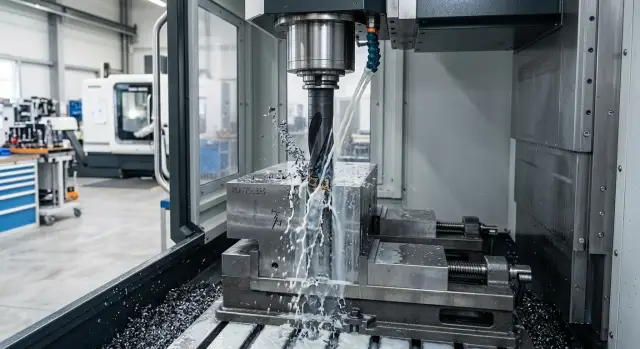
Why deep holes often slow the work down
The deeper the drill goes, the worse chips evacuate from the cutting zone. On a short hole they leave almost immediately. In a deep hole they pile up in the flutes, deform, rub against the wall and can get back under the cutting edge. At that moment the tool is cutting not only metal but also hot chips.
Because of this, temperature rises quickly. The tip of the drill works inside the part where air barely reaches, and external coolant often can’t reach the cutting edge after the first few centimeters. The edge heats more, wear accelerates, and hole size begins to drift. With ductile materials this shows up even sooner.
The operator usually notices the problem by sound and by the chips. The machine cuts heavier, chips come in jerks, and rubbing marks appear on the hole wall. To avoid breaking the drill, feed and speed are reduced. The part remains intact, but the cycle stretches out.
Even more time is lost on intermediate tool retractions. The drill goes in, comes out to clear chips, then returns. One such retraction seems minor. But if there are many holes or a large batch, these pauses become noticeable minutes of pure downtime.
This is especially visible on CNC machines. Other moves may be fast and smooth, while one deep hole suddenly becomes the slowest operation in the program. For that reason through-tool coolant feed is considered not as an expensive extra, but as a way to eliminate overheating and reduce unnecessary retractions.
A simple example: a 10 mm hole to 120 mm depth often slows the process not because of cutting length itself. Time is eaten by chips, overheating and conservative modes. As soon as the operator works with a safety margin, the cycle grows faster than calculated feed suggests.
What through-tool coolant changes
The main difference is simple: the fluid reaches the cutting zone from inside, not from outside. For deep holes this changes the process because an external stream often doesn’t reach the cutting edge after the first centimeters.
When coolant comes through the tool, the cutting zone is cooled exactly where needed. The edge heats less, metal at the drill tip doesn’t “soften,” and the tool cuts more consistently. This is especially noticeable when drilling deep holes without interruptions and in dense materials.
The second change concerns chips. Instead of piling up in the flutes and forming a compact mass, they evacuate more evenly. The coolant flow carries them from the bottom of the hole and helps eject them outside. As a result the tool less often rubs on already cut material.
In practice this produces a clear result: the cutting edge retains its form longer, the hole overheats less, chips come out calmer, and the machine better holds the programmed feed and RPM. That last point is often underestimated. When chips evacuate poorly, spindle load fluctuates: cutting alternates between light and heavy, and the operator has to be cautious. Internal coolant evens out the regime and removes those swings.
The difference is visible even on a simple part. For a deep hole in a steel blank, external coolant may work well at first, then temperature rises, sound changes, and chips darken. With internal coolant the tool cuts more calmly and the hole is cleaner through the full depth.
This does not mean the scheme is always needed. But on deep holes it often changes the whole operation: less overheating, fewer chip problems and fewer random stops mid-cycle.
Where it really shortens the cycle
The biggest gain is where a hole becomes “deep” relative to its diameter. While a drill at 2–3 diameters is fine for external coolant, at 6D, 8D and deeper chips are cramped, heat increases, and the operator often has to reduce feed or retract the tool.
Here through-tool coolant makes a noticeable difference. Fluid goes straight to the cutting zone, pushes chips out of the flutes and cools the cutting edge more effectively. The drill is retracted less often, so the spindle spends less time on idle moves.
This is especially clear in ductile materials. Stainless steel, some structural steels and ductile aluminum alloys often produce long chips. They wrap, clog flutes and force interrupted cycles. With internal coolant chips evacuate more evenly and the tool holds a stable regime longer.
On large batches the difference becomes very visible. If one hole is 8–15 seconds faster, on a hundred parts that’s significant. If a part has several deep holes, savings from fewer retractions add up to hours.
Usually the cycle shortens for four reasons: the drill is retracted less often, feed doesn’t need to be reduced as much, chips clog flutes less, and the tool cuts longer without frequent stops.
A good example is a production part on a CNC turning center where a small-diameter deep hole must be drilled. With external coolant the operator often uses an interrupted cycle: in, out, in again. Time is lost not only on retraction but also on acceleration, re-entry and chip checks. With internal coolant the same pass often runs smoother and almost without pauses.
The payback is strongest where three conditions coincide: deep hole, stringy chips and repetitive batch work. In such cases through-tool coolant affects not only tool life but directly cuts cycle time on each part.
When external coolant is enough
It’s not worth overpaying for internal coolant if the hole is shallow and chips evacuate on their own. On a short stroke the drill doesn’t clog the flute, and external coolant cools the edge sufficiently. For such operations the simple scheme often delivers the same result without changing tooling or increasing fixture cost.
This is especially true for steel and cast iron that cut calmly and do not produce sticky chips. If material does not cling to the drill and chips break into short segments, internal coolant often makes no difference. The hole comes out clean when cutting modes are chosen correctly.
Small batches change the math as well. For 20–50 parts the seconds saved per hole may not cover the cost of a more expensive tool, spindle coolant connections and extra maintenance. In that case the shop usually benefits more from a simple, proven setup.
If the machine holds RPM, feed and external coolant pressure well, that may be enough. A good chuck, rigid workholding and normal chip evacuation give more benefit than an extra feature just in case. Even on modern CNCs not every operation needs through-tool coolant.
A simple guideline: if you already get the required size, acceptable roughness and don’t spend time clearing flutes, don’t change the scheme yet. First squeeze the most from conventional drilling—check tool geometry, coolant pressure, cutting mode and fixture rigidity. Often that alone solves the issue without extra expense.
How to decide step by step
Decide based on your operation, not a general rule. For one part extra investment won’t pay back, while for a series internal coolant can eliminate repeated retractions and save noticeable time.
- First look at the depth-to-diameter ratio. For short holes external coolant often suffices. As depth increases, chips struggle to exit and the risk of stops grows quickly.
- Then evaluate the material and chip type. Aluminum alloys, stainless steel and ductile steels behave differently. If chips are long and sticky, internal coolant helps more.
- Next open the program and count the retractions for the tool. Don’t estimate by eye. If the drill retracts 3–4 times per hole, that is often where time is lost.
- Then check equipment. You need a pump that holds required pressure, a suitable holder and a sealed channel. If pressure is weak, the idea is good but results mediocre.
- Finally calculate for the batch, not just the cost of a component. For 20 parts the investment may pay back slowly. For hundreds, cycle savings and reduced tool wear usually offset the cost much faster.
A simple calculation helps. Suppose a deep hole requires four retractions and each retraction with return takes 3 seconds. That’s already 12 seconds per hole. If the part has two such holes and the batch is 300 pieces, that’s 7,200 seconds—2 hours of pure machine time.
The opposite situation also exists. If the hole is not very deep, chips break short, and the program rarely retracts, external coolant may be the wiser, simpler choice. It’s easier to maintain and doesn’t require extra investment.
If in doubt, don’t argue by feeling. Run one part both ways, measure time, inspect chips and tool condition. After that test the decision usually becomes obvious.
Common mistakes
A common mistake is buying an internal coolant system "just in case." The logic is understandable—depth increases, so choose the strongest solution. But for short and medium holes this often brings little benefit. If chips already evacuate and the tool holds size, extra cost for pump, holders and maintenance may not pay off.
Another frequent error is expecting quick results without checking pressure and flow. Internal feed works by effect, not by name: the jet must reach the cutting zone and push chips out. If pressure is insufficient, fluid just trickles and the problem remains. The operator then sees overheating and clogging and assumes the idea doesn’t work.
Many disputes are about tool condition. A blunt drill or wrong angle is blamed on coolant. Internal coolant doesn’t fix worn geometry. It helps the tool work in normal conditions but does not replace the tool.
There is a practical mistake too: neglecting cleanliness. Small-diameter channels clog with fine chips and tank debris. Then pressure seems adequate, but the actual flow to the cutting edge is reduced. If filtration is poor and flushing is occasional, the system loses effectiveness.
You usually see this by several signs: chips evacuate unevenly, cutting sound changes after a few holes, size drifts mid-series, and tool life is shorter than in a clean trial run.
Another error is evaluating results from a single part. The first workpiece may go fine. The real picture appears over a series: after 30–50 parts temperature rises, chip behavior changes and tool life drops. Compare not one good pass but a shift or an entire batch.
In machine shops this is especially visible on CNCs where downtime from chips costs more than expected. If you look honestly, the error is usually not the coolant itself but fitting it without checking the whole chain: machine, pump, tool and system cleanliness.
A simple shop example
Imagine a batch of bushings: a 12 mm hole to 90 mm depth. On paper it looks simple. On the machine it often runs slowly because long chips clog the flute and the drill starts cutting harder.
With external coolant the operator rarely runs one continuous pass. He often drills 15–25 mm, retracts to clear chips, re-enters and repeats. Time is lost not only on cutting but on constant retractions.
Losses accumulate: the machine spends seconds on each retraction and re-entry, chips sometimes clog by the cutting edge, sound changes, and the operator reduces feed out of caution. By the end of the batch the drill wears faster.
With through-tool coolant the picture is usually smoother. Fluid goes straight to the cutting zone and helps eject chips from the deep hole. The drill "breathes" easier, needs fewer intermediate cleanings and holds feed more steadily.
For that bushing batch the result often is simple: instead of multiple retractions per hole there is one short control retraction, or sometimes none. If previously one hole took a minute because of frequent stops, with internal coolant the cycle can shorten noticeably. The operator also doesn’t have to constantly anticipate when chips will start to jam.
But not every case justifies the system. If the batch is small, say 10–20 bushings, time savings may not cover costs for tooling, coolant pressure, fixtures and setup. Especially if a conventional drill already produces clean holes without overheating or risk of breakage.
So look not only at speed. If external coolant forces constant retractions and keeps the machine longer, internal coolant almost always pays back on a series. If parts are few and the process is already calm, skip the extra cost.
A short pre-run check
Before the first part count not only the cutting mode but chip behavior. On deep holes the problem rarely shows immediately: first parts may be fine, then cycle time grows, a squeal appears, and the drill starts to drift.
First convert depth into diameters. A 10 mm hole to 30 mm is 3D, 60 mm is 6D, 100 mm is 10D. The larger this number, the stricter the requirements for chip evacuation and coolant. For short holes external feed usually suffices. For 8D, 10D and deeper check whether through-tool coolant is needed.
Before starting, quickly check five things:
- how chips evacuate during cutting;
- whether coolant pressure and cleanliness are sufficient;
- batch size;
- how many cleaning pauses are already in the cycle;
- the cost of a broken tool or a scrapped part.
A simple rule: if the hole is shallow, the material does not produce long sticky chips, and coolant pressure is stable, external feed is often enough. If the hole is deep, chips form ribbons and the operator already plans intermediate retractions, internal coolant usually gives a clear gain.
Look at a whole shift, not one part. If a cleaning pause adds 12 seconds and you run 300 parts per shift, that’s an hour of pure loss. That arithmetic quickly shows where extra cost is wasteful and where it saves time and tool life.
What to do next
Don’t start by buying a new unit or expensive fixtures. First collect three numbers for your typical operation: hole diameter, depth and batch size. These figures quickly show where time is lost and whether investing in through-tool coolant makes sense.
One approach does not fit all. If the hole is 8 mm to 20 mm depth and the batch is small, external coolant probably solves the task without extra expense. If it’s 12 mm to 120 mm and parts come in the hundreds, the cost of mistakes is different: cycle lengthens, chips clog more often, and tool wear increases.
Then search for the bottleneck, not the trendy part. Sometimes the problem is the pump and coolant pressure, sometimes the tool, and sometimes cutting mode and unnecessary retractions. Such analysis often saves more than an impulsive purchase. A new pump may change nothing, while a different drill and mode adjustment can fix the issue in one day.
Next run a trial on one representative part. Don’t pick the easiest piece or a random blank. Use a part that reflects production and gives clear data on cycle time, chip shape, tool life and hole quality.
During the test record four things: operation time, number of cleaning retractions, chip condition and tool life over a small series. If the cycle shortens by 15–20%, chips evacuate more evenly and the drill lasts longer, the decision is evident without long debate.
If you are choosing a machine, tooling or want to know whether external coolant is enough, discuss it using a real part, not generalities. EAST CNC - ТОО Метиз, официальный представитель Taizhou Eastern CNC Technology Co., Ltd. в Казахстане, helps with equipment selection, commissioning and service. The company also has a blog with equipment reviews and practical machining materials, useful when you need to compare the solution with your shop’s real task.
A good next step is simple: pick one part, one material and one hole size that most often causes delays. After that test the right decision usually becomes obvious.
FAQ
What does through-tool coolant delivery mean?
This is delivering cutting fluid not from outside, but through channels in the tool directly to the cutting edge. For deep holes this flow cools the drill tip better and helps evacuate chips from the flutes.
From what depth does internal coolant make sense?
The benefit usually becomes noticeable around 6D–8D depth and deeper. For short holes external coolant is often enough, while in deep holes heating, friction and retractions increase.
Why does through-tool coolant shorten the cycle?
It removes extra pauses. If chips evacuate more evenly, the tool is retracted less often for cleaning and feed rates don’t need to be reduced as much. That means the machine spends more time cutting and less on idle moves.
On which materials is the gain usually largest?
It helps most with stainless steel, tough structural steels and some aluminum alloys that produce long, stringy chips. Those materials tend to clog flutes and force interrupted cutting without internal coolant.
When is external coolant enough?
If the hole is shallow, chips break into short segments and size/finish are already acceptable, external coolant is sufficient. In that case internal coolant usually only increases tooling cost without clear benefit.
What should I check before buying a through-tool coolant system?
First check more than depth: the pump must hold required pressure, the holder must not block the flow, and filtration must be clean. Then calculate how much time is spent on tool retractions and on what batch size.
How do I know the cycle is slowing due to poor chip evacuation?
Signs are visible in operation: the machine starts cutting harder, sound changes, chips come out in bursts or darken, the hole wall shows rubbing marks, and the size drifts during the run.
Is time saving really noticeable?
Yes. A few seconds per hole quickly add up to hours over a batch. If one retraction with return takes 3 seconds and you have four such retractions, that's 12 seconds per hole. On hundreds of parts that becomes substantial machine time.
Will internal coolant save me if the drill is already worn?
No. Internal coolant creates better cutting conditions but does not fix a blunt cutting edge, wrong geometry or poor cutting mode. If the tool is already worn or burning, address the tool and settings first.
How can I quickly check if I need through-tool coolant?
Run one representative part both ways: with external coolant and with through-tool coolant. Compare cycle time, number of intermediate retractions, chip appearance and tool behavior on a small series. This test usually makes the decision clear.