
Threaded Insert or Thread in the Part: Which Is More Profitable?
Compare a threaded insert versus a thread cut directly into the part: strength, repairability, machining time, and cost for housings that are opened often in service.
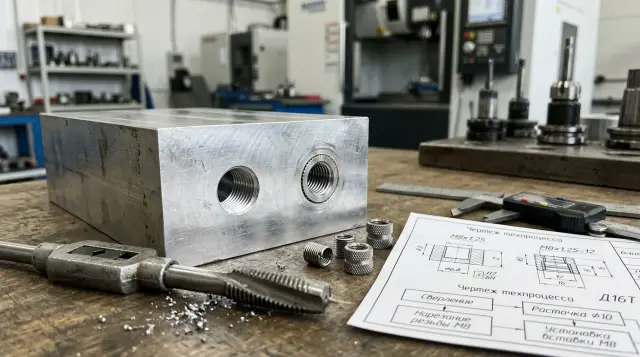
What is the real problem in practice
A thread problem usually does not show up on the drawing. It shows up a month after the batch starts. The housing is assembled and shipped, then opened a couple of times in service, and one stripped thread immediately changes the part’s economics. The housing has to be scrapped or repaired on site, where downtime and a service trip cost more than the fastener itself.
The choice between an insert and a standard thread is often treated as a small detail. In reality, it affects scrap, returns, and repair speed. If the thread is cut directly into an aluminum or mild steel housing, it stands up worse to frequent disassembly, bolt misalignment, and extra tightening torque. If an insert is added without proper calculations, the part becomes more expensive and the process gets more complicated without any real benefit.
Service housings suffer more than most. They are not just closed at the factory and forgotten. They are opened for inspection, cleaning, part replacement, and adjustment. For a pump housing, gearbox, or machine component, that is normal work. Every disassembly cycle adds risk: the technician is in a hurry, the bolt goes in crooked, dirt or chips remain in the hole, and the housing material does not forgive mistakes.
The problem rarely stays limited to one damaged thread. After that come cover misalignment, loss of clamping force, a leak at the seal, and another service visit. For products that are maintained regularly later on, this hurts both cost and reputation.
Before starting a batch, it helps to answer a few simple questions. How many times will the housing actually be taken apart over its service life? What material is it made from? Can the thread be restored quickly without replacing the whole part? What costs more in your case — one extra manufacturing step or downtime in service? And who will disassemble the unit — the factory shop or a field service team?
If there is no clear answer to these questions, the decision is usually made by habit. And habit in a process often leads to trouble. For a housing that regularly goes to service, it is better to calculate not only the manufacturing price, but also the cost of every future opening.
When a thread in the part is enough
A standard thread in the part is often the most sensible choice. Especially when the housing is made from a material that holds threads well and the unit is taken apart infrequently.
This option works where there is enough metal around the hole and a proper thread engagement length. For steel and cast iron, a thread length of about one screw diameter is often enough. For aluminum, it is better to leave more margin, but even then an insert is not always necessary.
The rule of thumb is simple. If the material is dense, the wall around the hole is not too thin, and the fastener is tightened with a clear torque, a standard thread works calmly. The same is true for units that are opened rarely — for example, only during scheduled maintenance.
In terms of cycle count, a standard thread is not as weak as it is sometimes made out to be. If the assembly is careful, the screw is not cocked, and the mechanic does not overtighten it until failure, the hole can handle several disassemblies without issues. For low-cost covers and housings that are opened 5–20 times over their service life, that is often enough.
A standard thread also has a clear manufacturing advantage. It removes one extra operation: there is no need to buy inserts, store them, install them, and inspect the fit separately. Over a batch, that saves time and money. For parts with moderate load, this simplicity is often more profitable than any overprotection.
In practice, this is easy to see on service covers, flanges, and small housings machined on CNC machines for housings. If the screw simply clamps the cover and does not hold a power-loaded assembly, a thread in the body of the part is usually more convenient and cheaper.
It also makes sense to stay with this scheme when the part itself is inexpensive. If the thread is stripped anyway, the housing can often be quickly rethreaded to a repair size or replaced without long downtime. For mass-produced and simple parts, this is often the most practical option.
When a threaded insert is better
If the unit is taken apart on a service schedule or because of frequent checks, a standard thread wears out faster than expected. The first cycles go fine, then play appears, and after one bad tightening the hole already has to be restored.
An insert is appropriate where a bolt is removed and installed again regularly: on covers, clamping plates, sensor mounts, and service access panels. In real repairs, not every technician uses a torque wrench. Because of that, the housing suffers more than the fastener, and an insert significantly reduces the risk of stripping the thread.
The difference is especially clear in soft alloys. An aluminum housing is lighter and easier to machine, but its thread stands up worse to repeated assembly. An insert provides a harder working surface and better handles repeated tightening. For housings on metalworking equipment, this is often more convenient than later restoring a damaged hole during service.
An insert usually wins in several situations. The unit is opened for cleaning, adjustment, or consumable replacement. The housing is made of aluminum or another soft alloy. The bolt can easily go in crooked. The hole is hard to reach, so an on-site repair is expensive. Or one stripped thread can stop the entire unit.
A good example is a service housing that is taken apart several times a year. If there is a series of identical holes in the cover or base, stripping even one of them can turn a normal repair into a separate operation with housing restoration. With an insert, the mechanic usually keeps the same mounting size and gets the unit back in service faster.
For manufacturers of housings for CNC machines and other industrial equipment, this is especially useful where service is predictable and repetitive. The extra process step pays off if it removes frequent repairs, equipment downtime, and scrap after shipment.
What about strength and wear
The strength of a threaded joint depends less on the option itself and more on the housing material and thread engagement length. In a steel housing, a standard thread often lasts a long time if the fastener is not removed constantly. In aluminum, magnesium alloys, and soft cast iron, the threads strip faster, especially during frequent maintenance.
That is why this question cannot be answered in general terms. For a soft material, an insert often gives a more predictable service life. It works against a harder internal profile and handles repeated assembly better.
Thread engagement length matters more than promises about “reinforced” threads. If the bolt engages too shallowly, the first few threads take most of the load. If the engagement is proper, the force is distributed more evenly, and the joint lasts longer. In practice, a short thread in a good material often loses to a longer thread in the same housing.
The rule is simple: the softer the housing material, the more carefully the thread depth and tightening torque need to be calculated. For steel, a smaller depth is often enough. For aluminum, it is better to build in margin from the start, especially if the unit will be disassembled in service.
Bolt misalignment damages both options. On a standard thread, the entry threads are crushed quickly. An insert tolerates wear from repeated assembly better, but severe misalignment will not spare it either: the bolt will damage the first threads, and the insert itself may start spinning.
Over-tightening also affects them differently. On a thread in the part, the housing threads usually strip. With an insert, the weak points are the outer seating, the wall thickness around the hole, and installation quality. If the wall is thin or the hole was made inaccurately, the insert holds worse than expected.
The picture is usually this: a standard thread is weaker in soft alloys and with frequent removal, an insert performs worse in a thin wall or with poor seating, and both options lose strength sharply with misalignment and extra torque.
For service housings made of aluminum and similar materials, an insert usually wins on wear. For steel housings where the fastener is removed rarely, a standard thread is usually simpler and perfectly reliable. What matters is not only the strength on paper, but the real operating mode: how many times the unit will be opened, who will assemble it, and how easy it is to make a mistake there.
What about labor and cost
The money here is not counted only by the price of one operation. For a housing that will later be taken apart many times in service, the difference often becomes visible not in the shop, but six months into operation.
If the thread is made directly in the part, the route is usually shorter. You need drilling, chamfering, tapping, chip removal, and gauge inspection. On a CNC machine, this often fits into one setup, especially if the housing is already in machining and the required tool is in the magazine.
With an insert, there are more operations. First, a hole for the seat is made. Then a special thread is tapped or the area is prepared for pressing in, depending on the insert type. After that, the insert is installed with a separate tool, and the seating depth and the thread itself are checked.
Piece time grows not only because of installation. It also increases because of tool changes, separate fixtures, manual work outside the machine, extra inspection, and the risk of scrap if the insert goes in crooked or sits at the wrong depth.
For small batches, a standard thread is almost always cheaper. It is easier to program, faster in cycle time, and does not require storing inserts in stock. If the housing is inexpensive, the material holds threads well, and disassembly is rare, there is usually no reason to pay extra for an insert.
But in service housings the picture changes. If the cover is removed often, a standard thread is easier to strip, especially in aluminum and thin walls. Then a cheap operation in production turns into an expensive repair: the housing has to be restored, drilled out to a repair size, or even scrapped.
An insert starts to pay off when the housing price is clearly higher than the fastener price and when equipment downtime costs more than a couple of extra minutes in the process. If a pump housing or machine component is opened several times a year, an insert can pay for itself after just one avoided repair.
For such parts, it helps to track two numbers separately: the manufacturing cost and the cost of one repair. On the first, a thread in the part usually wins. On the second, an insert often wins. If the housing regularly goes to service, looking only at the first operation price is a clear mistake.
How to choose step by step
It is better to make the decision based on the housing’s operating conditions, not habit. Usually the question is settled quickly if you calculate the load, service needs, and the cost of a mistake in advance.
- Start with the material and wall thickness. Steel with proper thread depth often makes it possible to avoid an insert. Aluminum, soft alloys, and thin walls strip faster, especially if the screw is tightened carelessly.
- Then count how many times the unit will be disassembled over its full service life. If the cover is removed once a year, a standard thread is often enough. If service is regular, an insert usually gives more margin.
- Next, assess repair conditions. If access is tight and the part is expensive or slow to replace, housing repairability becomes the priority. In such cases, it is better to build in a solution that can be restored without replacing the whole housing.
- After that, compare the cost of scrap and the cost of an insert. One insert is not expensive, but it adds operations. A stripped thread in a finished housing, however, can lead to rework, downtime, and arguments with service.
- Finally, lock the decision into the drawing and the metal machining process. Specify the thread type, depth, tolerance, tightening torque, and a separate operation for installing the insert if one is needed.
A small practical guideline: if the housing is made of aluminum and the cover will be removed 10–15 times over its service life, it is better to include inserts in the service points from the start. If the housing is steel, the wall is thick, and disassembly is rare, the extra operation often does not pay off.
Example for a service housing
Take a pump or gearbox housing whose service cover is removed regularly. For example, the seal is replaced every 2–3 months, the bearing is checked, or the internal cavity is cleaned. On the drawing, everything looks simple: a few bolts, threads in the housing, and a normal assembly.
The problems do not start on the first disassembly. After several openings, the technician notices that one or two bolts tighten more softly. If the housing is aluminum or the wall is not very thick, the thread gradually wears out. This happens even faster when bolts are installed crooked, tightened with extra torque, or the unit is assembled in dusty conditions.
If the thread is cut directly into the part, stripping one hole often leads to extra repair work. The unit is removed, taken to machining, the hole is drilled out, the fastener size is changed, or an insert is installed only after the fact. That is inconvenient for two reasons at once: the equipment is down, and the housing is no longer fully standard.
If this is discussed already at the process-planning stage, the answer for service housings is often very simple: it makes sense to include inserts right away in the holes that will be opened often. Not in every hole, but exactly in the service points.
The effect of such a decision is clear. A steel insert handles repeated assembly cycles better. The bolt behaves more consistently in tightening torque. If damage occurs, you replace the insert, not the whole housing. The fastener and cover size stay the same.
In practice, this saves downtime where the equipment has to get back to work quickly. If a pump loses a thread during scheduled maintenance, a preplanned insert usually helps avoid reworking nearby parts and a long repair. For a gearbox on the shop floor, that can be the difference between a short stop and a lost shift.
A standard thread in the housing also makes sense, but where the cover is opened rarely. For serviceable units, the logic is simple: it is better to make the process slightly more complicated at the start than to risk the housing every time it goes into service.
Common mistakes
Most mistakes are not made during assembly, but earlier — when the unit is designed as if it were ordinary and future service is not taken into account. For a housing that will be opened many times later, that is expensive savings.
The first mistake is making a standard thread in a material that is too soft. For aluminum alloys and some cast housings, this looks cheaper only at the start. If the cover is removed regularly, the threads wear out quickly, and the strength of the threaded joint drops after just a few cycles.
The second mistake is not counting the number of disassemblies. If the housing is opened once over its entire service life, a thread in the part is often fine. If service does this every few months, you need to calculate life based on repeated assembly, not just tightening force on a new part.
The third mistake is leaving too little metal around the hole. Even a good insert will not help if the wall is thin, the edge of the part is too close, or there is a nearby channel. In that kind of place, the housing can crack before the thread strips.
Another common problem is installing an insert without proper seating control. If the hole was drilled off-center, tapped crooked, or not checked for size, the insert will hold worse than it should. Later it comes out together with the bolt, and the insert itself seems to be at fault, although the real problem was the execution.
Fastener mix-ups within a series also cause trouble. Different thread pitches, similar but not identical screws, mixed batches in stock — all of this quickly ends with a damaged hole in service.
Before launch, it is useful to check five things: the housing material and hardness, the number of planned disassemblies, the wall thickness around the hole, the seating quality for an insert, and a single fastener standard for the entire series. For housings that are serviced often, that check saves far more than it seems.
Short check before launch
Before starting the process, it is better to settle this with a short checklist. The mistake usually shows up later, when the housing is already in repair and the thread was stripped after a couple of disassemblies.
What to check before the first batch
- Housing material. In aluminum and soft alloys, threads wear out faster than in steel or cast iron.
- Wall thickness and thread length. If there is little metal, an insert may help, but sometimes there is simply no room for it.
- How many times the unit will be taken apart in service. If the cover is removed regularly, wear margin is needed from the start.
- Repair cost. Replacing an insert is usually cheaper than restoring a stripped thread in the housing or making a new part.
- Shop capabilities. You need clear operations, the right tool for the chosen option, and people who can do it without scrap.
A simple example. If an aluminum pump housing will be opened at every scheduled service, a standard thread in the part is often more expensive over the long run. The part itself may be cheap to make, but every stripped thread brings downtime, scrap sorting, and extra service work.
If the housing is steel, the wall is thick, and disassembly is rare, a separate insert is often not needed. It only adds an operation, inspection, and a consumable without any noticeable return.
For the shop, it is better to make the decision before releasing tooling and the routing sheet. Then you will not have to urgently change the tool, correct the program, and redo an already approved part.
What to do next
If the debate is about “threaded insert or thread in the part,” do not reduce the decision to the housing price on the drawing. Look at the full service life of the unit. If the housing is taken apart often in service, one stripped thread quickly eats up the savings from simpler machining.
It is useful to look at the choice from three sides at once: how much manufacturing costs, how much repair costs, and how much time is lost in case of failure. For service housings, that is more honest than comparing machining minutes alone.
Another useful step is to discuss the decision not only between the designer and production. Bring in the process engineer and service team. The process engineer will say what is simpler and more stable in machining. Service will show where people most often strip threads, where they lose time, and which spots have to be repaired at the customer’s site.
When you need to evaluate the machining itself and choose equipment for such parts, the experience of a supplier who understands not only the catalog but also shop-floor launch helps. EAST CNC and east-cnc.kz have materials on metalworking, equipment reviews, and practical advice for tasks like this. The company supplies CNC lathes and supports the project from selection to commissioning and service, so questions like these are better discussed before the process is approved, not after the first problems in operation.
FAQ
When is a regular thread in the part enough?
A standard thread is usually enough when the housing is made of steel or cast iron, there is enough material around the hole, and the assembly is opened rarely. This works well when the screw only clamps a cover and the assembler uses the correct tightening torque. For low-cost housings, this is often the most economical route: fewer shop operations and simpler inspection.
When does a threaded insert really pay off?
An insert pays off where a cover or access panel is removed many times for service. This is especially noticeable in aluminum housings, in tight spaces, and wherever one stripped thread can stop the whole unit. If downtime and a service visit cost more than one extra operation, an insert usually pays for itself quickly.
What is better for an aluminum housing?
For aluminum, an insert is often more reliable under repeated assembly. A steel working surface handles repeated tightening better and is less affected by accidental over-tightening. If an aluminum cover will be removed 10–15 times over its service life, it is better to include inserts in the service holes from the start.
How does the number of disassemblies affect the choice?
The more often a unit is taken apart, the faster the threads in the housing wear. The first few cycles may look fine, and then one bad assembly can strip the hole. If disassembly is rare, a standard thread often lasts without issues. If service happens several times a year, an insert gives more predictable life.
How important are wall thickness and thread depth?
Yes, and very noticeably. If the wall is thin or the edge of the part is too close, a standard thread holds worse, and there may simply be no room for an insert. The first things to check are wall thickness and thread engagement length. For steel and cast iron, a depth of about one screw diameter is often enough; for aluminum, it is better to leave more margin.
Which is cheaper to produce?
In terms of manufacturing cost, a thread cut directly into the part almost always wins. It is easier to make in one route, there is no need to buy inserts, and no separate installation step is required. But that saving disappears quickly if the housing later needs frequent repairs because of stripped holes. For service parts, look not only at the operation cost, but also at the cost of one repair.
Which is easier to repair on site?
In service, it is easier to work with an insert if the unit is opened regularly. If damage occurs, the insert is often replaced instead of the whole housing, and the same fastener size is kept. A standard thread can also be repaired, but that often means drilling the hole out again, changing the fastener, or removing the housing for machining.
Should inserts be installed in every hole?
Yes, people often do. It makes sense to put inserts only in the points that service opens all the time, and leave the other holes with standard threads. That way you do not complicate the whole housing for no reason and you protect the places with the highest risk of stripping.
What causes threads to strip most often?
The most common causes are soft housing material, short thread engagement, bolt misalignment, and too much tightening torque. Dirt or chips in the hole during assembly are another common reason. Inserts have their own weak point: poor seating. If the hole is out of size or the insert is installed crooked, it may start turning together with the bolt.
What should be checked before the batch starts?
Before the batch starts, check the housing material, wall thickness, the number of future disassemblies, and the repair cost. That is usually enough to rule out a weak option. If the housing is aluminum and service is frequent, include inserts in the service points right away. If the housing is steel, the wall is thick, and disassembly is rare, a standard thread is usually more economical.