
Thread mill or tap: which is more cost-effective on difficult materials
Thread mill or tap: compare scrap risk, tool life and actual cycle time on stainless, heat-resistant and ductile alloys.
Why this choice affects money
On an easy material the difference between the two methods often looks small. On stainless steel, heat-resistant alloys and ductile steels the cost of a mistake rises fast. The question “thread mill or tap” affects not only cycle time but scrap, machine downtime and operator workload.
A tap works quickly while the process runs smoothly. But if it jams, walks the thread or breaks inside the hole, losses go far beyond the price of the tool. The part is often ruined, especially if it’s an expensive blank with finished datums and several prior operations.
This is most noticeable when cutting threads in stainless steel. The material galles, heats up and handles chips poorly. One failure at the end of the route can erase an hour of machining, inspection and the blank cost.
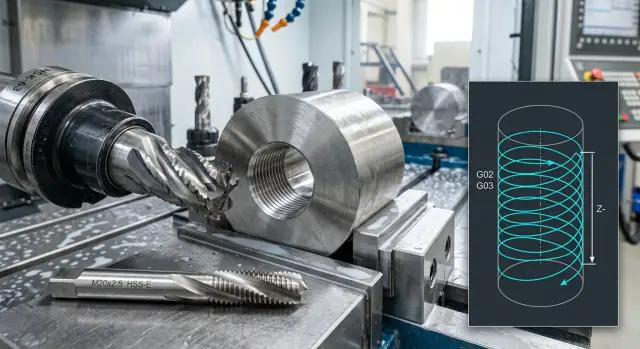
Thread milling usually cuts more gently. Tool load is lower, chips evacuate more consistently and the process tolerates difficult materials and blind holes better. Yes, the trajectory is more complex and the program needs attention. But the cost of that complexity is often less than the cost of a single ruined part.
There is also a hidden cost — machine stoppage. When a tap breaks the operator doesn’t simply change a tool. They spend time extracting the broken piece, inspecting the part, adjusting parameters, sometimes removing the fixture and calling a fitter. Even 15–20 minutes of downtime on one issue quickly wipes out the benefit of a shorter cycle.
So comparing in seconds almost always gives a biased picture. You must count the total processing time including losses: how many parts went to scrap, how often the machine stopped, what reboot cost was and how much tool life was written off early.
A shop loses money not where the cycle is 8 seconds longer, but where one heavy failure happens once per shift. If the batch is small and the part cheap, a tap can remain a sensible choice. But on difficult material even one broken tap can cost more than the total difference between the two approaches for the whole batch.
What changes on difficult materials
On ordinary steel the debate often comes down to tool price. On stainless, heat-resistant and ductile alloys the picture is different. The material dictates the rules: how chips form, where heat builds up and how many mistakes it forgives.
Stainless steel quickly heats the cutting edge and creates long chips. If the tool rubs instead of cutting, the metal work-hardens right in the cut zone. After that the next thread turn becomes heavier. In that situation a tap almost immediately sees a rise in torque because it works with the whole profile engaged. If chips pack at the bottom of a blind hole, the margin for error drops sharply.
With thread milling the load is usually gentler. The tool removes material in smaller increments instead of forcing the whole form at once. Chips have an easier path out of the cutting zone and the operator can keep the process under control more easily. That doesn’t make a difficult material easy, but it removes some of the abrupt spikes that typically trigger problems.
Heat-resistant alloys are even harsher. They retain heat and punish the tool for it. Any extra load quickly turns into edge wear, vibration and poor thread finish. A tap often runs at the limit here, especially for deep holes or less rigid machines. A thread mill gives more freedom: you can reduce depth per pass, tweak parameters and avoid forcing the tool into the material with one big push.
Ductile materials add another issue — built-up edge. A deposit grows on the cutting edge, the profile cuts poorly and the thread flanks become torn. The part may pass a gauge check but assemble poorly. Over a batch this becomes obvious quickly.
The difference is most pronounced in deep blind threads. There chips have little room to escape, heat dissipates worse, the bottom won’t forgive extra travel and a broken tap is hard to remove without losing the part.
Therefore on difficult materials you look not only at diameter and pitch. First assess metal behavior, hole depth and machine rigidity. Only then pick a tool. Otherwise the comparison looks nice on paper but works nervously on the shop floor.
When a tap still makes sense
A tap often remains the most sensible choice if you cut many identical holes and the material doesn’t throw surprises. The winner is not always the more flexible method. Sometimes the one that covers the shift fastest and cheapest wins.
If the batch is large and blanks behave consistently, a tap gives a predictable rhythm. The operator sets a simple cycle, gets stable times and doesn’t waste minutes tuning a trajectory. This is especially true for standard internal threads where no subtle bottom adjustments are needed.
A tap is convenient where the bottom requirements are lenient. If the thread isn’t required to reach the bottom exactly and a small undercut doesn’t spoil the part, the process is simpler. Thread milling is stronger where depth control matters, but not every job needs that precision.
There is also a purely machine question. On older or less rigid machines the tap cycle sometimes runs calmer than helical interpolation. If axes don’t move smoothly and the spindle/CNC system handles the simple tap cycle better, the tap gives fewer reasons to experiment. Shops value that more than theory.
In practice a tap is justified when several conditions align: many holes, repeated sizes, stable material hardness and a standard thread with no strict bottom requirement. Add a machine that handles the tap cycle confidently and the choice becomes clear.
There is a simple economic criterion. If the part is cheap, downtime doesn’t break the schedule and the risk of single-part scrap is not painful, a tap often gives better unit cost. The tool is cheaper, the batch runs faster and wear behavior is easy to understand.
A typical example is simple flanges or serial housings with dozens of identical threaded holes. If the material is familiar, coolant set up and scrap rare, the tap isn’t obsolete. It just does the job faster.
Where a thread mill reduces scrap risk
Here the argument is usually decided not by tool price but by the cost of a ruined part. This is most visible on stainless, heat-resistant alloys and expensive blanks where a single mistake costs more than many minutes of machine time.
Thread milling reduces risk where the material galles, springs or poorly evacuates chips. A tap in those conditions works harder: it immediately loads the full thread profile, presses harder on the walls and tolerates less error in feed, lubrication or hole size. A thread mill loads the cut more gently because it cuts progressively along a path.
The difference shows most on thin-walled parts, blind holes, housings with expensive pre-machining and stainless parts where a tap easily grabs. The same applies to holes near an edge or in a brittle zone where extra force quickly causes trouble.
Another advantage: one thread mill tool can sometimes cover several close diameters or pitches if the process allows. That means fewer tool changes, fewer chances to load the wrong tap and less confusion on mixed small batches. With wide part variety such mistakes happen more often than acknowledged.
If a tool breaks, consequences are usually gentler as well. A broken tap often remains stuck in the hole and the part goes to scrap or a long, expensive extraction. With a thread mill this is possible too, but much less frequently do you get to the point where the blank is irretrievable.
Thread size control is also easier. If the thread comes out tight or loose, the operator can correct offsets without changing the tool immediately. With a tap that freedom is small. When results drift you usually have to change the tap or lose the part.
In practice this matters especially for stainless batches and thin-walled parts. There a thread mill often wins not by speed but by predictability. And predictability in machining is almost always cheaper than scrap.
How to count time without illusions
Comparing by a single number almost always lies. If you take only the pure machine time per hole, a tap often looks faster. But a shop pays not for a pretty table but for a finished batch without stoppages and extra work.
What belongs in the calculation
First write down the pure cutting time per hole. Only cutting, no optimistic rounding. For both tap and thread mill this number is the base, but the calculation doesn’t end there.
Then add everything that eats minutes between holes: tool change, approach, retract, positioning, inspection after the first parts. On one hole it seems minor. On a batch of 300 or 500 holes these little things add up to hours.
Count stoppages separately. If a tap breaks, the operator loses time not only on replacement. They stop the machine, extract the broken piece, inspect the part and sometimes reconfigure the process. If a tool goes for regrind, translate that into minutes of downtime and add to the total.
Treat scrap separately. A common mistake is multiplying risk by tool price. That’s too soft. If you ruined a stainless blank after several operations you lose blank cost, time spent on prior machining and the place in the schedule. Scrap must be multiplied by the full part cost, not the price of the tap or thread mill.
For a quick estimate five numbers are enough:
- pure cutting time per hole;
- auxiliary time per hole;
- minutes of downtime per batch;
- number of scrapped parts;
- full cost of one part.
Why the batch gives an honest picture
Assume the tap cuts a thread in 8 seconds and the thread mill in 14. For one hole the result seems obvious. But if on a batch of 200 a tap breaks twice for 20 minutes each and ruins 3 parts, the picture changes. Thread milling can lose on seconds but win on money and delivery.
So compare over the whole batch. Only then do you see not just speed but the cost of mistakes. That’s where the real difference usually hides.
Example for a stainless batch
Take a simple case: a stainless housing, blind M10 thread, batch of 120 pieces. Material is sticky, chips evacuate poorly and the part has already undergone most costly operations. A mistake at the final operation hits harder than the time table suggests.
With a tap the start looks attractive. One pass can take, say, 14 seconds, while thread milling takes 24 seconds. On paper the tap saves about 10 seconds per part, roughly 20 minutes for the batch.
The problem comes when people count only pure machine time. In a blind stainless thread a tap may run quickly for 50, 70 or even 100 parts and then break due to built-up edge, overload or poor chip escape. If this happens on an almost finished housing, the saving disappears immediately.
A rough calculation might show:
- 80 parts with the tap saved about 13 minutes vs the thread mill;
- one break stopped the machine for 25 minutes;
- another part was scrapped if the broken piece couldn’t be removed cleanly;
- if a housing costs 30,000–40,000 tenge, the loss is already larger than the cycle-time gain.
Therefore for the batch the thread mill often looks calmer. Yes, its cycle is longer. But the result is steadier: fewer emergency stops, fewer inspection disputes and fewer parts you hate to scrap after the final operation.
Thread milling has another plus on such housings. If the tool begins to wear, the process usually doesn’t collapse instantly. The operator notices size or surface deviations and replaces the tool before an entire shift turns to scrap. With a tap the shift from “all good” to a failure can be abrupt.
There’s no single answer for all cases. If the part is simple, cheap and a tap reliably holds hundreds of holes without failures, its speed may yield a better cost. But if the housing is expensive, the thread is blind and a failure occurs even once every 50–100 parts, a thread mill often wins not by seconds but by the final batch result.
Common mistakes in comparison
When people argue which is more profitable they often count only catalog or CAM seconds. That’s a convenient number but rarely matches what the machine does during a shift. On stainless the gap between calculation and reality is especially visible.
Operators often take the nominal feed and forget about axis acceleration, trajectory entry, control pauses and safe retracts. A tap cycle can look very fast on paper, but on the part some of that gain is eaten by reverses, synchronization and cautious approach. The same goes for thread milling: if you count only the cutting pass the calculation looks pretty but empty.
A second costly mistake is not including failures. A broken tap in a part isn’t just tool cost. The shop spends time trying to extract it, then scraps the part, and sometimes pauses the batch to check other holes. On difficult materials one such case can cover the tool-price difference for dozens of parts.
People also compare a new tap with a worn thread mill that has lost sharpness. That test proves nothing. Put tools in comparable wear states and run on the same material, otherwise the result is random.
Another error begins before threading. If the hole is out of size, has a burr or a work-hardened entry after drilling, both tools will perform worse than they could. Then the method gets blamed while the real problem was poor hole preparation.
What shops actually check
A proper comparison rests on simple things: count the full cycle, separately record scrap cost and downtime after failures, verify hole size and cleanliness before threading and inspect not only the first but also the tenth part from the run.
The last point is often underestimated. The first part nearly always comes out neat because the tool is fresh, the machine is cold and the operator is attentive. By the tenth part you can already see how force changes, size drifts and burr risk grows. If a test doesn’t reach at least a small series, it shows process economics poorly and only a fortunate start.
Short checklist before launch
Before the first batch spend 15 minutes checking baseline data. It's cheaper than scrapping parts, swapping tools on the fly and figuring out why one method turned out slower than another.
Look at the specific job, not shop habit. On difficult materials a small assessment error quickly becomes scrap, downtime and extra tool consumption.
Check these five things before launch:
- exact part material, diameter, pitch and full thread depth;
- scrap cost of one part including prior operations, machine time and re-inspection;
- whether the machine can consistently hold the trajectory, speeds and feeds needed;
- whether the operator tracks tool life by batch, not by a single good part;
- whether the chosen method suits the batch size, because a decision for five parts and for five hundred is often different.
One more useful check: if a broken tap inside a part almost always means scrap, don’t pretend that this is a rare event and ignore it. For stainless and ductile alloys this risk should be built into the calculation from the start.
A small example sobers the view quickly. If a part costs 12,000 tenge before threading and scrap occurs even once per 100 pieces, that’s a noticeable amount. In that case a slower pass that cuts without surprises can be cheaper.
If numbers still aren’t clear after this check, run a short test of 20–30 parts and compare not only cycle time but actual scrap, tool wear and machine behavior toward the end of the run. That’s where the real difference usually appears.
What to do next
Don’t argue theory on the shop floor. Take the same batch and run it both ways: first with a tap, then with a thread mill or vice versa. Better use actual production with the same material, thread depth and tolerance requirements.
Watch real shift facts, not catalogue promises. One method may give a cycle a few seconds shorter but then lose that time to stoppages, tool failures and inspection.
It’s convenient to summarize the comparison in a simple table across four points:
- pure cycle time per part;
- number of failures and stoppages per shift;
- tool consumption per batch;
- percentage of scrap and time for rechecks.
These numbers bring the discussion back to reality fast. When cutting threads in stainless a tap often wins on a single part but loses on a series if the operator meets sticking, tool breakage or unstable size after wear.
Count exceptional losses separately. If the machine stood idle 18 minutes due to a broken tap, don’t hide that in general shift losses. Add that downtime specifically to the operation’s reckoning or the comparison will look pretty only on paper.
Before changing equipment
If you plan a new machine or change the machining scheme, discuss in advance which threads you cut daily and which materials you handle most often. For stainless, ductile alloys and parts with high scrap risk this affects the choice as much as spindle power or machine price.
It’s useful to decide early which tool you want to use, what rigidity margin is needed and who will do the commissioning for your tasks. Otherwise the machine gets bought to general specs and thread problems remain.
If the issue comes down to choosing equipment, do the analysis with people who understand both the machine and the machining task. In EAST CNC, the official representative of Taizhou Eastern CNC Technology Co., Ltd. in Kazakhstan, you can discuss machine selection, commissioning and service for specific parts and materials. Start that conversation from your shift losses, thread types and real material behavior rather than from a catalog.
FAQ
Which is generally better for stainless steel: thread mill or tap?
On stainless steel a thread mill is often more advantageous when the part is expensive, the thread is blind, or scrap is costly to the batch. It cuts more gently, evacuates chips better and less often leads to a process-terminating failure. A tap usually wins only when the material is familiar, there are many holes and failures almost never happen.
When is a tap still a good choice?
A tap makes sense for large series of identical holes in a stable material. It often gives a shorter cycle and a simpler program. This choice is good for low-cost parts where an occasional failure does not ruin the batch economics.
Why does a blind thread so often change the tool choice?
In a blind hole chips have less room to escape and heat dissipates worse. The bottom has little margin for error, and a tap more quickly encounters overload. If a tap breaks at the bottom, the part is often unsalvageable. That's why a thread mill is usually the safer option for blind threads.
How to correctly calculate what is cheaper for a batch?
Count not only cutting seconds per hole. Add approach and retract, tool changes, inspection, downtime after breakages and scrap cost. A fair calculation is done for the whole batch. On a single hole a tap may look faster, but over a series it can lose due to stoppages and scrapped parts.
What counts as downtime after a tap breaks?
Downtime includes more than tool replacement. The operator spends time stopping the machine, extracting a broken piece, checking the part, adjusting parameters and restarting. Even one such pause easily eats the saved seconds from a shorter cycle.
Is it always possible to save a part after a tap breaks?
Sometimes the part can be salvaged, but relying on that is risky. On an expensive blank, marks from extraction, thread distortion or wall damage can quickly turn a repair into scrap. If the broken piece sits tight in a blind hole, the loss often exceeds the price of the tool itself.
When does a thread mill help keep thread size in tolerance?
A thread mill gives more room to control thread size. If the thread comes out tight or loose, the operator can adjust offsets or parameters without immediately changing the tool. With a tap that margin is small: if the result is off, you usually must change the tap, rework the hole or accept scrap.
Should I perform a test before starting a batch?
Yes — a short trial before the run almost always pays back. Run 20–30 parts and watch not only cycle time but tool wear, dimensional drift and failures toward the end of the run. The first part typically looks better than the rest. A small series reveals the process truth.
How much does the machine itself affect the choice between tap and thread mill?
It matters directly. If the machine struggles with helical interpolation, a thread mill can cause extra trouble even with a good tool. Conversely, low rigidity and poor chip evacuation also hit taps hard. Check axis smoothness, stiffness, spindle speed stability and machine behavior under load.
What should I check before the first production run to avoid a wrong choice?
First check material, thread depth, scrap cost and the quality of the prepared hole. Then evaluate whether the machine can reliably hold the required paths and feeds, and whether you track tool life by batch rather than by a single good part. If still unsure, compare both methods on an identical series and record actual losses over a shift.