
Thin-Walled Housing Parts: Material Removal Without Warping
Thin-walled housing parts need a precise machining plan: pass order, size check points, allowance, and practical checks without unnecessary theory.
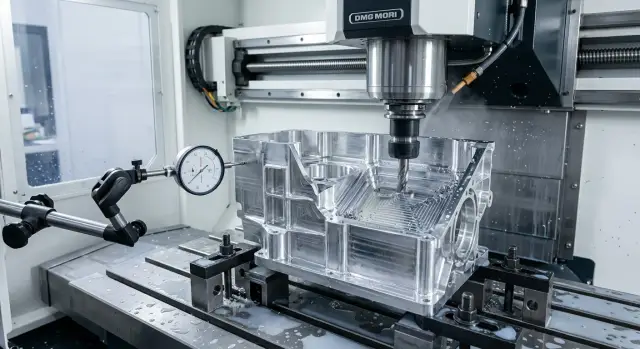
Why a part loses its shape during machining
Thin-walled housing parts often look rigid only until the first serious material removal. As long as there is extra metal inside, the blank holds together well. But once you open a pocket, the wall starts to spring back from clamping, cutting force, and even its own internal stress.
Usually, several things distort the shape at once:
- the clamp or jaws press on a thin area
- the tool pushes the wall away during the pass
- after the pocket is cleared, the housing suddenly loses rigidity
- heat and removal from the fixture change the size again
Clamping causes the first shift. If the operator pulls the part too hard in the fixture, the wall already changes position before cutting starts. Then the mill or turning tool adds its own load. At that moment the machine may show a normal size, but it is a size on a part that the clamp and tool have already bent slightly. When the load disappears, the wall springs back and the size changes.
A pocket almost always breaks the housing’s former rigidity. Before it is cleared, the part has a solid mass that absorbs the force. After it is cleared, only a thin shell remains, and the same cutting mode behaves very differently. On a simple housing this shows up quickly: while the pocket floor is still intact, the pass runs smoothly, and after the cavity is opened the wall starts to ring, vibrate, and spring away by a few hundredths.
Heat adds another error. Even if the datum is chosen correctly, a thin wall heats up fast. You measure right after the pass and see one value, then a few minutes later the metal cools and shrinks. If the tool is rubbing instead of cutting, the heat rises even more. That is why the size drifts without any change in setup.
After the part is removed from the fixture, the problem often becomes most obvious. While the clamp holds the housing, it seems to keep its shape. As soon as the operator releases the hold, the metal relieves part of its stored stress, and the walls settle into a new position. If the blank came from casting, welding, or heavy roughing, this effect is usually even stronger.
That is why warping rarely has only one cause. More often, the clamp bends the part first, the pocket weakens it next, cutting adds heat, and removal from the fixture changes the shape for good.
What to check before the first chip
When machining thin-walled housing parts, problems often start not on the finish pass, but much earlier, during preparation. If weak areas are not marked in advance, the part quickly loses rigidity and the size starts to drift even after roughing.
First, check wall and floor thickness in each area, not just one overall dimension. A housing almost always has places where metal is removed unevenly: near a pocket, by a rib, around a mounting surface, or by a window for fasteners. That is where the part changes shape first. It is better to mark on the sketch where the wall stays thick and where, after the first cut, it becomes flexible and starts reacting to clamping and heat.
Next, choose the surfaces that will serve as datums. The common mistake is simple: metal is removed from the convenient side first, and then size is built from a surface that has already shifted. A datum must stay alive longer than the roughing stock around it. If possible, leave one plane and one reliable stop untouched until the main cavities and pockets are already formed.
Before starting, it helps to mark four things:
- areas with the smallest wall thickness;
- surfaces for the first and second datum;
- places where ribs or temporary bridges can be left;
- dimensions that need to be checked early, while the housing is still rigid.
Temporary bridges often save the part better than extra caution with cutting parameters. If the housing is long or has a deep internal cutout, leave metal in the corners, on the ends, or between windows. Those areas are easier to remove later in a separate pass than to try to restore a part that has already warped.
Dimensions should also be separated in advance. Some need to be checked early, while the housing still holds its shape. These are usually the relationship between datums, the cavity depth, the distance to the support plane, and the fits for later machining. Other dimensions are better left for the end: thin outer walls, the floor after the cavity is fully opened, and areas near the bridges you will remove.
A simple example: a housing has a pocket, a thin floor, and two side walls 3 mm thick. If you bring the floor to size right away and almost finish the walls, the part starts to spring already on the next setup. If you leave a small allowance on the floor and walls, keep the base plane intact, and do not cut the bridges until the end, the inspection will be calmer and cleaner.
How to break down the metal removal step by step
If you machine a housing almost to size from the first minutes, it quickly loses rigidity. After that, the walls move and the size starts drifting in the middle of the program. For thin-walled housing parts, a better approach is different: first create support, then remove the main bulk, and only then move into the weak areas.
The first stage should not start with windows, pockets, or long thin walls. Start by machining the base planes, support shelves, and locating areas that will be used for the next setups. While the blank is still rigid, the tool cuts more evenly and the clamping behaves calmly. At this stage you do not need to remove all the material. It is enough to establish clean datums and a clear geometry.
After that, remove the main volume, but do not weaken the whole housing at once. If you clear large pockets on one side, then immediately machine the opposite side and open all the windows too, the part will start to spring. It is much better to alternate areas and leave temporary rigidity bridges where the wall is already becoming weak. Then the machining pass order helps the part hold its shape instead of working against it.
A sequence like this usually helps:
- Prepare the datums and locating surfaces.
- Remove the large internal and external bulk, but leave allowance on thin areas.
- Even out the finishing stock on the walls so it is roughly the same along the whole length.
- Finish the windows, pockets, edges, and small features at the very end.
A uniform finishing allowance matters more than removing metal as fast as possible without warping. If one area still has a large stock and another is almost done, the tool cuts them differently. As a result, one wall still holds while the next one moves away from size.
In practice, it helps to think like this: while the housing is rigid, do the operations that need support. When rigidity drops, switch to lighter passes with a small load. This order does not stretch the work for no reason. More often, it saves time because the part does not need correction after finishing.
Where to check size while the housing still holds its shape
For a thin-walled housing, it is better to catch the size not at the end, but while the blank is still rigid. If you wait until the internal cavities are fully opened, the outer contour may already shift by a few hundredths, and the finish pass will not always fix it.
For thin-walled housing parts, the first convenient inspection point usually appears after roughing the outer surfaces. At that stage, the housing is still supported by the internal metal, so width, height, and distances from the datums to the outer planes should be checked right away. Later, when the internal pockets are opened, rigidity drops and the same dimension can change without any program change.
The floor depth should also not be left until the very end. When the internal roughing is done and the walls are still left with stock, the floor usually behaves more calmly. If you first bring the walls to finish size and only then measure the floor, you may see extra hundredths because the housing has relaxed a little.
This order of inspection works well:
- check the outer contour after external roughing and before the cavities are fully opened;
- measure the floor after internal roughing, while the walls are still not weakened by finishing;
- verify distances from the datum to fits, windows, or steps while the housing still has some rigidity left;
- mark the point where the size starts to drift.
The last point is often underestimated. That is a mistake. If a size is stable until one operation and then drifts by 0.02-0.05 mm, the technologist already knows where the cause is. Then there is no need to guess on the next part. You can change the pass order, leave a different finishing allowance, or add an extra check right after that transition.
A simple example: on a housing, the base and outer planes are machined first, then the internal cavity is opened, and the side walls are finished later. If you check the outer width before the cavity is opened, it holds steady. If you check the same width after finishing the inner walls, the size sometimes drifts. It is better to record that shift in the operation sheet right away instead of chasing it on the finished part.
How to work with allowance and pauses
For a thin-walled housing, allowance is not just extra stock for finishing. It is a way to hold the shape of the part until the end of machining. If one wall is left with 0.8 mm and the next with 0.2 mm, the housing will start pulling to one side on the next pass. Then the size may still be caught, but the geometry will be lost.
Even allowance holds the shape
Neighboring walls are better machined with a similar amount of remaining stock. There is no need to make one side almost finished while the other is still thick. Different rigidity changes how the part reacts to cutting, and the housing starts behaving on its own.
Remove the remaining metal symmetrically as well. If you still need to remove 0.4 mm from the walls, the worst thing is to take it all from one side and leave the other for later. A calmer approach is to split the removal into paired passes: a little from one wall, a little from the opposite wall, then move on. That way the stresses redistribute more smoothly.
In practice, it looks simple. Suppose after roughing you have 0.6 mm left on four walls. It is better to remove 0.2 mm around the perimeter in one cycle, then let the part stabilize, check the size, and only then go for the next removal. One long cleanup on one side often costs more than an extra five minutes spent on a careful sequence.
Pause after heavy roughing
Long roughing heats the housing, especially around pockets and thin ribs. While the metal is warm, the size may seem fine. After cooling, the wall shifts slightly and the finish pass no longer saves it.
That is why it is better to pause after heavy material removal. Sometimes a few minutes on the machine are enough; sometimes it is better to remove the part, let it cool, and then locate it again. That is not a waste of time. It keeps you from chasing the size twice.
The finish pass should be kept complete and planned in advance. Random touch-ups after measurement usually make the situation worse: in one area you remove too much, in another you leave stress, and the housing warps again. If the size has drifted noticeably, the problem is more often not the finish pass itself, but the fact that the allowance was distributed unevenly or the pause was skipped.
For thin-walled housing parts, a simple rule works: equal remaining stock, paired removal, cooling after heavy roughing, and one calm finish pass without rush.
Example: machining a simple housing
Take a simple aluminum housing, 220 x 160 mm, with a central pocket, a flange on one side, and side walls 3 mm thick. If the operator opens the pocket to full depth right away and then starts finishing the walls, the part often warps after it is removed from the clamp. A housing like this loses rigidity quickly.
On the first setup, it is better not to chase final size. First, the operator machines the support plane, creates two datums, and only then roughs out the main pocket volume. Material is removed in layers, without plunging to full depth at once. On the walls, about 0.8-1.2 mm is left, on the floor 0.4-0.6 mm, and the flange is not finished yet so the part keeps its shape.
If the pocket is large, the operator can leave a temporary island in the center or a narrow bridge near a long wall. That leftover can be removed in a couple of minutes later. But during roughing, the housing moves less and handles the setup change more calmly.
On the second setup, the housing is located from the finished datums. It is better if the fixture supports the bottom across almost the entire area. Then the operator proceeds in this order:
- brings the pocket floor almost to size, but leaves the last pass;
- machines the holes in the flange and in the floor while the housing is still rigid;
- finishes the inner contour of the pocket;
- removes the final allowance from the walls and only then machines the outer surfaces of the flange.
Before the final stage, size control on the CNC is needed at the points the technologist marked in advance. Usually the operator checks the pocket width at the entrance and at the bottom, the distance from the datum to the floor, and the position of the holes relative to the datums. These points are useful because they clearly show when the housing has already started to drift, even though it is still barely visible from the outside.
In practice, the scheme is simple. The operator removes almost all of the allowance on the second setup, lets the part cool a little, and checks three or four dimensions. If the size holds, he makes the final pass with a low feed and tries to remove metal from the walls evenly. This machining pass order does not solve every problem, but it significantly lowers the risk of warping and helps avoid losing the part at the very end.
Where mistakes happen most often
When machining a thin housing, the mistake rarely looks obvious. The part seems fine at first, but after it is taken off the machine one wall shifts by a few hundredths, the plane bends, and the pocket pulls the rest of the dimensions with it. Usually there is not just one cause. The sequence itself is wrong.
The first common mistake is opening the internal pocket completely before checking the outer size. Once the inside is already empty, the housing quickly loses rigidity. The operator then measures the outer contour, adjusts it, and the part shows one result in the clamp and another outside it. For thin-walled housing parts, that is almost always a bad scenario: the metal has been removed, but there is nothing left to hold the shape.
Too much clamping force does not work any better. A thin side is sometimes pulled just as hard as a heavy, solid blank, simply "to be safe." As a result, the wall bends even before the first finish pass. While the part is sitting in the chuck or under the hold-down, the size seems fine. Release the clamp, and the geometry drifts. If the wall is thin, the clamping force should be chosen for that wall, not for the operator’s habit.
Another typical mistake is changing the datum between roughing and finishing without recalculating. The blank is turned over, a new base face is used, but no one checks how the stock behaves now and where the actual size is. Then small local adjustments begin, and size control on the CNC no longer helps: the operator sees a number, but the datum is different. As a result, one side comes into size while the opposite side moves out.
Often, size is also corrected with short passes only on one wall. That seems like a quick solution, especially when only a couple of hundredths are missing. But such correction removes stress unevenly. The wall responds immediately, the neighboring one changes next, and the housing starts breathing again. Much calmer results come from symmetrical passes, where material is removed from paired sides and one wall is not made thin before the other.
A simple set of rules helps in practice:
- do not fully open the pocket before the outer geometry is checked
- do not pull a thin wall with the same force as the thicker part of the blank
- do not change the datum without recalculating allowance and inspection points
- do not chase size with single short passes on one side
A good sign is that the part behaves almost the same in the clamp and after release. If the difference appears only at the end, the mistake was usually made earlier, not on the last pass.
Short checklist before finishing
Before finishing, it is better to spend five minutes on a check than to chase size across the whole part afterward. On a thin-walled housing, the error is rarely just one thing. Usually it is a chain: uneven allowance, a weak datum, heat after roughing, and measurement at the wrong point.
I would look at four things.
- Compare the remaining allowance on all thin areas. If one wall is already almost at size and the next is still thick, the finish pass will release stress unevenly and the housing will move.
- Make sure the datum is clean and repeats reliably on the next setup. Chips under the support, a burr on the plane, or weak clamping can shift the part by hundredths.
- Let the part cool after roughing. A warm housing often looks "straight," but after a pause the size drifts. For a thin wall, that is enough to ruin the finish pass.
- Open the operation sheet and check where you are catching the size. The control points should be written down in advance, not chosen on the fly when the part is already in the machine.
For thin-walled housing parts, this is not formality. It is normal protection. If the left wall has 0.6 mm left and the right wall 0.2 mm, do not expect finishing to "pull it in." First make the allowance even, then move toward size.
A good quick test is simple: remove the part after roughing, let it sit, then place it back on the same datum and check two or three control points. If the readings drift, the problem is not the finish tool. It means the housing is still living by its own shape, and you should not rush.
If you have several setups on the floor, add a short note to the route: which datum is primary, which points to measure before finishing, and what remaining allowance counts as normal. This kind of order saves not minutes, but entire batches.
What to do next on your shop floor
Most shops do not suffer from a lack of advice. They lack a clear system that works for their own parts, fixtures, and people. So start not with general theory, but with one typical housing part where thin walls have already caused size drift or warping.
Take the route for that part and write the steps in order: which datum comes first, where roughing happens, when the cavities open, when the wall loses rigidity, and where you check size. Even a simple one-page table often shows the weak spot right away. For example, the size is checked only after the housing has been weakened too much, and it drifts from clamping or from the stock that has been removed.
Next, it helps to divide the part into two groups of areas. In the first, the housing still holds its shape and lets you remove the main volume of metal calmly. In the second, risk already begins: long walls, corners around pockets, areas near a thin floor, and sections after the internal cavities are opened. These areas should be marked directly on the sketch so the technologist, setter, and operator are all looking at the same picture.
A good working check looks like this:
- choose one part that is repeated in production;
- record the actual sequence of steps, not the "ideal" one;
- mark after which step the size drifts most often;
- compare 3-5 parts from different batches;
- keep one clear takeaway for each risk point.
Comparing batches is more useful than one lucky run. If the size drifts at the same point in three batches, the problem is no longer random. Then you can change one step at a time: leave more allowance before finishing, move the inspection earlier, or split the removal into two passes with a pause.
If you are choosing a machine for this kind of work, it is better to gather the questions in advance. For a consultation with EAST CNC, it is useful to bring not only the drawing, but also your real problems: where the wall bends, which size is drifting, what material you are running, how many parts are in the batch, and which tolerances fail most often. Then the conversation will not be about "any suitable machine," but about your actual process and its weak points.
After that, you will have not an abstract rule, but your own risk map for the part. With it, it is easier to change the route, check the result, and avoid losing batches in the same place again.