
Thin-Wall Pipe Cutting: How to Prevent End-Face Crushing in Production
Thin-wall pipe cutting requires precise clamping, support, and tool geometry. Here’s how to prevent end-face crushing in series production.
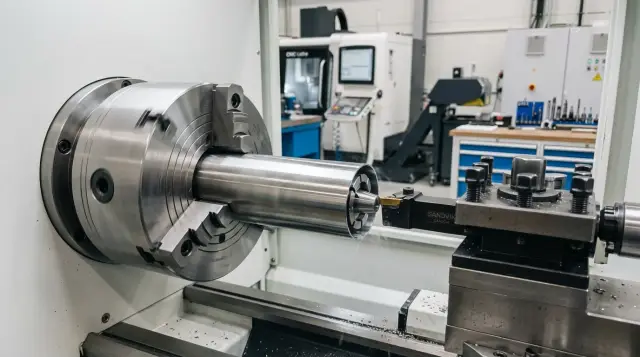
Why the end face crushes during cutting
A thin-wall pipe does not crush because the material is weak. The problem is that a thin wall does a poor job of keeping its shape under a local load. As soon as the jaws clamp the blank, the pipe easily goes oval. After that, the parting tool is no longer cutting a round ring, but a section with different stiffness around the circumference.
Because of that, the load in the cut changes in jerks. In one spot the tool cuts cleanly, in another it starts pushing instead of cutting. The end face loses its shape, burr grows, and at the end of the cut the edge can be pulled inward.
In series production, the defect is rarely caused by one big mistake. More often it is built from small things: too much clamping force, too much overhang, a worn tool, or variation in wall thickness. On the first parts, it may be almost invisible. After several dozen cuts, the problem becomes visible on every end face.
The marks on the part usually point to the cause quite accurately. If the pipe becomes oval before cutting even starts, first look at the clamping. If there are jaw marks on the outer surface and the size changes after re-clamping, the chuck is the likely cause again. If the end face tears at the very end, burr increases, and a squeal appears, the tool or cutting conditions are usually to blame. When chip evacuation is difficult, the edge heats up and pulls the remaining bridge, the first thing to check is the tool geometry and feed.
One good cut proves nothing. The first pipe may simply be a little stiffer, shorter in overhang, or straighter than the others. At the start of a shift, the tool is sharper, the chuck is cooler, and the operator is more careful with the first part. A production run quickly removes that kind of luck: the metal warms up, the edge dulls, and any variation between pipes shows up immediately on the end face.
If the defect grows after a few parts, look for a systematic overload of the thin wall. Such a pipe has very little stiffness reserve, and it usually does not forgive even a small excess of pressure.
What to check on the pipe before setup
Before setup, do not rely only on the drawing or the marking on the bundle. The pipe often shows its real behavior on the very first measurement: the wall varies, the section goes oval, and the overhang turns out to be too long for that level of rigidity.
Measure several blanks from the batch. The outer diameter is easy to check with calipers, while wall thickness is better measured at several points around the circumference. If one area is 1.5 mm and another is 1.2 mm, the pipe will already behave differently under clamping and during cutting.
It is also better to detect ovality in advance. Just compare the diameter in two perpendicular directions. Even a difference of a few tenths of a millimeter can cause crushing on a thin wall, especially if the jaws squeeze the pipe along the major axis and the tool reaches a section with lower stiffness.
Check the overhang separately. If the pipe sticks out too far, it starts to spring and pushes the cut off line. Then the problem is no longer just clamping force. Even a careful chuck will not help if the free end works like a lever.
In practice, four things are enough to check: outer diameter on several pipes, wall thickness at several points, ovality across two axes, and the actual overhang. After that, the setup becomes much more accurate.
If you are running a series, do not mix all pipes into one setup. Blanks with noticeable variation in wall thickness, ovality, or diameter are better processed separately. Otherwise, the machine is set up for the average pipe, and the crushed end face appears on the parts that fall outside the batch.
Usually it looks very simple. Out of a bundle of 100 pieces, 10 pipes may have a slightly thinner wall and a small oval. It is better to cut them in a separate pass with softer clamping or different support. That takes a few minutes, but later you do not have to sort scrap.
How to choose clamping without crushing
When cutting a thin-wall pipe, the end face often crushes not because of the tool, but because of how the part is held in the chuck. If the clamp presses in three points too close to the cut line, the pipe quickly goes oval. After that, the tool finishes cutting through an already weakened edge.
Collet or jaws
For series production, a collet often gives a calmer result than standard jaws. It grips the pipe all around, so the load is distributed more evenly and the risk of dents is lower. This is especially noticeable on thin walls and on batches with a consistent outer diameter.
But a collet is not always the best choice. If the pipe varies in size, has ovality, or comes with a noticeable diameter spread, the collet either holds too loosely or forces you to increase clamping force. In that case, soft jaws bored to the actual pipe size often work more reliably. They provide a larger contact area and allow the part to be held more gently, without sharp pressure points.
Soft jaws are especially convenient when a shop cuts the same size for a long time. The seat is bored once to match the pipe, the contact around the circumference is checked, and then the setup can be repeated without unpleasant surprises. For a small batch, this is not always worth the effort, but for a long production run it usually pays off quickly.
How to reduce force without slippage
A strong clamp does not solve the problem. Very often, it creates it. It is better to start with the minimum force that keeps the pipe from rotating during the plunge and at the end of the cut. The check is simple: make a test cut, look at the contact marks, and mark the pipe with a marker. If the mark has not moved, there is some reserve.
To hold more gently without slippage, it helps to do more than just increase chuck force. Often you get more by increasing the contact length, keeping the jaws clean and free of oil and chips, using a calm spindle ramp-up, and applying a moderate feed during the first millimeters of the cut. Once the groove has guided the tool, the pipe behaves much more calmly.
If possible, move the clamping zone farther from the cut line. When the jaws sit too close, they compress the area that is already losing stiffness as the groove deepens. A little extra distance often helps more than another turn on the chuck.
If the end face still crushes, it is usually not one thing but a combination: too much point contact, too much force, and clamping too close to the cut. Remove even one of these factors, and the series usually becomes smoother right away.
How to support the pipe during cutting
When cutting a thin-wall pipe, support often matters more than extra clamping. The pipe is compressed not only by the jaws, but also by its own flex near the cut line. That is why the free section should be as short as possible. The closer the cutting zone is to the support point, the less the pipe moves under the tool and the cleaner the end face becomes.
A good rule is simple: do not extend the pipe from the chuck farther than necessary for the part length, tool width, and a small reserve. An extra 20–30 mm often creates more problems than it seems. In that area the wall starts going oval, the tool pinches in the cut, and the end face begins to crush.
An internal mandrel is needed when the pipe loses shape before the cut is complete or when the end face must stay clean without later correction. It is especially useful on thin walls and on diameters where external clamping is already close to its limit. The job of the mandrel is not to force the pipe open, but to support the section from the inside near the cut zone. If the mandrel fits too tightly, it ruins the geometry itself. If it is loose, it does almost nothing.
A tailstock support can also work, but only with light force. Too much pressure does not save the pipe; it pushes it into the chuck and changes the end-face shape even before cutting starts. Increase pressure only until vibration disappears. After that, do not add more.
A steady rest is not always needed. It is useful when the blank is long and starts to chatter or vibrate without a second support point. But near the cut line on a thin pipe, a steady rest often gets in the way: rollers or shoes press on the wall, leave marks, and create ovality themselves. If you cannot avoid it, place it on a stiffer section and check the force as carefully as you would check tailstock pressure.
Usually the choice looks like this. A short overhang and a sufficiently rigid pipe are fine with one chuck. Thin walls and a clean end-face requirement often call for an internal mandrel. A long overhang with vibration is a reason to add a steady rest, and slight runout at the end sometimes disappears with light tailstock support. If the support is chosen correctly, the cut runs more smoothly, the edge does not fold inward, and the batch does not need constant readjustment.
How to choose the tool geometry
For a thin wall, the tool must cut, not push. If the edge is dull or too heavy, the pipe starts to move away from the cut, the end face crushes, and burr grows from part to part.
A narrow parting tool usually works better because it removes less metal and creates a lower axial load. This is especially noticeable in series production, where even a small excess load quickly turns into scrap. But an extremely narrow tool is not a cure-all either. If the insert or holder is not rigid enough, the tool deflects and the end face comes out crooked. So the goal is not the narrowest possible option, but the one that keeps enough rigidity for your overhang length.
The shape of the tip directly affects the edge after cutting. A tip that is too blunt compresses the metal before separation. The result is a crushed end face and a heavy burr. A radius that is too large can also cause trouble on a thin wall: the tool no longer cuts cleanly, but pushes the edge. A small radius with a clean sharpened edge usually works better here.
It is best to change the rake angle and feed together. A more positive angle makes cutting easier and reduces the load on the pipe. But if the feed stays the same, the tool may start pulling itself into the material. Then the end face gets damaged again, just for a different reason. After any geometry change, it is better to recheck the feed on the first parts, not on the whole batch.
A good sign of correct geometry is visible right away: the cut runs without squeal or jerks, chips come off evenly, there is no heavy burr on the end face, and the load does not spike sharply at the end of the cut.
A worn tool ruins a batch quickly. At first, it looks minor: the end face becomes rougher, heat increases, and chip flow gets worse. After a few dozen cuts, the load rises, the pipe is compressed more strongly in the cut zone, and crushing becomes a constant defect. In series production, do not wait for a clear chip to break. If burr has grown, the sound has changed, or the end face has darkened from overheating, the insert should be replaced right away.
Setup sequence for series production
When running a series, do not start with full pipe overhang and production speed right away. Begin with a test cut on a short overhang. In that condition, the pipe behaves stiffer, and the source of the problem is easier to see: clamping, support, or the tool itself.
The first trial is better done at calm settings. Watch not only the process itself, but also the end face after cutting: is there ovality, edge folding, or jaw marks. For thin-wall pipe, that is more useful than trying to save a few seconds of cycle time immediately.
Next, choose the minimum clamping force that holds the part without slipping. A very common mistake is simple: the operator adds extra force just to be safe, and the pipe crushes even before the tool enters. It is better to move in small steps. If the pipe does not rotate and the size holds, the clamping is already sufficient.
After that, add support and repeat the cut under the same conditions. That can be an internal mandrel, a steady rest, or another arrangement allowed by the tooling. The point is to change one factor at a time. If the end face pulls with no support and becomes cleaner with support, the cause is already clear.
At the tool exit from the wall, it is usually worth reducing feed. This is exactly when a thin wall most often loses shape. A small feed reduction in the last part of the cut is almost always more useful than trying to compensate with stronger clamping. If the machine allows it, set a separate cycle section for the last few millimeters.
Control is also better built around more than one part. The first part shows the basic setup. The fifth shows how the assembly behaves after several cycles. The tenth helps reveal whether the result is drifting due to heat, chip buildup, or slight support movement.
A good setup for series production looks almost boring: a short test, careful clamping, the right support, a gentle exit from the cut, and checking several parts in a row. In return, you do not have to waste time on dozens of ruined pipes.
Example from the shop
In one shop, a small-diameter thin-wall pipe was being cut into short bushings for a production order. The initial data were ordinary: 28 mm diameter, 1.5 mm wall thickness, final part length 18 mm. The first 20–30 parts came out clean, with no fold on the end face. Then a dent started to appear at the exit, and by the middle of the batch the scrap could no longer be called random.
At first, the tool was suspected. It was replaced and the feed was slightly reduced, but the situation barely changed. The end face still crushed at the end of the cut, when the separated bushing lost stiffness and drifted sideways.
The real cause turned out to be in two places. First, the clamping on the outer diameter was too aggressive. The jaws held the pipe securely, but the thin wall was already being deformed before the tool entered. Second, the part lacked internal support, and at separation the metal easily folded inward.
After that, the setup was changed. Clamping was reduced to a stable but non-aggressive level, soft jaws with a larger contact area were installed, and a simple internal support was added near the cut zone. The tool stayed narrow, but a geometry with an easier entry into the material was chosen. Scrap did not disappear completely, but it dropped from 12% to 1–2% of the batch. For the shop, that was a big difference.
By evening, the defect came back once. This time it was not the clamping. Fine chips had built up on the jaws during the shift, the pipe sat with a slight misalignment, and the tool had already started to dull. After cleaning the seating surfaces, checking the overhang, and replacing the insert, the end face became flat again.
This example shows one simple thing very clearly: in series cutting of thin-wall pipe, the defect is almost never located in just one place. Usually it is caused by three factors at once — clamping, support, and tool condition. When all three are under control, the process becomes much calmer.
Common mistakes
The most common mistake is clamping harder to feel safer. For a thin pipe, that is a bad habit. The wall easily goes oval before the tool even touches it, and after that it is hard to keep the end face straight even on normal settings.
The second mistake is a long overhang with no support. The pipe sticks out too far, there is empty space inside, and during cutting it starts to spring. The tool enters unevenly, the wall shifts, and the last few millimeters often end with crushing or a torn-off edge.
Problems also often appear when all pipes are cut on the same settings. The first part goes through acceptably, the setup is left untouched, and the next pipe with a different wall thickness behaves differently. In one case you need a softer approach, in another a lower feed, and in another a calmer speed. If that is not taken into account, quality in the batch starts to fluctuate.
A worn tool also rarely ruins a part immediately and very visibly. First the cutting force rises, chip flow gets worse, the end face darkens, and extra burr appears. If you wait for a clear squeal, the shop usually gets not one bad part, but a whole stack.
Another mistake is judging by one good part. For thin-wall pipe, that is not enough. The first blank may look fine, but by the fifth or tenth part crushing, end-face taper, or inconsistent burr can appear.
Usually the situation is corrected with simple measures: reduce clamping to the real minimum, shorten the overhang, add internal or external support, tune the cutting conditions to the wall thickness, and replace the tool before obvious noise appears. If the end face crushes for no clear reason, it is almost always a combination of two small misses, not some complex failure.
Quick check before starting a batch
Before a series, it is useful to do five short checks. They take only a few minutes, but often save the whole batch.
- Clamp the pipe as it will be used in production and compare its shape before and after clamping. If the circle already turns oval at this step, the end face will almost certainly start to crush later.
- Bring the parting tool up to the part at a light feed and watch the entry. If the tool immediately pulls to one side, the issue is usually overhang, tool height, or weak support.
- Make the first 2–3 parts and inspect the end face carefully. If the edge folds inward, the pipe is sagging, the tool is dulling, or the geometry does not suit that wall.
- Compare the first parts by length and burr. If the size already varies at the start and burr grows from part to part, the setup is not yet stable for series production.
- Repeat the inspection on the fifth and tenth part. That makes it easier to spot heating, chip buildup, tool wear, or a slow shift in support position.
This kind of short check is usually more honest than a single nice-looking first part.
What to do next
If you have already found a setup where the end face does not crush, do not keep it only in the master’s memory. For thin-wall pipe cutting, it is better to build a simple process card. It is enough to record the pipe type, actual overhang, clamping scheme and force, support used, insert width, holder overhang, and cutting conditions, including feed reduction at the end. That makes changeovers much faster and removes unnecessary arguments during a shift.
It is better to keep a separate working card for each size. If a shop cuts, for example, 30x1.5 and 42x2.0, a common average setup almost always creates extra scrap. It also helps to track scrap by batch, not just by shift. Then it becomes clear quickly where the process starts to drift: after a changeover, after an insert replacement, or near the end of a long run.
If the problem remains even after adjusting clamping, support, and cutting conditions, it is worth looking broader. Sometimes the issue is no longer a single insert or chuck, but the operation layout itself, machine rigidity, or the way the pipe is fed. In that case, it makes sense to discuss the task with the EAST CNC team. The company supplies CNC lathes for metalworking, helps with selection and service, and publishes equipment reviews and practical metalworking tips on east-cnc.kz. That is useful when you need to decide what to change first: the tooling, the process sequence, or the machine itself.
The goal is simple: get the same end face from the first part to the last. If the setup delivers that, it is worth locking it in and repeating it without unnecessary improvisation.
FAQ
Why does the end face crush right at the end of the cut?
Most often, the pipe loses its shape before the part is fully separated. The jaws compress the wall, the tool pushes on an already weakened edge, and in the last few millimeters the edge pulls inward. Check three things right away: clamping force, the distance from the jaws to the cut line, and the condition of the tool. Usually the defect comes from a combination of these, not just one cause.
What should be checked on the pipe before setup?
Take measurements from several blanks, not just one. Check the outer diameter, wall thickness around the circumference, ovality, and the actual overhang. If the wall varies and the pipe already arrived oval, a setup tuned to the average value will not save the whole batch.
Will a stronger chuck clamping force help?
No, you will usually only speed up scrap. Too much clamping quickly turns a thin pipe oval, and then the tool cuts an uneven section. It is better to start with the minimum force that prevents the pipe from slipping. If the part holds without jaw marks, there is no need to increase clamping further.
What is better for thin-wall pipe: a collet or soft jaws?
If the outer diameter is consistent and the batch is stable, a collet usually holds more gently and smoothly. It grips the pipe all around, so the risk of dents is lower. When the pipe varies in size or has ovality, soft jaws bored to the real diameter often work better. They provide a larger contact area and do not press at three points.
How do you know the pipe overhang is too long?
Hold the pipe as short as the part length and tool width allow. An extra 20–30 mm often creates flex, chatter, and a crushed end face. If the free end works like a lever, the problem is no longer only the chuck. Then the pipe can pull the cut off line even with careful clamping.
When should an internal mandrel be used?
A mandrel is needed when the pipe loses roundness before the cut is complete or when you need a clean end face without rework. It supports the wall from the inside near the cut zone and keeps the edge from folding inward. Do not make the fit too tight. If the mandrel expands the pipe, it will distort the geometry itself.
Which tool is best for cutting thin-wall pipe?
Choose a tool that cuts easily and does not push the wall. On thin-wall pipe, a narrow parting tool with a clean edge and a small nose radius usually works best. Too dull or too heavy a geometry quickly increases burrs and crushes the end face. But a tool that is too narrow and not rigid is also a bad choice: it deflects, and the cut becomes crooked.
Should feed be reduced before the tool exits?
Yes, this often helps. At the end of the cut, the wall is already weaker, and the same feed can easily crush the edge. A slight feed reduction over the last few millimeters usually gives a cleaner exit than trying to hold the part with stronger clamping.
Why is the first part fine, but the end face gets worse afterward?
The series quickly reveals what the first part hides. At the start of the shift, the tool is sharper, the chuck is cleaner, the pipe may be a little stiffer, and the operator pays more attention. After several cycles, the metal heats up, chips build up, the edge dulls, and weak points in the setup show up. That is why you should inspect not only the first part, but also the fifth and tenth.
How can you quickly check the setup before starting a batch?
Make a short test cut and compare the pipe shape before and after clamping. Then inspect the first few end faces and check whether the burr is growing from part to part. If the edge already starts pulling inward on the fifth or tenth part, the setup is still not stable for series production. It is better to spend a few minutes checking than to sort the whole batch later.