
Test Parts for Machine Acceptance: What to Bring
Test parts for machine acceptance help you check not only the passport data, but also real geometry, load, tooling, and ease of use.
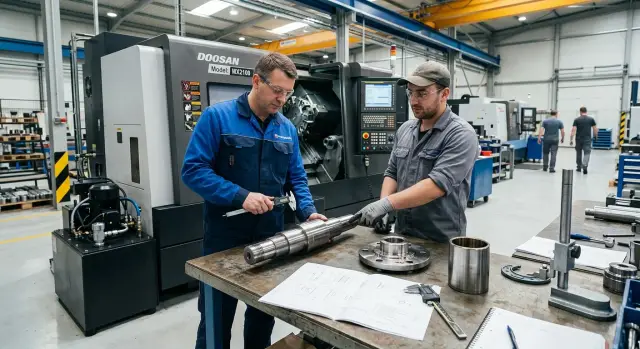
Why a passport check is not enough
A machine passport gives you numbers: travel, power, accuracy, spindle speed, chuck size. That is useful, but numbers do not answer a simple question: how does the machine behave in real work? The operator and technologist need more than rows in a table. They need a clear picture of cutting, setup, and access to the machine’s units.
A short factory demo often looks convincing. The machine quickly removes a small allowance, makes a couple of passes, and leaves a neat surface. The problem is that such a test rarely pushes it into a mode where vibration, heat, noise, power drop, and behavior over a long cycle become visible.
This becomes especially clear in a simple example. On a smooth short blank, everything may run evenly. But if you put in your part with a bore, a groove, and several tool changes, the picture changes. Then you immediately see how the machine holds size, how the feed works, how convenient the tool change is, and whether the layout interferes with normal setup.
Without your own CNC reference part, it is hard to understand the everyday details that later affect output. How long does setup take? Is it easy to reach the chuck, turret, probe, or coolant system? Can the operator see the work area properly, or will every check have to be done almost blindly?
Usually the passport does not show four things:
- how the machine cuts your actual parts, not a training sample
- how it behaves over a longer cycle
- how much time a normal setup takes
- where noise, heat, and signs of vibration appear
That is why test parts for machine acceptance are almost always more useful than a nice catalog demo. They quickly cut through unnecessary optimism. Even if the supplier, such as EAST CNC, handles selection, commissioning, and service, a check on a real part is still needed. It helps both sides talk not about the passport, but about the result: does the machine hold your size, your material, and your production pace?
How factory acceptance differs from site acceptance
Factory acceptance and post-installation checks answer different questions. At the factory, you look at what the machine is generally capable of. At the site, you check whether it kept that capability after transport, installation, and connection in your shop.
At the factory, it makes sense to use parts that load the machine a little harder than usual. There, the key things are basic accuracy, repeatability, cutting margin, spindle operation, drives, and automation. If this is a CNC lathe, the CNC reference part should show not only size, but also the machine’s behavior on roughing and finishing passes.
At the site, the task is different. After installation, problems are often connected not with the machine itself, but with the foundation, leveling, power supply, air, coolant, clamping, and tooling setup. That is why machine acceptance at the site should be shorter and clearer. It is there to quickly catch issues that appeared after delivery and commissioning.
One test does not solve both tasks. A long and complex test part for machine acceptance is good for showing the equipment’s capabilities at the factory, but in the shop it often just wastes time. If setup is still in progress, such a test introduces too many extra variables, and it becomes hard to tell what caused the deviation.
For the second acceptance, it is better to prepare a compact set of parts and operations. Usually it is enough to answer four simple questions:
- does the machine hold size across several repeats
- did the geometry change after installation
- do the clamping, coolant supply, and tool changes work properly
- is it easy for the operator to run the standard cycle without long workarounds
A good set for the site is almost always simpler than the factory one. A small stepped part, a short bore, one threaded feature, and a couple of repeat runs give more value than one complex demo blank.
For example, during factory acceptance you can ask for a part with a tougher cutting mode and a longer pass. After installation at a shop in Kazakhstan, it is more sensible to check a short batch of simple parts in your material and with your tooling. That way it becomes clear faster where the problem is: in the machine, in the installation, or in the organization of the workplace.
Which parts to bring to the factory
At the factory, do not bring one simple bushing with a short cycle. Such a part often looks "good" even on a machine that will later cause problems in the shop. Test parts for machine acceptance should load the axes, spindle, and the process itself the way it will happen in real work.
First, choose a part with a long pass along the axis. On a lathe, it better shows how the machine holds size and shape along the length, whether it pulls into a taper, whether chatter appears, and how the tool behaves at the end of the pass. A short blank will not show this.
Then add features from your usual product range. If you turn steps, grooves, threads, or shoulders, they should be in the test part. Otherwise acceptance becomes too "clean": the machine passes a simple cycle, and then questions start on transitions, entry cuts, and repeatability on real parts.
What to bring
- A part machined along the length, not only in one short zone
- A part with steps, a groove, or a thread from your regular work
- A blank made of the same material you use most often
- A drawing with tolerances and an agreed measurement method
Also check rough material removal separately. For that, you need not a training blank made of soft material, but your working material and a normal allowance. If you usually remove a serious layer from steel in your shop, test it that way. Otherwise you cannot tell whether the machine has enough power, how it holds the mode, and whether accuracy drops after load.
A good set usually consists of two parts, not one. The first shows geometry and finishing quality. The second puts load on roughing. This approach is more useful than one "nice" CNC reference part that is too simple.
Before the run, agree on how you will measure the result. The same size can be evaluated in different ways, and then the argument becomes not about the machine, but about the method. Specify tolerances, measurement points, inspection tools, and acceptable roughness.
If the machine is meant for serial metalworking, choose a part that matches a real order in at least two respects: machining length and material. During factory acceptance, this saves time and immediately shows whether the machine fits your work, not just the passport figures.
What to bring to the site after installation
After installation, a machine often cuts differently than it did at the factory. The shop has a different temperature, foundation, power supply, coolant, and shift rhythm. That is why the site test set should not just repeat the factory check, but compare it with real work.
First, repeat one part that was already machined at the factory. It is best to use the same blank, the same material, and a similar process route. That makes it easier to compare size, surface finish, batch spread, and cycle time. If everything was stable at the factory, but the size starts drifting at the site, the reason is often not the passport, but installation, setup, or shop conditions.
Then add a part from your current product range. You do not need a showcase sample, but a normal part that the shop makes regularly. If you work with flanges, bushings, or housing blanks, take one of those. This kind of check quickly shows how the machine behaves on a real operation: how easy it is to load the part, whether travel is enough, how chips come off, and how easy it is for the operator to measure between passes.
Using someone else’s tooling almost always makes the test too "clean." At the site, it is better to bring your own chuck, your own jaws, arbors, holders, cutting tools, and the measuring set used by the shift. Then the test parts for machine acceptance will show the real picture without polishing it up.
Usually this set is enough:
- one factory part for direct comparison
- one part from the shop’s product range
- your own tooling and standard tool set
- material and cutting modes close to daily work
The test should be run under the same conditions where the machine will live later. Not after a long, calm warm-up in an empty shop, but during a normal shift: with working temperature, regular coolant, your own operator, standard loading, and pauses for measurement. Sometimes a machine holds size on one part, but loses it on the third or fifth. That should be seen before the acceptance sign-off.
If the result on the factory part matched, and your own part also passed without surprises, you checked not only the geometry. You checked how the machine will fit into your process the very next day.
How to build the part set step by step
Do not build an acceptance set from memory. Open the list of parts your shop actually produced in the last 3–6 months, and look not at the prettiest drawings, but at what gives the machine its normal working load. This way the test parts for machine acceptance will show the real picture, not a lucky one-off test.
Start with the parts that repeat most often. If a part goes through the machine every week, it is the best indicator of whether the new machine suits you in travel, power, and setup convenience. Rare items that are made once a quarter just get in the way now.
Then mark the operations where you usually have problems. These are often long passes, heavy material removal, thin walls, tight tolerances, deep holes, or finishing of fit surfaces. You do not need ten different parts. It is better to understand where your biggest risk is.
After that, remove items that depend on rare tooling, nonstandard tools, or special fixtures. If a part cannot be made without a special chuck, steady rest, or homemade jig, that test easily pulls the discussion in the wrong direction. At that point you are testing not the machine, but someone else’s preparation.
Usually 2–3 parts are enough. One covers rigidity and material removal, another shows accuracy and surface quality, and a third is needed only if you have a separate frequent scenario, such as a long blank or a heavy flange part. There is rarely a reason to bring more: acceptance takes longer, but clarity does not improve.
A good set often looks like this:
- one part from your main serial production range;
- one part with tighter tolerances;
- one part with awkward geometry, if such orders are common for you.
Before going, agree not only on the drawing, but also on the starting conditions. The material should be the same as the one used in your shop. The allowance should be real, not "convenient" for a demo. Cutting conditions are also better discussed in advance, so you do not argue at acceptance about why the machine showed a good result under too gentle a mode.
In short, a good set is built not on the principle of "what is easiest to bring," but on the principle of "what will reveal the risk fastest." For machine acceptance at the factory and at the site, this approach saves time, money, and a lot of unnecessary arguments after the act is signed.
What each test part should show
One successful trial means almost nothing. Test parts for machine acceptance are needed not for a pretty report, but to check the machine’s behavior under real load and in the operator’s normal workflow.
First, the part should show geometry. Do not look only at one dimension on the drawing. You need runout, coaxiality, taper, diameter stability along the length, and accuracy of seating surfaces. If a shaft comes out to size near the chuck but drifts at the end, the problem is usually not the drawing, but setup, geometry, or unit rigidity.
Next comes power. A good CNC reference part gives stable material removal without a noticeable cycle-time drop and without a nervous sound during the cut. If the spindle loses speed during roughing and the feed starts to fluctuate, the passport numbers are no longer reassuring. You can see that right away during acceptance.
Rigidity shows itself best where the machine is uncomfortable. Long tool overhang, boring, thin walls, a long shaft between centers — these are the places that quickly reveal vibration. The surface after the pass should remain clean, without waviness or random marks. If a slight change in mode ruins the picture sharply, rigidity margin is small.
Also look at ease of use. A good test part checks not only the hardware, but also how the operator lives next to the machine all day. They should be able to walk up to the chuck quickly, change the tool smoothly, place a probe or micrometer, and take a measurement without extra movements. If a simple operation takes an extra 20 minutes because of access and measuring, that will repeat every day later.
Repeatability is checked in a series, not with a single piece. Make at least three to five identical parts in a row with the same tool set and the same mode. Then compare:
- size on the main features
- runout after re-clamping
- shape along the length
- surface finish on the same areas
- cycle time from part to part
If the third or fourth part drifts away from the first, the machine is not ready for normal work yet. A simple rule is this: each test part should answer one clear question. This part holds geometry, that one shows cutting margin, this one checks rigidity, and the series confirms repeatability. Then machine acceptance at the factory and at the site gives a clear result, not a bundle of random numbers.
A real acceptance example
A good test looks like this: a shop plans to machine both a flange and a long shaft on one machine. On paper, both parts seem suitable. But the passport will not show how the machine handles a long pass, how it behaves under roughing, and how much time is spent changing tooling.
For factory acceptance, it makes sense to bring the shaft. It catches mistakes that are not visible on a short part. On a long blank, you can immediately see whether the machine keeps straightness, whether the size drifts toward the end of the pass, whether taper appears, and whether the unit starts cutting with extra vibration.
At the factory, it usually is not worth spending time on a full part set. It is enough to make the shaft to your drawing, or very close to it. It is best to run both roughing and finishing. Then the CNC reference part will show not only geometry, but also the machine’s behavior under load.
After installation at your own site, the same shaft is repeated once more. That is no longer a formality. This is where the machine geometry check shows what changed after transport, installation, and leveling. If the factory result was stable, but the size drifted at the site, the reason is usually not the passport, but the foundation, leveling, or tooling setup.
Then a flange is added, but now with your real tooling and your usual process. This quickly reveals things that almost always stay hidden until the first working day: is it convenient for the operator to change jaws, is there enough room for the tool and measurement, how do chips leave the cutting zone, does the chuck get in the way, and how many minutes does setup take.
In the end you get three trials: the shaft at the factory, the same shaft at the site, and the flange at the site. This makes the test parts for machine acceptance much more useful than a random demo blank. After three parts, you compare not only the size, but also cycle time, repeat stability, and ease of operation changeover. If all three are good, signing the act feels much safer.
Where people most often make mistakes
At acceptance, it is more often the test that is too weak, not the machine, that causes problems. Good test parts for machine acceptance should check not only paper dimensions, but also the machine’s behavior in real work.
The most common mistake is simple: people use only a light part. If the blank is short, there are few transitions, and the modes are gentle, the machine almost always looks fine. But such a test does not catch geometry errors, power drop, or the small problems that later bother the operator every day.
The second mistake starts even before the run. People come to machine acceptance at the factory, discuss the part verbally, and do not record tolerances in advance. Then they argue about different things: the supplier looks at the fact of machining, while the customer looks at hundredths, surface finish, and repeatability. If there are no written dimensions, tolerance, cycle time, and number of repeats, an argument is almost guaranteed.
Testing is often ruined by changing the material on the spot. One bar was not enough, the right grade is not available, and someone offers something "almost the same." But different hardness, different metal structure, or even a blank with poor runout immediately changes the picture. After that, it is hard to tell what you actually tested: the machine, the tool, or a random piece of metal.
One successful run also means almost nothing. The machine should make several identical parts in a row. Only then can you see whether it holds size and whether the result drifts after the first part.
Do not look only at the finished part measurement. Check a few simple things as well:
- how the tool change goes
- how chips are cleared and whether they wrap around
- how easy it is for the operator to load the blank
- whether the machine holds size on repeat
- whether cycle time grows after the first runs
After installation at the site, this part is often skipped for no good reason. Machine acceptance at the site should show how the machine works in your shop, with your material and your people. If you rush to sign after one nice run, the problems will surface in the very first shift.
Quick checklist before signing the act
The act should be signed only after a short but strict check on a real test part. If the machine showed a nice idle run but fails on the part, that acceptance is not worth much. Look not at promises, but at how it cuts your material, holds size, and behaves in a normal cycle.
Before signing, check five things.
- The material, allowance, and tool match what you plan to use in production. If a softer blank was used for acceptance, the allowance was reduced, or a different cutting tool was given, the result cannot be considered fair.
- The operator runs the full cycle without manual workarounds. They should not have to adjust the mode every time, "push" the program, or save the process with small interventions.
- The size is held not on one lucky part, but on at least several in a row. One part can turn out right by chance. A series immediately shows whether there is spread, thermal drift, or repeatability issues.
- The machine does not fault in working mode. Watch normal feed, tool changes, chip removal, clamping behavior, and axis response under load.
- All measurements and remarks are written down immediately. Do not leave this for later. An hour later, it is much harder to argue about numbers.
If you are preparing test parts for machine acceptance, keep a simple control sheet nearby. Record the part number, drawing size, actual size, tool, mode, and any remark about the cycle. That sheet quickly shows where the problem is: geometry, mode selection, tooling, or program setup.
In practice, the last step is what people rush most often. The part came out good, everyone is tired, and the act is signed right away. It is better to spend another 20 minutes and repeat the cycle under the same conditions. For deliveries of complex machines that EAST CNC works with, this approach is especially useful: it removes disputes before series production starts.
If even one item does not match, record the remark in the act or in a separate report. A verbal agreement is almost always weaker than a precise written note with numbers.
What to do after the trial
After trial machining, saying "the part came out fine" is not enough. For each part, collect one sheet with facts: material, program, tool, cutting mode, cycle time, measured dimensions, and any deviations. When you have such a sheet, an argument about impressions quickly turns into a numbers-based discussion.
For test parts for machine acceptance, this is especially useful. The same part can show a normal size on a cold machine and drift after warm-up. If you do not bring the measurements into one document, that difference gets lost.
Then divide the remarks into two groups. The first relates to the machine itself: taper, size drift, vibration at the same mode, overheating of units, repeatability failure. The second relates to tooling and preparation: chuck jaws, holder, worn insert, weak clamping, crooked blank, or an error in part zero or in the program.
It is useful to keep a short list with three notes:
- fix on the machine
- check tooling and setup
- repeat the test under the same conditions
Do not delay a repeat check of disputed points. Set a specific date, a responsible person, and identical conditions for the repeat trial: the same material, the same tool, the same modes, the same measurement method. If you leave the issue for later, it will surface on a series part, and the cost of the mistake will be higher.
If a remark is not closed right away, attach it to the act as a separate list. Then the installation team, technologist, and line manager all see the same set of tasks. That is easier than reconstructing the chain later from messages and verbal comments.
If you are choosing a CNC lathe, EAST CNC can help you discuss the test part set, commissioning, and service in advance. That conversation is useful even before delivery: you decide ahead of time how you will check geometry, power, and ease of use, instead of arguing about it on acceptance day.
Keep all measurement sheets, photos of part markings, and final conclusions in one folder for the machine. A month later, that folder usually gives the most honest answer: is the problem in the machine or in the tooling.