
Sub-spindle in series production: when it actually saves time
A sub-spindle in series production doesn’t always save time. We’ll examine where it shortens the cycle and where a second setup on a separate machine is simpler and cheaper.
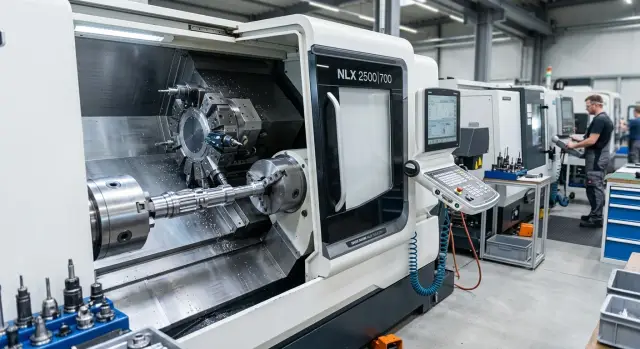
Where time is lost with a second setup
Most often the cycle grows not during cutting but in pauses between the two sides. After the first operation the operator removes the part, places it in a tray and waits for the next step. If the second CNC lathe is busy, the batch just stands. On paper this looks like a small detail, but over a shift it adds up to tens of minutes or even hours.
Then the second setup itself begins. The part must be picked up again, cleaned, reclamped and the datum found. Even for an experienced operator this is not a single motion. They check seating, runout and concentricity, and sometimes adjust jaws or the stop. On paper 2–3 minutes seems minor. On a batch of 200 parts it becomes hours when the machine isn’t cutting metal.
Inspection also takes extra time. After reclamping the operator almost always measures the part more carefully than after the first side. That’s normal: you need to be sure the second side didn’t shift in coaxiality, length or face. Each part requires additional checks, and if there’s doubt the machine is stopped and rechecked.
Typically losses sit in four places:
- removing the part and moving it to the next operation
- waiting for the second machine to be free
- reclamping and re-establishing the datum
- extra inspection after the new setup
There is a more costly risk too. A mistake on the second setup ruins not a blank but an already finished side. If the clamp shifts even slightly, scrap appears after the first side has already consumed machine time, tool life and material. That’s why a route with two setups often seems cheaper until you run the numbers honestly.
In series production these losses repeat on every part. So you must count not only cutting time but the sum of short pauses, waits and repeated checks.
What a sub-spindle changes in series work
In series work time is lost not only on cutting. Often the pauses between operations are worse: remove the part, carry it to the second machine, reclamp, check runout, wait in queue. A sub-spindle removes most of these pauses inside one cycle.
After the first side the machine itself grabs the part and the process continues without manual transfer. The operator doesn’t walk between two stations and doesn’t spend minutes on reclamping. On a single part the difference may look modest. On a batch of 300 or 500 pieces it becomes noticeable.
There’s a second effect. The part stays longer under the same clamping logic, which usually helps maintain coaxiality better than a second setup on a separate machine. When you remove, carry and reclamp a part, the risk of runout and misalignment increases. For bushings, shafts and parts requiring positional relation between two sides this matters.
Savings appear in several places: the machine transfers the part inside the program, the operator services the process instead of carrying semi-finished pieces between operations, and the route runs as one cycle and is easier to measure. It also becomes easier to see where delays occur: during cutting, at the transfer or at unloading.
Planning such a scheme is easier too. When first and second sides live in one route, the foreman sees the real takt time more clearly. You don’t need to separately account for inter-operation buffer, hunt for a free second machine or keep extra transitions in mind. One cycle is usually easier to standardize and repeat from batch to batch.
But the sub-spindle’s value isn’t that it’s “new.” It’s useful where the second setup consumes a noticeable share of time. If cutting takes 12 minutes and transfer plus reclamp take 40–50 seconds, the gain is worth calculating. If the second operation is rare, simple and barely affects output, the effect may be small.
How to calculate both routes step by step
It’s best to time with a stopwatch and base the calculation on shop reality, not the operator’s memory. The difference between two schemes often hides not in cutting but in small actions around the part.
If you evaluate a sub-spindle for series work, break both routes into the same elements. That way the comparison is fair and not just eyeballed.
Route with internal transfer inside the machine
First separate pure cutting from auxiliary actions. Cutting time is usually visible in the program, while the transfer, spindle synchronization, tool retraction, reorientation and part pick-up are better measured separately on a real cycle.
A convenient breakdown is:
- first side — cutting time
- transfer to the sub-spindle — separate measurement
- second side — cutting time
- open jaws, remove and load a new blank — separate measurement
This breakdown quickly shows where extra time goes. Sometimes the transfer itself takes 12–20 seconds, though it feels like almost a minute to the operator. Other times the program is quick but the machine waits for a safe position and the potential gain vanishes.
Route with a second setup on another machine
Now calculate the same cycle if the part goes to separate equipment. Again, don’t lump everything into one number. Time the first operation, the part transfer, waiting for a free machine, reclamping, datum checks and only then the second operation.
Waiting often breaks the calculation. On paper the second setup may look only 30–40 seconds longer, but if the second machine is busy for several minutes each cycle, shift output drops noticeably.
A simple table by step is enough to check. If the internal transfer takes 18 seconds and the transfer, queue, reclamp and check take 95 seconds, the difference is 77 seconds per part. On a batch of 300 that’s nearly 6.5 hours.
Look not only at one part. Compare how many finished parts come out per shift, which machine becomes the bottleneck and how often the operator intervenes. That’s where you see whether the internal transfer route gives real savings or if the second setup remains tolerable.
When a sub-spindle shows a clear gain
The clearest benefit is where a part must be finished on both sides and the datum cannot be lost. If after the first side the part is removed, carried to a second machine and re-zeroed, the station spends minutes on transfer, clamping and runout checks rather than cutting. In series those minutes quickly become hours.
This is especially visible when the second side is short. Suppose it needs only face trimming, one groove and a drill. The actual machining takes 40–60 seconds, while a new setup on a separate station drags to 2–3 minutes. Then the cycle shortens because the machine transfers the part inside one route.
The effect accumulates faster if batches are regular and the part mix doesn’t change dramatically. When a shop makes similar items for months, the saving on the second setup repeats on every part and isn’t lost to constant retooling.
The gain is even clearer when one operator tends multiple machines. A separate second operation almost always needs attention: remove, carry, reclamp, check, start. An internal transfer on a CNC lathe removes part of that manual work. The operator runs between stations less often and the cell’s rhythm becomes steadier.
Count a sub-spindle seriously if the part needs two-sided machining without shifting the datum, the second side is short, the batch repeats regularly and the second operation already slows the cell. The same applies where one operator serves several machines and extra manual actions begin to block output.
A simple example: a bushing in a batch of 800 pieces. The first side takes 2 minutes 20 seconds, the second 35 seconds. If the second operation requires another 1 minute 40 seconds for setup and inspection, the total cycle swells noticeably. If the machine grabs the part itself, those extra actions nearly disappear. Over long series the difference shows not as percentages on paper but in whole shifts freed up without hiring more staff or creating chaos at the machine.
When a second setup remains sensible
A sub-spindle does not always give the best route. If the batch is small and the part mix changes often, a separate second setup is often simpler. The setup technician can reconfigure the usual operation faster than tuning transfer, synchronization and cycle logic for each new part.
The same is true when the second side is needed only for part of the batch. For example, out of 100 blanks only 30 need face finishing or extra drilling. There’s no sense routing the entire flow through a more complex internal cycle — it’s easier to send only the required parts to the second operation.
Sometimes the reason is simpler: the second side needs a different machine or different tooling. A classic case is when after turning the part must go to a milling center, a special fixture or a supported device. Then a sub-spindle doesn’t remove the second stage but only adds complexity to the first. Two setups remain clearer and cheaper to set up.
Long or flexible parts also make transfers less attractive. A thin shaft, tube blank or low-rigidity part can shift, spring and show runout after transfer between spindles. On paper the cycle shrinks, but on the shop floor you add steady rests, supports, trial parts and extra inspection. Time then goes to holding size, not cutting.
There’s also a production-level point. If the first CNC lathe is already loaded without pauses, adding the second side into it can be counterproductive. One machine becomes the bottleneck while neighboring equipment idles. In that situation it’s better to split operations and keep the flow balanced.
Before deciding, answer four questions: is the batch repeating often or is it one-off; does the second side apply to all parts or only part of the batch; can the part be reliably transferred without losing size; and will the second operation overload the first machine? If at least two answers are uncomfortable, the second setup will likely remain the normal choice for some time.
Example on a simple part
Take a simple bushing. One side needs outer diameter turning, bore finishing and a chamfer. The other side needs a face trim to size and another chamfer. Geometry is standard, without complex milling. On such parts you can clearly see when a sub-spindle gives a real increase in output rather than just a good idea.
If the part follows the route with a second setup, the profile often looks like this:
- 38 s for the first side
- 6 s to remove the part
- 14 s to carry, flip and reclamp
- 4 s to check seating and runout
- 27 s to machine the second side
Total is about 89 seconds per piece. Cutting time isn’t the biggest share here. Almost a quarter of the cycle goes to the operator’s hands and reclamping.
Now the same example on a CNC lathe where the machine transfers the bushing with a sub-spindle. The first side still takes 38 seconds. Transfer and cut-off add about 8 seconds, and the second side runs without transfer and without a new manual clamp. The cycle becomes roughly 63–66 seconds per piece depending on synchronization and second-side machining time.
The difference seems small until you calculate for a series. Even a 24-second saving per piece on a batch of 3,000 bushings is 72,000 seconds — about 20 hours of pure time. If you run 6,000 pieces per month, that’s 40 hours. Essentially the shop gains another shift without hiring.
There’s another plus. With a second setup the operator places the part slightly differently each time. On a simple bushing this easily creates small scatter on the face or chamfer. When the machine transfers the part internally, that risk is lower and the route runs steadier and more predictably.
This example doesn’t mean a sub-spindle is always needed. If the batch is small and the second setup takes only a few seconds, the gain may be modest. But in series production where a bushing runs in hundreds or thousands, a difference of tens of seconds per piece quickly becomes hours per month.
Mistakes when choosing the route
Deciding between a sub-spindle and a second setup usually fails not on technology but on calculation. On paper one route can look faster while in the shop it adds minutes to every ten parts.
The first mistake is looking only at cutting time. If the process engineer compares only tool seconds, they miss everything that happens between steps: removal, transfer, waiting for the second machine, new setup and datum checks. So a sub-spindle route can lose on program seconds but win on shift output.
The second mistake is not accounting for the queue to the second operation. A separate CNC lathe or neighbor cell rarely waits only for your batch. A part can be machined in 40 seconds and sit in a buffer for 15 minutes. For one-off jobs that’s tolerable; for series it is a tangible loss and increases WIP.
Inspection after flipping is often forgotten. After a second setup the operator usually checks runout, length, coaxiality and size from the new datum. It takes little per part, but on a 500-piece batch extra 20–30 seconds per check adds up. With internal transfer some of these checks disappear or become simpler.
There’s the opposite mistake as well: buying a sub-spindle for one-off jobs just because it seems convenient. If batches are small and parts simple, the benefit may not recoup the machine cost or the tuning time. A second setup remains a valid choice when orders are infrequent and timelines are not tight.
Another pitfall is not checking clamp rigidity during transfer. On the drawing everything looks fine, but in practice the part is thin, long or has a weak gripping area. Then transfer causes runout, vibration or marks. Instead of saving cycle time the shop gets scrap and long tuning.
A proper calculation answers simple questions: how many seconds does the tool cut, how many minutes does the part wait for the second operation, how long does transfer and inspection take, how stable is the transfer and how many parts actually pass per shift. After that a sub-spindle stops being a nice-to-have and becomes a practical production solution.
FAQ
What exactly does a sub-spindle save?
Usually it removes not cutting seconds but the manual pauses around the part. The machine catches the part itself after the first side, so the operator doesn’t remove it, carry it to another machine, reclamp it or re-establish the datum. This is most visible in production runs where the second side is short. In those cases the transfer and reclamping can take longer than the actual machining.
When should I seriously consider a sub-spindle?
Look at the real losses from the second setup. If taking off, carrying, queueing, reclamping and inspection take at least 40–60 seconds per part, it’s worth checking the potential gain with numbers. Another clear signal is regular batches and the need to keep the two sides coaxial without extra scatter.
When is a second setup still a reasonable option?
A second setup remains practical for small batches and frequent part changes. In those conditions it’s often faster for the shop to perform the usual second setup than to fine-tune an internal transfer for each new part. The same applies when only part of the batch needs the second side, or when the second side requires a different machine or tooling.
How to fairly compare the two routes?
Take the same part and time both routes with a stopwatch. Log cutting, transfer or internal pick-up, waiting, reclamp, inspection and time to first good part. Then compare not only the cycle for one piece, but the output per shift. The real difference usually shows up there.
Why does queueing at the second machine hit output so hard?
Because a queue turns a short operation into a long loss. A part may be machined in under a minute but sit in front of the second machine for several minutes or longer. That lowers shift output, increases WIP, and makes the area dependent on one busy station.
Does a sub-spindle always give better accuracy?
Most of the time yes, because the part doesn’t go through a new manual clamp. That helps keep coaxiality, length and face more consistent, especially on bushings and shafts. But a sub-spindle doesn’t guarantee anything by itself. If the shop hasn’t tuned the transfer, jaws or synchronization, dimensions can still drift.
What if the second side of the part is very short?
It often gives the clearest benefit in that case. If the second side only needs a face trimming, one groove and a drill, the machining may take 40–60 seconds while a new setup on another station costs 2–3 minutes. Then the cycle shortens not because the cutter removes metal faster but because the machine transfers the part internally. Always count over a batch rather than a single part — on long runs the difference becomes significant.
Can internal transfer via a sub-spindle create new problems?
Yes, there is a risk. Long, thin or flexible parts can shift during transfer, spring back and show runout or marks in the clamping zone. If the shop has to add steady rests, supports, test parts and extra inspection, some of the gain disappears. In those cases a conventional second setup can be safer and cheaper.
What quick test can I run before deciding?
Take a typical part and time the full second-setup path: removal, carry, clamp, alignment, inspection and the second machining. Then compare that time with the cycle on a machine that picks up the part with its sub-spindle. Multiply the difference by the usual batch size. If the result is hours rather than minutes, you have a solid basis for the decision.
What should I watch besides cycle time?
Look at operator load, scrap risk after reclamping, frequency of inspection and which machine becomes the bottleneck. Often the losing route fails not because of cutting time but because of manual work and downtime. Also check how many similar parts follow the same scenario — if the second setup repeats across a family of parts, the benefit of a single decision grows.