
Straightening Shaft Blanks Before Machining: When It's Needed
Straightening shaft blanks removes runout and reduces vibration, but it's not always necessary. We explain the signs, how to check, and common mistakes.
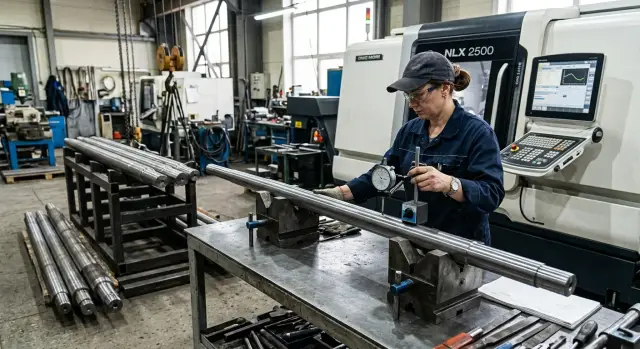
Why a shaft can run out on the first setup
Even a small bend shifts the rotational axis. From the outside the bar may look straight on the floor or shelf, but once in the chuck it becomes obvious that it isn't.
The chuck holds the part at the jaw contact points, but it does not straighten it. If a shaft already has curvature, the machine rotates a misaligned blank rather than a perfect axis. One section runs true while another starts to wander.
At low speeds this looks like ordinary runout before machining. The operator sees the edge moving away and the tool alternately cutting too much and barely touching the surface. As speed increases, the part trembles and then vibration appears during turning. That quickly affects dimensional accuracy, surface finish, tool life and process stability.
With long blanks the problem grows faster. A short shaft with the same deviation can often be held without noticeable shaking. A long one behaves worse: the lever arm is greater, so even a small bend moves the free end more. If 500–700 mm protrudes from the chuck, the difference becomes clearly visible.
On the shop floor it looks simple: a bar arrives with a slight curve, it is clamped into the CNC lathe, programs are set, and on the first rotations noise and trembling appear. People often look for causes in the jaws, the tool or feeds, while the source can be much simpler — the blank is already rotating off its geometric axis.
So straightening shaft blanks is sometimes necessary before the first setup. If you skip it, the machine will faithfully reproduce the blank's error instead of correcting it.
Where the blank's curvature comes from
It is rare that a shaft arrives perfectly straight for the first setup. Even if the bar looks straight, there are often residual stresses inside the metal. After cutting some of those stresses relieve and the blank can bend slightly. On short parts this is almost invisible, but on long ones runout appears quickly.
A common cause is storage. A blank is cut, placed on a rack, moved a few times, and after a week it may no longer lie as it did on delivery. If it was supported only at the ends or stored in a bundle without proper pads, it will sag. It seems minor until the blank is chucked and vibration appears on the first pass.
Heat treatment also plays a role. After hardening, tempering or local heating metal expands and contracts unevenly. If material structure varies along the length, the shaft can bend in an arc or a spiral. Preparing a shaft for turning sometimes starts not with choosing the tool, but with asking: what happened to this blank before it reached the machine?
Transportation is a separate topic. A long blank can be damaged in transit if it was over-secured or carried on poor supports. This is especially noticeable on thin, long shafts where even a small bend later makes proper clamping difficult.
Forgings behave even more unpredictably. Their cross-section and internal density can vary along the length, so perfect straightness shouldn't be expected. The longer the blank, the higher the chance its axis has shifted.
In practice the cause is rarely a single factor. A bar may bend slightly after cutting, then sit unsupported, and finally arrive with poor transport. Externally the blank looks normal, but on the machine it shows a different character.
When straightening is truly needed
Straightening isn't a habit — it's done when the curvature already interferes with setup or cutting. The clearest sign is noticeable indicator runout before the machine. If the part sits in V-blocks or between centers and the dial immediately shows a large deviation, that won't go away by itself.
This is especially important for long shafts. The longer the part and the fewer its supports, the more the bend affects the work. You can clamp the shaft, but under the tool it still moves and then noise, surface waviness and vibration appear.
Straightening is almost always justified before finish machining with a small allowance. If only a few tenths of a millimeter are left for the finish pass, large initial runout can quickly "eat" that allowance. In one place the tool will take too much, in another it will barely touch the metal. After that it's hard to hold both size and shape.
Another good indicator is repeatability. If similar blanks from the same batch, of the same length and the same setup have already produced trembling, don't rely on luck. Shop experience is more reliable than general rules.
A steady rest and tailstock don't always save the day. They support the part while the deviation is moderate. If the bend is strong, supports only partially damp it out. The shaft still works under stress and begins to spring under load. That leads to taper, crushed marks and unstable sizes.
If you simplify the rule of thumb: straighten when the curvature already affects setup, cutting stability or the remaining allowance. In that case it's better to straighten right away. In production this usually saves more time than it costs.
When straightening just wastes time
The opposite case is common too. If the blank is going to rough turning with a normal allowance, a small bend can be removed on the first pass. Spending 10–15 minutes at the press to correct a deviation the cutter will remove anyway makes no sense.
This happens with short shafts. They sit more rigidly in the chuck, flex less under load and tolerate small initial irregularities. On such parts the machine keeps the process more easily, and minor deviation doesn't immediately become a problem.
Straightening is often unnecessary when the next operation creates a new reference. For example, you rough the OD first, then make center holes or re-reference the part from the machined diameter. After that the raw blank's geometry matters much less.
The guideline is simple: if runout fits within the allowance, the blank is short and clamped rigidly, and the reference will change later, straightening usually isn't worth it. It's more useful to spend that time on setting the cutting mode and checking the first part.
In practice it looks like this: clamp a short shaft in the chuck, do a roughing pass, then flip and reference from the machined surface. There was runout on the raw blank, but on the rough stage it doesn't affect the final result as much as the dial reading suggested.
When preparing a shaft for turning, compare the measurement not to an abstract perfect straightness but to the task of the current operation. If the machine cuts confidently, the allowance is sufficient and a new reference will be created later, straightening is premature.
How to check a blank before the machine
Five minutes of checking often prevents long problems at the machine. If the blank has dirt, scale or rust, the indicator will show extra error and the operator will look for the wrong cause.
First clean the support and measuring areas. A wire brush, rag and light cleaning usually suffice. Pay special attention to the faces and shoulders that will be the base in the first setup.
Then place the blank as it will be used in the first operation. Short shafts are convenient to check on V-blocks. Long ones are better measured between centers if that's how they'll be set up. This matters more than it seems: a part can look straight in one setup and show deviation in another.
Don't measure only at one point. Walk at least three sections: one end, the middle and the other end. For long shafts add one or two more points. Slowly rotate the blank by hand and see where the indicator moves most. That quickly shows whether it's a general bend, a local kink or just a surface defect.
Mark the spot with the largest deviation with chalk or a marker. If you have many parts from a batch, note the runout value as well. This helps decide quickly whether a blank needs straightening or can go directly to the machine.
The final practical step: compare the measurement to the allowance and the setup. If runout is 0.2–0.3 mm and the roughing pass removes 2 mm per side, straightening may not help. Another picture is when the allowance is small, the overhang is large and the first setup is at the bent end. Then even a small deviation can turn into vibration during turning.
A good rule: look not only at the number but also where it appears. The same deviation in the middle of a long shaft and near the chuck are two different situations.
How to straighten without wasting time
If the bend is small, strong force only makes things worse. Place the blank on parallels, find the point of maximum deviation with the indicator and start with a light press. Then measure runout again. This way you see how the metal responds and avoid bending the shaft the other way.
Straightening often drags on because the operator presses "with margin" hoping to fix it in one go. In practice short steps and frequent checks work faster. One too-strong push often adds another measurement cycle or even damages the blank.
You can't work on a long shaft at one point only. Pressing only at the center often shifts the bend to a neighboring area and the runout begins to wander along the length. It's better to work in sections: remove the largest deviation, recheck the shaft and then correct adjacent areas.
The typical workflow is simple: lay the shaft on supports and mount the indicator, mark the section with the highest runout, apply a small force, rotate and record readings. Repeat the cycle until the deviation noticeably decreases.
There is also a clear signal to stop. If after another press the runout hardly changes, don't press further. That means you're near the practical limit of quick straightening and the remaining error is related not only to shape but also to internal stresses, the setup method or the supports.
For production this is more practical than trying to reach a perfect zero before the first setup. If the blank already falls within the working allowance for rough turning and doesn't cause vibration, extra straightening only wastes time.
Shop example: a long shaft from bar stock
One batch arrived with blanks of varying lengths. The longest were over a meter, the short ones noticeably less. The metal looked straight, so the first long part was put into the CNC lathe without a separate check.
The roughing pass was acceptable, but during finishing a tremor appeared. The surface developed a fine wobble even though cutting parameters were not aggressive. At first the team suspected the tool or clamping, but replacing the insert didn't fix the issue.
They removed the blank and measured it at several points. On supports with an indicator it became clear that runout was not only near the ends. The main bend sat in the middle. For a long part this is typical: the ends can still be clamped true, but the middle pulls the shaft under load.
The solution was simple. Instead of a long straightening session they did two short cycles at the press with measurement after each. After the first press the bend reduced noticeably; after the second the trembling on the finish pass almost disappeared. The surface became flatter and dimension stability improved.
What is most telling is this: short shafts from the same batch went straight to the machine without straightening. They were checked quickly, no large bend was found, and vibration did not appear. On those parts an extra operation would only have eaten time.
Same material, same batch, different approach. Long blanks should be checked before the first setup. Short ones can often be machined immediately if measurements show no significant deviation.
Mistakes that make straightening useless
The most frequent mistake is simple: straightening too early and almost blindly. The runout doesn't go away and sometimes gets worse. Straightening only helps when you first understand exactly where the deviation is and how the part will be held on the machine.
The first error is straightening without an initial measurement. By eye curvature almost always seems worse than it is. One blank bends in the middle, another near the face, a third gives trouble because of chuck seating. If you don't run the indicator across several sections, you're likely to press in the wrong place.
The second error is too much force. Trying to remove the deviation in one try makes the metal spring back the other way. After a couple of such attempts the part may wander in a different place, creating the impression that straightening is useless. The real problem is haste.
The third error is checking only the middle. On long blanks the ends often cause as many problems as the center. You can straighten the middle and then get a skew when clamped because of an uneven face or a problem near the jaws.
Another common slip is ignoring the reference. A shaft can look straight on parallels but behave differently once chucked and pushed with the center. A rough face, dirt on the jaws, a burr at the base or poor centering can invalidate the previous measurement.
There is also an organizational mistake: mixing straight and bent blanks in one batch and then giving them all the same processing route. One part runs fine while another needs separate checking and straightening.
A normal routine is short: first measure runout in several sections, mark the zone with the largest deviation, understand the machine's clamping scheme and only then straighten in small steps with repeated checks. Boring but effective.
Quick check before starting a batch
Before a series don't inspect just the first blank. Take at least 3–5 pieces from the start, middle and end of the bundle. Long bar behavior can vary and one straight blank can give a false sense of security.
No complex report is necessary. A simple worksheet is enough. Measure runout at two or three sections: near the clamping zone, in the middle and near the free end. If you record the numbers for the first blanks the decision for the batch becomes obvious.
Then divide parts into two groups. Group one: those where the roughing pass will cover the deviation. Group two: those better sent immediately to straightening or processed with a steady rest. This approach avoids needless debate at the machine and prevents changing the decision on each part.
It's useful to set a simple shop threshold. For example, below a certain runout the part goes to normal processing; above it goes to a separate pile for straightening or for reinforced support. Then the operator doesn't decide anew every time.
The most common mistake looks familiar: the programs are set, the tool is in place, but nobody checked the real curvature of the first batch. Then they change feed and insert and search for a chuck problem when the cause was the blank itself. Five minutes of measuring at the start of the batch usually avoids such losses.
What to do next
Don't decide about straightening by eye. First measure the actual runout, then compare it with the allowance and the requirements for the current pass. If the allowance covers the deviation, an extra operation isn't needed. If runout already consumes the allowance or almost guarantees vibration during turning, straightening is justified.
For the shop it's best to set one clear rule. Short, rigid shafts can go straight to machining if runout fits the working allowance. Long blanks should be checked always, even if documentation claims the material is straight. If there's a local bend, straighten it before the first setup rather than after a trial pass.
For long parts also look beyond the shaft itself. Problems can come from insufficient stiffness of the machine, tooling or support scheme. Overhang, chuck type, tailstock support, use of a steady rest and the parameters of the first pass matter as much as the initial curvature.
If you are selecting a CNC lathe for these tasks, discuss not only part dimensions but also the processing scheme for long shafts. You can see materials at EAST CNC, east-cnc.kz: the company supplies CNC lathes and helps with selection, commissioning and service.
A practical production conclusion is simple: measure, compare with allowance, and set one rule for repeat parts. That's faster than straightening everything or hoping the machine will magically correct a bent blank.
FAQ
Do I need to straighten every shaft before the first setup?
No. First measure the runout and compare it to the allowance for the current pass. A short, rigid shaft with sufficient allowance can often be machined immediately, while a long shaft with noticeable deviation is better straightened before the first setup.
How do I know that straightening is already necessary?
Use the setup and the cutting process as your guide. If the part already shows noticeable runout on the dial indicator, has a large overhang, and the finish allowance is small, straightening usually saves time and reduces the risk of vibration.
In which cases does straightening only waste time?
When the roughing pass easily removes the deviation, straightening often just slows the work. This is common with short blanks that sit rigidly in the chuck and will get a new reference after the first pass.
Why doesn't the chuck straighten a bent shaft?
The chuck only clamps the part at the jaw contact points. If the blank's axis is already off, the machine will rotate that deviation rather than correcting it.
How to quickly check a blank before the machine?
Clean the support and measuring areas first, then check the shaft in the same setup that will be used for the first operation. Measure at least three cross-sections and mark the spot where the indicator shows the largest deviation.
What should I compare first: runout or allowance?
The raw number means little without the allowance. A 0.2 mm runout may be fine for a heavy roughing cut but can ruin the finish if the allowance is small and the overhang is large.
Will a steady rest or tailstock save me from vibration?
Sometimes they help, but not always. If the bend is strong, supports only reduce part of the vibration and the shaft can still spring under the cutter, causing size and surface defects.
How to straighten a shaft without wasting time?
Don't press too hard. Find the area with maximum deviation, apply a small force on the press and measure again — short steps and frequent checks work faster and safer than trying to fix it in one big push.
Why does runout sometimes remain after straightening?
Most often because of haste: the operator presses in the wrong place, uses too much force, or measures only the middle while the real deviation is at the end or near the jaws.
What to do with a batch where some shafts are straight and some are bent?
Check several blanks from the start, middle and end of the bundle, then split them into those that the roughing cut will correct and those that need straightening or extra support. Set a simple threshold so operators don't decide case by case.