
Standard or Custom Jaws for Production Parts
Choose between standard and custom jaws by lead time, clamping repeatability and batch cost. A simple step‑by‑step approach helps decide which option pays off.
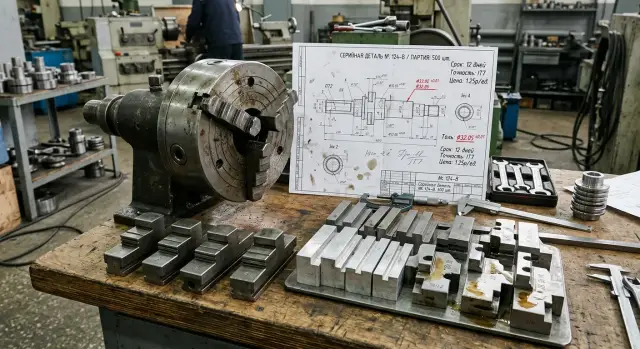
How to make the choice
The decision between standard and custom jaws rarely comes down to price alone. Usually three things decide: how quickly the run must start, what level of clamping repeatability is needed, and how many mistakes the batch can tolerate.
If the part is simple and the start date is tight, a standard set often gives the fastest launch. If the run is long and tolerances are tight, the savings on tooling vanish quickly. Then you have to count not only the price of the lathe chuck jaws, but everything around them: setup time, extra measurements, reclamping, stoppages and scrap.
There’s also the question of whether the order is one‑off or recurring. If you run the part every month, custom jaws often pay back quickly. If the same item returns only after a year, the picture changes. Then it’s important to know whether the tooling will be kept, whether the drawing will stay the same, and whether the money is being spent on a single batch solution.
Much depends on the part itself. A thin‑walled sleeve, a short flange or a blank with an interrupted surface might behave on the first trial ten pieces, then start to “walk” halfway through the run. The reason is usually not the machine, but how the part rests on the jaws and how the clamping force is distributed.
On CNC lathes this is especially visible in serial work. When locating is predictable, the operator reaches a steady result faster and rarely adjusts. When the seating varies each time, scrap grows — and so do batch costs: extra checks, pauses and root‑cause hunting for size loss.
The logic of choice is simple. Quick start — advantage of standard jaws. Stable results across the run — frequent advantage of custom jaws. Compare not by catalog price but by the cost of every extra micron of variation and every lost hour.
When standard jaws are suitable
Standard jaws are chosen not for perfect conditions but for ordinary work without extra expense. They are convenient where the part is simple, the batch is small or a trial, and a quick start is required. If you are still testing demand or adjusting the route, waiting for custom tooling usually makes no sense.
This option works well when clamping is on a clear, stable surface: a plain cylinder, a short sleeve or a simple blank for the next operation. If the jaws hold the part without tilt, that is enough for many tasks.
A standard set is typically justified in four cases:
- the batch is small or it’s the first trial;
- the part has a simple clamping surface;
- the machine must be started immediately;
- the order may change quickly.
The main advantage is speed. The shop does not wait for someone to design and manufacture custom jaws. The setter installs a common set, makes trial parts, checks sizes and launches the run. For short orders this is often preferable to investing in tooling that will end up on a shelf.
There is also flexibility. If the customer changes diameter, length or the part within a close range, a standard set is easier to adjust or replace. This is handy where machine loading changes during the week.
But this economy has limits. If high clamping repeatability is required and runout must be held with little margin, the difference between standard and custom jaws becomes noticeable. For ordinary series with moderate requirements the standard option often covers the task comfortably. For long and precise runs you need to calculate further.
When custom jaws are needed
Custom jaws are necessary where the run is long and the part stays the same. In such work not only clamping force matters, but consistent blank position from first to last piece. If the operator doesn’t have to “hunt” the datum each time, the batch runs more evenly.
Normal jaws cope on short and medium runs. But when a part is produced for weeks or regularly returns to production, a bespoke shape usually gives more predictable results. It supports the blank on the required profile, avoiding random shims and extra machine adjustments.
This is especially noticeable with thin walls, long overhangs, complex profiles or when scrap is costly after subsequent operations.
A good custom jaw does more than clamp harder. It supports the part exactly where that geometry needs it. That reduces the risk of ovality, datum shift and small runout that later spoils size or fit.
On long runs the gain is often not in cycle seconds but in what happens between parts. The operator adjusts less, rechecks fewer doubtful parts and stops the machine less for unstable results. Over a shift this becomes a noticeable time saving.
A simple example: a thin‑walled sleeve with a finished OD and a coaxiality requirement. With standard jaws it can be machined, but some pieces after reclamping begin to “walk.” Custom jaws, machined to the specific contact form, typically give the same seating and reduce scatter across the batch.
Custom jaws usually pay off where the cost of an error exceeds the tooling price. This is typical for serial parts in automotive, shipbuilding, medical devices and other industries where repeatability matters more than initial tooling savings. If your part list changes weekly, tooling lead time and extra costs may not be justified.
What affects clamp repeatability
Repeatability rarely depends on how the jaw looks externally. Far more important is the real contact area with the part. If the jaws hold the blank on a narrow strip or in two random points, the part seats slightly differently each time.
Proper contact gives the blank a clear support. Then the chuck does not “search” for position during tightening, and the blank shifts less in axial position and runout. For a run this matters more than a complex jaw profile or a neat external finish.
Base support is equally important. When the operator locates the part against the same stop each cycle, the setup length does not float. Without a solid stop even careful work produces scatter: one blank is pushed deeper, another not fully seated, and the length dimension changes.
People often make a simple mistake with clamping force — they overdo it. On thin‑walled parts this quickly becomes a problem: the blank distorts, shape changes, and after unclamping the dimension shifts even more. On sleeves, rings and long thin parts this is noticeable quickly.
Cleanliness also strongly affects results. One chip between the jaw and the part alters seating more than expected. You may miss it on the first parts, but after a few cycles runout and size scatter become visible.
Before launch check a few things: where exactly the jaw contacts the part, is there a firm base stop, are you over‑tightening thin blanks, and is there any chip, dirt or burr in the seating area.
Another issue is wear. Even with the same part, jaws change over time: the working surface polishes, small dents appear and contact shape alters. Worst of all, repeatability falls gradually, not suddenly.
In practice it’s useful to look not only at the first successful part but at the tenth and twentieth. If results drift with work, the cause is often seating, clamping force or jaw condition rather than the machine program.
How batch size and cost change the decision
Lead time often settles the debate faster than price. If the batch must start this week, a standard set almost always wins. It can be taken from stock or prepared quickly, so the shop starts sooner instead of waiting for tooling.
Custom jaws have a longer chain: first the technologist defines locating and clamping zones, then a drawing is prepared, jaws are manufactured and checked. Even for a simple part this takes time. When the order is urgent, the wait easily eats the benefit of more accurate clamping.
But looking only at the jaws’ price is a mistake. For a run the total cost matters: initial setup time, repeated setups, inspection of first parts, adjusting clamping mode, possible scrap and machine downtime while the setter hunts runout and size.
Sometimes standard and custom jaws give unexpected results. Suppose the standard set is noticeably cheaper and available immediately, but each new setup takes 20 minutes longer. If you start ten such runs a month, the shop loses several hours of machine time. For a small batch this is tolerable; for a long series it is not.
The reverse happens too. Custom jaws cost more and may require two weeks to make. But then the part seats consistently, the first good piece appears sooner, and the operator spends less time correcting overhang and clamping. For a large batch the tooling pays back through lower scrap and shorter setups.
A simple scheme helps: divide the one‑time cost of custom jaws by the number of parts in the batch and compare it with losses from standard jaws. If tooling adds, say, 80–100 tenge per part but saves more on machine time, inspection and scrap, the decision is clear. If the batch is small or the order is one‑off, that markup is often unnecessary.
For shops that regularly run recurring series on CNC lathes the rule is simple: the larger the batch and the more often you return to the same part, the easier it is to justify custom jaws. If starting today matters more than saving on the hundredth or thousandth part, a standard set is usually wiser.
Step‑by‑step decision process
Turn the debate about standard vs custom jaws into numbers. If you count only tooling price you may save initially and lose more on checks, reoperations and scrap. For a run the important metric is the cost per good part by the shipping date.
A practical workflow looks like this:
- Fix three numbers: batch size, tolerance and launch date.
- Estimate how many manual actions the operator will need: repositioning, extra clamps, repeated checks.
- Compare two start scenarios — standard versus custom jaws.
- Calculate the cost per good part for each option, including setup, inspection, potential scrap and downtime.
- Choose the option that keeps size stable and does not force frequent stops every few dozen parts.
A small example clarifies priorities. For a batch of 200 parts, a start in two days and a relaxed tolerance, standard jaws often win. Tooling lead time simply doesn’t pay off here.
But for 3,000 parts the math changes. If the operator regularly tightens the part and size “walks,” even a cheap standard set raises batch cost more than it seems. Custom jaws start slower and cost more, but they reduce scatter and give steadier work across the run.
If calculations are close, prefer the option where the operator intervenes less. In serial production that is more reliable.
Example for a simple production part
Take a common task: make 800 shafts with a thin flange. The part is not complex, but the flange deforms easily and the start is urgent. Here the choice between standard and custom jaws is rarely about convenience. It usually comes down to lead time, runout scatter and total batch cost.
Using standard jaws you can start almost immediately — that’s their strength. But the operator will need to check runout and seating more often because the thin flange tolerates even small clamping shifts poorly.
On the first tens of pieces the difference may seem small. Problems usually appear later, as the run continues, jaws wear and inspection becomes less frequent. Then some shafts go to rework or scrap.
Custom jaws take longer to make but hold the part on the correct contact surface and provide steadier clamping repeatability across the entire run. For 800 pieces this is noticeable: fewer checks, less adjustment and calmer shift work.
If the deadline is extremely tight a mixed approach can work: start on standard jaws, increase runout checks on initial parts and order custom jaws in parallel. When they arrive, switch the remainder of the run to the custom set.
This is not ideal, but it prevents missing the launch. The first pieces cost a bit more in inspection time, while the rest of the batch benefits from better tooling.
Moneywise the conclusion is simple. For a one‑off batch the faster start usually wins. If the same shafts repeat monthly or quarterly, a custom set often becomes cheaper for the whole run by reducing checks, lowering scatter and saving time on future starts.
Common mistakes
Most losses occur not on the jaw set price but on the first tens of parts. The mistake starts when choice is reduced to price alone: standard jaws are cheaper, so take them. On paper this makes sense; in production it can be more expensive.
If the part is rigid and simple this may pass without trouble. But in serial parts any small issue quickly becomes an expense: extra minutes for setup, one re‑pass, several scrapped pieces. In the end a cheap set produces a more expensive batch.
Another mistake is to look only at clamp diameter and ignore part shape. The same jaw type behaves differently on a thin sleeve, a short flange and a long shaft. Overhang length also changes the picture: the further the part extends from the chuck, the stronger the effect of micro‑shifts, tilt and vibration.
Many try to solve this by simply tightening harder. Understandable, but it often ruins repeatability. Thin or insufficiently rigid parts can deform before machining; after unclamping the size “runs,” and the operator starts blaming the program or the tool.
Typical warning signs:
- it takes a long time to stabilize the first parts;
- runout changes after each reclamp;
- one part is fine, the next is not;
- clamping marks are larger than expected.
A quieter mistake is not leaving time to fine‑tune the first parts. Even good custom jaws rarely give a perfect result on the first setup. You need trial parts, check the contact patch and sometimes a slight rework. If the schedule is too tight the setter cuts minutes where hours are later lost.
Also avoid mixing worn and new jaws in one setup. Shops sometimes do this to start a run, but the different wear changes contact, force and repeatability and the problem appears as a series of unstable sizes.
Quick pre‑start check
Spend half an hour on a short check before the run — it’s cheaper than troubleshooting scrap all shift. At this stage you can see whether current jaws are adequate or whether the start carries extra risk.
Begin with economics. If the batch is small, separate tooling rarely pays. But when parts are many and tolerances tight, batch cost quickly grows due to scrap, extra setups and slow starts.
Before launch run through a few points. The batch should be large enough to justify dedicated tooling. After the first 20–30 cycles the size should not drift. The operator should seat the part the same way without shims or tricks. Runout should not increase toward the middle of the shift. And tooling lead time must not break the launch plan.
If you have doubts on two or more points, don’t start the full run yet. Make a short trial batch, measure several parts in sequence and check them later in the shift. Problems usually appear there, not in the first five blanks.
A good sign is when two operators mount the part the same way and get similar results without personal tricks. A bad sign is when one uses a thin shim, another rotates the part slightly, and size holds only thanks to individual experience.
In practice the choice between standard and custom jaws is often decided by the behaviour of the first trial run. If runout increases, size drifts after a few dozen cycles, and the operator must assist mounting manually, change the tooling before full production.
At EAST CNC this preliminary analysis is usually more useful than a hasty purchase “just in case”: first calculate the run, check stability and only then approve tooling. For serial work this is calmer and often cheaper.
Next steps
To decide between standard and custom jaws don’t open the catalogue first. Collect three numbers for one part: batch size, allowable runout and start date. These narrow the choice quickly.
Then give the technologist the part for two assessments. Scenario one — run on standard jaws with normal setup. Scenario two — custom jaws for the specific geometry. Compare by numbers: how many days tooling takes, what runout can be held in series, how much time is spent on setups and how the cost per part changes across the batch.
Record the calculation in a short table or the setup card. Otherwise when the order repeats in a few months the debate restarts. With the past decision documented you immediately see why standard jaws won once and custom jaws paid off on a large run.
If doubts remain, do a simple test. For a 300‑piece batch with a week to start and moderate tolerance the quick option usually wins. But if the same part runs monthly at 3,000 pieces, stable clamping almost always shifts the math in favour of custom tooling.
When you select not only jaws but the machine for a series, count everything together. EAST CNC supplies CNC lathes for metalworking and helps with selection, delivery, commissioning and service. This is especially useful when the decision is about total serial production, not a single part.
FAQ
When are standard jaws enough?
Standard jaws are a good choice when the batch is small, the start is urgent, and the part is clamped on a simple, rigid surface. For a trial or one-off order this is usually the most convenient option. If the series has tight tolerances and frequent restarts, calculate custom jaws right away.
When are custom jaws needed?
Custom jaws usually pay off for long runs or for parts that regularly return to production. They provide more consistent seating of the blank and reduce time lost on re‑adjustments, checks and scrap. The cost of mistakes determines how quickly tooling pays back.
How to know if custom jaws will pay off?
Look at the whole batch cost, not just the jaw set price. If standard jaws cause extra checks, stoppages and scrap, their low price becomes meaningless. For a small one‑off batch special tooling often does not pay back.
What affects clamping repeatability the most?
Most often poor repeatability comes from bad contact between jaw and part, not from the machine. If the jaw grips on a narrow strip or at random points, the blank seats slightly differently each time. Dirt, chips, weak seating and overclamping also harm repeatability.
Can we just tighten the chuck more for reliability?
Over‑tightening is a common reaction, but on thin‑walled sleeves, rings and long overhangs this deforms the blank; after unclamping the dimension shifts. It's better to select an appropriate clamping force and check behavior not only on the first piece but after 20–30 cycles.
Does it make sense to start on standard jaws and switch to custom later?
Yes. If the start is urgent, this approach often saves the deadline. Begin on standard jaws with intensified checks on the first pieces and order custom jaws in parallel. It’s not the cheapest option, but it prevents idle machines while tooling is made.
What are the signs that jaws were chosen poorly?
Warning signs appear quickly: the dimension takes long to settle, runout changes after each re‑clamp, clamping marks are larger than expected, and the operator constantly tweaks settings. If this repeats during the shift, reconsider the tooling before full production.
What to check before starting a batch?
Before a run check the contact patch, cleanliness of the seating, base stop and clamping force. Make several consecutive pieces and compare results not only immediately but later in the shift. If size and runout stay stable, you can launch the full batch.
Is it worth making custom jaws for a single order?
Usually no. For a one‑off order standard jaws are more sensible, especially if the drawing may change. Custom tooling makes sense when you will run the same part again and can reuse the setup for the next runs.
How much does the result depend on the operator?
Yes — it’s a practical test. If two operators can mount the part the same way and get similar results without tricks, the tooling is suitable. If stability relies on the experience of a single operator, problems will likely emerge in serial work.