
Stabilized shop climate: when heating isn’t enough
A stabilized shop climate is needed where tight tolerances, long cycles and sensitive materials quickly change dimensions and repeatability.
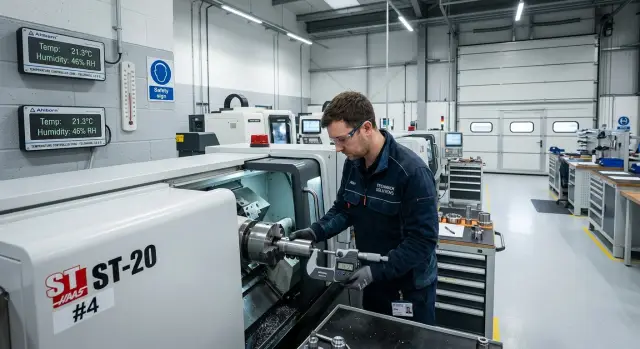
Why dimensions drift during a shift
A well-maintained machine doesn't guarantee the same dimension from morning to night. Often the cause is not mechanics or the program, but heat. Metal expands, machine components warm up, and shop air changes — all at different rates.
In the morning the machine is usually cold after downtime. The spindle, guides, ball screws, hydraulics and the bed are just warming up. The blank may also be colder than the room air, especially if it sat by the gates or came from an unheated warehouse. The machine starts gaining temperature while the metal hasn't yet. That's why the first part of the shift often measures differently from the part made an hour later.
After lunch the situation changes again. The shop gets warmer from sun, open gates, nearby equipment or general heating. But the part, the tool and the machine structure don't warm up simultaneously. One component may have shifted by a few microns while another hasn't. Everything looks normal, but repeatability drops.
While tolerances are wide, thermal expansion is easy to ignore. But for tight fits, finishing passes and long series, even a small shift quickly produces scrap. The operator sees size drifting, changes an offset, and later the size drifts the other way. Time is spent on measurements, trial parts and stops rather than cutting.
Typically it looks simple: the first part is adjusted in the morning, the correction is changed again by mid-shift, and by evening you have a third value. If a shop works with tight tolerances, ordinary heating is not enough. You need stable conditions so air, blanks and equipment temperatures don't jump during the day.
This hits hardest on operations where size is held in the last tenths or less. There the difference between "OK" and "no-go" often appears not because of tool wear but because the machine and part in the morning are not the same as after lunch.
When ordinary heating is no longer enough
Regular heating solves the basic task: the shop isn't freezing, equipment doesn't sit in dampness, and people can work a whole shift. For precision that is not enough. If it is 17–18°C at the machine in the morning and 23–24°C after lunch, dimensions will drift even on a good machine.
The line is usually visible by tolerance. With a tolerance field around 0.05 mm a shop can still get by with ordinary heating if temperature changes little during the shift. At 0.02 mm the margin quickly melts. At 0.01 mm and below you need not just warmth, but a stabilized shop climate.
Long, thin parts are especially sensitive. A 1000 mm steel shaft changes length by about 0.036 mm with a 3°C change. That's acceptable for a rough part, but problematic for a long shaft with precise journals.
Thin-walled parts behave even worse. They are influenced not only by overall part temperature but by local heating in the cutting zone. A part can leave the machine within size and then slightly change shape in minutes. Bearing fits also drift quickly: a bore with a 10–15 µm tolerance easily goes out of range if the blank, chuck and measuring area are at different temperatures.
Ordinary heating usually fails when cycle times are 20–40 minutes, series run without pauses, long shafts, thin-walled housings or precise fits are machined, and measurement is done elsewhere at a different temperature. Even a 2–3°C difference between the working zone and the inspection area is noticeable.
This temperature mismatch is often underestimated. A part is turned in a warm bay and then taken to a cooler inspection room and shows a different size. Or it's measured near an air conditioner and later warms up and changes. People argue about machine setup while the cause is conditions.
If a shop has long cycles, nonstop series and tolerances around 0.01–0.02 mm, regular heating isn't enough. You need stable temperature, a waiting period before measurement and identical conditions for machining and inspection.
Which materials suffer most
Different materials on the same machine react to temperature differently. When sizes are held to hundredths, this shows quickly: size drifts, repeatability falls and the operator starts adjusting manually.
Aluminum usually reacts the most to heating. It expands roughly twice as much as common steel and does it quickly. A 300 mm aluminum blank heated by just 5°C can change by about 0.03–0.04 mm. That's fine for roughing, but not for precision work.
Stainless steel behaves differently: it expands more than carbon steel and conducts heat worse. The cutting zone heats up more and size can drift during machining, not just because of room air.
Ordinary steel is calmer. Its size changes with temperature but more predictably. Cast iron is usually even more stable, which is why heavy cast iron parts and beds are valued: they change temperature slower and affect geometry less.
In simple terms: aluminum reacts first, then stainless, then steel and cast iron. But material is not the only factor. A thin part changes faster than a massive one. A thin sleeve or plate reaches shop temperature in minutes, while a heavy blank warms slowly. So two parts of the same metal can behave very differently.
Problems often start before the machine. A blank arrives from outside in winter, sits by the gates and then is put into a warm shop. Its surface may be warm while the core is still cold. The operator runs it and dimensions drift through the lot.
So a steady climate is needed not only for "difficult" materials. It's needed where there are tight tolerances, thin parts and blanks with different starting temperatures. Aluminum punishes first, stainless doesn't forgive for long, and steel and cast iron give you a bit more time to react.
Which operations and tolerances suffer first
Finish operations are usually the first to drift, where the allowance is small and tolerance strict. On rough turning temperature swings are often hidden by extra allowance. On finishing and boring that allowance is gone, and even a small thermal shift shows on the size.
Bearing fits show this quickly. If a shaft is turned at one temperature in the morning and three hours later the machine, chuck, part and shop are warmer, an interference or transition fit can move by several microns. That's enough to make assembly too tight or too loose.
The situation is similar with assembly bores. Boring is sensitive to heat because the part, mandrel and spindle all affect size. If a hole must fit another part without adjustment, batch variation becomes apparent very quickly.
Paired parts that must fit each other without hand-fitting are another risk area: a shaft and sleeve, housing and cover, bearing seat and mating journal. With temperature swings, individual parts can still be within tolerance, but the pair fails to assemble consistently.
Often the issue is not the mean size but repeatability. The batch average can look normal: some parts slightly high, some slightly low. But the spread grows, and that spread breaks assembly, tool setup and process predictability.
This shows fastest on finishing shaft journals and bearing diameters, boring precise holes, paired parts without fitting and operations with long cycles and narrow tolerance bands. If a shop does these operations daily, the CNC shop temperature affects not just a single dimension but the whole shift's result.
A quick check for the shop
You can understand whether a shop needs a stabilized climate in one working day. No complex audit is required. Just see where temperature changes, how quickly metal adapts and where you measure parts.
Start at the machine, not a thermometer on the wall. In the same shop it can be cool by the gates, hot by the spindle and change every hour near a heat gun. For repeatability the important factor is not the average room temperature but conditions at the cutting point and near measurement.
Put a simple sensor near the machine and record temperature in the morning, after lunch and at the end of the shift. Compare the blank from the warehouse with one that has been in the machining area. Look for drafts: open gates, windows, fans or directed heaters often create odd variation. Separately check how long a part sits before measurement and whether the shop differs from the inspection room.
There is an even simpler test. Take the same part, measure it immediately at the machine, then after 15–20 minutes on the shop floor and then in the inspection room. If numbers differ without tool or program changes, the issue is often temperature, not the machine.
On turning shops this is most noticeable on long shafts, thin sleeves and bearing sizes. If the shop works with tight tolerances, first remove temperature swings and drafts, then look for tooling, fixtures or setup problems.
How to organize a stable climate step by step
Don't start by buying an air conditioner; start with measurements. Without numbers the conversation turns into feelings: who is hot, who is cold. You need a simple temperature log by shift, zone and season: at the machine, at raw material storage and in the inspection area.
In 2–3 weeks it usually becomes clear where the problem is strongest. Size drift often occurs not across the whole shop but on a specific operation: finishing turning, boring, final drilling or inspection fits. Find those points first, then change conditions locally.
Where to begin
Direct air flows are the worst. If cold air hits the machine from the gates in winter or a heater blows from the side, temperature becomes uneven. One part of the assembly warms while another stays cold and repeatability falls. So first remove direct cold and hot streams instead of adding another heat source.
After that it's useful to divide the shop into three zones: the machining zone with even temperature and no abrupt changes, a raw material storage zone where metal has time to reach shop temperature, and an inspection zone placed away from gates, radiators or sunny windows. This simple arrangement often helps more than simply heating the whole building harder.
What to fix in the workflow
Next you need a clear warm-up routine. Machines, fixtures and parts should not go straight to precision work after a cold start. Usually a simple rule works: warm the machine on a typical cycle, let fixtures and measuring tools sit in the working zone and don't start finishing on blanks brought in from outside right away.
Also revise incoming material handling. In winter blanks from the truck often go to work too early. It's better to accept them in advance, sort them by batch and allow time for temperature equalization. If space is limited, at least don't place such batches near the inspection station.
The idea is simple: first remove abrupt swings, then level the zones, and only after that consider more complex climate equipment.
Common shop mistakes
One common mistake is placing a powerful heater right next to the machine. The operator feels warmer, but the machine and part heat unevenly. One side of the bed is warm, the other still cold. The display looks normal, but sizes float from part to part.
Measuring immediately after machining causes no fewer problems. After cutting both the part and the chuck are heated. You can get a nice number that disappears after 15–20 minutes when the metal cools and temperatures equalize.
Cold blanks by the gates also break repeatability. In winter the difference is noticeable even in a heated shop: material cools near the entrance and is then put into the machine. The first parts drift, the operator corrects offsets, and after an hour the blanks warm up and sizes drift the other way.
Another typical mistake is focusing only on room air and forgetting the machine itself. The spindle heats up in operation, fixtures gain temperature, chuck jaws change size. If the machine is started cold in the morning and is warm by lunch, the same program will give different results.
So people often look in the wrong place: they change the insert, blame a batch of tools, suspect backlash or setup error. Sometimes the tool is to blame, but first check the environment: where the blanks were stored, how the machine warmed up, when measurements were taken and whether hot air is blowing on the work area.
A quick test is simple: compare part size immediately after machining and after a pause, check blank temperatures from different shop zones, see if a heater is aimed at the machine, and note how size behaves on a cold and warmed spindle. If these signs repeat, ordinary heating is not enough.
A simple real-shop example
On a turning line the same batch of bushings ran accurately in the morning. The first parts held size and inspection rarely returned them for recheck. The problem began later when the gates to the warehouse were opened several times and cold air entered the shop.
The machine continued to run normally, but the temperature around it changed. Blanks near the gates were colder than those that had rested by the line. For a part with a 0.02 mm tolerance this was enough: size began to drift and repeatability fell without tool failure or program error.
The operator did the usual thing — slightly tightened the correction after measuring. That worked briefly. By evening the same correction became wrong because the shop air equalized and the machine warmed more, and thermal expansion changed the picture again.
Inspection saw a strange result: identical parts from one shift behaved differently. Some parts passed easily, some approached the upper tolerance, and a few went out of range. On paper the process was the same. In reality conditions had changed several times during the day.
The cause wasn't in the tool or machine rigidity. The shop moved raw material storage away from the gates so blanks would reach a more uniform temperature before machining. They also fixed the inspection area: removed drafts and agreed to measure parts only after a short stabilization period in a stable spot.
Within days the spread noticeably decreased. The operator adjusted offsets less often and inspection stopped seeing differences between morning and evening parts. This example shows a simple truth: if dimensions drift during the shift, ordinary heating is not enough.
What to do next
Start with a list of operations where size drifts most often. These are usually finishing shaft fits, boring, final planar machining and inspection immediately after the machine. For each operation note material, tolerance, when deviations appear and how much size changes by mid or end of shift. In a few days it becomes clearer whether the tool or temperature is at fault.
Then collect simple data for at least two weeks: air temperature near the machine at the start, middle and end of shift, blank temperature before machining, inspection area temperature and notes when gates were opened, heating turned on or cold-stock batches brought in.
That is enough to decide whether the shop needs a stabilized climate rather than just heating. If size drifts at the same hours as temperature swings, the debate about causes ends quickly. You get a factual basis for decisions instead of guessing at the machine.
Think about climate before buying equipment. Not only the machine's stated accuracy matters but also installation location: next to gates, radiators, raw material storage or the inspection area. It's easier to fix an error on the shop layout than to chase the same size drift every week.
If you are selecting a CNC lathe or machining center, discuss these requirements up front. EAST CNC, the official representative of Taizhou Eastern CNC Technology Co., Ltd. in Kazakhstan, supplies metalworking equipment and helps with selection, commissioning and service. In such work the shop conditions cannot be separated from repeatability requirements.
A good next step is simple: choose three operations with the most frequent size drift, start measurements on Monday and review the numbers after two weeks. Then you'll see where organizational measures suffice and where maintaining the needed tolerance is difficult without a stable climate.
FAQ
How to tell that size drift is caused by temperature?
Start by checking temperature at the machine, at raw material storage and in the inspection area at the start, middle and end of the shift. If size drifts together with a 2–3°C change, and the tool and program stayed the same, the cause is often environmental, not mechanical.
At what tolerance is regular heating no longer enough?
Ordinary heating usually suffices for loose tolerances. When a shop works around 0.01–0.02 mm, you already need an even climate without noticeable temperature swings during the shift.
Which operations suffer first?
Finish operations drift first: fits for bearings, shaft journals, precise bores and paired parts without fitting. There is little material allowance there, so a few microns quickly cause rejects or unstable assembly.
Which materials react most to heating?
Aluminum usually reacts first, then stainless. Steel behaves calmer, and cast iron is often the most stable. But a thin or long part of any material can change size quickly.
Should the machine be warmed up before precise machining?
Yes — if the shop does precise sizes. Let the machine reach operating temperature on a typical cycle; otherwise the same program can give different results in the morning and after an hour.
Can you measure a part right after machining?
No. It's better not to rush. Immediately after cutting the part and clamping area are still warm, so the measured size may look fine but change after 15–20 minutes.
What to do with blanks brought from a cold warehouse?
Do not put them straight into finish work. Let the batch sit in the shop area so the metal evens out to room temperature; otherwise the first parts almost always force corrections.
Will a heater next to the machine help?
No — that often makes things worse. A heater blowing directly at the machine warms parts and the machine unevenly, so sizes start to drift even if the operator feels more comfortable.
Do you need a separate stable inspection area?
Yes, if you work with tight tolerances. Measuring in a colder or warmer place gives a different size, and you end up adjusting the machine for the wrong conditions.
What to do if there is no budget for complex climate control?
Start a simple temperature and measurement log for three operations where size drifts most. Eliminate drafts, even out raw material storage and require a short stabilization period before inspection — often this already cuts the spread significantly.