
Geared spindle or without one in serial turning
A geared spindle or a spindle without a gearbox affects metal removal, noise, and cycle time. Let’s look at where production loses pace during heavy roughing.
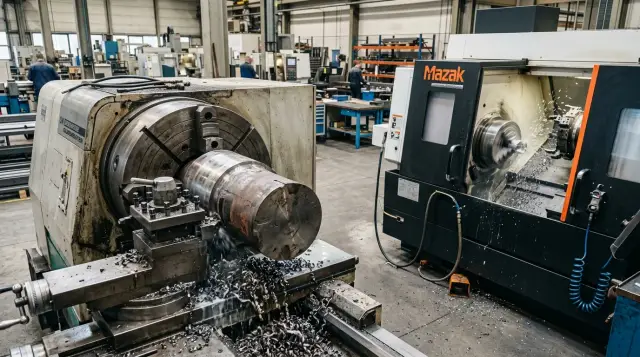
Where the production run loses pace
The same rated power in the spec sheet does not guarantee the same number of finished parts per shift. In serial turning, pace is lost not on paper, but in actual work: when the spindle takes a long time to get up to speed, pulls weakly at low rpm, or forces you to cut more cautiously than necessary.
This is most noticeable on parts that require heavy roughing. If the blank is large, the stock allowance is big, and most of the metal removal happens in the first passes, the machine spends a long time not at maximum speed, but below it. That is exactly where the difference between two spindles with the same rated power becomes clear.
Usually, the loss of pace shows up in several places. The roughing pass has to be run at a lower feed. The spindle takes longer to accelerate after a mode change. The operator reduces the settings because of noise and vibration. As a result, the cycle on each part grows by only 10–20 seconds, but over a batch that turns into hours.
That is why the question of "a geared spindle or without a gearbox" cannot be reduced to a single power figure. One machine can handle heavy cutting at low speeds with no trouble. Another, with the same power, loses torque, and the process engineer has to reduce feed or depth of cut. Metal comes off more slowly, the tool heats up more, and the cycle gets longer.
Low speed is not a problem by itself. The problem starts when there is not enough pull at those speeds. In serial turning, that quickly affects output, because the losses repeat on every blank. On a simple, light part, the difference may be almost unnoticeable. On shafts, flanges, and massive housing parts, weak spindle torque at the start of roughing quickly eats into the shift plan.
Noise also matters more than it seems. Loud operation, jerks during acceleration, and extra vibration make staff keep a safety margin in the settings. And that is not overcautiousness. People simply hear and feel that the machine is running close to its limit. On the surface it is running without stopping, but the production run moves more slowly than it could.
In shops where the machine is bought for heavy roughing, this is considered before the purchase. EAST CNC also follows this approach: for serial work, not only the rated power matters, but also how the spindle behaves in the real cycle.
What changes in spindle operation
When a machine cuts a heavy blank at low speeds, the difference between the two designs is obvious right away. A geared spindle usually holds torque more confidently. It is easier for it to pull a large diameter, a deep pass, and a tough material when high torque is needed from the first seconds.
A direct-drive spindle has a different character. It reaches high speeds faster and performs better where the cycle often requires acceleration, braking, and short finishing moves. On small and medium parts, this often creates a quicker rhythm.
At low speeds
A gearbox is useful not because the machine is stronger across the whole range. Its advantage shows exactly where production often slows down during roughing: low speeds, large stock removal, and the risk of losing speed under load. In this zone, the operator has to reduce feed less often so the spindle does not bog down under the cut.
A direct-drive spindle can also work normally at the same settings if the part is not too heavy and the stock allowance is moderate. But when the blank is large, the chuck is heavy, and the passes are deep, torque reserve stops being a catalog number and becomes a direct takt-time limit.
During acceleration and in noise
A direct drive usually wins in acceleration. The spindle gets up to speed faster after a tool change or when moving to another section of the program. If the batch has many short operations, those seconds add up quickly and start affecting output.
The difference in noise is also noticeable. A geared design often sounds rougher, especially under load and when switching between speed ranges. A direct drive usually sounds smoother and quieter. That matters for the operator: over a long shift, it is easy to hear by sound where the machine is running smoothly and where the components are under strain.
Spec-sheet figures do not always help. Maximum power and peak torque look impressive, but for serial turning something else matters more: how much torque the spindle can hold for a long time, how it behaves at 150–400 rpm, and how quickly it accelerates a specific chuck with a specific blank. So the choice is better made not by the top line in the table, but by your part, your cycle, and your roughing load.
When a gearbox brings more benefit
A gearbox is needed where the spindle works under heavy load for a long time, not just where it reaches speed quickly. If the blank is large, the stock allowance is big, and the tool removes metal deeply, a direct drive often loses pace at the low end of the rpm range. The machine cuts, but less confidently.
In that situation, a gearbox usually wins in heavy roughing. It helps maintain spindle torque where the part needs force, not speed. For serial turning, that matters: the cycle should run the same from the first part to the hundredth, without a drop in feed and without constant attempts to save the process by reducing stock removal.
A gearbox is especially appropriate in four cases:
- the blank is massive and keeps the spindle under load for a long time;
- the stock allowance is large, and the tool cuts to a noticeable depth;
- the material is dense, tough, or cuts with high resistance;
- most of the cycle takes place at low or medium speeds.
Under these conditions, the machine runs more calmly. The spindle is less likely to bog down at the start of the cut and pulls better when the tool enters the material at full depth. This is easy to see on steels, heat-resistant alloys, and parts where you cannot simply raise the speed and escape the load.
Where this is felt most
If a part is machined mostly at 120–400 rpm, a gearbox often pays for itself through the shift rhythm alone. The operator has to reduce feed less often because of insufficient torque. The tool works more evenly, and cycle time fluctuates less.
Of course, that strength comes at a price. A geared spindle is usually noisier and accelerates more slowly. But for heavy roughing, that is not the main drawback. When the machine is under heavy cutting load for 30–60 seconds at a time, a couple of extra seconds for acceleration do not change much. Much more important is that the spindle does not sag at the moment of maximum metal removal.
If your production run includes many thick-walled blanks, deep passes, and dense materials, a gearbox more often helps than hinders. In that kind of work, force at low speeds is more valuable than a fast, quiet run up to high speed.
When it is better to go without a gearbox
A gearbox does not help in every case. If the part is short, light, and does not require long heavy roughing, a machine without a gearbox often works faster in real cycle time. It gets to the needed speed faster and drops speed just as quickly before the next transition.
This is especially clear in serial turning where cutting happens in short bursts: facing, a small diameter pass, grooving, parting off, then acceleration again. When there are many such actions, every extra second between them affects output per shift.
For such parts, the choice often leans toward the version without a gearbox. The reason is simple: with frequent acceleration and braking, what matters is not only torque, but also the spindle’s quick response.
A machine without a gearbox is usually the better fit if the blank is small and does not require much torque at low speed, most transitions last only a few seconds, the spindle changes speed many times in one cycle, and the work area needs less mechanical noise.
A geared spindle has a strong advantage: it pulls more confidently at low speed under serious load. But if that mode is needed rarely, that reserve may simply go unused. Meanwhile, the heavier drivetrain and the gearbox itself can sometimes take time away where the cycle is already very short.
Noise is also underestimated here. When the machine is close to the operator and the shift spends the whole day hearing frequent acceleration, the difference in background sound is very noticeable. A spindle without a gearbox is usually quieter and smoother. In the shop, that is less tiring.
There is also another simple point. A short, light part does not handle idle pauses well. If the actual cutting time is 12–15 seconds, then a couple of extra seconds to reach speed already looks too expensive. In that kind of job, a fast direct spindle often gives better shift output than a more powerful option intended for a very different product mix.
When choosing a CNC lathe for this kind of work, people should look not at force in general, but at the nature of the cycle. If there is almost no heavy roughing, and the production run depends on frequent short transitions, going without a gearbox is often the smarter choice.
How to evaluate your part step by step
Many people look at the maximum spindle speed and stop there. For production, that is not enough. The better choice should be made based on the part itself and how the cycle runs.
First, do not start with the catalog. Start with the machining route for one typical part. Ideally, choose the one that makes up most of the volume. It immediately shows where the machine spends time and where it lacks torque.
-
Assess the blank. A large diameter and noticeable mass almost always push the process into a lower speed range. If you load a heavy blank and remove a lot of metal in the first passes, spindle load rises at the very start of the cycle.
-
Estimate how much time goes into removing the main stock allowance. Do not focus on finishing; focus on the part where the tool cuts deeply and for a long time. If roughing takes up a large share of the cycle, the machine needs torque reserve, not just a fast run up to high speed.
-
Split the cycle by speed ranges. List the time at low, medium, and high speeds separately. If a significant part of the work is done in the low and middle ranges, a gearbox often gives steadier performance under load. If the part lives in the medium-high range, the advantage may shift to direct drive.
-
Look at how many times the spindle changes speed during the cycle. On a simple part, this is barely noticeable. On a complex one where roughing and finishing sections alternate, frequent acceleration and braking already affect pace. The more such transitions there are, the more expensive slow acceleration becomes.
-
Then ask a simple question: what hurts output more, lack of torque or lost seconds during acceleration? For heavy roughing, weak torque is usually the bigger problem. For short cycles with frequent mode changes, inertia is usually the issue.
The rule of thumb is also fairly simple. If the part looks like a large bushing, flange, or housing blank, where the start of the cycle involves long rough stock removal, look toward more low-speed torque. If the batch consists of lighter parts and the cycle is short and speed changes often, a fast spindle without a gearbox will often give a better pace.
The final result is best checked not by a single number in the machine specs, but by actual cycle time. That is where you can see where the production run loses minutes per shift.
A simple shop-floor example
Imagine a normal batch of bushings made of dense steel. The blank comes with a large stock allowance, and the first passes remove a lot of metal. Then the work moves to a completely different stage: short finishing passes, where the machine has to speed up quickly and move just as quickly to the next part.
On roughing, the difference between the two designs is obvious right away. A machine with a geared spindle handles the load more calmly when the tool goes deep into the metal. The rpm does not sag as sharply, the cutting sound is more even, and the operator does not need to reduce feed at every heavy section. If the batch is large, that low-speed torque gives you not a nice figure in the catalog, but real minutes saved per shift.
Suppose the bushing is machined from a blank with 5–6 mm allowance on the diameter. In the first stage, rough passes with a noticeable depth of cut are used. Here, the geared spindle often wins simply because it pulls more confidently at 200–400 rpm. A machine without a gearbox can also handle it, but it more often asks for a softer setting or takes longer to settle into stable cutting under that load.
Then the picture changes. Roughing is finished, and the production run moves to short finishing passes, where the machine needs to accelerate quickly, remove a thin layer, and immediately move on to the next cycle. Here, the machine without a gearbox often looks better. It reaches speed faster, slows down faster before a mode change, and usually runs more quietly on light cutting.
On the same bushing, the comparison is simple: the gearbox helps where there is a lot of stock to remove and spindle torque is needed, while the direct drive saves seconds where quick speed changes matter.
That is why the choice is rarely made by one power number. If 70% of the cycle is heavy roughing, a gearbox often keeps the pace better. If most of the time goes to short finishing passes and frequent mode changes, a machine without a gearbox may give the whole batch a more energetic rhythm.
In the shop, you feel it very simply: one machine cuts more confidently, the other breathes faster between operations. That is exactly where the production run either loses pace or holds it.
Common mistakes when choosing
Most often, a machine is chosen by the number that stands out first: the maximum spindle speed. That is convenient for a catalog, but not for the shop floor. In production, pace is not lost at the pretty top end, but in how the spindle pulls at working speeds, how quickly it accelerates after a mode change, and how it behaves under real load.
Because of that, people often ask the wrong questions. If your work includes a lot of heavy roughing at low speeds, a high maximum rpm alone does not help much. If the part is short, cycles are frequent, and acceleration and braking happen in almost every takt, slow spin-up begins to eat into shift time.
Another common mistake is buying a machine for a rare part instead of for the main production run. A shop may have one difficult blank where a big torque reserve is desirable, but 80–90% of the output is made up of ordinary parts with a lighter process. In that case, a machine chosen for the rare heavy scenario works every day in a less favorable mode.
Many people do not calculate acceleration time at all. But it should be viewed inside the cycle, not separately from it. If an operation lasts 40 seconds and the spindle changes speed several times, even an extra 1–2 seconds at each transition quickly turns into a noticeable output loss.
Noise is also often dismissed, although it is not a small thing. If the machine is next to permanent workstations, extra noise tires people out by the middle of the shift. On paper, productivity may look the same, but in real work the difference is felt every day.
There is also confusion between heavy roughing and a one-time overload. If a part once a week requires a hard cut, that does not automatically mean the entire production run needs a geared spindle. First, look at the normal mode: how much metal is removed in most cycles, at what speeds the work is done, and how long the load lasts.
Before making a decision, it helps to check four things: at what speeds the machine spends most of the shift, how many times the spindle accelerates and brakes during a cycle, which part makes up most of the output, and where the machine will stand if noise matters for the area.
That makes the choice sober and realistic. Not for a rare case and not for a marketing number, but for real serial turning.
Quick check before deciding
Look not at rated power, but at the part that runs almost every day. It will show fastest where production loses time: on heavy cutting, on spindle acceleration, or on unnecessary noise around the machine.
Before choosing, answer five questions:
- Which part most often appears in the production run: a short, light one or a massive blank with a lot of metal removal?
- How many minutes in one cycle does the spindle actually spend cutting under heavy load?
- Do you need high torque at low speeds when deep roughing is taking place?
- How many times per shift does the machine need to reach high speed quickly?
- How much do noise and overall operator comfort affect the work?
If the main part is large and roughing takes a noticeable part of the cycle, a gearbox often gives more even operation. The spindle holds speed more easily when the tool removes a lot of metal. This is especially noticeable on steel, large flanges, shafts, and other blanks where cutting lasts a long time rather than happening in bursts.
If the production run consists of small parts with frequent starts, short cycles, and high-speed acceleration, extra mechanics are not so useful. In that case, a machine without a gearbox usually pays off faster: it is quieter, accelerates faster, and spends less time between operations.
If you are unsure, take three parts that make up most of the workload and write down four numbers for each: roughing speed, cutting time under load, number of accelerations per cycle, and total cycle time. After that, the choice is usually clear. If the machine spends most of the shift pulling a heavy cut at low speed, a gearbox makes sense. If the production run lives on short cycles and frequent acceleration, direct drive is the better direction.
What to do next
The decision is better made not from a catalog, but from your own parts. The same machine can look good on paper and still lose minutes in production on every cycle because of extra acceleration, noise, or weak low-speed torque.
First, do not collect an abstract list of requirements. Gather 3–5 typical parts. Pick the ones that really load the shop: different diameters, stock allowances, lengths of cut, and shares of roughing. If one part runs often and two others only occasionally, that is worth noting too.
Then do not look only at spindle power. For serial turning, the character of the cycle matters: how much time goes into heavy roughing, how often the spindle accelerates and brakes, whether there is low-speed cutting with high metal removal, and how sensitive the area is to noise. At that point, the choice stops being theory and becomes a calculation in minutes.
For convenience, you can put the data into a short table: blank and finished diameter, material and average stock allowance, speed range for roughing and finishing, cycle time and share of acceleration time, surface finish requirements, and repeatability.
After that, ask for a recommendation based on your production run, not a general opinion. A proper assessment relies on your settings, not on the phrase "this machine is more powerful." Sometimes a gearbox really does help maintain pace in heavy roughing. Sometimes it only adds noise and extra inertia where the parts are small and the cycle is short.
If you already have a machining route, it is useful to send the supplier two numbers right away: how many parts per shift you need and where time is currently being lost. Then the conversation becomes specific.
When choosing a CNC lathe, this approach is much more useful than comparing spec sheets. At EAST CNC, parts, cutting modes, and spindle type are usually matched to the real production run. For that kind of selection, it is much more honest than relying only on table figures.
FAQ
How is a geared spindle different from a spindle without a gearbox?
Not always. For heavy roughing, a geared spindle usually pulls better at low speeds. A direct-drive spindle more often wins where fast acceleration, short transitions, and quieter operation matter.
When is a geared spindle really needed?
If you have large workpieces, a big stock allowance, and long roughing passes at low speeds, a gearbox is often more useful. It helps maintain feed and avoids sagging under load. On shafts, flanges, and dense steels, you can feel it right away.
When is it better to choose a machine without a gearbox?
When the production run consists of small parts with short cycles and frequent speed changes. Such a spindle usually reaches speed faster, slows down faster, and makes less noise. If heavy roughing takes up little time, this often gives better output per shift.
If the power is the same, will the part output also be the same?
No. The same rated power in the spec sheet does not mean the same real-world performance in the shop. One spindle cuts confidently at 150–400 rpm, while another forces you to reduce feed or depth of cut at the same settings.
How do I know whether I need high torque at low speeds?
Look at where most of the cycle happens. If the machine spends a long time cutting at low speeds and removing a lot of metal in the first passes, torque matters more than maximum speed. If there are almost no such sections, extra torque may simply go unused.
Does spindle acceleration really affect productivity?
Yes, quite a lot. On short cycles, even one extra second at each acceleration quickly turns into a noticeable loss over a shift. If the spindle changes speed often, fast response can matter more than extra torque reserve.
Why does spindle noise matter when choosing a machine?
Because noise and vibration change how the operator works. If the machine sounds rough, people lower the settings themselves to keep cutting more calmly and avoid risking the tool. In the end, the machine is still running, but the production run moves more slowly.
What should I look at besides spindle power?
Look not only at power and maximum speed. It is more useful to compare torque at working speeds, acceleration time, behavior under load, chuck and workpiece mass, and how much of your cycle is roughing. These figures show the machine’s real performance better.
Can one spindle option cover all tasks at once?
Usually not. If you choose a machine for a rare heavy part, it may run every day in a suboptimal mode for the main production run. It is more sensible to choose a configuration for the parts that make up most of the workload.
What should I send to the supplier to choose a spindle without guesswork?
Prepare 3–5 typical parts and give simple data for each: material, stock diameter, allowance, roughing speed, cutting time under load, and number of accelerations per cycle. Then the supplier can match the machine to your real production run instead of a vague statement about power.