
Spindle Power: Peak Rating vs Real-World Performance
Spindle power is often judged by the peak figure, but for cutting continuous load matters more. We cover selection mistakes and a simple way to check.
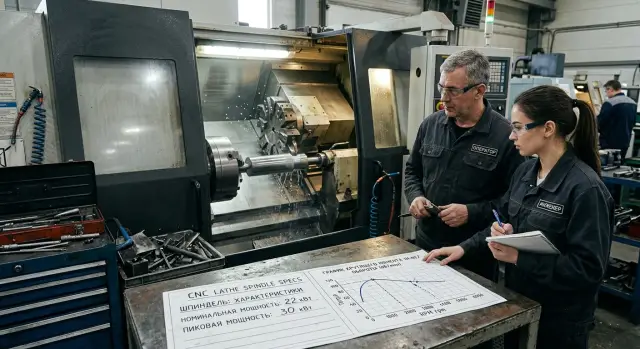
Why the catalogue number is misleading
The most visible number in a catalogue usually draws attention fastest. For a machine it's often the spindle's peak power, not the load it can hold comfortably over a whole shift. On paper the difference seems small. On the shop floor it appears quickly.
Peak power is short-lived. A machine can show high kilowatts on acceleration, when the tool enters the material, or on a short heavy section. But if the operation continues for a long time, the spindle runs in a different regime. For the operator a few seconds of surge don't matter — what matters is steady pulling power without drops in RPM and feed.
Because of this, a CNC machine is often chosen by a single line in the spec and later produces an unpleasant surprise. It looked fine in a test, but in production you must reduce feed, cut depth or add an extra pass. Cycle time grows, the tool heats up more, and planned productivity never appears.
Even identical kilowatts don't guarantee the same result. Two machines rated at 15 kW can behave very differently. One holds the load confidently at working RPMs, the other shows a similar number only in a narrow range and quickly loses pulling power if the regime changes.
The reason is usually threefold: the manufacturer lists peak rather than nominal power; torque changes with RPM and may be insufficient at the regime you need; and the machine's mechanics, drive and setup affect cutting as much as the kW number.
This is especially noticeable in serial production. For a simple aluminium part the mistake may remain almost invisible. On steel, stainless or intermittent cuts it shows up immediately. So a nice catalogue number is only the start of the conversation, not the answer.
What peak power is
Peak power is a short reserve the spindle can deliver at a moment of sudden load increase. For example, when the tool enters the material, passes a denser area, or takes a heavy layer at the start of a cut.
That number shows the motor and drive can withstand a short jolt without an instant drop. It sounds impressive in a catalogue, but for real work a single peak is not enough. If the spec doesn't say how long the machine holds that regime, the comparison almost loses meaning.
The peak is useful. It helps with spindle acceleration, tool entry, intermittent cuts and brief overloads. But that regime doesn't last the whole operation. Sometimes it's seconds, sometimes tens of seconds. After that everything depends on cooling, the drive and the specific machine's settings.
So the main question is simple: what happens not in a short jolt, but during normal work when a pass lasts 10–15 minutes and such passes happen dozens of times per shift?
What the machine actually holds in production
On the shop floor people don't look at the loudest catalogue number but at the nominal power. It shows the regime in which the spindle can operate for a long time calmly and without overheating. For everyday machining this is much closer to reality than the peak value.
In turning the difference is obvious. Suppose you rough-turn a steel blank. At the start the spindle takes the load confidently, but what's more important is whether it keeps RPM, whether feed holds, and whether the operator must soften the cutting mode. If there's no margin for continuous work, the datasheet looks better than the real shift.
Usually the shortage shows up quite practically. RPMs drop under load, the machine requests a gentler cutting mode, cycle time grows, and the part finish is worse than expected. Nothing dramatic at startup, but in a series this quickly becomes lost time and frustration.
So in the datasheet look not just at the maximum, but at the spindle's working regime: nominal power, the RPM range where it holds, and long-duration load data. If the manufacturer happily advertises the peak and speaks vaguely about continuous operation, that's a reason to ask more questions.
Put simply: peak and nominal power are not the same. When buying, focus on what the machine can pull every day, shift after shift, at your regimes.
Why a single power number is not enough
A kW figure looks convincing, but by itself it says little about how the machine cuts metal. Work depends not only on spindle power but also on torque, especially for steel, castings or large blanks rather than small aluminium parts.
The difference is simple: power shows overall potential, while torque shows how much "force" the spindle pulls at specific RPM. If torque drops at low speed, a machine can look good in a catalogue yet perform poorly in real cutting.
This is clear in heavy turning. When an operator takes a large steel blank, sets low RPM and wants to remove a significant layer per pass, weak points show quickly. The spindle starts to lose pace, load grows, surface quality worsens, and cutting parameters must be reduced. On paper power is the same, in practice metal removal is different.
At low RPMs torque reserve often matters more than a big peak figure. For a lathe this is common: the larger the part diameter, the lower the RPM and the more important torque becomes. If a machine holds the cut in that regime it behaves predictably. If not, the operator is constantly compromising.
Blank size changes the picture more than expected. A small shaft and a massive flange demand different effort from the spindle even with the same material. Add depth of cut and feed, and the load rises rapidly. Choosing by a single "power" line often leads to mistakes.
One more thing often underestimated: cutting is influenced not only by the motor but by the whole unit: drive, machine mechanics, rigidity and settings. Two machines with similar specs can cut differently for these reasons. One calmly handles roughing, the other asks to reduce feed on the first serious pass.
How to check the characteristics
Start not with the catalogue, but with your part. You need the material, diameter and length of the blank, not just the item name on the order. A steel shaft 80 mm and an aluminium sleeve 80 mm create very different loads despite the same size.
Then define realistic cutting conditions. Roughing and finishing need different RPM, feed and depth of cut. Without these numbers comparing machines is premature. Power without reference to a regime says almost nothing.
Next, don't look at the top figure in the brochure, but at nominal power and torque at the RPM where your operation will run. If the pass runs at 700 rpm, check torque at 700 rpm. It sounds obvious, but that’s where mistakes happen.
After that verify whether the machine holds the chosen regime without dropping. The best check is a test on a similar part or a calculation for it. Request spindle load during cutting, cycle time and the machine's behavior on a long pass. If RPMs fluctuate, vibration increases or the operator reduces depth of cut, the datasheet number already tells you little.
A normal request to the supplier usually covers four things: material and hardness, blank diameter and length, cutting mode, and surface or tolerance requirements if they affect machining. For a lathe that's enough to move from generalities to an honest calculation.
If you compare similar models, ask for a calculation for a part like yours. With EAST CNC such a conversation makes sense in those terms: material, diameter, pass type and duration. This quickly filters out options that only look good in a catalogue.
Example on a simple part
Take a common series job: a shaft in 45 steel with a 60 mm blank, several rough passes and one finish. The part is simple but the batch is large. Such a task shows quickly whether a machine earns its keep in a real shift.
The first machine may seem stronger at first. Its catalogue peak spindle power is higher, and that figure easily convinces a buyer. The second looks more modest, but its gap between peak and nominal is smaller, and it holds working loads longer.
On a short section the first option can indeed look lively. It enters the cut sharply and performs well at the start. But if the stock allowance is uneven, the pass long, and the batch runs without pauses, the peak reserve runs out quickly. The machine more often drops RPM, asks to reduce feed and depends heavily on how precisely the operator chose parameters.
The second machine behaves more steadily. It doesn't impress with a brochure figure, but it keeps the regular working regime longer without fuss. In series turning you feel it immediately: the cutting sound is steadier, the tool works calmer and the process depends less on small load variations.
The difference is visible by part size too. When load doesn't jump, the machine holds a stable metal removal. The finish varies less from the first to the fiftieth part. The operator adjusts less, and the setup technician spends less time on minor tweaks between batches.
For one trial part you can overlook flashy numbers and imperfect stability. For ongoing work that's a poor trade. If a shop turns steel every day, you usually win more with a machine that honestly holds its load hour after hour than with one that only posts a record peak.
Where people most often go wrong
The most common mistake is looking only at kilowatts. The number is easy to compare between two catalogs, so it seems convenient. But power without a torque curve says little about machine behavior at medium and low RPM.
Another confusion comes from motor datasheets. The buyer sees an attractive motor figure and expects the spindle to deliver the same in cutting. In practice you must check the spindle assembly specs: what power and torque it holds, in which RPM range and for how long.
A typical error is designing regimes only for an easy or “ideal” part. Buyers pick a soft material, small allowance and calm finishing cut, then a tougher batch or a blank with a casting skin arrives. A machine that seemed adequate quickly reaches its limit.
People also forget margin. Choosing a machine exactly to the spec leaves no room: any tougher batch, a dull tool or a slight increase in removal immediately causes trouble. A small reserve is not luxury but insurance against downtime and extra setups.
RPMs cause mistakes too. A catalogue may show an impressive peak, but it is available for a short time and in a narrow range. Parts are not cut in the brochure. If the rough pass runs at 600–900 rpm, you must know what the machine delivers there. If torque drops, cycle time lengthens and tool wear increases.
What to check before buying
Before ordering, put the catalogue aside for a minute and check what you are actually buying. The attractive number under “spindle power” sounds convincing, but by itself it doesn't describe real performance.
First clarify which power is listed. If it's a peak value, it's a short maximum, not the regime the machine runs comfortably through a shift. For normal loading it's fairer to look at nominal power.
Then ask about torque at the RPM where your main operation runs. Many see a big power number but don't check what happens at 800, 1200 or 2000 rpm. It is at those speeds the machine either cuts confidently or starts to "deflate".
Next describe your typical operation: material, diameter, depth of cut, feed, pass duration. Then you can ask whether there's margin for roughing and who will be responsible for selecting parameters, commissioning and initial setup. If the supplier cannot connect characteristics to your part, that's a bad sign.
One more often underestimated point is post-purchase support. Delivering the CNC is not enough. You need commissioning, regime checks and service that doesn't disappear after payment. EAST CNC, for example, offers a full cycle — from selection to commissioning and maintenance — and for a buyer this is a practical matter, not a formality.
What to do before the final decision
Before ordering don't fixate on a single catalogue number. Take two or three real parts for comparison: for example a short shaft, a housing with a bore and a part in tough steel. These quickly show where a machine pulls confidently and where it trips up in everyday shifts.
Then compile the data in a simple table. It should include not only peak and nominal power but torque at working RPM, material, blank size, cutting mode and load duration. Such a table quickly reveals which number is useful in practice and which just looks good on paper.
If a supplier shows only the maximum, that's not enough. Request a calculation for your usual load: how many hours of cutting, which passes repeat, whether heavy roughing occurs, and how often the spindle runs at low RPM. This is more useful than any general presentation.
A simple example clarifies things fast. If you machine a batch of steel flanges and often run low RPM because of large diameter, a machine with a loud peak may lose to a model with a calmer figure but better torque in the working range.
If you have several typical parts, ask for comparisons across them, not just the easiest operation. Then you see where a machine will run without pauses and unnecessary feed reduction, and where the operator must constantly compromise.
The conclusion is straightforward. When choosing a machine look not at the flashiest kilowatt but at how the spindle behaves at your RPM, with your material and for your cycle durations. If a calculation for real parts is clear, the decision becomes much easier.
FAQ
Which is more important when choosing: peak or nominal power?
For purchasing, the **nominal (rated) power** matters more. It shows what the spindle can hold for long periods without overheating, not just in a short surge. The peak figure is useful as a reserve for tool entry and brief overloads, but it shouldn't be the main decision factor.
Why do two machines with the same power cut differently?
Because identical kW figures don't guarantee identical cutting performance. One machine may hold torque at working RPMs, while another loses drive when conditions change. Drive system, rigidity and setup also affect the result.
When is peak power actually useful?
It helps in short, heavy moments: during acceleration, tool entry and intermittent cuts. If those sections last only seconds, the peak can save you. But you can't base an entire operation on it.
What's more important at low RPMs: power or torque?
At low RPMs, **torque** is usually more important. Torque shows how strongly the spindle pulls at a given speed. For steel, cast iron and large diameters this often outweighs a flashy peak number in the brochure.
How do I know if a machine is enough for my part?
Start from your part, not the brochure. You need material, diameter, length, depth of cut, feed and the RPM at which the cut will run. Then check torque and nominal power specifically at those RPMs.
On which jobs does a weak spindle reveal itself fastest?
Weak spindles show up first on steel, stainless, cast iron and on intermittent cuts. Long roughing passes reveal the issue quickly: RPMs drop, cycle time grows, and the tool heats up more. On simple aluminum parts the weakness can stay hidden longer.
What should I ask the supplier before buying a machine?
Ask for a calculation for your typical operation, not general statements. A proper request includes material, hardness, blank size, cutting mode and duration. If the supplier (including EAST CNC) offers selection, commissioning and service, discuss those points and verify the solution in practice.
Why can't I rely only on motor power?
Because motor specs alone don't equal what the spindle delivers in cutting. Check characteristics of the entire spindle assembly: power, torque, usable RPM range and duration of load. These parameters determine real machining performance.
Do I need a spindle reserve or can I buy a machine sized exactly to the calculation?
Buying exactly to the calculation is risky. A slightly tougher batch, a dull tool or a small increase in cut depth will force the operator to reduce the feed. A modest reserve in working load is usually better insurance than a zero-margin purchase.
What test should I ask for before making the final decision?
A test on a part similar to your series work is the best check. Watch a long cut, not just the start: does the machine hold RPMs, does vibration increase, does it ask to reduce the regime? If the model passes that test comfortably, the spec is much closer to reality.