
Spindle bore: how to choose without mistakes
The spindle bore affects bar diameter, blank overhang and margin for future orders. We explain calculations, common mistakes and quick checks.
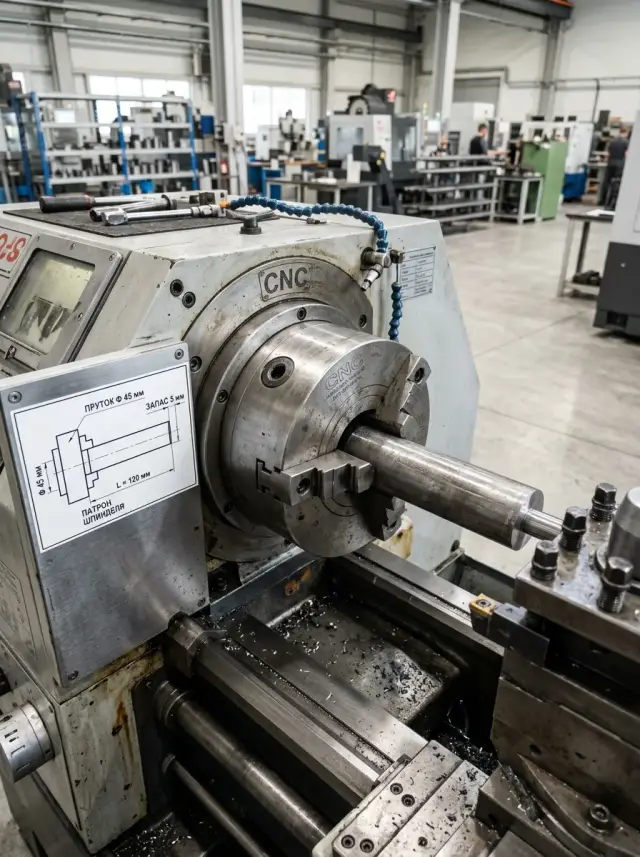
Why people often miss the spindle bore
The spindle bore is often chosen based on the most obvious number — the diameter of the bar from the current order. If today's job uses a 42 mm bar, it seems the machine 'for 42' will be enough. But you buy a machine for several years of work, not for one part. That's where mistakes begin.
The first mistake is simple: people look at the nominal material diameter and don’t build in a real margin. Bars have tolerances, parts have machining allowances, batches can be slightly oval, and material suppliers can change. As a result, a bar that 'almost fits' will cause pauses, friction and nervous feed adjustments in daily work.
The second mistake concerns length. When blanks are long, it’s not enough to know whether they fit through the bore. You must consider how the bar is fed, how it behaves at speed and how much length remains for normal machining.
The third mistake appears when calculating the remaining length for clamping. Often they count only the finished part length and forget the section that the chuck must hold, plus facing, cut-off and a small process margin. On paper everything adds up. On the shop floor there is no proper clamping.
Before buying a machine it helps to answer at least four questions:
- what is the largest bar you will need not today, but over the year;
- what real feed length is needed for a series;
- how much material goes to clamping, facing and cut-off;
- what if a new order is 2–5 mm larger.
Buying a machine that barely fits looks like savings only on the purchase day. Then a new order arrives, and the shop must change its process, switch to single blanks instead of bar feed, or subcontract part of the work. The spindle-bore mistake rarely looks big immediately. It becomes visible later — in lost orders, extra changeovers and the constant question why a machine that formally fits is uncomfortable to work on.
What determines the required size
You don’t choose the size based on one part but on the largest bar that will realistically be used. If orders include diameters of 38, 42 and 45 mm, you should base the choice on 45 mm, not on an average. Otherwise the machine will suit only part of the range and will hit its limit at the first larger run.
What to check first
Look at more than just the number on the drawing. Bars have tolerances and their actual diameter often runs high. The same nominal size from different suppliers can behave differently. That’s why the spindle bore is chosen with a margin for the real outer diameter, not for the ideal number from the document.
The logic is simple. First take the largest bar diameter from your range. Then add tolerances, possible batch variation, ovality and, if applicable, coating. After that check whether the bar will pass through the spindle entirely or whether blanks will be cut beforehand. Only then compare the result with the machine specifications.
Many make a mistake at this step. They see a 46 mm bore in the specification and decide that a 45 mm bar will pass without problems. Formally yes. But that margin is often too small for calm operation. The material should enter without friction, wobble or attempts to push it through by force.
Why length also matters
Blank length doesn’t always change the bore diameter, but it strongly affects the working scheme. If you feed a long bar through the spindle, the through diameter becomes a hard limit. If you pre-cut material into short blanks, you can manage with a smaller bore because the blank doesn’t pass through the whole spindle.
Also treat part length and overhang separately. A part can be short while its overhang from the chuck is large because of shape, shoulders or the machining zone. Then the question is not only whether the bar fits through the spindle, but whether the blank will be held stably without vibration.
A practical approach: identify the largest real bar, understand the feeding scheme, calculate clamping and only then look at passport dimensions. That way the choice is calmer and the margin for future orders is visible immediately.
How to calculate the size step by step
If you take the catalog size without a margin, the bar will go tight, start to scratch the surface or won’t pass the spindle at all. Therefore calculate for the real maximum you will meet in work, not the nominal value.
- List the largest bar diameter from current and recurring orders. Don’t take the average. You need the upper bound the machine must handle.
- Add material deviations. A batch can have spread, slight ovality, sometimes a coating.
- Include a working clearance. The bar should not enter the bore snugly. You need free play so the feed runs without wedging and extra friction.
- Check clamping. The chuck or collet must hold the blank securely. If the bar passes through the spindle but too little length remains for clamping, the calculation fails.
- Compare the result with machine sizes. If your calculation gives 54 mm, don’t look at 52 mm — choose the next size up.
A handy calculation formula: maximum bar diameter + batch tolerance + ovality + coating + working clearance. That gives the minimal bore size to start from when choosing a machine.
Simple example. You have a 52 mm bar. Batch spread gives up to 0.3 mm, ovality 0.2 mm, coating 0.1 mm. If you leave at least 1.5–2 mm clearance, the safe result is about 54.1–54.6 mm. So a 52 mm bore is immediately out, while a 56 mm model looks reasonable.
This approach doesn’t force you to overpay for an oversized machine. It just filters out machines that only fit on paper.
When blank length changes the decision
The same bar diameter does not mean the same working scheme will suit every machine. Blank length greatly affects material behavior. The longer the bar, the more likely runout, noise and vibration become, even if the diameter would otherwise have a margin.
You won’t see this problem in a catalog. It appears on the shop floor. A long bar turning behind the spindle behaves like a lever: a small deviation quickly becomes noticeable wobble. That increases load on the chuck, bearings and the tool. Part surface goes out of tolerance and the tool wears faster than planned.
If the part itself is long, looking only at the spindle bore is risky. Immediately check whether the machine can work with a tailstock or steady rest. For long shafts this is often more important than a few extra millimeters of bore. Without support the part bends during cutting and even a good chuck won’t prevent vibration.
There is also the reverse case. If the part is short, it’s sometimes easier to pre-cut blanks to size rather than feed a long bar through the spindle. Yes, it adds one operation. But setup runs smoother, the machine runs steadier, and the risk of scrap on first parts is lower. For small and medium series this option is often cheaper.
In series work count not only the part length but the leftover bar after each cut-off. If from a six-meter bar a regular leftover piece cannot be safely fed further, material is wasted on every run. Sometimes this calculation changes the machine choice.
Before ordering, quickly check four things:
- what bar length you will actually feed into the machine;
- what overhang will be beyond the chuck and spindle;
- whether tailstock or steady rest support is required;
- how many parts you get from one bar without excessive leftover.
How to leave a margin for future orders
If you only look at the current order, the spindle bore is almost always chosen snug. On paper this looks reasonable. Half a year later a new part arrives and the machine no longer takes the needed diameter without extra operations.
Better to review orders from at least the last 12 months and look not at the average size but at the whole spread. If today you turn a 42 mm bar, but several times a year you took 48 mm or 50 mm, basing the machine only on 42 mm is risky.
Also note rare items that still load the shop well. They may not arrive every month, but such orders often give good margin and fill downtime. If a small bore makes you refuse a few of these jobs, the savings on purchase quickly disappear.
A sensible margin is not built on a random maximum or on a vague 'just in case'. Usually you look at the next practical size that could appear in your range over the next 2–3 years. If main work uses bars up to 45 mm but the market regularly asks for 50 mm, choose a machine with that step in mind. If requests for 65 mm are almost nonexistent, the extra cost will likely not pay off.
An oversized spindle bore is also not always justified. If the margin doesn’t expand your product range, you simply pay more for a capability you don’t use.
Example calculation for a real case
A small shop turns bushings from a 45 mm bar. Work is steady, so it seems a machine with almost no clearance will cover the task. On paper it looks economical. On the shop floor such choice often costs more.
If the bar diameter is 45 mm, don’t pick a spindle bore with only 1 mm clearance. Bars are not perfectly uniform: there are tolerances, slight ovality and storage marks. When the bore nearly equals the diameter, feeding becomes nervous and sometimes simply doesn’t work properly.
Now add the second part. Every few months the shop receives an order for parts from a 52 mm bar. If you buy a machine that barely passes 45 mm, it will handle current work but cut off future orders. You’ll have to switch to short blanks, change the feeding scheme and lose time on manual loading.
For this situation it’s wiser to choose a model with a clearance margin. Then both 45 mm and 52 mm will pass through the spindle without changing the whole workflow. This is not unnecessary size — it’s a clear margin for real orders.
In numbers: suppose the shop makes an 80 mm bushing from a 45 mm bar. Facing and cut-off take another 4–6 mm. One part requires about 85 mm of feed. If reliable clamping needs 40 mm and a safe leftover at the bar end gives another 60–80 mm of unusable length, some material will regularly become waste. That’s acceptable if you calculated it before buying the machine, not after.
With a 52 mm bar the checks are even stricter. It’s not enough to see 52 in the catalog and relax. You must understand whether the real material will pass, what the overhang will be and whether automatic feeding will remain. If not, the shop loses not only new orders but its regular working rhythm.
Expensive mistakes
The most common mistake sounds innocent: they take the bar diameter from the drawing and assume it’s enough to choose the machine. In practice you can’t pick a spindle bore snugly. If the bar is 52 mm, a 52 mm bore is not enough. The material can have tolerances, ovality, marks from rolling or a coating. As a result the bar sticks, the feed jerks, and the operator spends time on every load.
Another mistake is to look only at the machine spec and not check what material actually arrives. One batch runs easy, another already hangs up. This is especially noticeable in series production, where a 10–15 minute downtime per shift quickly becomes lost hours.
People also forget the leftover in the chuck. If you don’t count the length the chuck needs to hold securely, your calculation is too optimistic. Formally the blank fits. In reality useful length is less and the bar end can’t be safely machined.
The problem also appears when the machine is bought for a single part. Today you need a 45 mm bar and it seems enough. In six months a neighboring size 50 or 52 mm appears and production hits the spindle limit. You either pre-cut blanks or move work to another machine. Both options hurt lead times and cost.
If you plan series work, discuss not only the diameter but the whole bar path: how it enters, how it’s supported and what remains at the end. It’s a boring calculation, but it saves money.
Quick check before ordering a machine
Before paying for a machine it’s useful to run a short checklist on one sheet. It often saves you from the situation where the equipment is already in the shop and the required bar doesn’t pass the spindle or only fits 'on the edge'.
First fix the maximum bar diameter from real orders, not the average. If you usually turn 38 mm but once a month take a 42 mm batch, note 42 mm. Then add a working margin so the bore doesn’t limit you at the first nonstandard request.
Next check material spread. Steel, stainless and nonferrous metals behave differently in feeding and clamping. If a bar arrives with diameter deviation or imperfect geometry, work 'on the edge' quickly turns into stoppages.
Look separately at blank length and feeding scheme. For short parts one approach, for a long bar with automatic feeding another. You need to understand not only the part length but how much is taken by chuck, collet, clamping zone and the leftover that can no longer be safely machined.
A pre-order check can look like this:
- the largest bar that actually goes into production;
- material deviations requiring a margin;
- the feeding scheme and useful blank length;
- length losses to clamping and cut-off;
- the nearest size that may appear in future orders.
If at least one item is unclear, the calculation is not ready. Many mistakes occur here: on paper everything seems fine, but on the shop floor the useful length is 40–60 mm less than expected.
If you compare several models, show the supplier your real diameters, lengths and feeding scenario. At EAST CNC when selecting a machine we usually look not only at bar diameter but also at part types, blank length, feeding method and margin for future orders. Have that conversation before purchase, not after the machine is running.
What to do next
Start not from the machine but from your product range. Pull orders for the last year and make a simple table: maximum bar diameter, working range, typical blank length, material, clamping length and cut-off losses. After such a summary it quickly becomes clear what the shop actually works on.
Then split parts into two groups. In the first keep those that come regularly and load production every month. In the second mark rare but profitable orders that you also don’t want to close the door on.
Next list where you already had losses. Write down cases when a bar didn’t fit the spindle, when blanks had to be pre-cut, when feeding time grew or extra changeovers appeared. This is the most direct way to understand what spindle bore you need in practice, not by feeling.
Final step is simple:
- collect the product range by bar diameter and blank length;
- calculate clamping, cut-off and leftover at the end of the bar;
- mark orders that hit the spindle limit;
- compare 3–4 models using the same template.
After that check, the decision usually becomes clear on paper. And that is the best moment to make a mistake: it costs nothing. After the machine is bought, every extra millimeter or every missing millimeter becomes much more expensive.