
SPC at the machine: when statistics help without extra measurements
SPC at the machine helps spot shifts in key dimensions earlier, reduce unnecessary checks and keep production moving. We explain when and how to use it.
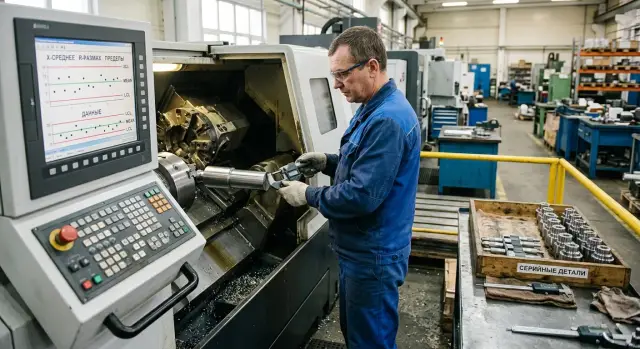
Why QC sees shifts too late
A dimension rarely goes straight to scrap on the machine. More often it drifts gradually: the insert wears, the chuck changes the grip slightly, the part and spindle heat up. The first parts can still meet tolerance, so everything looks fine at a glance.
That's also the weak spot of ordinary QC sampling. It detects a clear failure well but is worse at noticing movement inside the tolerance. If today the size was 20.01 mm, then 20.015, then 20.02, the parts are still formally good. The report looks fine, even though the process has already shifted.
On serial turning this is common. The operator sees steady output, while the inspector takes samples every 30 or 50 parts. For a slow drift that isn't enough. By the time QC comes to check, the machine may have produced several dozen more parts.
A simple example: a shaft should be 40.00 +/- 0.03 mm. The first check shows 39.98 mm, then the size moves to 40.00, then to 40.02. Formally within tolerance. But if nobody watches the trend, the next sample could be 40.04 mm by the time part of the lot is finished, packed or passed to the next operation.
QC is late not because the inspection is weak. Its job is different: to confirm batch quality, not to track every small in-process shift. For gradual drift that's insufficient, especially with short cycles and dense output.
Because of this the shop faces several problems at once: defects are found later than they could have been stopped, rechecks and sorting increase, and root-cause search starts after the batch is released.
SPC at the machine is meant for exactly these cases. It shows not only excursions beyond tolerance but the process trend itself. When the trend is visible early, the operator can adjust correction before QC has any reason to raise an alarm.
Which dimensions to include in SPC
You don't need SPC for every line on the drawing. It's far more useful to pick a few dimensions that tend to drift first. Then the operator notices shifts earlier and production isn't slowed by unnecessary measurements.
Typically, fit diameters and lengths to stops go on the card. They most often affect assembly. If a shaft must fit in a bearing and an end must seat against a datum without play, even a small drift quickly becomes a problem.
Next candidate is a dimension with a narrow tolerance. When the margin is small, tool wear, part heating or a correction error push the process to the limit faster. For a dimension in the hundreds of microns, statistical control is more useful than for a coarse outside diameter with a wide tolerance field.
Another clear guide is dimensions that noticeably creep during a run. In turning this is often internal diameters, bearing fits, lengths from a stop and machined faces. If the operator already knows that after 20–30 parts the size starts to drift, include it on the card.
A simple filter works: include a dimension in SPC if it affects assembly or fit, has a narrow tolerance, depends on tool wear, is quick and repeatable to measure, and allows immediate correction at the machine.
In practice, two dimensions are often enough. For a serial shaft you can monitor the bearing diameter and the length to the shoulder. A general outside diameter that stays stable and doesn't impact assembly is better left off the card.
Don't pull everything into SPC. A large card rarely helps. More often it overloads the operator and important signals get lost among dimensions that are already stable.
When frequent measurements only harm
Measuring every dimension on every part sounds safe. In practice it often slows production. The machine waits, the operator is distracted, and the measurement log grows faster than the actual benefit.
The problem is that dimensions behave differently. If the tolerance is wide and the process is stable for that dimension, ordinary control is enough. There's no point adding that dimension to SPC just for peace of mind.
Frequent checks are needed where the dimension actually drifts during a run. Usually this is clear by insert wear, heating, clamping or a recurring shift after several cycles. For such a dimension statistics help spot a shift earlier and correct it before scrap appears.
If points stay flat for a long time without a trend or spikes, reduce the frequency. First it makes sense to measure more often to understand the process. Then you can switch, for example, from every part to every fifth or tenth. That saves time and doesn't drown the operator in numbers.
A simple sign of excessive control: you record many values but almost never make decisions based on them. In that case control creates the appearance of order but doesn't help hold the dimension.
Dense control should be dropped if the dimension has a wide tolerance and rarely approaches limits, recent batches showed no creeping drift, the measurement takes a noticeable part of the cycle, and the operator spends more time writing than watching the machine and tooling.
This mode isn't permanent. After an insert change, retooling, starting a new batch, a long idle period, material swap or correction tweak, increase the frequency again. On the first parts after such events the process often behaves differently.
A normal approach is: measure more at first, then reduce frequency on a stable process, and tighten control again when there is a real reason. This usually works better than measuring everything forever.
How to choose the measurement interval
If the operator measures too rarely, a drift can become scrap. If too often, the machine waits and people waste time. Set the interval not by habit but by how the dimension behaves after setup.
Take the first five consecutive points on one dimension right after the part is brought into tolerance. You need a short uninterrupted series. It quickly shows whether the process is stable from the first parts or already starting to drift. If scatter is small and points are steady, the step can be larger. If the dimension drifts almost immediately, control must be denser.
Then choose one clear rule: by time or by piece count. For a long cycle it's convenient to measure every 30 minutes. For a short cycle a rule by number of pieces is simpler, for example every 20th part. Pick one. When two rules live simultaneously on the shop floor, everyone interprets them differently.
It's useful to tie the interval to tool wear. That's more sensible than sticking to an old habit. If an insert typically shifts the size noticeably after 40 parts, measuring every 5 parts makes little sense. But waiting until 50–60 parts is too late. It's much better to set measurement before the point where wear normally requires correction.
After the first insert change the rule should almost always be reviewed. Real material, a batch of inserts and cutting conditions often behave differently than expected. After one change you usually see whether the interval can be increased safely or should be shortened.
To keep everyone consistent, write the rule in plain words. After setup measure 5 parts in a row. If stable, switch to the chosen step. After an insert change take 5 consecutive points again. If two consecutive measurements drift in the same direction, apply correction.
This order is easier to follow than "measure as needed." Both day and night shifts will act the same.
How to start SPC at the machine step by step
Start with one dimension, not an entire control card. Take the dimension that most often leaves the center of the tolerance and directly affects part acceptance. For turning this is often the final outside diameter or a fit bore. If you start with five dimensions the operator will quickly tire of recording and lose interest in the idea.
Next check the measuring tool. If the card specifies a micrometer but the machine only has calipers, the control will add noise. The measuring instrument must give repeatable results in the hands of the ordinary operator, not only the QC inspector. Before starting, do a quick check: measure the same part twice and see if the result wanders.
Then agree on one place and one moment to measure. This removes disputes and random errors. For example, the operator measures every fifth part immediately after the finish pass, before putting parts in the bin, on the same surface location. If today you measure a hot part in the chuck and tomorrow a cooled part on the table, the chart will show noise instead of process.
After that set the target value and reaction limits. The target is usually the midpoint of tolerance unless the process requires otherwise. Reaction limits are not for scrap decisions but for early warning. A simple first rule: if two consecutive points move toward the upper or lower limit, the operator checks tool wear and prepares a correction.
Finally, agree in advance who does what. Who and when changes correction, by how many microns, and when the fitter should be called. Without this the chart quickly becomes paperwork for its own sake. It's far more useful when the operator can make a small correction by a clear rule and calls the fitter only if the signal repeats or the pattern becomes erratic.
This kind of start doesn't slow production. It gives a clear rhythm: one dimension, one measurement method, one interval and one reaction rule. When this order sticks, add the next dimension.
A simple example on a serial part
A turned part has a bearing fit diameter. You can't hold such a dimension "by eye": if it grows the bearing will be too tight, if it shrinks there will be play. SPC at the machine is especially useful here because the size changes slowly, not abruptly.
Suppose a shaft is machined in batches of 80 pieces. Required diameter 40.000–40.015 mm. The first parts are fine: 40.006, 40.007, 40.008. Then the insert wears, the machine heats up, and the size gradually creeps upward. By part 30 the operator sees 40.011, then 40.012 and 40.013.
Looking only at individual numbers there may be no alarm. Formally no scrap yet. But the chart already shows a trend: several measurements in a row move toward the upper limit. That's the moment SPC detects a process shift earlier than routine sampling.
QC might see the problem later, for example at the end of the tray when 50 or 80 parts are checked. Then part of the batch might need rework or sorting.
With SPC at the machine the operator doesn't need to measure every part. He checks the dimension at a clear interval, logs points on the chart and sees the upward drift. After the 30th part he makes a small wear correction, for example a few microns, and the next check brings the size back closer to the center of the tolerance.
The batch continues without full remeasurement. That's the point: in-process control shouldn't slow output but should allow timely intervention. For serial shafts, bushings and other fit features SPC works especially well where the dimension creeps gradually and the cost of late detection is high.
Where SPC won't help
SPC at the machine isn't useful everywhere. It works where the process repeats and the dimension drifts gradually. If you have short runs, frequent setups and varying fixturing, statistics often become extra work.
For small batches the chart is almost empty. If you make 3–5 parts you won't see a process trend. It's simpler to measure every piece and confirm it's within tolerance than to spend time building a chart that won't show anything.
A wide tolerance often makes SPC unnecessary. If the dimension stays comfortably within limits and rarely needs correction, frequent checks won't give an early signal because there's nothing to catch. The operator just records something that is already stable.
A bad case is when the datum or fixturing changes almost every part. Then you're not comparing one process but a set of different conditions. The chart will be noisy even if the machine is fine. Here the cause of scatter must be found in fixturing and setup, not in statistics.
There is also a practical problem: long measurement time. If machining takes 50 seconds but a measurement and record take 2–3 minutes, the cell quickly loses pace. The operator either skips measurements or holds the machine for the sake of a report. Both are pointless.
A good example is a one-off repair batch of four bushings with a simple OD and wide tolerance. It's reasonable to check the first part, one in the middle and the last. That's enough. A full SPC chart at the machine adds nothing.
Start SPC where there is repeatability, a real risk of drift and fast measurement. If any of these conditions is missing, standard control routing often works better.
Mistakes in at-machine control
Mostly SPC at the machine fails not because of formulas but because of small shop habits. The chart looks tidy and points exist, but no decisions are made. As a result, in-process control is performed in form only and process drift is still found late.
One common mistake is mixing data from different machines, fixtures or shifts on one chart. If a part runs on one machine in the morning and another in the evening, you don't have a single process but several. Such a chart hides the cause of drift. The same happens with measuring technique: one operator squeezes the micrometer harder than another and the chart shows extra scatter.
Second mistake is trying to cover too many dimensions. At the start people often choose five or six dimensions for "complete control." In practice the operator gets tired, records lag, and attention scatters. Much better to pick one or two dimensions that actually show tool wear or setup drift and record them without gaps.
A third error seems minor but ruins a series: changing the micrometer or bore gauge mid-run without verification. A new instrument can read slightly differently and the chart suddenly jumps, though the part hasn't changed. Before swapping tools do a quick check on a reference or measure the same part with both instruments in sequence.
Another bad habit is waiting for an out-of-tolerance result. If several parts drift slowly in one direction, the process has already moved. Yes, tolerance still holds. But in a few cycles you'll get scrap or an urgent adjustment at the worst moment. That's exactly what SPC at the machine is for: catching the drift before QC does.
A chart alone is not enough for the operator. For every signal there must be a clear action. If a point spikes, repeat the measurement on the same part first. If a trend continues for several cycles, check tool wear. If a tool or instrument was changed, mark it on the sheet. If the cause is unclear, call the fitter immediately, not at the end of the shift.
A good at-machine chart answers one question: what to do right now. If there's no answer, the chart quickly becomes archival paper.
Quick check before start
You don't need a big control plan before the first series. Start with one dimension that drifts most and affects part acceptance. Use one chart for it, not a whole set. If the operator records one part per measurement, a simple individuals chart is usually enough.
At this stage many make the same mistake: trying to run many dimensions and abandoning the scheme quickly. Start small and make one control a habit. When it runs smoothly you can add a second dimension.
Before start check the measuring tool. The micrometer or gauge should zero and read correctly on a verification size. If the measurement already wanders in the operator's hands, the chart will only confuse and give false signals.
Prepare the control sheet in advance. It should contain specific actions: how many parts between measurements, where to put the point and what counts as a signal. Keep this sheet by the machine so the operator doesn't have to recall the rules from memory.
Decide four things before the first part: which dimension goes into SPC first, who records points on shift, what to do if the operator is occupied with setup or tool change, and what interval to use in normal mode and what constitutes a signal that the operator adjusts correction instead of waiting for QC.
The last point is especially important. Without a written rule each shift worker acts differently. One delays until the last moment, another adjusts after every deviation. Both harm the process.
A working rule can be very simple: if several points in a row drift in one direction or the size reaches an internal working limit, the operator makes a small correction and notes it. If the cause is unclear, call the fitter. Then SPC at the machine won't slow production and will help catch drift before scrap and extra measurements.
What to do next on the shop floor
Don't try to rebuild the entire line control at once. Start with one part, one dimension and one shift. That way you'll quickly understand whether SPC at the machine helps your process rather than just looking good on paper.
Choose a dimension that truly drifts due to tool wear, heating or correction shift. If the size hardly moves, statistics will only add measurements and frustrate the operator.
The first trial plan should be short: which dimension you measure, how many parts between measurements, who makes corrections and at what signal the operator stops and checks the cause. That's enough to see the shift pattern over a shift.
Then compare the shop before and after the trial. Watch not only scrap but rework, number of measurements and downtime. If you doubled measurement frequency with no benefit, the control won't stick.
A good sign is simple: you catch drift before the size reaches the limit and you don't choke production with constant checks. For example, QC used to find a drift after a run of 40 parts. After at-machine control the operator notices a trend at part 12 or 15 and corrects without end-of-shift scrap.
Keep only control points that show process shift in advance. Remove everything else. Extra checks quickly turn a useful idea into a formality.
If you select a CNC turning machine or a line for a series, discuss the at-machine control scheme early, during equipment selection. EAST CNC can link selection, commissioning and later service so measurement method, part access and start-up are considered from the beginning.
One shift on one part usually delivers more value than a month of talk about "statistical control" without a real trial.
FAQ
What is SPC at the machine in simple terms?
It's monitoring a few dimensions right at the machine at a clear interval. The operator watches not only for parts going out of tolerance but also for which way the dimension is drifting within the tolerance, so they can correct it before producing scrap.
When is SPC at the machine really needed?
It makes sense for series machining when a dimension drifts slowly due to tool wear, heating or clamping. An at-machine chart sees the shift earlier than a sampling inspection by QC.
Which dimensions are best to take into SPC first?
Start with bore and shaft fits, lengths to stops and any dimensions with tight tolerances. Prefer dimensions that affect assembly, are quick to measure and allow immediate correction.
Do I need to measure every part?
No. Measuring every part rarely helps. If the tolerance is wide and the dimension stays stable, 100% inspection only slows production and fills the log with unnecessary values.
How to choose the measurement interval?
After setup, take several consecutive pieces and see how the dimension behaves. If points are stable, switch to a fixed step by pieces or time and review after a tool change or other event.
What to do if the dimension is moving toward a limit but still in tolerance?
Don't wait for an out-of-tolerance result. If several measurements in a row drift toward one limit, the operator should check tool wear, clamping and measurement conditions, then make a small correction per the shop rule.
When should you not start SPC?
Short runs, frequent setups and changing part locating are poor candidates. When you only make a few pieces or conditions change every time, it's simpler to measure each part or a few control pieces without an SPC chart.
What measuring tool is suitable for SPC?
Pick a tool that gives repeatable results at the machine. If you need hundredths, a micrometer is better than calipers; before start, measure the same part twice to check repeatability.
How many dimensions should you track at the start?
Usually one or two dimensions are enough at the start. If you add everything at once the operator spends too much time recording and may miss the dimension that really drifts.
How to know SPC is already bringing value on the shop floor?
Look at shop metrics: if shifts detect drift earlier than QC, rework and sorting drop, and production hasn't slowed from extra checks, the scheme works. The sign of success is catching a trend before it reaches the limit while keeping throughput normal.