
Spare Parts for the Lathe Shop Without Extra Cost
Which spare parts should a lathe shop keep in stock to avoid lost shifts from breakdowns and long delivery times.
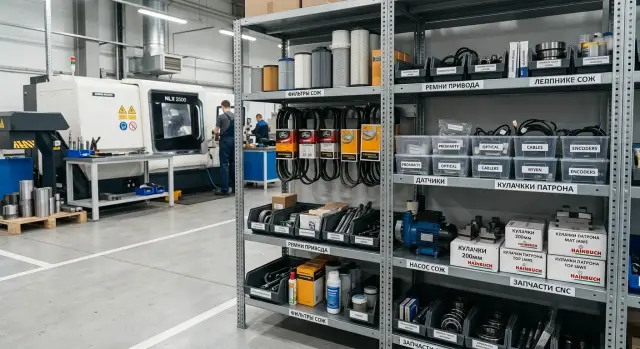
Why the shop stalls over small parts
Shifts are more often disrupted not by a major breakdown but by a small failure that prevents the machine from starting a cycle. A blown fuse, a leaking seal, a clogged filter, or a failed sensor — and a finished order shifts by hours.
The worst part is this: such a part is usually cheap compared to the losses. But it costs the shop operator, the setup technician, and the whole production rhythm. If the stoppage happens at the end of a shift or before the weekend, a cheap item quickly becomes an expensive problem.
On a turning shop, machines most often stop because components work in a dirty, heavily loaded environment. These are position and pressure sensors, fuses, relays, buttons, contactors, lubrication and coolant filters, belts, seals, hoses, fittings, coolant pumps and small lubrication system parts. These items are rarely discussed in advance because they don’t look serious. Yet they often keep a machine idle for half a shift.
This situation is familiar to many shops. In a cell with three CNC lathes, one can stop because of a coolant pressure sensor. The sensor itself is inexpensive, but without it the system won't allow a start. If there’s no spare, the shop waits for delivery, reshuffles orders and overloads neighboring machines. Losses are counted not by the part’s price but by hours of downtime.
So you shouldn't build a spare-parts stock for a turning shop by someone else’s template. One list doesn't fit all. A new cell running light cuts has one risk profile. A shop running two shifts on steel with heavily loaded machines needs a broader list. Machine brand, age, coolant quality and how quickly service can bring a rare item all affect the list.
A good spare-parts stock doesn’t start with a long catalog but with a simple question: which small failure has already stopped a shift at least once?
What to keep on the shelf always
It’s convenient to divide spare parts for a lathe shop into two groups. First: items replaced on a schedule. Second: items that can fail any day but are replaced in 10–30 minutes.
The first group almost always includes coolant, oil and air filters. They’re cheap, but a clogged filter quickly leads to dirty emulsion, overheating, pressure drop and an extra stop.
Also in that group are belts, hoses, seals and O-rings. These parts rarely look urgent until they fail. But when a hose bursts or a leak starts, the machine is stopped immediately and the shift loses hours.
Give special attention to simple electrical parts. Work-area lamps, buttons, fuses and contactors don’t seem important until a small component fails. If the operator can’t start a cycle or can’t clearly see the machining area, work halts for a frustratingly small reason.
It makes sense to keep spare lubricants, nozzles, brushes and fasteners for quick replacements. The rule is simple: if a technician can replace a part in 15 minutes, it should be on the shelf. For a small cell this is especially important because a single stopped machine can ruin the whole day’s plan.
Don’t forget clamping elements. Jaws, soft liners and other frequently changed tooling parts wear gradually but immediately affect referencing and repeatability. Without a spare set, the shop either waits for delivery or risks producing scrap.
For a start, the following minimum often suffices:
- one set of common filters per machine;
- a small stock of fuses, lamps and contactors of the needed sizes;
- the most common hoses, belts and seals;
- one spare set of jaws or soft liners;
- lubricants, nozzles and fasteners for at least a month.
This kit doesn’t require large investment. It removes the most annoying downtime: sudden, small, and costly in time.
Rare items that stop work for a long time
Long downtime is often caused not by the most expensive assembly but by a part no one stocked. A burned sensor, a stuck valve, or a failed cabinet fan — and a working machine can stand idle for days.
Therefore, divide parts not only by price but by lead time. If a machine won’t start without a part and the delivery takes weeks, that item is more dangerous than an expensive but readily available assembly.
Items that often stop work for a long time include:
- position sensors, limit switches and encoders;
- coolant pumps, lubrication pumps and solenoid valves;
- 24 V power supplies, cabinet fans and rare contactors of the needed ratings;
- boards, modules and cables without which the machine won’t pass startup.
You don’t need to keep all these per machine. But mark slow-delivery, critical-failure items as a reserve in advance. Especially when the same part fits multiple machines.
How to build your list step by step
Don’t start with the supplier catalog. Build the list from your machines and your failures. Otherwise the stock quickly becomes full of unneeded items while missing what’s needed today.
First, make a simple table for the whole cell. Include machine model, year, CNC system, spindle type, turret head, hydraulics and lubrication. Even on similar machines the same part can differ, and a mistake in one character can later cost a week.
Next, pull the failure log for at least 12 months. If a full log doesn’t exist, use repair requests, technician notes, service reports and correspondence with the mechanic. You don’t need perfection — you need an honest picture: what failed, how often, how many hours the cell stood and how long deliveries took.
Then follow a simple order:
- Mark parts that were changed more than once. These are the first candidates for permanent stock.
- List parts with long lead times separately. Even a rare failure is dangerous if the part takes 30–60 days to arrive.
- Note on which machines the same part is interchangeable. This reduces stock without extra risk.
- Add the downtime cost next to each part. A cheap small item that stops a machine is often more important than an expensive assembly.
- Divide the final list into three groups: permanent stock, reserve for long lead times and order-on-demand.
After this analysis the list becomes workable. You’ll see what to keep always, what can be one-per-cell and what to order only when needed.
How to set minimum stock without wasting money
Don’t set minimums by guesswork. Base them on how the shop really operates. Otherwise the warehouse fills with expensive items while the next outage still lacks one small part.
Start with a typical period, preferably the last 6–12 months. Check how many of each part were used per month: belts, filters, sensors, seals, lubrication items. Average monthly consumption gives a sensible baseline.
For most consumables use a simple rule: daily average consumption multiplied by lead time in days, plus a buffer for delays. Round to whole units or sets. That’s enough to avoid guessing and arguments.
Lead times are often underestimated. For a shop in Kazakhstan this is noticeable if parts come not from a local stock but by order. In winter, during carrier overload seasons or long customs chains, lead times easily stretch. In such moments calculations without buffer fail first.
Use a different approach for expensive parts. If a servo drive or control board is costly, don’t immediately keep one per machine. First calculate how much you lose per hour of downtime for that machine and multiply by the usual lead time. Sometimes a day of downtime costs more than the part. Sometimes it doesn’t, and then it’s wiser to order quickly than to hold expensive stock.
A uniform stock for all machines usually causes extra spending. A new machine with even loading and an old machine running two shifts wear consumables differently. If several machines use the same part, keep a shared stock for the group. If a part is unique to one rarely used machine, you can reduce its reserve.
Look not only at consumption but at failure consequences. If the machine stops immediately without a part, rank it higher. If you can finish the shift or temporarily move the work to a neighbor, the stock can be smaller.
After every major failure, review numbers: what broke, how long you waited, what you used as replacement and how many hours were lost. One such analysis quickly shows which items just lie idle and which actually mitigate risk.
A simple example for a small cell
Two CNC lathes stand in a cell. One turns bushings for construction equipment, the other makes a batch of shafts for an urgent order. The schedule is tight, and even one day’s delay shifts shipments.
In the morning the coolant pump on the first machine fails. There’s no spare; you can’t run the machine dry, so the order stops immediately. They try to move parts to the second machine, but by noon its limit switch is acting up. The machine sometimes starts a cycle, sometimes faults. In the end both jobs stop, though the failures were of inexpensive parts.
For such a shop the stock shouldn’t be big. A short monthly kit that covers common small failures is enough:
- 2–3 sensors of the same type if they are used on both machines;
- 1 coolant pump assembly or a repair kit for your model;
- a set of fuses and relays that are actually installed in the cabinet;
- 2 sets of filters for coolant and lubrication;
- 1 set of belts if the machines use the same type.
This kit often costs less than one lost shift. If two machines stand for 8 hours, the shop loses not only revenue: it pays wages, misses order deadlines, uses technician time and later rushes to catch up.
It also makes sense to keep a small reserve of rare but painful items: one 24 V power supply, a spare encoder or home sensor, a cable reel and common connectors, and a contactor or starter in the machine’s existing ratings. This reserve is not for routine use; it’s for cases when downtime starts immediately.
One more rule saves more nerves than any accounting method: when a part is taken from the shelf, reorder it the same day. If you wait until the end of the month, the shelf will be empty right before the next stoppage.
Common mistakes
The most common mistake is simple: stocking what’s cheaper, not what would stop the machine today. As a result the shelf holds inexpensive bits while the needed sensor, belt or board is missing.
People often confuse consumables for different models. Parts can look similar externally but differ in size, connector or fit. On a turning shop this shows up at the worst moment: the mechanic takes a part from the shelf, installs it and sees it doesn’t fit.
The problem is usually not the warehouse itself but poor labeling. If a box is just labeled “filter” or “sensor,” it’s not very useful. Each item needs a clear tag: part number, machine model, assembly, arrival date and storage location.
Another mistake is not tying parts to a specific machine. After the first replacement, records quickly scatter. In a couple of months no one knows which limit switch fits machine A and which fits machine B.
Holding one unit of everything rarely works. If a consumable arrives in three days, one may be enough. If a rare part takes a month, one unit covers only the first failure and leaves the shop exposed again.
The same goes for scheduled replacement. Many wait until total failure because the part still “works.” That approach is usually more expensive. It’s safer to replace belts, filters, seals and other consumables by operating hours rather than after an emergency stop.
Quick warehouse check
Even a good list is useless if no one checks it against reality. A quick check takes 15–20 minutes and often prevents extra downtime.
Start by checking per machine, not the whole shelf. It’s useful to have two lists: one per machine and one for the whole cell. Then you can see which parts are needed by everyone and which fit only one machine.
For each part record two things: quantity on hand and lead time. Quantity answers whether the part will last until the next delivery. Lead time shows the risk. One unit on the shelf with a six-week lead time is no small matter.
Inventory records should be alive. When the storekeeper logs arrival and issuance dates, it’s easier to see real consumption. In a few months you’ll know which consumables move regularly and which stay idle.
Check urgent items separately. The mechanic shouldn’t hunt through boxes and other people’s drawers. If fuses, belts, limit switches, filters or a pump are kept in one obvious place, repairs go much faster.
Run through a short checklist:
- Is there a list for each machine and for the whole cell?
- Is the quantity recorded for each item?
- Is the lead time noted?
- Are arrival and issue dates recorded?
- Does the mechanic know where the urgent stock is?
Once a month perform a simple reconciliation. One person takes the service log, another opens the inventory list and compares shelf quantities. If the log shows three filter changes but the inventory still lists a full set, the records are already wrong.
On a small cell this check is especially useful. They rarely keep large stocks and one missed small item can stop production quickly. Better to find the discrepancy on Friday afternoon than Monday before a batch run.
What to do next
If the spare-parts list lives only in the master’s head, the shop is already at extra risk. Start simple: pull repairs and stoppages for the last 6–12 months and list ten parts that have already disrupted production. Usually these aren’t the most expensive items but those that prevent quickly returning a machine to the shift.
Then bring the master, mechanic and purchasing together. The master knows what stops production. The mechanic knows what fails and how long parts last after replacement. Purchasing sees lead times and price ranges. Together they quickly remove unnecessary items and find what really needs to be on the shelf.
Next, split items into three groups: permanent stock, reserve for long lead times and order-on-demand. A separate reserve for long lead times is almost always necessary. If a part takes weeks to arrive and the whole machine stands without it, saving on that spare usually costs more than the stock itself.
If EAST CNC supplies or services your machines, it’s useful to cross-check your list with their service team. They handle supply, commissioning and service, so this check helps ensure compatibility and avoid storing unnecessary items.
Finally: set a review date in three months. By then you’ll see which choices were right, what was missing and what lay idle. One short quarterly review keeps the stock in order better than a single large purchase.
FAQ
Where should I start my spare-parts list for a lathe shop?
Start not with a supplier catalog but with your outages. Take repairs and stoppages from the last 6–12 months and list the parts that have stopped a machine at least once. Then split them into three groups: permanent stock, reserve for long lead times, and order-on-demand items. This quickly shows what really saves a shift and what just takes up shelf space.
Which parts most often stop a machine?
Most often the shop is stopped not by big assemblies but by small items: sensors, fuses, relays, contactors, filters, belts, hoses, seals and coolant pumps. These parts are inexpensive, but without them the machine often won't start a cycle. That's why they should be kept close and checked first.
What should be kept in permanent stock?
Keep the parts that the technician replaces quickly and that actually fail on your shop. Usually that's coolant and lubrication filters, fuses, lamps, contactors, hoses, belts, seals, nozzles, fasteners and replaceable tooling elements. A good rule: if a replacement takes 10–30 minutes, it's better to have the part in stock. Otherwise a small failure can eat half a shift.
Should I buy expensive assemblies in advance?
No. Don’t keep expensive assemblies as one-for-one spares for every machine. First, calculate how much you lose per hour of downtime and compare that with the usual lead time. If a day of downtime costs more than the part, a spare is justified. If not, it’s better to order quickly when needed.
How do I calculate minimum stock without overspending?
Take the average monthly consumption of the part, convert it to daily consumption and multiply by the lead time in days. Add a buffer for delays and round to whole units or sets. Also consider downtime risk: if the machine stops immediately without the part, keep a larger stock even if consumption is low.
What stock is needed for a small shop?
For two or three machines a month-long short kit is usually enough. Typically this includes several sensors of the same type, one coolant pump or a repair kit, fuses, relays, filters and belts. Such a set often costs less than a single lost shift. For a small shop it’s the most sensible start.
What if there is almost no log of failures?
Reconstruct what you can from existing records: repair requests, technician notes, service reports and messages with mechanics. Even incomplete data is better than relying on memory. At the same time, start simple logging from today: what failed, how many hours the machine stood, and how long the part took to arrive. In a few months you’ll have a working database.
How to avoid filling the warehouse with unnecessary items?
Don't keep identical stocks for all machines. Look at workload, machine age, cutting regimes and interchangeability. If the same part fits several machines, keep a shared stock. If a part is unique to one seldom-used machine, you can lower its reserve. Also avoid buying only one unit of everything: one piece may cover the first failure but leave you exposed if lead time is long.
How to mark and track parts so nothing gets mixed up?
Label every box clearly: part number, machine model, assembly location, and arrival date. Then the mechanic won't waste time guessing during a breakdown. Also record issuance immediately. When a part is taken from the shelf, reorder it the same day so the shelf doesn't run empty before the next failure.
How often should I check the stock and review the list?
Do a quick monthly check and inspect urgent items more often. Look not only at quantities but also at lead times: one unit on the shelf doesn’t help if a replacement takes six weeks. After a major failure, review the list immediately. If EAST CNC services your machines, it’s useful to verify part numbers and compatibility with their service team to avoid storing unnecessary items.