
Small 3-Minute Stops and Their Cost to Output
Short 3-minute stops often slip past reports, but they are what cut shift output during loading, measurements, and chip cleanup.
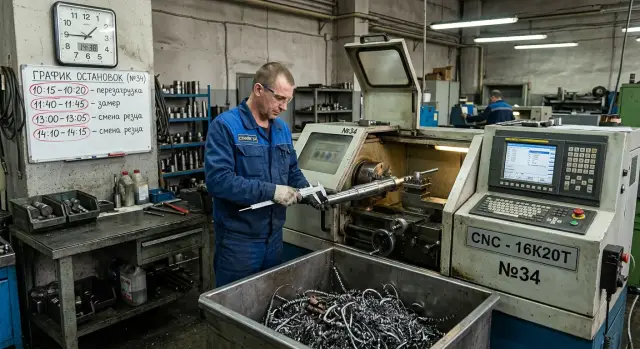
Why short stops are dangerous
A big breakdown is noticed right away on the shop floor. The machine stops, the supervisor calls the setter, and the start and end times are usually recorded. That kind of loss is easy to discuss and count.
Short pauses are harder to catch. The operator adjusts the blank, checks a dimension, clears chips, and starts the cycle again — and from the outside it looks like nothing major happened. But if these pauses repeat 10, 20, or 30 times in a shift, they take away not just minutes, but a noticeable share of output.
That is the problem. One 2-3 minute stop is almost never counted. Fifteen 2-minute stops already add up to half an hour. For a CNC lathe with a short cycle, that means several fewer parts in a shift.
What is worse is that the loss is not only about time. Frequent stops break the rhythm. Each time, the operator drops out of the sequence of actions, and the machine stops running smoothly. On paper, people were on site the whole day. In reality, the equipment stopped dozens of times for small reasons.
This is especially noticeable on a metalworking line where a part should come off every 4-5 minutes. Even a couple of extra pauses quickly eat into the plan. The problem is not one failure, but repetition that everyone gradually gets used to.
Where the shift loses minutes
Most often, time is lost not during breakdowns, but between cycles. That is where the pauses appear that are easy to mistake for normal work.
The first common reason is loading the blank. The part is lying too far away, the chuck has to be opened twice, the blank has to be adjusted by hand, and the jaws do not catch the size right away. Each delay seems minor. But if it repeats 20 times in a shift, the loss becomes noticeable.
The second reason is unnecessary measurements. Inspection is always important, but checking every part turns into a separate stop. Often the operator does this just in case, even though the process is already stable and a clear interval would be enough.
The third reason is chips. The machine is not in an alarm state, the tool is fine, but chip buildup gets in the way of cutting and visibility. The operator stops the cycle, removes the chips, cleans the work area, and only then continues. From the outside everything looks normal, but output slips away.
Another quiet source of loss is waiting. There is no empty container, the neighboring station has taken the needed tool, the operator has stepped away for another tool, or is helping on another machine. The wait itself is short, but the spindle is idle during that time.
If we reduce it to a simple list, the shift most often loses minutes in four places:
- during loading and positioning of the blank
- during measurement more often than the process requires
- during chip removal and quick cleaning of the area
- while waiting for a container, a tool, or a person
Even 24 lost minutes in a shift is already a problem. If one part takes 6 minutes, the line loses 4 parts without a single major breakdown.
Why small pauses cost more than a big breakdown
A major breakdown looks scary because everyone sees it. The machine stops, the cause is clear, the reaction is quick. That kind of downtime gets into the log and is almost always discussed separately.
Short stops pass quietly. The operator removed chips, adjusted the setup, made an extra measurement, and started the cycle again. Each pause on its own looks harmless. But together they can cause more loss than one obvious failure.
The comparison is simple. One machine was down for 40 minutes because of a failed unit. That is unpleasant, but it is one event. Now another case: there were 14 stops of 3 minutes during the shift. That is 42 minutes. Formally, there was no breakdown, but more time was lost.
There is another reason these losses cost more. A big breakdown is fixed as quickly as possible. People get used to small pauses. They start treating them as part of the process: waiting for the crane, clearing a long chip, rechecking the dimension, resetting the blank. As a result, the line loses parts every day, but there is no clear warning sign.
How to calculate losses for a shift
Start with a normal shift on one machine. Do not take a day with a breakdown, a long changeover, or an urgent order. You need a typical picture, otherwise the calculation will be distorted.
Record all short pauses caused by repeating reasons: loading, measurement, chip cleanup, waiting for tools, program adjustment. For the first calculation, there is no need to argue about seconds. It is enough to mark every moment when the machine stopped cutting metal.
Then count how many times each pause happened during the shift and take the average duration. The easiest way is to measure 5-10 identical pauses and calculate the average.
Losses by reason = number of pauses x average duration
Total shift losses = sum of losses by all reasons
Losses in parts = lost minutes / time per part
Losses in % = lost minutes / clean shift time x 100%
Example for one CNC lathe. Suppose one part takes 8 minutes of pure machine time. During a 480-minute shift, the operator paused 6 times for loading at 2.5 minutes each, measured 5 times at 3 minutes each, and stopped 4 times because of chips at 4 minutes each.
Let's calculate step by step. Loading caused 15 minutes of loss, measurements another 15, chips 16. In total, that is 46 minutes. If one part takes 8 minutes, the line loses almost 6 parts in a shift. In percentage terms, that is 9.6% of the time.
This kind of calculation is a quick reality check. A major breakdown is obvious immediately, while dozens of short pauses pass quietly. But the losses are already comparable to almost a full hour of downtime.
To see repetition rather than coincidence, track at least 5 shifts in a row using the same template.
How to analyze stops in practice
If you look at the whole line all at once, it is easy to get lost in the details. It is better to take one machine and one operation where pauses happen most often: loading, measuring, or clearing the cutting area.
Then you need a real record. Memory is almost always unreliable here. People remember a long breakdown, but they forget small stops within an hour. A simple log in paper form, a spreadsheet, or a note with the supervisor will do.
The working method is this:
- take one machine for 1-2 shifts
- record each pause immediately: start time, duration, and reason
- do not split reasons too finely; at the start, 3-4 groups are enough
- at the end of the shift, look not at the longest downtime, but at the most frequent one
- first remove one repeating cause and compare the result
It is important to record not just the stop itself, but also the trigger. For example, measurements can take time for different reasons: unstable dimensions on the first parts, awkward access to the gauge, or a long search for the tool. In the log, that is one group, but the corrective actions will be different.
After any change, make sure to check the result. If the container was moved closer to the machine, loading pauses should shrink in the next similar shift. If output does not improve, then that was not the main cause.
One shift example
Imagine a normal shift on a turning line. The machine makes one part every 4 minutes, the program is tuned, and the tool is in good condition. There are no serious breakdowns, and from the outside everything looks calm.
But output drops because of short pauses. The operator stops the cycle 12 times for measurements. Each check takes about 3 minutes. That is already 36 minutes.
At the same time, chips in the cutting zone are causing trouble. The operator cleans the work area 8 more times. Even if each cleaning takes the same 3 minutes, that is another 24 minutes.
In total, that gives 60 minutes. Almost one full hour of pure time when the machine could have been working, but was not.
Now let us convert that into parts. If the cycle takes 4 minutes, the line misses up to 15 parts in the lost hour. Even if some pauses were shorter and the actual loss is closer to 40-50 minutes, that is still 10-12 parts in one shift.
That is how short stops work. They do not feel alarming because each one seems like a small thing on its own. But together, they change the output plan more than one loud failure that everyone remembers.
What mistakes make it harder to find the cause
The first mistake is looking for one big breakdown. The supervisor sees a missed plan and tries to find a major failure: a unit breakdown, a long changeover, or a tool-related stop. In reality, the losses often sit in dozens of short pauses.
The second mistake is putting different reasons into one common category. If everything is recorded as "operator downtime" or "auxiliary time," the picture loses meaning. Loading, measurements, and chips may look similar on paper, but in reality they are different processes and different causes.
The third mistake is trusting memory instead of time-based records. By the end of the shift, people remember an unpleasant episode better than seven short 2-3 minute stops. That is why conversations after the shift rarely give an accurate picture.
The fourth mistake is drawing conclusions from one bad shift. One day may be off because of the batch, a new employee, a different material, or worn tools. First check whether it repeats across several shifts.
A proper check is simple: split the stops by type, count how often they repeat, and then total the minutes. After that, it becomes clear what is random and what is a constant leak in output.
A short checklist for the supervisor
A supervisor does not need a long report. A few questions at the end of the shift are enough.
- How many times did the machine wait for a blank?
- How many unnecessary measurements happened between cycles?
- How often did chips interfere with work?
- Which reason repeated most often?
- What can be removed before the end of the next shift without a big project?
There is a simple working threshold: if the same reason repeated three times in a shift, it is already worth fixing, not just discussing.
After a week of these short notes, the picture becomes much clearer than from a summary of breakdowns alone. A big failure is noisy. A small loss is quieter, but it is the one that cuts output every day.
What to do after the analysis
After the analysis, do not try to fix everything at once. Start with the place where the shift most often misses the plan. If a similar pattern exists on several machines, choose the one with the shorter cycle and more parts. The effect will be visible faster there.
Next, you need simple tracking for at least a week. Not a complex program and not a thick report, but a short record that the supervisor and operator will actually keep every day: pause time, machine or operation, reason, duration, and what was done right away.
After a week, do not look at the total amount of records, but at the repeats. If the machine most often stops because of chips, there is no point in changing everything at once. It is much smarter to test one action on one frequent cause and see whether the pauses got shorter.
The examples are very practical. If the operator loses minutes on measurements, the gauge can be moved closer to the workstation and the inspection moment can be clearly defined. If problems happen during loading, a stop, a blank layout template, or more convenient containers often help. If chips are the issue, check the cutting режим, coolant flow, and the cleaning routine between cycles.
Sometimes the issue is not discipline, but the process setup itself, the tooling, or the condition of the equipment. In such cases, it helps to involve the people who handle selection, commissioning, and machine service. For example, EAST CNC works with CNC machines for metalworking and supports equipment startup and maintenance, and on the east-cnc.kz blog they publish practical materials on the topic.
The point of all this work is simple: вернуть the lost minutes to output. If, after the analysis, the line consistently makes at least 2-3 more parts per shift, then the cause was found for a reason.