
Slot Milling in Steel: One End Mill or Two Passes
Slot milling in steel is not always best done with one end mill. Learn when a roughing pass and a finishing pass give better size control and a more stable process.
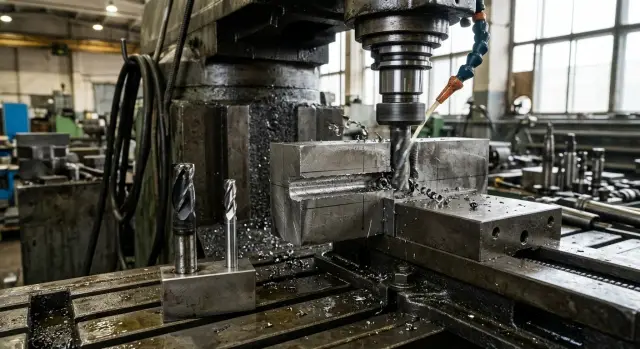
Why a slot drifts out of size
When milling slots in steel, the tool almost never travels as straight as it does on the drawing. When an end mill cuts a slot at full width, the load rises on both sides at once. Because of that, it shifts slightly to one side, even if the machine is set up accurately.
You don’t always see it from the outside. The slot may look clean, but the size has already moved by a few hundredths or more. The longer the tool stickout, the harder the steel, and the deeper the cut, the more noticeable the deviation becomes.
The part itself is another problem. Thin walls and narrow sections flex a little under load. While the cutter is pushing on the metal, the wall moves away. When the load disappears, the metal springs back partway. In the end, everything looked fine on the machine, but after measuring, the slot turned out narrower, wider, or uneven along its length.
Chip evacuation also causes more trouble than it seems. If chips do not leave the cutting zone, the cutter starts not only cutting but also rubbing the metal again. Then the slot bottom gets scratches, the side walls lose finish, and the size starts to vary. In steel this happens often, especially in deep slots and when coolant flow is weak.
The difference between entry and exit is another common case. At the start, the tool is just entering the cut, so the load has not yet reached its full level. In the middle of the slot, it is higher, the cutter bends more, and near the exit the picture changes again. That is why the same slot often has a different width along its length: one size at the beginning, another at the end.
A simple shop-floor example: you need a 14 mm slot in a steel part. A 14 mm end mill is used, and the operator goes straight to size. On a short section, the result may be acceptable. But if the slot is long and deep, the cutter starts to drift, the walls flex a little, and chips ruin the surface. The drawing says 14 mm, but in reality the size comes out with a surprise.
That is why the problem rarely comes down to just one cause. Usually several things shift the size at once: side force on the cutter, elastic deformation of the part, poor chip evacuation, and changing load along the cut. If this is ignored, the slot behaves on its own instead of following the program.
What happens when you cut the slot to size in one pass
When the cutter goes straight into the slot and immediately aims for final width, it does not cut with extra allowance—it cuts right to the finished size. On paper that looks simple: one tool, one path, fewer operations. In steel, that approach often creates extra problems.
The end mill works across the full slot width right away. The side edges take the load at the same time, and in a deep or long slot the load grows even more. Chips have a harder time escaping, the cutting zone heats up faster, and the tool begins to bend slightly more. Sometimes you cannot hear much from the sound, but the part already shows the effect.
The most unpleasant part is that even a small drift immediately becomes a width error. If the cutter shifts by a few hundredths, one wall can end up slightly eaten away, while the other keeps a small ridge or waviness. For slot milling in steel, this is common, especially when the slot is narrow and the tool stickout is large.
The problem gets worse when the slot is long. At the start of the pass, the cutter is still holding steady, but farther along the load changes because of heat, chips, and contact along the side wall. As a result, the slot width can vary along its length: one size at the entry, another in the middle, a third at the exit. On the drawing, that is already scrap, even if the average value seems to fall within tolerance.
After such a pass, correcting the walls becomes harder. There is almost no allowance left, and a repeated pass no longer cuts steadily—it mostly rubs in places. That hurts surface finish and does not always fix the geometry. Instead of a straight wall, you may end up with shine, streaks, and vibration marks.
A single pass to size usually shows these signs:
- the slot width shifts by a few hundredths;
- the walls come out with different surface quality;
- vibration risk grows in deeper areas;
- the exit size changes more than the entry size.
Imagine a simple case: you need to make a long slot in a steel part, and the end mill is almost the same width as the slot. The operator starts a single pass, and the first few centimeters look fine. But by the middle of the slot, the tool is already working harder, drifting slightly to one side, and the finished size is less stable than expected.
That is why the “one cutter straight to size” approach does not always work. It only saves time when the slot is short, shallow, and the requirements for walls and size are not very strict.
When two tools give a better result
Two tools give a better result when the slot needs to be even in width and clean on the walls, and the metal is hard to cut. A single end mill going straight to size often takes on too much: it removes a large volume, heats up, bends more, and leaves marks on the walls. This is especially noticeable in steel that smears and likes to stick to the cutting edge.
In this setup, the roughing tool has a simple job: remove most of the material quickly. It does not need to leave a perfect surface. That means you can run it more confidently and keep the pass more stable. After that, the finishing tool removes only a small layer and does not fight extra load.
When the allowance is small, the cutter runs more smoothly. It deflects less to the side, and the slot width stays closer to the calculated value. The walls also come out straighter because the finishing tool does not tear the metal—it just cleans up the prepared surface.
This approach usually wins in several cases:
- the slot is long, and the cutter gradually starts to deviate;
- the steel is tough, with built-up edge and heat;
- the slot is deep, and chips are hard to clear;
- you need a precise size without long trial adjustments;
- wall quality matters as much as slot width.
A good example is a long slot in a housing part. If you go straight to size with one cutter, the beginning may come out fine, and then the size starts to wander. With a roughing pass, that is less of a problem. A finishing cutter then removes the remaining layer and corrects the geometry along the full length.
On CNC machines, this setup is often chosen not for the beauty of the process, but for predictability. The part comes out more consistent on the first try, and the operator spends less time on trial corrections. For long slots and tough steel, this is usually the calmer and more accurate route.
When one end mill is enough
One end mill is often enough. This option works well when the slot is short, shallow, and does not require a very tight width tolerance. In that case, the tool deflects less, the walls do not move around as much, and the pass is easier to control.
The difference is especially noticeable on small batches. If there are only a few parts and there are no strict requirements for the side walls, separate roughing and calibration often only add time. The setup operator spends more minutes selecting the cutting conditions, changing tools, and checking the result than the process saves.
A single pass to size is usually justified when several conditions line up at once:
- the workpiece is clamped firmly, without vibration or shifting;
- the tool stickout is short, and the cutter is not too thin for the slot;
- the steel cuts smoothly and does not build up much on the edge;
- the width tolerance allows a small spread without scrap.
Under these conditions, slot milling in steel is predictable. The cutter cuts without heavy side load, heats up less, and holds size better. If the depth is also small, chips leave more easily and the risk of recutting drops significantly.
There is also a practical side to it. If the slot serves as a fit for a cover, a clamping strip, or another element that is not a precise sliding pair, extra precision is not always needed. The part just needs to assemble without force and without play beyond tolerance, and a mirror-like slot wall does not change much here.
A good example is a short slot for a fastener on an ordinary steel part. The width is not critical to hundredths, the depth is moderate, and the workpiece is clamped securely. In that kind of job, one end mill to size often gives a good result on the first trial pass.
Still, do not skip the check. Take the test part, measure the width at the start and end of the slot, and look at the walls and bottom. If the size holds, there is no built-up edge, and the cutting sound is steady, there is no need to complicate the process.
How to leave allowance for calibration
The allowance for calibration should not be set “by eye,” but based on how the tool behaves in that specific slot. If you leave it only on one side or remove too much in roughing, the finishing cutter will start acting like a roughing tool. Then the size drifts and the walls get extra marks.
For slot milling in steel, it is better to plan equal allowance on both walls from the start. That way the finishing pass cuts smoothly and does not pull the slot to one side. If one wall is already almost at size and there is still a lot of metal on the other, the cutter is loaded unevenly. You can often hear that in the sound and see it in the wall marks.
Too little allowance is also bad. The finishing cutter may rub instead of cutting. Too much allowance is also a mistake: cutting force rises on the finishing pass, the tool deflects, and the size starts to wander. Usually you begin with a moderate allowance and check the first part instead of trying to guess the “perfect” number right away.
Several things affect the allowance the most:
- slot depth
- tool stickout
- cutter diameter
- workholding rigidity
- vibration marks after roughing
A deep slot and a long tool stickout almost always require a more careful approach to the finishing pass. The longer the tool, the easier it is for it to move away from the line. In that case, it is better not to leave extra material for calibration. Let the finishing cutter remove less, but do it consistently.
After roughing, look at the slot walls. If you see ripples, waves, or isolated vibration marks, do not rush to use the same allowance for the whole batch. First find the cause: feed, speed, stickout, clamping, or the path itself. Otherwise the finishing tool will simply repeat part of the problem.
The first part almost always gives you more useful information than any calculation on paper. Measure the slot width in several places, check the bottom and the walls, then adjust the allowance. Often a small correction is enough for the next part to run smoothly and without extra load on the cutter.
How to structure the machining step by step
If you need a straight slot without width surprises, do not start with the cutter exactly at final size. In slot milling in steel, that pass often causes drift: the cutter pulls to one side, chips heat the metal, and weak clamping quickly ruins the result. It is much calmer to split the job into roughing and finishing.
First, clamp the part firmly and without skew. If the workpiece sits on chips or the clamp pulls it sideways, you will not get an accurate slot. Before starting, check the supports, clamps, and base. It is a boring step, but it saves parts more often than you might think.
Then follow this sequence:
- For roughing, use a cutter smaller than the slot width. If the slot needs to be 16 mm, it often makes sense to start with a 12 or 14 mm cutter.
- Remove the main volume of metal in one or several passes. Do not try to take everything too aggressively. If the machine starts to sound rough or vibrate, reduce the load.
- After roughing, clear the chips and check the slot bottom. If there is a burr, a step, or packed chips left there, the finishing cutter will simply copy the defect.
- Then make the finishing pass with a small allowance. A light wall cut usually gives a straighter size than trying to remove the last bit in one heavy pass.
- At the end, measure the slot at the entry, in the middle, and at the exit. That way you can immediately see whether the tool holds size along the full length.
If the slot is long, do not rush the finishing pass. A slightly lower feed often gives a straighter wall and a cleaner surface. The same applies to the bottom: after the pass, it is useful to check not only the width but also the depth in several points.
In practice, this order is often faster than it sounds. Yes, you change tools and spend an extra minute. But you are less likely to end up with a slot that looks good only at the entry and has drifted by the middle or exit.
A simple shop-floor example
A part needs a long slot for a guide. The material is steel, the slot is long, and the width tolerance is fairly tight. On paper, the task looks simple: take an end mill of the required diameter and cut the slot straight to size.
In real work, that approach often creates scatter. At the start of the pass, the cutter cuts smoothly, then the load rises, the tool shifts slightly, and the slot width changes along the length. At one end, the operator sees almost nominal size; at the other, there are extra hundredths, and sometimes visible marks on the wall.
That happens even on a decent machine. When slot milling in steel, a long contact between the tool and the metal rarely forgives haste. If the slot is deep or chips are not clearing well, one cutter to size starts working at the limit.
A calmer setup looks different. First, roughing removes most of the metal and leaves a small allowance on the walls. Marks from the load, small vibration, and any drift stay in that allowance, not on the finished size.
Then the finishing pass comes in. A separate cutter or the same tool in a light pass straightens the walls, removes the roughing marks, and holds the width much more consistently. It is easier for the operator to hit tolerance because the finishing cutter is no longer fighting a full metal removal.
On the shop floor, it looks very down to earth. If you make the slot with one cutter, the part sometimes passes inspection and sometimes does not. If you split the work into roughing and calibration, the size becomes more stable from part to part. Surface finish on the walls is usually better too.
The time difference is not as large as it seems. Yes, the cycle gets longer, but not by a factor of two. In return, the shop spends less time on measurements, adjustments during the batch, and rework. On a production run, that is often more profitable than saving a few seconds on one pass and then chasing size on every second part.
That is why the two-step approach works well where the slot is long, the steel is tough, and the guide does not forgive play. One extra pass costs less than a batch of parts with a drifting width.
Where people most often make mistakes
Most of the time, slot size is ruined not by cutting conditions, but by small decisions before the job starts. One mistake on a single part can add 0.02 mm, and in a batch it turns into scrap and lost time for fitting.
The first common problem is too much tool stickout. The tool starts to spring, especially in steel and with a deep slot. At the entry, the size still holds, but farther along the slot drifts, the wall gets a wave, and the cutting sound changes within the first millimeters.
The second mistake is related to allowance. After roughing, people sometimes leave too much material for calibration, hoping the finishing pass will fix everything. In reality, the finishing tool then becomes loaded almost like a roughing tool, starts to deflect, and no longer gives the expected size. For calibration, it is better to leave a small and stable layer, not try to remove a noticeable remainder in one go.
Another bad habit is trying to finish size with a worn cutter. When the cutting edge is already dull, the tool no longer cuts cleanly—it rubs the metal and heats the part. The operator sees that the slot is a little narrow or rough and adjusts feed or offset, but often the problem is the cutter itself.
Before the finishing pass, many people forget to clear the chips. That seems minor, but chips often scratch the walls and bottom, and sometimes they even push the tool sideways. In a narrow slot, just a few remaining chips can change the result more than a small change in cutting conditions.
Another mistake is measuring only at the entry. The slot should be checked in at least several points along its length, and if it is deep, the depth difference should be checked too. Otherwise the entry may look good while the middle or exit is already narrowing.
In practice, it helps to check five things:
- tool stickout without unnecessary extra length
- a small allowance for calibration
- the condition of the finishing tool
- a clean slot before the final pass
- measurement not in one spot, but along the full length
If the slot stubbornly refuses to hold size, do not blame the machine right away. Much more often the reason is simple: a long cutter, too much allowance, a worn edge, or rushing the measurement.
Quick checks before starting
If the part shifts or bends even a little, the slot will go out of size on the very first pass. That is why before starting, you check not only the program, but also the setup: how the part sits, where the clamp holds it, and whether there is a firm support under the machining zone.
For slot milling in steel, this is especially important. Steel forgives less than it seems: the cutter pushes on the wall, the part responds by bending, and then the size wanders along the slot length. If there is a gap under the part or the support is weak, neither careful roughing nor end-mill calibration will give a straight result.
Before starting, it helps to go through five short checks:
- Make sure the clamp holds the part firmly without crushing the thin wall near the slot.
- Confirm that there is support under the cutting zone, not empty space.
- Keep the tool stickout as short as possible for the slot depth.
- Plan how chips will leave the slot: air, coolant, a cleaning pause, or a calmer depth step.
- Decide in advance where you will measure after the first part: at the start, in the middle, or closer to the exit.
Chips are often mishandled even by experienced operators. If they pack into the slot, the cutter starts cutting them again, heats up, and deflects. As a result, one wall darkens, the other gets a scratch, and the slot width drifts. With the “roughing plus calibration” setup, this shows up immediately: the roughing pass leaves an uneven mark, and the finishing pass does not fix the cause.
It is better to choose measurement points before starting, not after the first warning sign. For example, if the slot is long, measure it in at least two places. That way you quickly see what is actually moving the size: overall tool correction, deflection at entry, or a clamping issue.
Another simple step is to decide in advance how you will adjust the setup after the first part. What do you change first: radial compensation, finishing feed, or the calibration allowance? When that decision is made ahead of time, the operator does not act by guesswork. The pause usually takes only a few minutes, but it saves both stock and the cutter later.
What to do next
Before the next part run, open the drawing and check not only the slot width, but also its length and depth. That combination often determines whether one end mill to size is enough or whether the work should be split into roughing and calibration.
It is useful to go through a simple check:
- What width tolerance is required for the slot
- How long and deep the slot is
- How many parts are in the batch
- How much one error costs in part value, time, and tooling
If you look only at cycle time, one cutter usually seems more profitable. But in practice, a difference of 15–30 seconds quickly loses meaning if the slot starts drifting in size and the operator has to chase the result with adjustments. One scrap part on an expensive blank can easily wipe out the savings from an entire shift.
That is why the method should be chosen for the batch, not by habit. For a one-off part or a small run with a moderate tolerance, one tool often gets the job done without extra moves. For a repeated batch, a long slot, or a tight tolerance, a setup with allowance and separate calibration is usually calmer. It may be slower on paper, but in the shop it is usually more consistent.
A good rule is this: if you already suspect that one cutter will not hold size along the full length, that doubt is worth accounting for in the process. In such cases, it is better to plan a finishing pass than to try to save the size later by changing feed or tools in the middle of the batch.
For slot milling in steel, it is important to count not only minutes, but also how stable the result is from the first part to the last. Especially when the parts are made in a series and the slot affects fit, assembly, or later machining.
If you deal with these operations often, it makes sense to discuss the task with EAST CNC. The company offers equipment selection, delivery, commissioning, and service for metalworking machines. Based on the part drawing, material, and batch size, it is easier to understand where the current setup is enough and where you already need a stiffer machine or a different class of equipment.