
Size Is in Tolerance, but the Assembly Won’t Fit: Finding the Cause
Size is in tolerance, but the assembly won’t fit? Let’s look at how taper, barreling, and the wrong measurement base can get in the way of assembly.
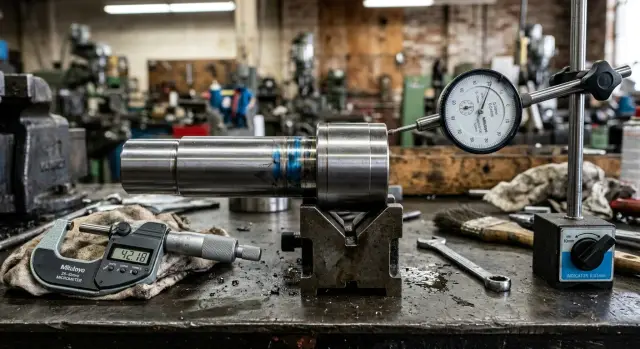
Why size does not guarantee assembly
On a drawing, people usually look at the diameter or width. But during assembly, it is not one number that matters, it is the whole surface of the part along its length and along the contact with the mating part.
The situation "size is in tolerance, but the assembly won’t fit" usually appears when an inspector sees a normal size at one point, while the part’s shape has drifted somewhere else. The micrometer showed an acceptable value, but the shaft may slightly taper toward one end, swell in the middle, or have a local area with extra material.
Because of that, the part often enters the pair only partway. The first millimeters go in easily, then it stops, drags, or the force rises sharply. This usually points not to a "wrong diameter overall," but to a change in geometry along the length.
In practice it looks simple. A shaft is measured at the end, the size looks good, and it goes to assembly. It enters the bushing by one-third of the length and stops. If you measure the shaft again in the middle and closer to the other end, the picture may be completely different.
Assembly force can also be read the wrong way. A fitter feels the part going in hard and concludes: the size is too large. But tight movement can be caused by taper, barreling, out-of-roundness, a tilt during setup on the gauge, or even the wrong measurement base. The force itself does not yet tell you which parameter is out of spec.
One good measurement proves almost nothing if the surface is long or the fit is tight. You need a series of measurements:
- in several cross-sections along the length
- in different rotational positions
- with a clear and consistent base
This is especially important for parts after turning, grinding, and re-clamping. After re-clamping, the size may still be in tolerance, but the shape may no longer be.
So assembly should not be judged by one number in a report. If the part does not complete the full travel, look not only at the size, but also at how that size behaves across the entire working surface.
What to check before arguing about reject status
If the size is in tolerance but the assembly won’t fit, do not rush to call the part scrap. First, you need to understand where the binding starts. It is one thing if the shaft will not enter at all. It is another if it passes part of the fit and stops inside.
Start by looking not at the number in the report, but at how the pair behaves. Is the insertion force the same, exactly where does assembly stop, and does the result change if the part is rotated? These simple observations often tell you more than one measurement at the end face.
- Find the first contact point. Mark the depth at which the assembly starts to become tight.
- Inspect the marks on the shaft or in the hole. A shiny band, a local scratch, or a contact spot immediately narrows the list of possible causes.
- Take 2–3 more parts from the same batch and repeat the assembly under the same conditions.
- Turn the part by 90 or 180 degrees and check the fit again.
- Measure in several cross-sections and in two directions, not just at one point.
Rotation is especially telling. If the force changes after rotation, the problem is often not the nominal size, but the part’s shape or the base you used for measurement. If the force stays the same in any position, the picture is different.
Contact marks also say a lot. If the band appears only on one side of the shaft, check geometry and alignment. If contact runs almost around the full circumference but the part binds at one depth, look at how the size changes along the length.
A small shop-floor example: a shaft enters a hole by 8 mm and then stops. The end face size is fine, and the argument starts right away. But after rotating the shaft, it goes another 3 mm, and a narrow contact band appears on the surface. In that situation, it is too early to argue about scrap. First you need measurements at several points and a simple map of where the binding begins.
A good habit is to write down the part number, assembly position, and all measurements right away. Then the fitter, setter, and quality inspector discuss facts instead of impressions.
When taper is the culprit
Taper gives a very recognizable picture: the diameter changes gradually from one end to the other. On paper, the size may still be within tolerance, but that does not help much in real assembly. One end goes in freely, and then the part starts to bind.
Most often it looks like this: the part goes in easily at first, then suddenly stops at one point in the travel. If you flip the shaft or bushing over, the behavior changes. On one side the fit seems normal, while on the other the assembly is tighter from the first millimeters. This effect is rarely caused by a simple overall diameter error. It is often caused by taper.
There are several signs that quickly point in that direction:
- the fit changes along the length, not just at one point
- after the part is turned over, the assembly force is noticeably different
- the contact mark stays closer to one edge
- when measured in different cross-sections, the diameter gradually moves up or down
Checking one point is pointless. You need at least three sections: start, middle, and end. If it is a shaft, measure each section in the same plane, then repeat the measurement in another plane. If you are checking a hole, do the same with an inside gauge. When the difference between the ends is stable and the middle sits between them, the cause is almost certainly taper.
It is also useful to separate the check into two parts. In the shop, people often measure only the shaft because it is easier to reach and faster to check. But the mating hole can also have taper. Then both sizes look acceptable on their own, but together they create assembly problems.
A small example. A shaft must enter a hole to a depth of 40 mm. The first 10–15 mm go in by hand, then it takes force and stops. After turning it over, it instead binds almost immediately. That is typical taper behavior, not a random scratch or dirt.
If you get the situation where the "size is in tolerance, but the assembly won’t fit," taper is one of the first things to check. A normal measurement in the middle of the part often creates a false sense of security and only delays the search for the real cause.
When barreling is the culprit
Barreling often produces a defect that looks simple, but is unpleasant in practice: the middle of the part becomes thicker than the ends. On paper, the size may be fine, but during assembly the shaft goes in easily at first, then hits a stop and starts to seize in the middle of the travel.
This case is easy to confuse with a simple oversized diameter. But there is a difference. If the whole section is oversized, the problem is visible almost anywhere. With barreling, the ends pass inspection, and that is exactly what misleads the inspector and the setter.
For assembly, this is especially bad when the fit is tight and the engagement length is long. The part seems to "go in," and then it binds. That is why the argument often starts: the size is in tolerance, but the assembly won’t fit. The cause may not be one number, but the shape of the surface along the length.
What it looks like in measurement
A normal short measurement near the ends often misses the peak in the center. For example, the operator checked the shaft in two places near the edges, saw acceptable values, and sent the part onward. But in the middle zone, the diameter was larger by several microns, and that was enough to cause sticking in the bushing.
So one measurement is not enough here. You need to capture the profile in several sections along the part. In practice, people usually check:
- near one end
- closer to the middle
- at the center
- after the center
- near the other end
If the size grows in the center and then drops again, the picture looks very much like barreling. This profile is easier to see than a single number in a report.
How not to confuse it with out-of-roundness
Out-of-roundness and barreling leave different traces. With out-of-roundness, the problem changes if you turn the part and measure the same section in another direction. In one cross-section, one diameter will be larger and the other smaller.
With barreling, the main change runs along the length of the part, not around the angle in one section. So measure both along the length and in several positions around the circumference. Then it becomes clear where the defect really is: in the cross-section shape or in the longitudinal profile.
In the shop, this saves time. If you look not only at the size at the ends, but also for thickening in the middle, you find the cause much faster.
Why the measurement base changes the conclusion
The same part can pass inspection and still not fit into the assembly. Often the reason is not the size itself, but the surface from which it was checked.
In the shop, the base is usually chosen to make measurement quick and convenient. That is normal for production flow, but the chosen base does not always match the one the part actually works from in assembly. Because of that, inspection shows "OK," while on the machine you get tilt, binding, or a tight fit on only one side.
If the part’s axis is offset, the wrong base can easily hide the problem. Suppose a shaft is clamped and measured from the outside surface, which itself was machined with a slight shift. The diameter will be in tolerance. But if, in the assembly, the shaft works from a bearing journal or from a center hole, the real axis will be different. Then taper or local barreling will only show up during assembly.
A good example is a bushing whose outside diameter is used as the base when checking the hole. If the outside surface is offset relative to the hole, the gauge will show a normal size. But in the assembly, the bushing sits on the hole, and the shaft starts to go in hard or catches only in one area. Formally, the size is there; in practice, the part does not work.
The same measurement can lead to different conclusions if the setup changes. Turn the part, change the support, use another measurement base, and it immediately becomes clear that the problem is not "bad assembly," but the geometry of the part relative to the working axis.
To avoid repeated arguments between the shop and quality control, it is better to fix the inspection method in advance:
- which surface or axis is used as the base
- in which position the part is set for inspection
- at which sections and over what length the size is taken
This is especially useful on CNC lathes for repeat parts. If the operator, setter, and inspection all measure by the same method, there are fewer disagreements. And the key point is to use not the most convenient base, but the one from which the part actually works in the assembly.
How to check the part step by step
If the size is in tolerance but the assembly won’t fit, do not argue about scrap based on one number. First, find the point where the fit fails: the part does not enter at once, goes in hard from the middle, or stops near the end. That depth already tells you where to look for shape, not just size.
The easiest way is to sketch the part simply on paper and write the numbers next to it right away. Do not rely on memory: in an hour it is easy to mix up where 18.02 was measured and where 18.05 was.
- Mark the depth at which assembly stops. If the shaft goes in 15 mm and then binds, write down exactly that value, not just the general "won’t fit."
- Measure the part in at least three sections. Usually people take the start, the middle, and the end of the working zone. If in doubt, add a fourth section near the binding point.
- In each section, check the size in two directions. That makes it easier to spot not only taper, but also barreling.
- Remove the part, reinstall it, and repeat the measurements. If the numbers shift noticeably, the issue may not be the part, but the setup or the way you are using the measurement base.
- Compare the result with the working base and with the base that is merely convenient for measurement. The difference between them often changes the conclusion. By the convenient base, the part may look fine; by the working base, the offset becomes obvious.
After that, assemble the unit with another mating part if you have one nearby. One quick swap often saves half a day of arguing. If the second pair assembles normally, look for the deviation in the first part. If the problem remains, check the mating part the same way.
A useful rule is simple: do not record only dimensions. Also write down the measuring point, the base, and the part position after reinstallation. Then you can see not a random set of numbers, but the whole picture. With that record, the fitter or inspector can more quickly tell whether the culprit is size, shape, or measurement base.
Where people most often make mistakes
The situation where the "size is in tolerance, but the assembly won’t fit" almost always starts with an overly narrow check. The inspector or setter measures one diameter in one place, sees the tolerance, and decides the part is good. But a fit does not live in one point.
If there is taper or barreling along the length, the assembly will bind even with a correct micrometer reading. That is why one good measurement still proves nothing.
People also often look only at diameter and miss the shape. For a shaft, a difference of a few hundredths between the middle and the edge is already enough to change the way the part behaves in the pair. The same goes for a hole: the entry goes in easily, and then the part starts to seize.
Another common confusion comes from how the measurement base is chosen. The machining base and the inspection base may not be the same. The part was turned from one surface, but checked from another, and then the measurement shows tolerance even though the actual assembly axis shifts.
The checking method itself can also create errors. If the part is clamped too hard, especially if it is long or thin-walled, it changes shape right during inspection. After it is removed from the gauge, the geometry returns, but the numbers no longer describe what is happening in the assembly.
A separate problem is looking for the cause in only one part of the pair. That is convenient, but often wrong. The shaft may be in tolerance, and so may the hole. Each part passes inspection on its own, but together they create too tight a fit because of shape, misalignment, or the wrong measurement base.
Usually four simple actions are enough:
- measure not one section, but several along the length
- check the size in two directions, not along one line
- inspect the part without excessive clamping force
- look at both parts of the pair if the problem already appeared during assembly
When the argument about reject status drags on, the reason is often not that someone measured the diameter poorly. The reason is that the check was too narrow and did not show the real geometry of the part.
A short shop-floor example
On one line, a shaft and bushing for a drive were being assembled. The complaint sounded familiar: the size is in tolerance, but the assembly won’t fit. The control sheet showed nothing wrong with the shaft, so at first the argument was not about the part, but about who had made the assembly mistake.
The inspector checked the shaft diameter with a micrometer and found no deviation. The values were within tolerance, and the remark log stayed closed. At the assembly station, the bushing also behaved calmly at the start: the shaft edge went in without force, and there was no tilt.
The problem appeared later. Roughly in the middle of the travel, the shaft suddenly stopped, and it could not be pushed any farther without extra force. The fitter tried another bushing, then one more, but nothing changed.
After that, the part was measured not at one point and not only at the ends. The shaft was divided into several sections along its length, and the size was taken in each one. That is when it became clear that the issue was not taper, but barreling: the ends were normal, while the middle zone was a few microns larger.
Because of that, the first part of the assembly went in easily. The bushing edge passed the end area without resistance, and then it hit the thickened middle section. By eye, such a defect is almost impossible to see. If you measure only where the tool can easily reach, it is also easy to miss.
The final point in the dispute came from checking the working base. At first, the shop measured the shaft from one end face, while inspection oriented the part from the other end, which did not act as the supporting surface in the assembly. Once the part was set up the same way it sits during assembly, the picture became clear: the middle section of the shaft was offset relative to the base, and the barreling affected the fit more than it seemed from standard inspection.
After that, the dispute between the shop and quality ended quickly. The size at one point was normal, but the part shape was preventing assembly. The simple lesson for such cases is this: if the unit stops in the middle of the travel, look not only at the diameter, but also at the profile along the length, and do it from the base that the part actually works from.
Quick checklist before trying assembly again
If the size is in tolerance but the assembly won’t fit, do not rush to rework the part or force the assembly. First, do a short check. It often takes less than 15 minutes and immediately shows where to look for the cause.
Before trying assembly again, it helps to follow this order:
- Measure not at one point, but in three sections: at the start of the fit, in the middle, and at the end. If the numbers differ noticeably, look for taper or barreling.
- Turn the part and repeat the same measurements. It is better to check at least in two positions. If the result changes after rotation, the issue may be not only in the lengthwise shape, but also in the cross-section.
- Mark the contact area with a marker. Assemble the unit without force, then take it apart and see where the paint was rubbed off. That trace often says more than one number in a report.
- Check which base was used to measure the part during inspection, and which base it actually works from in the assembly. This is a common source of conflict between the shop, quality control, and assembly. The part may pass measurement but bind against a completely different surface in assembly.
- Compare the result with another part from the same batch. If the second part assembles normally, look for a local defect. If both behave the same way, check the process setup or the inspection method.
Write down not only the numbers, but also the place where you got them. A simple note like "start," "middle," and "end" already helps. It is even better to note right away which position the part was in during measurement.
There is also a typical mistake: the operator sees a normal diameter at one point and considers the issue closed. In practice, the assembly works along the full length of the fit, not at one cross-section. So a single measurement almost always gives an overly calm picture.
After such a check, usually only two or three real options remain, not ten guesses. And the conversation in the shop then goes by contact marks, numbers, and the measurement base.
What to do next if the problem keeps coming back
If the size is in tolerance but the assembly won’t fit, do not blame chance every time. A repeating failure almost always means the error is in the process: in the routing, the setup, the clamping, or in the way the shop and quality control measure the same part.
Start by opening the process route and checking which surfaces are used as the base at each operation. Then compare that with the surface used for inspection. If the machinist sets the part from one base and the inspector measures from another, taper or barreling can easily stay hidden. On paper everything looks fine, but during assembly the part starts to stop, bind, or seat at an angle.
What is needed is not a long check, but a precise one.
- compare the setup points across all operations;
- check the clamping, the condition of the jaws, collet, or arbor;
- look at tool wear and any applied offsets;
- compare cutting parameters between shifts;
- agree on one inspection method for the shop and quality control.
That last point often resolves the dispute fastest. When the shop measures one section of the outside diameter, and quality control checks the part in another place or from another measurement base, people see different results and argue not about the cause, but about the numbers. One inspection sheet, one setup order, and several identical measuring points quickly show where the shape is drifting.
If the problem keeps repeating in a batch, do not patch it part by part. It is worth reviewing the process itself: where extra load from clamping appears, which operation shifts the shape the most, and whether the machine and tooling are rigid enough for this part. Sometimes it is enough to replace worn jaws or adjust the cutting parameters. Sometimes a different setup method is needed.
At that point, a practical conversation with EAST CNC can help. The company supplies CNC turning machines and helps with selection, commissioning, and service, so you can discuss not only the machine, but the whole chain: the part, the tooling, the setup, and the inspection. That is usually cheaper than running another questionable batch and losing time on repeat assembly.