
Signs of Spindle Bearing Wear on a CNC Lathe
We break down the signs of spindle bearing wear: heat, noise, marks on the part, slow spin-up, and simple checks before you stop the machine.
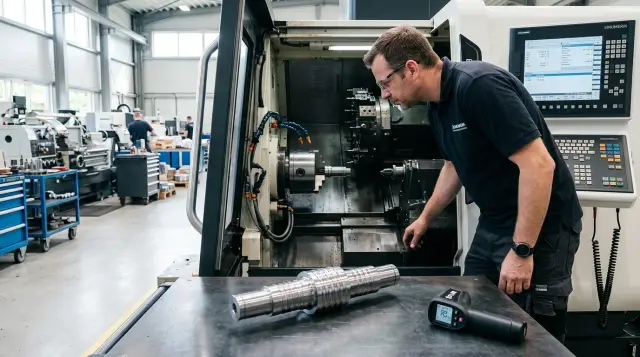
What changes in machine operation
Spindle bearing problems rarely start all at once. More often, the machine changes its behavior little by little, and that is easy to miss in the rush of the workshop. Yesterday it was working as usual, and today the operator already notices that the sound is different, the housing warms up sooner, and the part does not look as clean after the pass.
The first signs of spindle bearing wear usually do not appear one at a time. If the spindle started heating up faster, a new hum appeared at the usual speed, and acceleration took a little longer, that is no longer a coincidence. Taken separately, these things are often blamed on the cutting mode, the weather in the shop, or the material itself. Together, they speak much louder.
Heat is usually the first thing you notice. The machine reaches its usual operating mode, but the unit is already warmer than it was during the same job a week or a month ago. A small increase in temperature does not prove anything by itself, but a sharp difference from the usual picture almost always calls for a check.
The same goes for sound. A healthy spindle runs evenly. When a new hum, a light whine, or a trembling tone appears at certain speeds, the unit is already sending a signal. An operator often hears it before the instruments show a problem.
Then the result on the part changes. The surface loses its clean finish, and fine ripple, waves, or marks appear that were not there before on the same material and the same program. This is especially noticeable on finishing passes, where the machine usually does not surprise you.
Another common sign is that the spindle takes longer to reach the set speed or feels heavier when stopping. It is as if the machine is doing the same job, but without its former ease.
On a CNC lathe, these shifts are best noticed right away. One weak symptom can be checked later. Several weak symptoms at once should not be ignored, because a small problem in the spindle unit usually does not stay small for long.
When heat is no longer normal
One of the first signs of spindle bearing wear is heat that rises on its own, not only after hard work. Heat by itself is normal: the unit reaches operating temperature, the lubricant spreads, and the housing warms up a little. The problem begins when the temperature rises above the usual level without a clear reason.
Only comparison gives you a reference. Measure the temperature at the start of the shift, then after warm-up, and again after 30-60 minutes of work at normal speed. If the machine runs in roughly the same mode, but the heat gets higher every day, that no longer looks like normal warm-up.
By hand, this is judged too roughly. The housing may feel "comfortably warm," but a difference of 10-15 degrees already changes the picture. It is better to use a pyrometer or at least the same contact thermometer every time. Then you are looking at real numbers, not feelings.
What to look for during the check
- Compare the temperature in the morning and after reaching working speed.
- Check whether the heat rises even without heavy cutting.
- See whether the temperature is the same in different areas of the housing.
- Write down the conditions: lubrication, speed, feed, and shop temperature.
If one part of the spindle unit is noticeably hotter than another, that is a bad sign. This often happens when a bearing is already working with extra friction, the lubrication is distributed unevenly, or there is misalignment. Even heat is usually safer than local overheating in one spot.
Do not blame everything on the bearings right away. The wrong lubricant, excessively high speed, shop heat, and long cutting without pauses also raise the temperature. But if you reduce the load and the spindle still stays hot, the list of possible causes gets shorter.
A good simple test: let the spindle run idle after warm-up. If the temperature keeps creeping up without noticeable load, the unit needs attention. This kind of rise rarely goes away on its own. Usually, noise, longer acceleration, and marks on the part surface appear next.
What noise says about the unit
A spindle rarely fails without warning. Often, it changes sound first. If the machine used to run smoothly and now there is a new hum, whistle, or dull rumble, that is a reason to listen closely instead of waiting for the next stop.
It is best to listen to the spindle in two modes: idle and under cutting. At idle, you hear the unit itself, without the influence of chips and load. Under cutting, the picture changes. A slight bearing defect may barely show up without load, but under the tool the sound becomes rougher and louder.
A steady working sound is usually predictable. It rises with speed, but does not change character. If a new tone suddenly appears in the usual background noise, that is already a signal. A healthy spindle should not change its character.
How the part surface reveals the problem
The part surface often notices a problem before the operator hears a clear noise. When spindle bearings lose accuracy, the tool no longer cuts as smoothly. Ripple, waves, or a fine vibration pattern appear on the metal.
It helps to compare not one, but two identical parts. Take the first one after the machine starts and the same part after 30-60 minutes of work. If the trace becomes rougher on a warmed-up spindle, and the pattern on the surface becomes more pronounced, the issue may not be the cutting mode but the condition of the unit.
Look not only at the surface, but also at the size. If the dimension shifts after warm-up in the same operation, even though the tool, program, and blank are the same, that is a serious signal. In the morning, the part stays within tolerance, but later it drifts by a few hundredths. This kind of behavior is often part of the topic "signs of spindle bearing wear."
It is easy to confuse one problem with another here. A dull tool usually damages the surface in a more even and predictable way: cutting force rises, the mark stretches across the whole part, and the edge crushes the metal more strongly. A bearing usually shows itself differently. The defect may appear only at certain speeds, change after warm-up, and disappear in another mode.
To avoid guessing, record the conditions under which the defect repeats:
- spindle speed
- feed
- cutting depth
- running time before the mark appears
- the machine condition, whether cold or already warmed up
If ripple appears every time at the same speed, that is an important clue. If the pattern is visible only after warm-up, the clue is even more precise. These notes make talking to service much easier. For companies like EAST CNC, this saves time in diagnostics, because it becomes easier to separate a spindle problem from a mode error or tool wear.
When the same operation gives a different surface on a cold and a hot spindle, do not rush to change the insert and keep working. Check the spindle unit first. Otherwise, the defects will keep coming back, and the cause will stay in place.
Why spin-up and coast-down matter
Spin-up and coast-down often change before clear defects appear. If the spindle takes longer to reach speed, does it unevenly, or stops differently than before, the unit is already sending a signal. For an operator, this is one of the earliest signs of spindle bearing wear.
Do not look for an abstract standard; look at the normal behavior of that specific machine. One spindle always reaches 6000 rpm in a few seconds, while another is slower. What matters is the deviation from the usual picture: yesterday the acceleration was smooth, and today there are pauses, jerks, or a strange hesitation before the machine reaches speed.
Coast-down after stopping also says a lot. If the spindle now stops noticeably faster than before after a stop command, the reason may be increased friction inside the unit. If the coast-down time has suddenly changed in the other direction, check not only the bearings but also braking, lubrication, and the general spindle setup.
It helps to record just a few observations:
- how many seconds it takes to reach working speed
- whether there is a jerk at the start or in the middle of acceleration
- whether the spindle stops the same way after the same command
- whether this happens on a cold and a warmed-up machine
A one-time glitch does not prove a failure. But if the picture repeats every time the machine starts, that is no longer a coincidence. This repeatability is especially important: it helps separate a one-off power or setup issue from a mechanical problem.
In practice, it looks simple. For months the machine reached speed smoothly, and then it started taking 2-3 seconds longer to spin up. The operator hears a slight drop in sound, and after stopping, the spindle slows down faster than usual. Even if the part is still acceptable for now, you should not delay the inspection.
At EAST CNC service, these small changes are usually recommended to be checked right away, not after obvious noise and overheating appear. The earlier you notice a change in spin-up and coast-down, the better the chance of getting by with inspection and adjustment instead of long machine downtime.
How to check everything step by step without special tools
Start with a short idle run. The machine should warm up a little in normal mode; otherwise, the check will give a random result. A cold spindle often runs quieter, and after 10-15 minutes it already shows the first signs of spindle bearing wear.
Listen to the spindle as the speed increases. First give it low speed, then medium, then close to working speed. If a hum, whistle, trembling sound, or stronger-than-usual tone appears in one range, that is already a reason to be cautious.
Always check the temperature in the same spots. A simple pyrometer will do if you have one nearby. If you measure near the front support today and on the side of the housing tomorrow, the comparison will not help. Write down not only the number, but also how many minutes after startup it appeared.
A simple routine works well:
- warm up the machine at idle;
- listen to the spindle at three speed ranges;
- measure the heat in two identical spots;
- make a short test part;
- write down all observations in one place.
The test part should be simple. Use a familiar material and repeat a short operation that the machine used to perform cleanly. Then look at the part surface quality: did ripple, fine waves, matte streaks, vibration marks, or size variation appear?
Also pay attention to the spindle spin-up time. If it used to reach the needed speed quickly, but now the acceleration has become sluggish or the sound during coast-down has changed, the unit already needs attention. One such case is not yet proof, but repetition in the same mode is rarely random.
It is better to keep a simple table: date, speed, noise, spindle heat, acceleration time, and surface appearance. After a few shifts, the picture becomes clear. One entry is easy to misread, but five show what is changing.
If the noise suddenly becomes stronger, the temperature rises faster than usual, and the part surface is getting worse right in the middle of the shift, it is better to stop the machine. A couple of extra parts are not worth the spindle and a more expensive repair.
Where people most often make mistakes
Signs of spindle bearing wear rarely come one by one. If you look only at noise or only at temperature, it is easy to go in the wrong direction and waste time.
The most common mistake is simple: the operator hears a new sound and immediately blames the belt. That can happen, but the check should not stop there. If heat rises along with the noise, spin-up time changes, or the part surface suffers, you need to look at the whole spindle unit.
Another mistake is drawing conclusions from a single symptom. The spindle may be noisy because of the cutting mode, the tool may create ripple on the part, and the temperature may rise because of long operation at high speed. One sign proves almost nothing. Several signs appearing together give a much clearer picture.
People also often get confused about temperature. You cannot compare spindle heat in different modes and at different times of the shift. If the spindle ran for 15 minutes at medium speed in the morning, and then held high speed for an hour after lunch, the numbers will be different even without a failure. Compare the same conditions: the same speed, the same load, a similar duration.
A sudden rise in heat is often ignored, especially if the machine is still cutting and has not stopped. That is a bad decision. When the temperature rises noticeably faster than before, it is better to stop for a quick check. One lost hour is almost always cheaper than a spindle repair and a batch of scrap.
Another trap is starting with the tool. People change the cutter, collet, or holder and do not check the spindle unit. Sometimes the tool really is the problem, but if the CNC lathe spindle noise remains, the spindle acceleration time has increased, and the part surface quality has dropped, the cause is deeper.
It helps to keep a simple order in mind:
- first compare the machine behavior in the same mode
- then assess the noise, heat, spin-up, and coast-down together
- after that, check the tool and clamping
- and only then decide whether work can continue
This approach helps you avoid guessing and treating the wrong problem.
A simple shop-floor example
The shift started normally: the lathe reached speed without extra noise, the spindle ran smoothly, and the operator noticed no vibration or strange ringing. The first parts after startup also looked fine, and nothing suggested a problem.
About an hour later, the picture changed. The housing in the spindle area got hotter than on the same days with the same program and the same blank. This was not just a little warmth after work, but a noticeable difference that the operator felt right away, because yesterday the machine behaved more calmly.
Almost at the same time, a light ripple appeared on the finishing pass. It was not rough, and there was no obvious defect at first glance, but the surface no longer looked clean. If the part goes into a tight tolerance or a later fit, such a mark can no longer be dismissed as random.
Then another signal appeared: the spindle took longer to accelerate to the usual speed. The difference was small, only a few seconds, but the operator noticed it immediately, because startup repeats many times during a shift and those things stick in memory. When heat, noise, and spin-up time change together, it already looks like signs of spindle bearing wear rather than a minor glitch.
In that situation, it is better to stop after the current part instead of pushing through to the end of the batch. Usually, a short pause is enough to check how the spindle reaches speed, whether there is a new hum, and whether the temperature keeps rising. If you keep working as if nothing is wrong, a light ripple can quickly turn into a stable surface defect, and spindle heat can turn into a more expensive repair.
A good shop response is simple: record the symptoms, do not change all the settings at once, and do not try to force the mechanical problem away with cutting mode alone. For CNC lathes, this set of signals already calls for a pause and inspection, even if the machine is still cutting and has not triggered a clear alarm.
Short checklist
Many signs of spindle bearing wear are visible without instruments if you watch the machine in the same mode every time. The idea is simple: do not look for a rare failure, but notice a deviation from normal work. It is best to do this at the start of the shift and after a standard cycle, when the conditions are easy to compare.
For a quick check, five actions are enough:
- Listen to the spindle at idle and under load. Compare it not with an "ideal" sound, but with yesterday’s shift. A new hum, ringing, dry rustle, or trembling tone rarely appears for no reason.
- Check the heat after the same cycle. If yesterday the housing was only warm, and today it is noticeably hotter with the same program, that is already a signal. Your hand does not replace a sensor, but you usually feel the difference right away.
- Inspect the first and last part from one batch. If ripple, waves, or finish quality gets worse by the end of the cycle, the unit may be behaving worse as it warms up.
- Time how long the spindle needs to reach working speed. If acceleration has become slower or the speed comes up in jerks, it is worth noting and checking again at the next start.
- Record any new behavior in a log. A short note is enough: date, mode, sound, temperature by touch, spin-up time, and what happened to the part surface.
Such a log is often more useful than a one-time "deep" inspection. One entry is hard to judge, but five make it clear whether this is random or a stable change in behavior. If two or three signs match on the same day, it is better not to wait for a clear failure. Stopping for a short inspection is almost always cheaper than a spoiled batch of parts and an unscheduled spindle repair.
What to do next without unnecessary downtime
If the symptoms repeat, do not rely on memory. Write down when the spindle heat rises, at what speeds the noise appears, how the spin-up time changes, and what happens to the part surface. A couple of short notes after the shift often give more than a vague conclusion like "the machine is acting strange."
It is useful to note:
- the speeds at which the new sound is heard
- the housing temperature after the same running time
- the parts where a surface mark appears
- how many seconds it takes the spindle to reach speed and how long it takes to coast down
Then you need a sober assessment. If the noise has become louder, spindle heat is rising faster than usual, and the part surface quality has already dropped, do not try to force the shift through at any cost. One extra hour of work can sometimes turn a bearing replacement into a full spindle repair.
You can do one more short check only in a calm mode. No heavy load, on a clear program, with the operator nearby. If the machine behaves the same as yesterday and the symptoms are weak and not getting worse, this kind of check helps collect facts for service. If the picture is already worse at startup, it is better to stop the check.
When signs of spindle bearing wear appear together, waiting is almost always a bad idea. For example, the machine first takes longer to spin up, then a steady hum appears, and after that a wave or fine ripple shows up on the part. Taken separately, these can still be blamed on the cutting mode, but together such signals are rarely random.
If you want a second opinion, discuss the situation with the EAST CNC service team. With notes, sound, operating modes, and a photo of the part surface, it is easier for a specialist to understand whether inspection, lubrication, adjustment, or repair is already needed.
This approach saves more than time. It also reduces the risk that the unit will fail expensively and the machine will stop at the worst possible moment.