
Handover on a CNC Cell Without Loss: A Short Standard
A smooth CNC shift handover starts with a short standard: what to note about the tool, measurements, scrap and open questions.
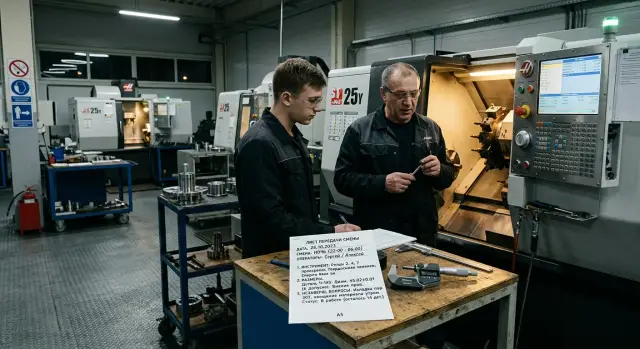
What goes wrong with shift handovers
The costliest pause on a CNC cell often doesn't start with a breakdown. It starts when one shift has left and the next one doesn't know what's happening at the machine. The machine stands idle for 15–20 minutes while the operator hunts for a tool, checks the last correction, or re-measures a dimension. Each instance seems small, but over a week those pauses add up to hours of downtime.
Time is usually lost in the same places. The incoming operator doesn't know which part is being run, which operation the process stopped on, which tool is nearly spent, or which dimension began drifting toward the end of the previous shift. If this isn't written down, the person must verify everything from scratch. They spend time, take extra measurements and often over-correct out of caution, slowing production.
Verbal handovers rarely hold even during the day. At night and on weekends they break even faster. People are tired, in a hurry, someone leaves early or arrives late, and some details simply slip from memory. Phrases like "the cutter has worn in" make sense only to the person who said them. The next shift needs facts, not hints: which cutter, on which operation, which dimension moved, what was already adjusted and what must not be touched.
Because of this, one mistake easily carries over to the next shift. If the operator didn't record a tool correction, the next person may apply the same offset again and move the dimension even further. If nobody marked that a part from the last batch was set aside for recheck, it may be treated as a normal startup and a whole run released with the same deviation. Then the argument isn't about the cause but about who saw what and when.
A short standard isn't for paperwork. It closes the most common handover gaps: what's in the machine, which dimensions were confirmed, which tool needs changing soon, what questions remain open, and who handed over and accepted the work. When this minimum is recorded the same way every time, the new shift starts from facts instead of guesses.
What to record each shift
Shifts fail not because of rare complex breakdowns but because of a few empty lines in the log. One operator leaves, another arrives, and guessing begins: which cutter is installed, what was the last measured dimension, why did the machine stop and who should resolve it.
To make handovers uncontroversial, four blocks in the record are enough.
The first block — the tool actually in use. Use concrete details: position, tool type, condition and remaining life. If position T05 has a roughing cutter that should reliably make 30 more parts, write that. If a spare tool is already prepared in the cabinet by the machine, note it too.
The second block — the last confirmed measurement. The phrase "within tolerance" solves nothing. Record the exact value, measurement time and the direction of drift if it has appeared. For example: "D42.012, measured at 21:40, last 8 parts trending +0.003." From that line it's clear whether to continue the run or check corrections first.
The third block — why the operation stopped, if it did. Not "machine stopped", but "stopped after overload alarm on roughing pass, spindle restarted, not re-started the run." It's better to add which operation it happened on and what has already been checked. Then the next shift won't repeat the same checks.
The fourth block — open questions. Usually these are decisions for the foreman, technician or process engineer: can the remainder of the batch be finished with this tool, should a correction be agreed, change the chuck, or call service for an axis? Be clear: who must decide and how urgent it is. If an answer is needed before restart, write that explicitly.
A good entry is short but shows immediately which tool is used, which dimension was last confirmed, where work stopped and what remains open. If these four parts are missing, the next shift makes decisions blindly. At night this quickly becomes scrap, downtime or an unnecessary test start.
Step-by-step handover
Don't hand over at the last minute. Start filling the shift sheet 10–15 minutes before the end of the shift, not by trying to remember everything at the locker room. Then the handover becomes a normal part of work, not a rush at the end.
A consistent routine every time works better than a long instruction:
- 10–15 minutes before the end of the shift, fill the sheet for the current batch, program, machine status and remaining parts.
- Go to the machine and verify the tool in reality. The number in the record must match the tool in the turret or magazine. If a insert is at its limit, write that clearly.
- Record the last measurements with exact time. Not "dimension OK", but: diameter 24.012 at 19:43, after correction X -0.01.
- Verbally communicate only the risk areas: the dimension is approaching the upper limit, the tool will need replacement soon, few blanks remain, the part was not finished, the program needs checking.
- Have both shifts mark the sheet. A signature in the logbook or a mark in the electronic form is not a formality — it prevents morning disputes over who handed what.
The main mistake is simple: people start retelling the whole shift. That's unnecessary. The next operator only needs deviations, the last confirmed facts and unresolved items. Everything else is visible from the job order and the log.
A short live sentence at the machine works well: "For part 451 the dimension holds, last check at 19:43. Cutter T3 after 20 parts should be checked. 12 blanks remain at op2. No program issues." That takes less than a minute and saves the night shift from wasting half an hour guessing.
If there are several machines on the cell, don't try to cover them all with one general entry. Each machine needs its own short line or its own sheet. For CNC lathes this is especially important: confusion over tool number and last measurement usually costs more than two extra minutes at the logbook.
How to record tools without confusion
Tool confusion starts not at the machine but in the record. If the operator writes "tool OK" or "drill will last", the next shift wastes time guessing. At night and on weekends this is especially bad: there is often no one to ask and downtime starts immediately.
A tool entry should answer four questions: which tool is installed, how much life remains, is there a problem and where is the replacement. That's enough for the incoming shift to accept the machine without extra calls.
Agree on one format for all machines. For each position note the tool number, type, remaining life, current status and where the prepared tooling is stored. The comment should be short and clear without decoding.
Also agree on how to account for remaining life. If one shift writes life in parts and another in percent, the log quickly loses meaning. Any method works as long as everyone uses it consistently. One area may count parts, another minutes of running time.
Mark questionable or broken tools clearly. "Seems to hold size" doesn't help. Much better: "T07, 8 mm drill, hole drifts on the second part, do not use." With such a note the next shift won't check the obvious at the cost of scrap.
If a tool was changed during the shift, record that too. Otherwise people see a new position in the morning but don't know why it was installed and whether to touch the correction. A short line resolves this: "T03 changed at 02:40, cause - chipped edge, X correction +0.08."
Prepared tooling mustn't be kept only in someone's head. Indicate a place anyone can find: "cassette 2", "cabinet right, shelf 3", "trolley by machine #4". On shops where tooling and change units are prepared in advance, this helps a lot at night: finding tooling often takes longer than changing it.
A good tool entry saves not seconds but tens of minutes. And it almost always reduces the risk that the new shift continues from someone else's mistake.
How to record dimensions so the next shift doesn't argue
Arguments usually start not at the machine but in the log. One operator writes "dimension OK", another sees a shift of 0.1 mm and doesn't know if it was a one-off or a trend. If the entry is vague, the next shift spends time rechecking and often slows production out of caution.
It's better to record the last accepted measurement, not an "average" result for the hour. The average looks good on paper, but the machine is cutting the next part now and the incoming operator needs the last confirmed result to decide.
A dimension entry should include four things: exact value, measuring instrument, who measured and how many parts were made after that measurement. That's already enough to remove half the questions. Three parts after a check is one situation; 47 parts after it is a very different one.
It's also important to indicate the full tolerance and the direction of drift. Phrases like "almost at the top" are not acceptable. Better: "tolerance 25.000 +/-0.010, current 25.008, drifting toward the upper limit." Then the next shift knows immediately what to check first: tool wear, temperature or correction.
A short single-line format works well. For example:
Ø25,000 +/-0,010 | факт 25,008 | микрометр №2 | мерил Ибраев | после замера прошло 12 шт. | уход к плюсу
Such an entry takes less than a minute but saves much more time. On one shop they argued over a batch of bushings: the day shift left "dimension holds" and at night production moved to the upper limit. If the log had shown the last measurement was 18.014 with a tolerance up to 18.015 and 30 parts had been made after it, the night operator would have checked correction immediately and not guessed who was right.
The simpler the entry form, the more often it's filled correctly. If a line can be understood in five seconds, the shift works calmer.
Mistakes that break handovers
Most breakdowns are caused not by a complex failure but by small omissions. On a CNC cell a short entry without numbers can cost a whole batch, especially at night when the day technician isn't around.
The most frequent error is an urgent re-setup without recording the original state. An operator changes a tool, adjusts correction or repositions a blank to quickly restart, but doesn't save the old values. The next shift sees the new result but doesn't know what to use as a baseline. If the dimension changed, the argument begins immediately: who changed it, when and why.
Saying "everything's fine" also breaks the handover. It means nothing. For one operator "fine" is 24.98 with a tolerance up to 25.00; for another the part is already at the limit. The log needs facts, not impressions.
So after every important action leave a short note: which dimension was checked, what value was obtained, when the measurement was done, what was changed afterwards and how many parts were made since the change. It's short, but these details remove unnecessary questions later.
Another common mistake is mixing old and new notes on one sheet. Then the next shift reads the entry and can't tell if an issue is closed or still open. Cross out the old problem with "closed" or move it to a new line with time and current status. Otherwise the same play of looseness, insert wear or size drift will migrate through logs for days.
Where disputes most often start
A measurement without a time almost always creates confusion. Suppose at 18:40 the size was within tolerance, and at 22:10 drift started due to tool wear. If there is no timestamp, the night shift may assume the entry is fresh and continue production. In the morning quality control finds scrap and reconstructing the moment of error falls to memory.
Problems are added when notes are passed through a messenger instead of one standard. A message gets lost, a photo goes to the wrong chat, someone reads it but doesn't enter the data in the log. The shift needs one source of truth located at the machine or in a shared system. Messenger can be a quick alert: "stop and check the log."
When shifts use a single template, disputed points are far fewer. People see time, dimension, correction and open questions for each operation instead of other people's wording.
Example for night and weekend shifts
On a turning shop you can clearly see whether the routine works when fewer people are around and the foreman isn't nearby. The evening shift runs a batch of shafts and near the end notices the finish size slowly increasing. There's no scrap yet, but the margin is small.
The operator does not write a vague note like "watch the size." The log contains three precise entries: cutter T0303, the last two measurements 40.012 and 40.018 mm, and the increase started after the 26th part. He also notes that he did not touch the correction.
The night shift receives a fact-based picture, not a guess. The operator sets the check not on the tenth part but on the third. After the first check he sees the same increase and doesn't argue with the previous shift because the numbers match.
He slightly lowers the finish feed and makes two more parts with an intermediate measurement. The third part shows 40.011 mm. The fourth stays close with no new increase.
After that the night operator writes the new feed value, the time of change and two fresh measurements. If the dimension had continued to drift he would have recorded a cutter change or stopped the batch immediately. But here the process stabilized and the shift didn't waste an hour searching for the cause.
On a weekend the same routine is even more useful. The process engineer may be unavailable, the technician tied up on another cell, but a quick decision still must be made.
In the morning the foreman opens the log and in a minute understands what happened overnight. He sees the full sequence: evening increase, night check, reduced feed, third-part control, stable result. He doesn't need to gather people to parse who meant what.
This example works for a simple reason: the log contains not only the problem but also the actions taken. For the next shift that matters more than a long comment. When the operator writes the cutter number, last measurements and the action taken, the cell continues without needless arguments or a restart from zero.
Short checklist before leaving
Five minutes at the end of a shift often decide whether the incoming operator can start work immediately or will lose half an hour guessing. What matters is not long explanations but a few verifiable facts.
Before leaving check five things:
- Mark the actual tool. If an insert was changed, note it. If the tool is at its limit, write it clearly.
- Record the last measurement with time and reference to the part.
- Separate scrap and suspicious parts from good ones. Don't keep them in the same tray.
- List open questions one by one, without vague wording.
- Leave a clear first step for the next shift: check the corrector, measure the first part or replace the insert.
A good entry is simple: "T03, insert changed at 21:10. Dimension 24.98 at 21:40 on part 18. Two parts set aside, risk of taper. First step - check the first part after startup and re-measure after 3 pieces."
This format is shorter and more useful than an oral recap. It reduces disputes between shifts because everyone sees the same facts. If there are multiple machines, keep the standard the same for all. Then an operator doesn't have to learn a new format each time.
If an entry can't be understood in 20 seconds, shorten and rewrite it more clearly.
What to do next
Start with one cell, not the whole shop. It's easier to see where the form helps and where it only takes time. The usual best start is one machine or a group of similar machines, one part and one week of observation.
Create a draft standard on a single A4 sheet. If the record doesn't fit on one page, people will start abbreviating, skipping lines or moving data to personal notebooks. A good template is readable in a minute and fillable in 3–4 minutes.
Then give the form to day and night shifts without extra explanations and watch where everyone asks the same questions. It quickly becomes clear which fields nobody fills and which everyone needs. After a week remove everything that doesn't help accept the machine without calls and guesses.
After that fix one form for all shifts. Don't make a separate sheet for night, another for weekends and a third for setups. Different templates quickly break the habit and bring back disputes: where to note an insert change, who records the last measurement, who logs a part left in the chuck.
It's useful to appoint one person to collect feedback and make adjustments after the test. Usually this is the cell foreman or a senior operator. They don't need a long report. Three questions suffice: what's unclear, what's extra and what's missing.
If you're updating your machine fleet or reviewing cell operations, you can base the form on practical materials from the EAST CNC blog at east-cnc.kz. The company has CNC equipment reviews and metalworking tips that are easy to adapt to your operations and control points.
A normal result looks simple: one form, one sheet, the same recording order across all shifts. If a new operator can accept a machine on a Saturday night without calling the foreman, the standard is already working.
FAQ
Is verbal handover between shifts enough?
No — verbal handover is not enough. After ten minutes people already forget the measurement time, tool number and last correction. It's better to leave a short note at the machine: what is installed, which dimension was last confirmed, why the machine stopped and what to check first.
What must be recorded during shift handover?
Four things are enough: the current part or batch, the tool in use, the last confirmed dimension and any open questions. If the machine was stopped, record the reason and what has already been checked. That prevents the next shift from repeating work.
When is the best time to fill the shift sheet?
Start filling the sheet 10–15 minutes before the end of the shift. At that time it's still easy to verify the tool, measurements and remaining parts. If you wait until the last minute, people rush and leave vague notes instead of numbers.
How to record tools correctly in the log?
Be specific: tool position number, tool type, remaining life and its status. If a replacement is prepared, note where it is. Vague phrases like “the cutter will last” don't help. The entry should be understandable to any operator without calls or guesses.
Why not just write “dimension within tolerance”?
Write the exact value, measurement time and the direction of drift. It is useful to note how many parts were made after that measurement. The phrase “dimension is within tolerance” usually causes disputes. It doesn't tell whether to continue production or check corrections first.
What to do with suspicious parts before leaving?
Separate suspicious parts from good ones immediately and note this in the record. Otherwise the next shift may treat them as normal production. Write how many parts were set aside, why, and what should be done with them next.
Where is it better to keep the handover: chat or a single template?
One template per machine works best. The operator sees required fields right away and doesn't hunt for information in several places. Use messenger only for urgent signals like “stop and check the log”. The main record should be at the machine or in a shared form everyone uses.
How long should a normal shift handover take?
Usually 3–5 minutes is enough if the form is short and clear. That's far less time than losing 20–30 minutes later searching for tools and re-checking dimensions. If filling the form takes too long, the template is overloaded and should be simplified.
How to hand over a machine at night or on weekends without a foreman nearby?
Night shift needs precise numbers, not hints. Leave the tool number, last measurements, what was changed and the first action to take after start-up. This lets the operator make decisions alone even if the foreman or technician are unavailable.
How to implement this standard so people actually use it?
Start with one machine or a group of similar machines for a week. That is enough to see which fields people fill and which they skip. Then remove unnecessary items and keep a single form for all shifts. The simpler the template, the more consistently it will be used.