
A Year-Long Shop Floor Upgrade: What to Change on a Small Budget
A year-long production cell upgrade starts with a simple plan: find the bottleneck, then compare a machine, tooling, measurement, and service by payback time.
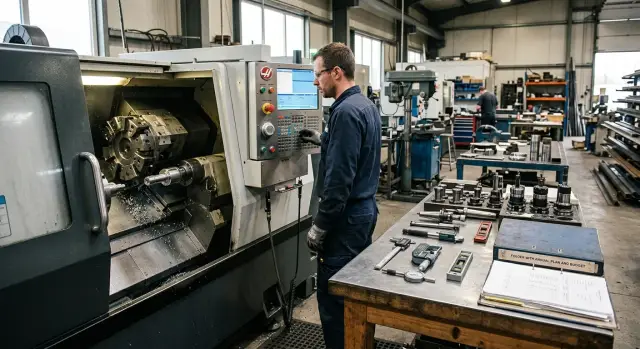
Where the shop floor loses money and time
To modernize a shop floor over the course of a year, don’t start with the machine catalog. Start with the places where work slows down. The most expensive problem often looks ordinary: a batch is waiting for a free machine, the operator adjusts the size by hand, and the supervisor pushes the deadline back by another day.
Usually, the losses hide in four areas. It’s better to write them down on one page for each operation instead of talking from memory.
- Where the queue grows between operations and how many parts are sitting there at the end of the shift.
- How much scrap and rework cost each month: material, machine time, repeat inspection.
- How planned cycle time compares with actual cycle time on real parts.
- Which breakdowns disrupt the shift and how long it takes the shop floor to get back into rhythm.
A queue shows the bottleneck faster than any report. If a turning operation takes 6 minutes on paper, but the next step waits 40 minutes, the problem is already obvious. In that case, a new machine may do more than replacing small tooling. But if the queue is growing because of frequent changeovers or unstable clamping, it is too early to buy a machine.
Scrap and rework put pressure on the budget more quietly, but more painfully. The part has already gone part of the way through the process, the material is paid for, and people’s time is already spent. If a shop floor is losing 3–5% of a batch on one dimension, the cause is often measurement, tool wear, or play in the setup, not a lack of capacity.
Comparing planned and actual cycle time quickly brings you back to reality. On paper, the part takes 12 minutes, but the shift log shows 18. Those 6 minutes are the real hole in profit. Sometimes they come from extra moves, manual chip removal, or a long first-piece inspection.
Breakdowns should be counted separately. If the same CNC machine stops a shift twice a month, the shop floor is already paying for service even without a bill from the service team. For a small workshop in Kazakhstan, that often hurts deadlines more than a slow but stable machine.
Once you have the numbers for at least 3–4 weeks, choosing between a new machine, tooling, measurement, and service becomes much easier.
What to gather before the first purchase
It’s better to start buying a machine, tooling, or a measurement system with shop-floor numbers, not a catalog. Otherwise, a year-long modernization quickly turns into a set of expensive but random decisions. One simple table is enough if it includes the data that affects output, scrap, and downtime.
First, break down the parts the shop floor makes regularly. Not by name, but by volume and money: what comes in large batches, what brings a healthy margin, and what only eats time. The picture is often unpleasant, but useful: one part loads the machine all month, and yet the profit from it is lower than from a smaller batch of another item.
Next, look at each machine over the last month. You need not only the total shift hours, but real work: how long the machine is cutting, how long it sits in setup, how much time goes to small repairs and waiting for tools. If one turning machine is busy for 210 hours a month and the one next to it is loaded for only 80, a new machine may not be the first purchase.
In the same table, note three costs that are often underestimated:
- tools and their life by part type
- setup time between batches
- repairs and service visits
- losses from scrap and repeat processing
Then clarify the quality requirements. For parts with tight tolerances, the problem is often not the age of the machine, but weak size control, worn tooling, or unstable setup. If the tolerance is being held at the limit, investing in in-process measurement sometimes pays off faster than buying a new machine.
And one more thing: set a payback period in advance. For a small shop, it is easier to use a simple limit, such as 12 or 18 months. Then the debate between “new machine or tooling” becomes calmer: you are comparing not wishes, but how long it will take for the purchase to pay back.
When a new machine should come first
A new machine comes first not when the old one is simply “tired,” but when the shop floor has already hit a ceiling in volume or capability. If there are orders in the queue, people are busy, and deadlines are still slipping, the reason is often simple: the current machine park can’t keep up with the plan.
A good sign is that one machine has become the bottleneck. One operator works on it all day while the other operations wait their turn. In that situation, new tooling barely changes the picture. It may speed up one step, but it will not clear the queue if the machine itself is already at its limit.
Another clear signal is frequent downtime on an old machine. When a machine breaks down every couple of weeks, the workshop loses more than repair hours. Deliveries slip, the operator switches into emergency mode, and the supervisor rebuilds the shift plan from scratch. If service can no longer keep the situation under control, a new purchase may cost less than constant failures.
A new machine is also needed when a job appears that you simply cannot make on the current equipment. There is not enough rigidity, axis travel, accuracy, or the automation you need. Then people add manual steps, extra repositioning, and more inspection. In that case, one purchase removes several manual operations at once and noticeably shortens cycle time.
For a small workshop, the check is simple:
- demand is steady for at least a few months ahead;
- the bottleneck is visible in both load and queue;
- the old machine breaks down often or can’t handle the new part mix;
- the new machine will remove several losses at once, not just one small issue.
For serial metalworking, this is a normal situation. For example, a turning shop gets more orders for parts for the automotive industry or construction equipment, and the whole flow depends on one old CNC. In that case, delaying replacement is usually more expensive. If you are planning a year-long modernization, a new machine is the first step in this scenario.
When tooling gives more
Tooling pays back faster than a new machine if the machine itself still holds accuracy and keeps the plan, while the losses come from part setup and tool changes. Often the problem is not the machine itself, but the fact that the operator spends too long preparing each operation.
If tool changes drag on, the cycle time grows even on a simple part. Five extra minutes per setup do not look scary on one batch, but over a month they eat many hours. In that case, a new holder, a more convenient set of arbors, or a quick clamp gives a clear result without a major purchase.
Another common signal is size variation caused by part clamping. The machine cuts the same way each time, but the chuck or fixture places the blank slightly differently every time. Then the operator chases the dimension with adjustments, makes extra passes, and gets nervous at every startup. Here, new jaws, a new chuck, or a simple fixture does more good than replacing the machine.
On a turning shop floor, this is easy to see. If the operator is adjusting the same assembly shift after shift, the shop floor is living on manual crutches. You can work that way, but it is expensive.
Usually, tooling comes first when at least two of these signs are present:
- the machine is idle during frequent changeovers
- the size drifts because the clamping is unstable
- the operator keeps repeating the same setup
- the cycle can be shortened without increasing cutting parameters
A small purchase sometimes closes the bottleneck completely. For example, a workshop turns small bushings on a CNC machine: cutting is smooth, but setting and aligning the part takes 3 minutes. After changing the chuck and holder, the tools go in faster, the part clamps more evenly, and the cycle drops without raising scrap risk.
For a year-long shop floor upgrade, this is often the smartest move. Tooling costs less than a machine, is faster to implement, and quickly shows where the real problem ends and where the shop floor has simply gotten used to tolerating extra motions.
When to invest in measurement first
If scrap is only found at the end of a batch, a new machine will not solve the main problem. The shop floor has already spent metal, operator time, and tool life, and the mistake was noticed too late. In that situation, measurement pays back faster than a new purchase.
A common sign is that employees measure the same part differently and argue about whether it is within tolerance. The reason is usually simple: different gauges, a different inspection sequence, or worn measuring tools. Until every shift follows the same rule, the shop floor loses not only parts, but also time in arguments.
Another signal is that the size drifts after a tool change. The operator installs a new insert, makes the first part, and the deviation is only noticed an hour later or at the end of the batch. If you put a simple inspection point near the shop floor and check the first parts right after setup, the mistake is caught earlier.
In practice, it looks like this:
- check the first part after a tool change;
- inspect every fixed number of parts;
- record the actual size, not just “good” or “bad”;
- use one clear tolerance for all shifts.
Even a basic setup often changes the situation. It can be a separate inspection area, working micrometers and gauges, a clear inspection sheet, and one person responsible for a single inspection method. This step costs much less than a machine, and the effect shows up quickly.
A simple example: a workshop turns a small batch of bushings. After a tool change, the size starts to drift slowly upward. If inspection happens only at the end, the whole batch goes to rework. If the first part and every twentieth part are measured right at the machine, the operator corrects the shift after two or three parts, not after fifty.
Early inspection reduces material waste and rework time. If the shop floor often makes mistakes not in cutting, but in checking, invest in measurement first.
When service matters more than a new purchase
If the machine still handles the load, but the size starts to drift, a new machine is often not the first expense. It is better to bring the current machine back to a normal condition first. A workshop usually loses money not because of machine age, but because maintenance was missed: play increases, assemblies heat up, the operator keeps correcting settings, and scrap appears where it did not before.
The problem is that a breakdown rarely arrives all at once. First a bearing gets noisy, repeatability slips, vibration grows, or accuracy drops on a long part. If this is ignored, a small fault pulls a costly repair behind it. A couple of inexpensive replacements today often save you from replacing a whole unit next month.
Service should be the first step in the modernization plan if you see these signs:
- the machine is busy, but it consistently gives size variation
- after setup, the operator spends a long time finding the first good part
- the maintenance log is empty or service has been postponed more than once
- consumables were changed “by feel,” not by condition
- downtime from small failures has started repeating every week
Good service is more than lubrication and cleaning. It includes geometry checks, adjustments, drive inspection, and replacing filters, belts, seals, and other consumables. After that work, the machine often holds size again and the cycle becomes smoother. For a year-long shop floor upgrade, this is one of the most underestimated steps: the effect comes quickly, and the bill is usually lower than an unplanned stoppage.
For workshops in Kazakhstan, this approach is especially convenient when the supplier handles not only sales, but also service. At EAST CNC, that is part of the overall workflow. If, after service, the machine again holds accuracy and no longer disrupts deadlines, the purchase of a new machine can be safely moved to the next stage and the budget can be spared early.
How to choose the order for the year
The order is better built not around the most visible purchase, but around the most expensive problem. If the shop floor loses time every day because of changeovers, scrap, or downtime, the first step should be the one that removes that loss in the next few weeks. For a year-long shop floor upgrade, this approach is usually more accurate than arguing about whether you need a new machine or new tooling.
First, find one bottleneck that can be measured in hours, parts, and money. If the turning area is idle because of frequent failures, service may give more than a new machine. If the machine is stable but the cycle is long because of weak tooling, the priority changes. If sizes are drifting and the operator is spending time on extra checks, in-process measurement should come first.
It helps to compare the options with four simple questions:
- How much does the solution cost, including startup, setup, and training?
- In how many days or weeks will the real effect appear?
- What risk are you taking: shop-floor stoppage, scrap during startup, long implementation?
- What is blocking output right now, and what can wait until the next stage?
The first step is usually the one with the fastest return. If a tooling set can cut cycle time by 10–15% and does not require a long shutdown, it goes before a machine that will arrive in several months. But if the old equipment is disrupting the shift because of repeated failures, CNC machine service moves to first place.
A year is better split into stages. At the start, close what is blocking output today. Then add improvements that increase accuracy and speed. A major purchase should be moved to the point when the shop floor has already squeezed the most out of the current machine park and can accept a new machine calmly.
The budget should also be fixed by stage, not held as one sum “for later.” That makes it easier to avoid a spontaneous purchase. If by midyear it is clear that growth has already hit the ceiling without a new machine, then it makes sense to discuss delivery with a company that handles startup and service as well, like EAST CNC.
A small workshop example
A small workshop turns shafts and bushings in small batches. Orders are irregular: today it is a batch of 40 parts, and two days later it is a different item. The old CNC turning machine still works, but it only keeps the schedule if the setter keeps adjusting the size and hardly ever walks away from the machine.
On paper, it looks like a new machine should be the first purchase. In reality, the bottleneck is often not capacity, but losses between batches. If each changeover takes 35–50 minutes and the first good part does not appear right away, the money is going not into metal, but into downtime.
In such a workshop, I would start with tooling. Quick-change holders, proper chucks or collets for standard diameters, and a set of soft jaws for repeat parts shorten setup time. If a change from a shaft to a bushing used to take almost an hour, after the tooling change it may take 15–20 minutes. For small batches, that is a very noticeable improvement.
Next, it is worth investing in in-process measurement. Not a complicated system just for show, but a clear check after the first operation. For example, the operator removes the part after rough machining and immediately checks the basic diameter and length. This quickly cuts scrap: the mistake does not run to the end of the batch, but is caught on the first or second part.
After that, the old machine starts running more calmly. The setter makes fewer trips to the control panel, the operator corrects size drift less often, and shift planning becomes more accurate. Only then does the purchase of a new machine or higher-level tooling make clear sense.
Why? Because by that point you can already see:
- how many hours are really lost to changeovers;
- how many parts are scrapped without early measurement;
- what load the new machine would get each month;
- whether it would pay back faster than another tooling set.
For a small workshop, that is a calm order of action: remove extra losses first, then invest in a machine. Then the purchase is based not on a feeling, but on numbers.
Mistakes that eat the budget
Most often, money is not lost on modernization itself, but on the wrong order of decisions. The workshop buys what looks solid instead of what removes daily losses. In the end, the new machine looks good, but deadlines are still missed, and scrap and downtime are still there.
The first common mistake is buying a machine for a rare part or a one-time contract. Such a purchase may seem justified if the part is complex and the margin is good. But if the order repeats only two or three times a year, the equipment will be underloaded most of the time. With a small budget, it is better to close the bottleneck that affects work every week first.
The second mistake is even more common: the shop changes equipment without solving the issue of clamping, cutting tools, and machining parameters. A new machine will not help if the part still takes a long time to locate, the tool wears out too fast, and setup takes half a shift. Sometimes a good tooling set and a proper setup sheet bring more value than an expensive purchase.
The third mistake is delaying service until there is a serious breakdown. Play, spindle overheating, unstable hydraulics, and sensor faults rarely appear suddenly. First the machine simply loses accuracy and eats operator time. Then comes emergency downtime, urgent repair, and a missed delivery. For CNC machines, service is often cheaper than one day of downtime on a busy shop floor.
Many people calculate payback only by the purchase price. That is too narrow. You also need to count:
- downtime during startup
- the cost of tooling and tools for the new process
- operator and setter training
- losses from scrap in the first months
- service and consumable costs
There is also a management mistake: the modernization plan is made without the supervisor, setter, and operator. The manager sees the numbers, but not the small things that eat a shift: awkward access to the part, a weak chuck, long measurement of the first part, extra passes because of old tools. In companies that supply and service equipment, including EAST CNC, a proper conversation usually starts not with a catalog, but with questions to the people at the machine.
If the shop floor is arguing about what to buy first, start with something simple. Pull the downtime log for the last three months and add the causes of scrap and the setup time. After that, unnecessary purchases usually become obvious right away.
A short checklist
Before any purchase, a workshop needs not long presentations, but a few clear answers. If even one answer is missing, money can easily miss the real problem: the workshop buys a new machine while output is being slowed by worn tooling, or invests in measurement when the shop floor is losing hours to breakdowns.
It is useful to go through this check before every purchase request. It takes little time, but it does a good job of filtering out decisions that look nice on paper but barely change the shift result.
- Describe the bottleneck in one sentence. For example: “The turning area loses 8 hours a week because of long changeovers.” The simpler the wording, the easier it is to choose the action.
- Gather the numbers for the last month. You need downtime hours, scrap rate, average cycle time, and the number of unplanned stoppages. Without numbers, the debate quickly becomes opinions.
- Name one person responsible for the rollout. Not a department or a group, but a specific employee by name. Otherwise, the task will get stuck between purchasing, the supervisor, and service.
- Set the date for the next check in the calendar right away. Often 30–45 days after launch is enough to see whether things improved.
- Add a reserve not only for the purchase, but also for service, consumables, setup, and small modifications. This is often forgotten, and then the new solution starts eating the budget in the very first month.
A simple example: a workshop is planning to buy a new machine because it cannot keep up with deadlines. But the downtime log shows 18 hours a month because of an old chuck, drifting geometry, and poor maintenance. In that case, the first step is often service and tooling replacement, not a major purchase.
If the problem still looks just as clear after this check, you can move forward. If the wording breaks into two or three different causes, the shop floor is not ready to spend yet.
What to do in the next month
Start not with an equipment catalog, but with one part family that creates the most scrap, downtime, or missed deadlines. One family is already enough to see the problem without guesswork. For a year-long shop floor upgrade, that kind of start is usually more useful than general talk about renewing the whole workshop.
Collect simple numbers for that family over the last 4–6 weeks: cycle time, scrap rate, unplanned stoppages, tool consumption, setup time, and rework returns. If data is thin, ask the supervisor and operator to write it down by hand for at least two weeks. Even that level of tracking quickly shows where the money is going.
Then compare the four options not by purchase price, but by monthly effect:
- A new machine, if the current one no longer holds accuracy, stops often, or cannot handle the required volume.
- Tooling, if the losses come from long changeovers, weak clamping, or fast tool wear.
- Measurement, if parts are being scrapped because control comes too late and the size drifts across the batch.
- Service, if the machine is generally suitable, but play, geometry, the spindle, or feed issues are making work difficult.
Take first the step whose effect is already clear. If a new tooling set can cut setup time by 20 minutes per shift, that is easier to verify than a promise that “things will generally get better.” If service restores size stability and removes random scrap, it may pay back faster than buying a new machine.
A one-month plan is better kept short: one goal, one budget, one person in charge. For example, cut scrap on one part from 6% to 3%, or reduce downtime by 8 hours a month. Without that framework, money gets spent on small purchases while the shop floor keeps working the old way.
If the numbers show that new equipment is unavoidable, it helps to discuss not only the machine model, but also startup, setup, and service right away. EAST CNC, as the official representative of Taizhou Eastern CNC Technology Co., Ltd. in Kazakhstan, works with CNC machine selection, startup, and service support.
After a month, check only the facts: time, scrap, downtime, output, and tool consumption. If the numbers have moved, go to the next stage. If not, change the decision, not the budget.